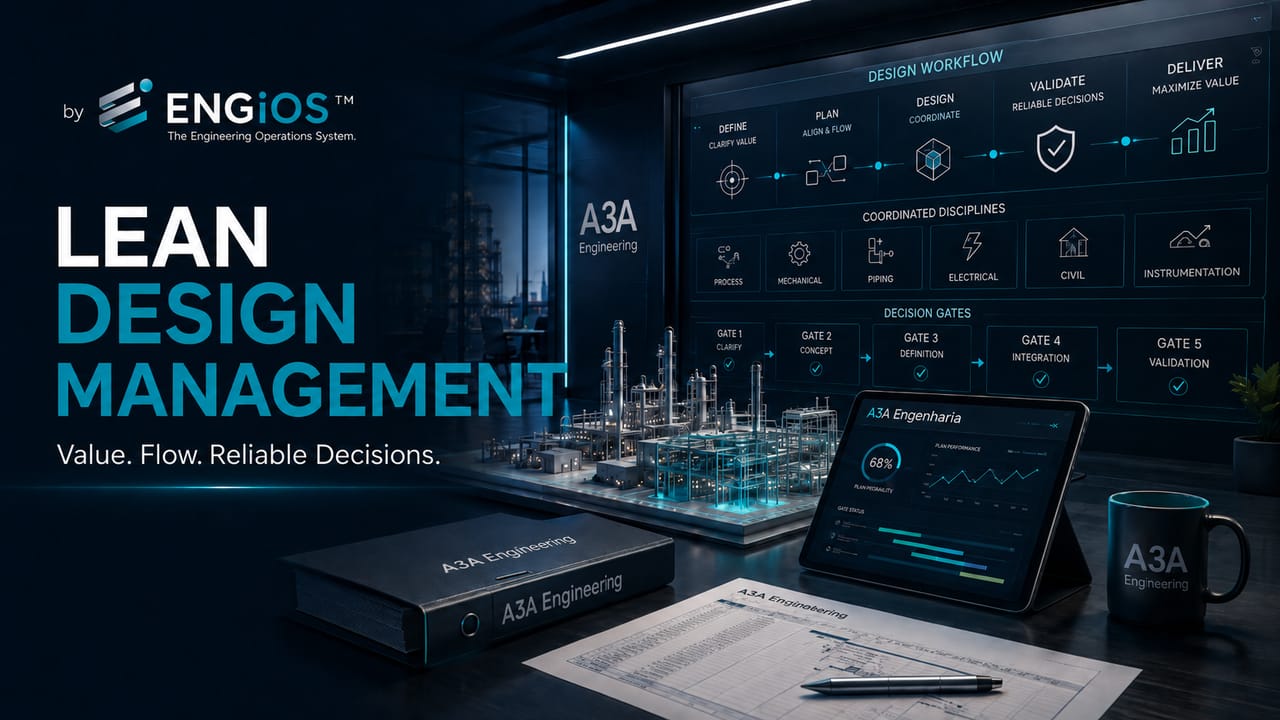
Understand Lean Design Management in Engineering: value, flow, pull, decisions, LPS, Set-Based Design, indicators, and application in the design process.
Check it out!
Lean Design Management is the application of Lean principles to the management of the design process. The objective is not simply to make designers produce documents faster, but to increase value for the client, improve the flow of information and decisions, reduce waiting and rework, coordinate interfaces, and make design commitments more reliable.
In Engineering, this requires treating design as a knowledge-production system. Drawings, reports, BIM models, lists, specifications, and calculations are important deliverables, but the actual flow also depends on requirements, assumptions, decisions, manufacturer data, client responses, interfaces among disciplines, acceptance criteria, and technical maturity. When these elements do not flow, the team may look busy while the project remains stalled.
What is Lean Design Management?
Lean Design Management combines Lean principles with design-process management practices to maximize value and reduce waste throughout conception, development, and detailing.
Fosse and Ballard describe Lean Design as an approach that emphasizes early client involvement, clear identification of needs, waste reduction, concurrent design of product and process, decisions at the last responsible moment, and improved task sequencing to reduce unnecessary iterations.
This changes the focus of management.
In a purely document-oriented approach, the question is: how many drawings were issued?
In a Lean approach, additional questions become central:
- did the client receive the information needed at the right time?
- did the disciplines work with mature inputs?
- were interfaces resolved before issue?
- was information produced prematurely and later reworked?
- did critical decisions arrive on time?
- did the flow reduce uncertainty or merely generate more files?
Why is Engineering design a different production process from construction?
Design produces information and reduces uncertainty. This creates characteristics that differ from physical production.
A construction activity normally transforms materials into an observable physical state. A design activity may depend on multiple reciprocal inputs and generate an outcome whose quality becomes evident only after coordination, review, or subsequent application.
Some dependencies are not purely sequential:
- architecture influences structure;
- structure influences building systems;
- building systems may require architectural changes;
- equipment selection changes electrical load;
- electrical load may change infrastructure and technical space;
- an operations decision may change automation and control;
- a maintenance requirement may require a new layout solution.
For this reason, trying to manage design as a rigid physical production line can create false certainty. Lean Design does not eliminate iteration; it seeks to distinguish iteration that generates learning from rework caused by poor inputs, premature decisions, or lack of coordination.
What does value mean in the design process?
Value is not synonymous with the quantity of documents.
For the owner, value may mean:
- technical performance;
- safety;
- reliability;
- operability;
- maintainability;
- budget compliance;
- implementation schedule;
- future flexibility;
- energy efficiency;
- availability;
- compliance;
- quality of information for procurement and construction.
A team may produce dozens of graphically polished drawings and still fail to deliver value if relevant requirements remain undefined.
Lean Design seeks to bring these criteria into the process early and keep them visible throughout decision-making.
Conditions of Satisfaction: how do you define what success means?
At the Lean Construction Institute, Conditions of Satisfaction are used to create a shared understanding of the expected project outcomes.
In Engineering, this principle can be translated into explicit criteria such as:
- minimum capacity;
- required availability;
- consumption limits;
- redundancy requirements;
- maintenance standards;
- cost targets;
- regulatory milestones;
- physical constraints;
- implementation conditions;
- operational requirements;
- expected documentation level.
The later these criteria emerge, the greater the chance that the design will progress technically in a direction that later needs to be reversed.
In the design process, waste often appears as waiting for decisions, incomplete information, successive revisions, and deliverables produced before interfaces are mature. Identifying these losses helps improve flow without confusing speed with productivity.
What are the main sources of waste in the design process?
Lean waste appears differently in design than in manufacturing.
Waiting
A designer waiting for a decision, information, survey, review, or response from another discipline.
Overproduction
Producing detail before the required maturity, generating documents that will not be used, or developing a solution beyond the level required for the current decision.
Work inventory
A large quantity of documents started but not completed, open RFIs, pending items, revisions, and interfaces awaiting resolution.
Defects and rework
Reissue caused by a missing requirement, incompatibility, incorrect information, or a late decision.
Overprocessing
Redundant reviews, approvals without criteria, duplicated information, manual conversions, and parallel controls.
Information transport and handoffs
Transfers between systems and teams that do not add value and increase the risk of losing context.
Motion
Searching for documents, versions, data, and responsible parties across fragmented environments.
The objective is not to eliminate every review or every wait. Some waits are technically unavoidable; some reviews are essential controls. The goal is to identify what neither creates value nor protects a relevant risk.
When lead time grows without an equivalent increase in technical work, the waste is probably in queues, handoffs, and decisions.
Value Stream Mapping in Engineering helps make this hidden time visible before redesigning the process.
Flow in Lean Design: what actually needs to flow?
The object of flow is not only the final document.
The following need to flow:
- requirements;
- assumptions;
- decisions;
- questions;
- input data;
- models;
- documents;
- approvals;
- interfaces;
- evidence;
- commitments.
A drawing may take 16 hours to produce and then remain 8 days waiting for approval. In that case, focusing only on drafting productivity is unlikely to reduce total lead time.
Flow logic therefore requires observing queues, aging, WIP, and handoffs as well.
Pull in the design process
In design, pull means organizing production from the needs of the next process, decision milestone, or required delivery, rather than simply pushing documents according to local availability.
A Pull Planning session can start from the final milestone and ask:
- what deliverable must exist immediately before it?
- which decisions does that deliverable depend on?
- what inputs does each discipline need to receive?
- who provides those inputs?
- when must they be mature?
- what constraints may prevent the commitment?
This logic helps build a more realistic network of handoffs.
Planning design requires dealing with reciprocal dependencies, decisions, and information handoffs. The Last Planner System can increase transparency and reliability by turning needs between disciplines into explicit and verifiable commitments.
Explore the Last Planner System applied to Engineering projects
Last Planner System applied to design
Although historically associated with construction, the Last Planner System can be adapted to the design process.
Fosse and Ballard documented its application in design, with benefits such as greater alignment, better task definition, clearer sequencing, increased transparency, and earlier identification of problems.
In design, a sticky note or visual commitment can especially represent the moment when information or a deliverable is handed off to another discipline.
The system can combine:
- Pull Planning;
- Lookahead;
- Make-Ready;
- weekly commitments;
- Percent Plan Complete — PPC;
- analysis of causes of non-completion;
- continuous learning.
The value lies in the reliability of commitments, not in the sticky-note board.
If disciplines keep promising deliverables without mature inputs, the visual board merely makes the problem look better — not more reliable.
See how the Last Planner System in Engineering Projects structures Pull Planning, Lookahead, Make-Ready, and learning from uncompleted commitments.
What does deciding at the last responsible moment mean?
The concept does not mean procrastinating.
It means avoiding freezing a decision before sufficient information exists, when keeping alternatives open still creates value and does not threaten the schedule.
There is a difference between:
- irresponsibly late decision-making, which blocks the project; and
- deliberately postponing convergence, which preserves options while relevant data mature.
The right point is the last moment at which the decision can still be made without causing an unacceptable impact on the subsequent flow.
This reasoning is particularly important in projects with uncertainty involving technology, equipment selection, future capacity, layout, and operational interfaces.
How does Set-Based Design relate to Lean Design?
Set-Based Design keeps multiple viable options open for longer and progressively eliminates alternatives as criteria and information mature.
Instead of choosing a single solution early, detailing it, and later discovering that it does not meet cost, space, or performance requirements, the team works with sets of possibilities and converges in a controlled manner.
Lean Design Management provides the governance environment, criteria, information flow, and decision structure required for this practice to work.
Big Room, Obeya, and multidisciplinary collaboration
Design problems often remain open because each discipline analyzes only its own portion.
Collaborative environments, physical or digital, can reduce coordination cost by bringing decisions, constraints, and interfaces into the same work cycle.
The Big Room concept brings relevant participants together; Obeya reinforces visual management and multidisciplinary decision-making.
But co-location does not automatically create collaboration.
It is necessary to define:
- decision agenda;
- responsible parties;
- criteria;
- required information;
- deadline;
- decision records;
- relationship with the project plan.
Without this, the meeting merely concentrates conversations.
Does BIM automatically make design Lean?
No.
BIM can reduce clashes, improve visualization, support coordination, and facilitate alternative analysis. But a BIM process can still be full of waiting, reprocessing, late decisions, and overproduction of information.
Technology does not automatically fix a poorly designed process.
Lean Design can use BIM as a tool, provided the modeling flow is connected to requirements, decisions, interfaces, and actual project needs.
The same applies to CDE, automation, and workflow platforms.
How does Design Review fit into Lean logic?
Design Review is a necessary technical control, but it needs to be designed to create value.
A poorly structured review can become a queue of documents, repetitive comments, and approvals without clear criteria.
A Lean review seeks:
- explicit criteria;
- maturity appropriate to the gate;
- sufficient information;
- defined responsible parties;
- traceable comments;
- interface resolution;
- closure of critical pending items;
- a clear decision to proceed, correct, or hold.
The objective is not to eliminate review; it is to prevent review from becoming an opaque bottleneck.
Which indicators can be used in Lean Design Management?
Metrics should reveal flow health and commitment quality.
Examples:
- PPC;
- approval lead time;
- review cycle time;
- RFI aging;
- decision aging;
- document WIP;
- number of reissues;
- causes of non-completion;
- open interfaces;
- percentage of Make-Ready tasks;
- volume of critical pending items;
- rework rate;
- achievement of maturity milestones.
A metric without context can generate poor behavior. If the team is rewarded only for the number of documents issued, it may produce too early and increase rework.
How to apply Lean Design Management by project phase?
Studies and FEL
The focus is to understand value, needs, constraints, and alternatives before premature commitment.
Conceptual design
Work on criteria, possible solutions, and major interfaces.
Basic design
Consolidate requirements, system architecture, capacities, procurement criteria, and relevant decisions.
Detailed design
Protect the flow of detailing, interfaces, manufacturer data, reviews, and release for construction.
Procurement
Integrate submittals, vendor data, approvals, long-lead items, and purchasing decisions into the project flow.
Construction
Prevent the field from operating with incomplete, obsolete, or uncoordinated information.
Commissioning and handover
Close pending items, evidence, final documentation, and acceptance criteria without accumulating everything at the end.
What mistakes are common when implementing Lean Design?
Turning Lean into an additional meeting
Adding ceremonies without changing flow, responsibilities, or criteria only increases administrative burden.
Using sticky notes without a system
Visualization helps, but it does not replace Make-Ready, commitments, and learning.
Using PPC as an individual accountability tool
PPC should help understand system reliability. Using it to blame individuals encourages problems to be hidden.
Producing before deciding
Starting detailing without mature requirements creates overproduction and rework.
Freezing too early
A premature decision can eliminate alternatives before cost, operations, and interfaces are sufficiently understood.
Automating waste
A digital workflow does not create value if it merely accelerates redundant approvals.
When the client receives inconsistent designs, late decisions, and recurring incompatibilities, the problem may lie in the governance of the design process, not only in the isolated quality of each discipline. Technical review and interface management need to operate in a structured manner.
Which client pain points indicate a problem in the design process?
The client does not usually look for “Lean Design Management.” It notices symptoms such as:
- the design never seems to finish;
- too many revisions;
- disciplines working with different versions;
- decisions accumulating;
- aging RFIs;
- low schedule reliability;
- documentation arriving late to construction;
- incompatibilities discovered in the field;
- suppliers waiting for definitions;
- slow approval;
- difficulty understanding what is actually blocking the project;
- cost increasing after late decisions.
These symptoms indicate that the problem may lie in the project production system, not only in the technical capability of the designers.
When reviews, decisions, and interfaces begin to dominate the schedule, adding more design staff may not solve the root cause.
A structured technical review — Design Review can be combined with process diagnosis to distinguish technical deficiencies from flow, maturity, or governance failures.
How can Engineering Consulting organize the process?
A structured engagement can begin with diagnosis and redesign of the design system.
The work may include:
- AS-IS mapping;
- Value Stream Mapping;
- requirements matrix;
- definition of Conditions of Satisfaction;
- interface map;
- decision structure;
- pull planning;
- Make-Ready;
- workflows;
- review criteria;
- pending-item management;
- indicators;
- document governance;
- Design Review;
- Project Controls;
- assisted implementation.
A3A Engenharia can apply these principles within Engineering Consulting, Owner’s Engineering, Design Review, project management, and Project Controls engagements when the problem requires integration among process, documentation, decision-making, and implementation.
What should be procured?
The client does not need to buy “Lean” as a label.
It can procure outcomes such as:
- design-process diagnosis and optimization;
- Design Management;
- design planning and control;
- workflow review;
- Design Review;
- interface management;
- Owner’s Engineering;
- Project Controls;
- Engineering governance.
Deliverables may include process maps, interface matrices, delivery plans, maturity criteria, decision records, dashboards, constraint matrices, and improvement plans.
Final considerations
Lean Design Management treats design as a flow of value, information, decisions, and learning. Its objective is not to eliminate the iterative nature of design, but to reduce unnecessary iterations, waiting, poor handoffs, and premature decisions.
Mature application combines client value, flow, pull, reliable commitments, visual management, Set-Based Design, Design Review, and interface control.
For the client, the central issue is recognizing when delays and rework stop being isolated problems and begin to indicate a systemic failure in the design process. In that situation, Engineering Consulting can structure the diagnosis, redesign the process, and support implementation of a more reliable way of working.
Technical references
[1] FOSSE, Roar; BALLARD, Glenn. Lean Design Management in Practice with the Last Planner System. Proceedings IGLC-24, 2016. Available at: https://iglc.net/Papers/Details/1327.
[2] LEAN CONSTRUCTION INSTITUTE. Lean in Design: Architecture and Engineering. Available at: https://leanconstruction.org/lean-topics/lean-in-design-architecture-and-engineering/.
[3] LEAN CONSTRUCTION INSTITUTE. Set-Based Design. Available at: https://leanconstruction.org/lean-topics/set-based-design/.
[4] LEAN CONSTRUCTION INSTITUTE. Last Planner System. Available at: https://leanconstruction.org/lean-topics/last-planner-system/.
Frequently asked questions
It is the application of Lean principles to managing the design process in order to increase value, improve information and decision flow, reduce waste, and make commitments more reliable.
No. BIM is a methodology and a set of information/modeling processes; Lean Design addresses value, flow, waste, decisions, and reliability. BIM can support Lean, but it does not replace it.
Yes. It can be adapted for pull planning, Lookahead, Make-Ready, commitments, and learning in the design flow.
It is the last point at which a decision can remain open without causing an unacceptable impact on subsequent flow, allowing information to mature without procrastination.
Set-Based Design is a Lean practice that keeps multiple viable options open and progressively converges as criteria and data mature.
Rework, waiting, late decisions, poorly resolved interfaces, excessive WIP, slow approvals, and low reliability of design deliverables.
Complementary technical materials
Main content on the topic
- Lean Construction in Engineering Projects
- Lean Thinking applied to Engineering
- Last Planner System in Engineering Projects
