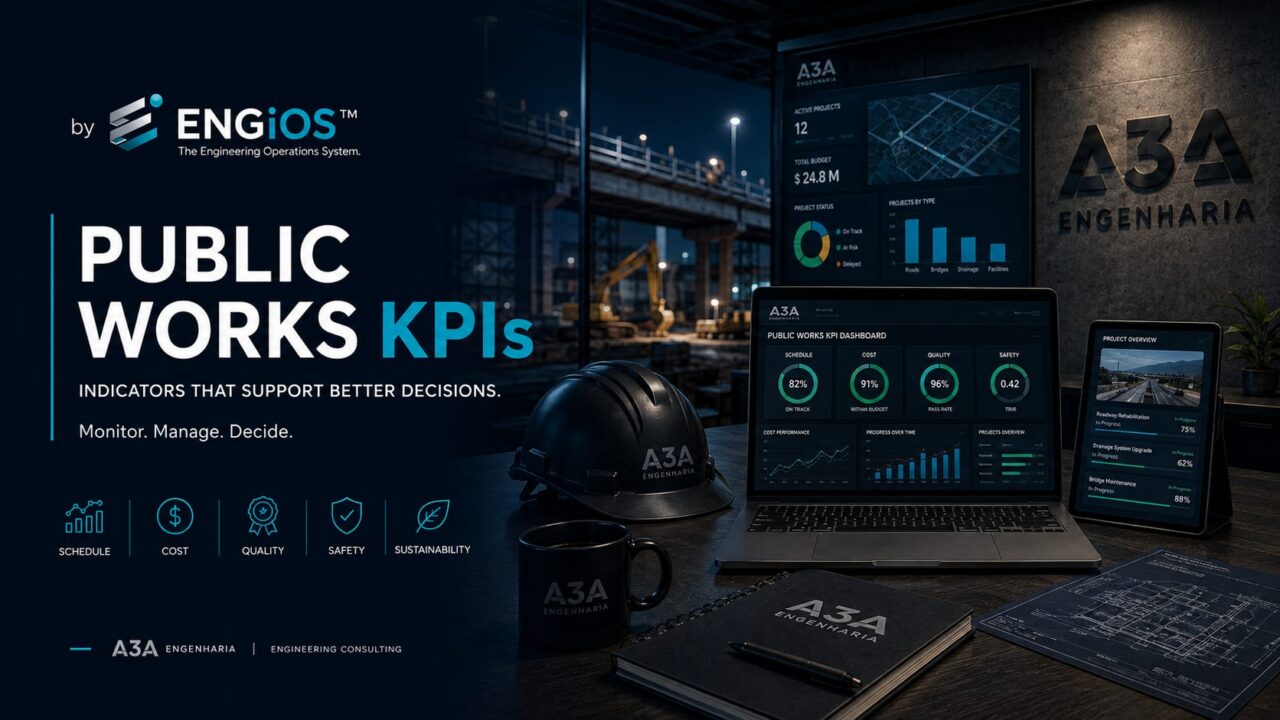
Learn how to structure KPIs for public-works inspection and management: progress, schedule, quality, measurements, open items, risks, and decision-support dashboards.
Check it out!
Public-works inspection does not improve simply because it starts producing more reports. It improves when field facts are transformed into comparable information and that information into decisions. KPIs — key performance indicators — fulfill this role when they objectively show whether schedule, physical progress, quality, measurements, open items, risks, and contractual obligations are converging toward the expected result.
In public works, a good indicator system should not exist to decorate dashboards or replace the inspector’s role. It should make it possible to detect deviations early, prioritize inspections, verify whether measurements correspond to demonstrated progress, monitor the contractor’s recovery capacity, and record trends that need to be escalated to the contract manager. The reference remains the contract, the design, acceptance criteria, schedule, and execution evidence.
Law No. 14.133/2021 requires monitoring and inspection of contract execution, and Decree No. 11.246/2022, in its current wording, structures management and inspection functions at the federal level. The practical challenge is to make this routine preventive, systematic, and traceable. Well-defined indicators are one of the most efficient tools for doing this without turning inspection into statistical bureaucracy.
Why KPIs are useful in public-works inspection
Inspection deals with a large volume of information: daily construction reports, inspections, designs, revisions, measurements, schedules, minutes, notices, NCRs, tests, material approvals, requests for information, open items, amendments, and risks. If each document is analyzed in isolation, the team may know many facts and still miss the contract trend.
A KPI creates a synthesis layer. It does not eliminate technical detail; it indicates where the detail needs to be investigated.
A physical-progress indicator, for example, may show that the work is 8 percentage points below the baseline. That still does not explain the cause. Inspection must break the deviation down by discipline, work front, package, or milestone and relate it to field records. Likewise, an increase in the number of nonconformities does not automatically mean quality deterioration: it may indicate more active inspection. Interpretation depends on context, denominator, trend, and severity.
For this reason, the system should connect three levels:
- primary data, such as executed quantity, date, inspection, or occurrence;
- indicator, which transforms data into a consistent measure;
- decision, which defines what to do when the indicator exceeds a given threshold.
This logic complements the method described in How to Inspect a Public Work and the traceability chain presented in Evidence-Based Inspection in Public Works.
A KPI is not just any number in a report
A metric reports a value. A KPI reports an aspect of performance that is relevant to a decision.
The number of photographs attached to a daily construction report is a metric. The percentage of critical work fronts with complete and validated evidence can be a KPI. The number of meetings held is a metric. The percentage of overdue critical actions without treatment can be a KPI. Total measured value is a metric. The difference between validated physical progress and measured financial progress can be a KPI.
Selection should begin with the management question. If the Public Administration wants to know whether the contractor can recover a delay, looking only at overall progress is not enough. Production rate, mobilization, productivity, milestones, critical path, constraints, and trend must be observed.
A mature KPI needs at least:
| Element | Required definition |
| objective | which decision or risk the indicator supports |
| formula | how the value is calculated |
| source | where the data comes from |
| responsible party | who collects, validates, and interprets |
| frequency | when the reporting cut-off occurs |
| unit | %, days, quantity, R$, index, or another unit |
| baseline or target | what the reference is |
| alert threshold | when to investigate |
| critical threshold | when to escalate |
| evidence | how the data can be audited |
| action | what to do when there is a deviation |
Without this minimum definition sheet, two inspectors can calculate the same indicator in different ways and produce incompatible conclusions.
Which KPIs should be used in public-works inspection?
Mature inspection does not need more spreadsheets; it needs a control base where progress, measurements, open items, and evidence can be independently cross-checked.
Learn about Technical Support for Inspection of Engineering Works and Contracts
There is no universal list. The set depends on the object, execution regime, complexity, risks, measurement criteria, and team maturity. However, some indicator families recur in engineering contracts.
1. Cumulative physical progress
The first indicator is the difference between planned physical progress and effectively validated physical progress.
Progress variance = cumulative actual – cumulative planned
The critical word is validated. A percentage reported by the contractor should not automatically be considered inspection progress. Measurement must be linked to progress criteria and verifiable evidence.
The article on S-Curves in engineering projects and works shows how baseline, actual, and forecast must remain separate.
For works with multiple disciplines, the global KPI must be decomposable. A project may show 72% overall progress while electrical installations, automation, or commissioning are still in critical condition.
2. Production rate
Cumulative variance shows where the project is. Production rate shows its recent speed.
Examples:
- m² completed per week;
- meters of piping installed per period;
- points certified per day;
- equipment installed and tested per week;
- documents approved per cycle;
- percentage of physical progress per period.
A delayed project with a production rate above plan may be recovering. A project close to baseline but continuously losing speed may be entering a risk condition.
3. Compliance with contractual milestones
Not every delay has the same consequence. Milestones may represent area release, energization, equipment delivery, phase completion, start of commissioning, or asset availability.
A simple indicator is:
Milestone compliance = milestones completed on time / milestones planned for the period × 100
The analysis should distinguish contractual milestones, internal milestones, and critical-path milestones. A delayed milestone with no effect on completion should not receive the same treatment as a milestone that blocks the project’s main sequence.
4. Schedule variance of critical activities
Inspection does not need to replace the contractor’s planning function, but it does need to verify whether the schedule used for control still represents the execution strategy.
The KPI can monitor:
- number of delayed critical activities;
- average delay of those activities;
- greatest delay in a critical activity;
- float consumption on near-critical paths;
- difference between forecast completion and contractual completion.
The important point is to avoid the simplistic interpretation that a percentage difference on the S-Curve directly equals a given number of days of delay.
5. Completion forecast
The contractual date says when the work must finish. The forecast indicates when it tends to finish considering current performance and constraints.
If the probable completion date begins to move away from the contractual date, discussion of a recovery plan must occur before the delay becomes irreversible.
Inspection should verify whether the forecast is supported by:
- schedule logic;
- demonstrated productivity;
- resource availability;
- actual supply dates;
- known constraints;
- design releases;
- operational windows;
- testing and acceptance sequence.
6. Percentage of overdue constraints
Many projects lose performance not because of a lack of overall effort but because specific constraints accumulate: pending design, unreleased area, unapproved material, interference, authorization, supply, access, or decision.
A constraint KPI should distinguish quantity from criticality. Ten simple administrative open items may have less impact than a single approval blocking the critical path.
A matrix may use:
| Situation | Interpretation |
| high quantity, low impact | need for operational organization |
| low quantity, high impact | immediate focus on critical blockers |
| growing quantity | deterioration in closure capability |
| increasing average age | decisions or responses are not occurring |
7. Age of open items
Counting open items is not enough. It is necessary to know how long they have remained open.
A distribution by ranges — up to 7 days, 8 to 15, 16 to 30, and over 30, for example — can reveal backlog aging. The ranges should be adjusted to the pace of the contract.
An old open item tends to mean one of three things: poorly defined priority, undefined responsibility, or inability to resolve. All require management action.
8. Open and closed nonconformities
The absolute number of NCRs should be interpreted carefully. The system should monitor:
- NCRs opened during the period;
- NCRs closed during the period;
- open balance;
- average age;
- recurrence;
- severity;
- responsible discipline or supplier;
- time from identification to correction;
- approval rate at reinspection.
Recurrence is particularly relevant. If the same deviation reappears, the problem may not be the local correction but the execution process, training, material, or contractor supervision.
9. First Pass Yield or approval at first inspection
The first-inspection approval rate shows how much of the work submitted to inspection is actually ready for acceptance.
FPY = inspections approved on first submission / inspections performed × 100
A persistent decline may indicate rushed execution, insufficient internal quality control, or poorly understood criteria.
This KPI must consider the nature of the inspections. Disciplines with very different complexity should not be compared directly without segmentation.
10. Rework
Rework consumes schedule, materials, labor, and supervision capacity without creating new progress.
It can be measured by:
- hours dedicated to corrections;
- estimated value of reworked services;
- number of units reinstalled;
- percentage of inspections requiring correction;
- impact of rework on the schedule.
Not all rework creates a right to payment or schedule extension. The indicator first serves to reveal efficiency loss and quality risk.
Measurement and payment KPIs
Inspection must also control the relationship between demonstrated execution and financial value.
Physical progress vs. financial progress
A significant difference between the two curves deserves investigation. Financial progress may be ahead because of mobilization, supplies, advance payments, or pricing structure. There may also be front-loading or measurement of items whose financial weight is high compared with physical effort.
The indicator should not automatically imply an irregularity. It serves as a consistency check.
Percentage of measurement disallowed
Disallowance = unaccepted value / submitted value × 100
A high disallowance rate may indicate poorly supported measurement, ambiguous criteria, quantity discrepancies, or recurring attempts to recognize services without sufficient evidence.
If the rate remains high for several cycles, the team should address the cause rather than simply repeat the checking process.
The Construction Measurement Report must be linked to calculation records, execution records, and acceptance criteria.
Measurement cycle time
The time between period close, submission, checking, correction, certification, and release can also be monitored. Excessively long cycles create disputes, accumulate open items, and reduce financial-control quality.
It is important to break the time down by stage so that the entire delay is not attributed to a single party.
Documentation and engineering KPIs
Complex works often fall behind because execution depends on engineering decisions that do not appear in field productivity.
Open RFIs and response time
The indicator can monitor:
- quantity issued;
- quantity answered;
- average age;
- RFIs blocking a work front;
- RFIs by discipline;
- percentage of responses generating a design revision.
A high RFI rate may indicate incomplete design, but it may also reflect better document discipline. The KPI’s quality comes from classification.
Design revisions after execution has started
Late changes can generate rework and schedule impacts. Inspection should record when revisions affect released work fronts, purchased materials, or completed services.
Pending submittals and materials
In contracts with many items of equipment and materials, delays in submittals and approvals often precede field delays. Monitoring lead time and the approval queue creates a leading indicator rather than merely a reactive one.
Leading indicators and outcome indicators
A good dashboard combines leading indicators and lagging indicators.
Outcome indicators show what has already happened:
- progress below plan;
- accumulated delay;
- actual cost;
- overdue NCRs;
- missed milestones.
Leading indicators show conditions likely to produce future outcomes:
- declining mobilization;
- delays in material approval;
- increase in critical RFIs;
- declining production rate;
- growth in constraints;
- late commissioning documents;
- equipment with compromised manufacturing schedules.
Preventive inspection needs both. If the dashboard shows only the past, it documents the problem after the ability to react has diminished.
How to turn indicators into a management routine
When schedule, risk, cost, and execution indicators are scattered among teams, the dashboard loses its function. Governance must integrate source, cut-off, analysis, and decision.
A dashboard only creates value if it is linked to a decision-making routine.
A mature routine can operate at four levels.
Field
The team records execution, impediments, inspections, and evidence. The Daily Construction Report — RDO preserves the chronology.
Control
Data is consolidated by cut-off date. The system updates progress, schedule, open items, NCRs, and measurements.
Analysis
Inspection identifies exceptions, investigates causes, and separates noise from relevant deviation.
Decision
The manager defines the action, responsible party, deadline, authority level, and need for contractual formalization.
The dashboard should answer not only “which KPI is red?” but “what action is associated with it, who is responsible, and by when must it be completed?”
KPI traffic lights: useful but dangerous when oversimplified
Green, yellow, and red classifications facilitate executive communication. The risk is hiding the logic.
Each range must have an explicit criterion. Illustrative example:
| KPI | Green | Yellow | Red |
| milestone compliance | ≥ 95% | 85% to 94% | < 85% |
| overdue critical open items | 0 | 1 to 2 | ≥ 3 |
| first-inspection approval | ≥ 90% | 75% to 89% | < 75% |
These values are not legal or universal parameters. They serve only to illustrate the logic. Actual thresholds must derive from risk, control frequency, history, and the contract.
In addition, some KPIs should not be reduced to an isolated traffic-light status. A single safety failure, for example, may require immediate action regardless of the monthly average.
How to avoid manipulable KPIs
Every indicator creates behavior. If a team is measured only by the “number of NCRs closed,” it may prioritize easy items and let critical ones age. If the contractor is assessed only by “percentage progress,” there may be an incentive to recognize progress in packages with greater weight and lower difficulty.
To reduce this risk:
- combine quantity, quality, and schedule;
- maintain predefined progress criteria;
- preserve source and audit trail;
- do not allow retroactive formula changes without control;
- use complementary indicators;
- review incentives created by the metric;
- segment critical items;
- keep evidence available for audit.
The KPI should reveal reality, not create a path to optimize the appearance of the report.
KPIs by governance level
Not everyone needs to see the same dashboard.
Technical inspector
Needs operational, verifiable indicators:
- progress by work front;
- inspections;
- NCRs;
- technical open items;
- materials;
- tests;
- constraints;
- missing evidence.
Contract manager
Needs to integrate dimensions:
- contractual schedule;
- milestones;
- measurements;
- changes;
- risks;
- notices;
- obligations;
- consolidated performance;
- pending decisions.
The distinction between contract manager and inspector under Law 14.133 helps define the reporting architecture.
Senior management
Needs few indicators, but with drill-down capability:
- overall progress and forecast;
- schedule exposure;
- relevant financial variance;
- critical risks;
- strategic milestones;
- pending executive decisions;
- contract trend.
The mistake is sending management dozens of field metrics without hierarchy and expecting that to create governance.
How KPIs relate to Article 117 of Law 14.133
Article 117 establishes monitoring and inspection of execution. Indicators do not replace occurrence records or the actions of the Public Administration’s representative. They organize information so that those actions can be more systematic.
At the federal level, Decree No. 11.246/2022 regulates the functions of the manager, technical inspector, administrative inspector, and sectoral inspection. The current wording reinforces that management and inspection should occur preventively, routinely, and systematically.
This has a management consequence: inspection that produces only a narrative report at the end of the month may record facts, but it has less anticipatory capacity than inspection structured around cut-off data, evidence, and alerts.
The KPI serves as a detection mechanism. Formal action remains subject to the contract, the agent’s authority, and the applicable administrative process.
Indicators for contracts with independent technical support
Law 14.133 allows inspectors to be assisted and supported by third parties without transferring the public agent’s formal powers. In complex projects, this support can be particularly useful for structuring the indicator base.
An independent team can:
- define a data dictionary;
- validate sources;
- structure the control baseline;
- check progress reported by the contractor;
- cross-check daily reports, measurements, and inspections;
- consolidate dashboards;
- analyze trends;
- identify inconsistencies;
- prepare technical recommendations for decisions by the inspector and manager.
This is one of the roles of Technical Support for Inspection of Engineering Works and Contracts: increasing the Public Administration’s analytical capacity without replacing the designated agent.
Example of a monthly dashboard for a public work
Consider a project with contractual completion in eight months. At the cut-off date:
| Dimension | Planned/target | Actual | Trend |
| physical progress | 54% | 47% | unfavorable |
| progress in the last month | 8 p.p. | 6 p.p. | below required recovery rate |
| milestones in the period | 5 | 4 | 1 critical milestone delayed |
| open NCRs | ≤ 8 | 17 | growing |
| NCRs > 30 days | 0 | 5 | critical |
| first-inspection approval | ≥ 90% | 74% | deteriorating |
| critical constraints | 0 | 3 | two affect the critical path |
| measurement disallowance | ≤ 2% | 9% | recurring |
| forecast | contractual date | +42 days | incompatible with target |
The conclusion should not be “there are several red indicators.” The analysis must connect causes.
If the drop in first-inspection approval coincides with increased rework, net production falls. If critical constraints block two work fronts and the forecast already points to 42 days of delay, the recovery plan must address constraints and quality rather than simply increasing labor in a generic way.
This is the difference between a dashboard and management: the dashboard shows relationships; management decides the response.
How to define a minimum indicator architecture
For organizations that do not yet have a mature system, it is better to begin with a few reliable KPIs and expand later.
An initial architecture can include:
- planned vs. actual physical progress;
- progress rate during the period;
- milestone compliance;
- completion forecast;
- overdue critical constraints;
- open NCRs and age;
- first-inspection approval;
- physical vs. financial progress;
- measurement disallowance;
- overdue critical actions.
Later, as maturity increases, productivity, procurement, engineering, risk, commissioning, and discipline-specific indicators can be added.
The Physical-Financial Schedule in Engineering Projects and Works and the S-Curve are important foundations because they stabilize schedule, progress, and value references.
Data quality: a KPI is only as reliable as its source
A dashboard can have excellent visualization and low reliability. Before automating, the organization must answer:
- who owns the data;
- where the data originates;
- who can change it;
- what the cut-off date is;
- which evidence supports it;
- how revisions are recorded;
- how inconsistencies are handled;
- which version is used in the report.
If the contractor directly updates the progress percentage in a spreadsheet without criteria and inspection merely imports that number, the problem is not the dashboard. It is information governance.
The Engineering Indicators, Dashboards, and Executive Reports solution must operate on data with defined rules, sources, and responsibilities.
KPIs and risks of amendments, claims, and suspension
Indicators also help identify conditions that precede contractual problems.
Combined warning signs include:
- growing number of critical RFIs;
- late design revisions;
- aging constraints;
- declining production rate;
- recurring disallowances;
- increasing rework;
- forecast moving away from baseline;
- critical materials awaiting approval;
- changes without formal decision;
- pending licensing or access.
No single KPI proves the cause of a future amendment or claim. But the combination creates an exposure map that allows action before the problem becomes established.
This use brings indicators closer to risk management, change control, and contract management instead of treating them only as a presentation tool.
What should not become a KPI
Some information must be recorded and handled but does not necessarily need to be converted into an index.
Rare, high-criticality events are an example. A serious safety condition, a structural failure, or a failed critical test may require immediate action with no need for a statistical trend.
It also makes no sense to create a KPI for everything. Excess increases collection cost and reduces attention. The question should be: “if this number changes, does any decision change?” If the answer is no, it is probably a secondary metric.
How to audit a construction KPI system
A simple audit can follow five tests.
Test 1 — traceability
Can the value shown on the dashboard be traced back to the source record and evidence?
Test 2 — consistency
Is the same formula applied in all periods and comparable contracts?
Test 3 — timeliness
Does the data arrive early enough to allow action?
Test 4 — materiality
Does the indicator represent relevant risk or performance?
Test 5 — actionability
Is there a defined response when the value leaves the acceptable range?
If a KPI fails all five tests, it may be visually sophisticated and managerially useless.
How to procure support for structuring inspection indicators
The support scope should not be “create a dashboard.” The object needs to include engineering of the control system.
Possible deliverables include:
- objectives and decisions matrix;
- KPI catalog;
- definition of formulas and sources;
- WBS and control-package structure;
- baseline and cut-off calendar;
- data dictionary;
- evidence rules;
- report templates;
- executive dashboards;
- analysis routine;
- alert levels;
- team training;
- implementation monitoring.
In complex contracts, Engineering Project Management can integrate schedule, risk, documentation, and decisions, while inspection support remains focused on execution compliance.
From measurement to decision: a matrix of triggers, evidence, and actions
A KPI system begins to effectively support inspection when each indicator stops being merely informative and acquires an escalation rule. This requires a matrix linking the observed signal, required evidence, technical analysis, and possible action. Without this layer, the dashboard may show deterioration for weeks without producing any formal reaction.
In public works, action should not be automated solely by the indicator color. A KPI is a detection mechanism; the decision still depends on the contract, materiality, cause, responsibility, and authority of the public agent. The matrix’s function is to reduce the interval between the emergence of a deviation and consistent analysis of what it means.
| KPI / signal | Evidence to check | Decision question | Typical action |
| forecast exceeds contractual date | updated schedule, critical path, productivity, constraints | is the delay recoverable and what is its cause? | request a recovery plan, record the risk, and monitor milestones |
| recurring measurement disallowance | calculation records, measurement criteria, inspections, quantities | is there a documentation failure, technical discrepancy, or attempt at financial acceleration? | correct the process, formalize criteria, and address recurrence |
| critical NCRs aging | NCR, reinspections, cause, correction plan | does the contractor have the capacity to eliminate the cause? | escalate, require corrective action, and assess impact on acceptance |
| decline in First Pass Yield | inspections, rework, teams, and work fronts | is the contractor’s internal quality control deteriorating? | audit the execution process and reinforce hold points |
| overdue critical constraints | responsible party, deadline, impact, and dependencies | who needs to decide to release the work front? | escalate to the competent authority and record potential impact |
This matrix also reduces two opposite errors: overreacting to every fluctuation and normalizing a relevant deviation because criteria are absent. A well-governed indicator should have thresholds, but also an interpretation rule.
The KPI baseline must be established before execution
It is not advisable to invent the indicator system once the work is already delayed. The most useful KPIs depend on references that must exist from mobilization onward: WBS, baseline schedule, physical-progress criteria, measurement matrix, milestone list, criticality classification, NCR workflow, daily-report structure, and evidence rules.
When the contract starts without these definitions, inspection must retrospectively reconstruct what should have been agreed. This creates disputes about formulas precisely when an indicator begins to show a problem. In significant contracts, the KPI catalog and data governance should form part of the inspection plan or contract-management plan.
The same applies to changes. If a contractual modification changes schedule, scope, sequence, or measurement weights, the baseline must be versioned. Replacing the original reference without preserving history destroys the ability to explain how the contract evolved. A reliable dashboard must distinguish the original baseline, the current approved baseline, and the forecast.
Portfolio KPIs: when the Public Administration manages multiple works simultaneously
For agencies with multiple works, the greatest benefit is not creating a different dashboard for each contract, but standardizing a common core of indicators and allowing object-specific extensions. This makes contracts comparable without erasing their technical differences.
A corporate core can include physical progress, forecast, milestones, critical open items, overdue NCRs, disallowances, changes, risks, and pending decisions. Each project can add specific indicators for telecommunications, electrical systems, structures, HVAC, electronic security, commissioning, or other disciplines.
This standardization creates an institutional language for senior management. Instead of receiving incompatible narrative reports, leadership can see which contracts are losing schedule, accumulating risks, generating rework, or requiring decisions. Detail remains available to the inspector, but the executive layer becomes comparable.
Final considerations
KPIs are useful in public-works inspection when they reduce the time between the emergence of a deviation and the decision about what to do. Their value is not in the number of charts, but in the ability to transform execution, evidence, and contractual obligations into reliable signals.
A mature system combines outcome and leading indicators, preserves the baseline, distinguishes reported progress from validated progress, links measurement to evidence, and maintains traceability back to the source. It also defines who interprets each indicator and which action is expected when thresholds are exceeded.
The Public Administration does not need to begin with dozens of KPIs. It needs to begin with indicators that represent its main risks and decisions and ensure that every number can be technically defended. From there, automation and dashboards cease to be an aesthetic layer and become an effective part of construction governance.
Agencies with multiple works and contracts can standardize KPIs, templates, analysis routines, and escalation levels without internalizing a fixed structure for every specialty.
Technical references
[1] BRASIL. Lei nº 14.133, de 1º de abril de 2021 — Lei de Licitações e Contratos Administrativos. 2021. Available at: https://www.planalto.gov.br/ccivil_03/_ato2019-2022/2021/lei/l14133.htm.
[2] BRASIL. Decreto nº 11.246, de 27 de outubro de 2022 — atuação dos gestores e fiscais de contratos. 2022. Available at: https://www.planalto.gov.br/ccivil_03/_ato2019-2022/2022/decreto/d11246.htm.
[3] TRIBUNAL DE CONTAS DA UNIÃO. Licitações e Contratos: execução do contrato. 2025. Available at: https://licitacoesecontratos.tcu.gov.br/6-1-execucao-do-contrato/.
[4] TRIBUNAL DE CONTAS DA UNIÃO. Obras públicas: recomendações básicas para a contratação e fiscalização de obras de edificações públicas. 2014. Available at: https://portal.tcu.gov.br/publicacoes-institucionais/cartilha-manual-ou-tutorial/obras-publicas-recomendacoes-basicas-para-a-contratacao-e-fiscalizacao-de-obras-de-edificacoes-publicas.
[5] INTERNATIONAL ORGANIZATION FOR STANDARDIZATION. ISO 21502:2020 — Project, programme and portfolio management — Guidance on project management. 2020. Available at: https://www.iso.org/standard/74947.html.
Frequently asked questions
An initial set can monitor planned vs. actual physical progress, production rate, milestone compliance, completion forecast, critical constraints, nonconformities, first-inspection approval, physical vs. financial progress, measurement disallowances, and overdue critical actions. Selection should be adjusted to the object and contract risks.
No. A KPI summarizes performance signals. Reports, occurrence records, inspections, measurements, and other evidence remain necessary to explain causes, responsibilities, and actions.
A progress difference should not be automatically converted into days of delay. Control must consider the schedule, critical path, milestones, float, and completion forecast.
A metric is any measure. A KPI is a measure selected because it represents relevant performance or risk and is associated with a management decision or action.
By defining formulas, sources, progress criteria, cut-off dates, responsibilities, evidence, and review trails in advance. Progress reported by the contractor must be validated when the KPI is used by inspection.
Yes. Law 14.133 allows third parties to provide technical assistance and support to inspectors without transferring the public agent’s formal powers. Support can organize data, validate evidence, consolidate indicators, and produce technical analyses.
There is no general requirement to use a specific dashboard. The central requirement is to perform adequate management and inspection with records and controls consistent with the contract. Dashboards are a tool for making this monitoring more systematic.
Supplementary technical materials
Related solutions
Related services
- Technical Support for Inspection of Engineering Works and Contracts
- Engineering Project Management
- Ongoing Consulting Engineering Services