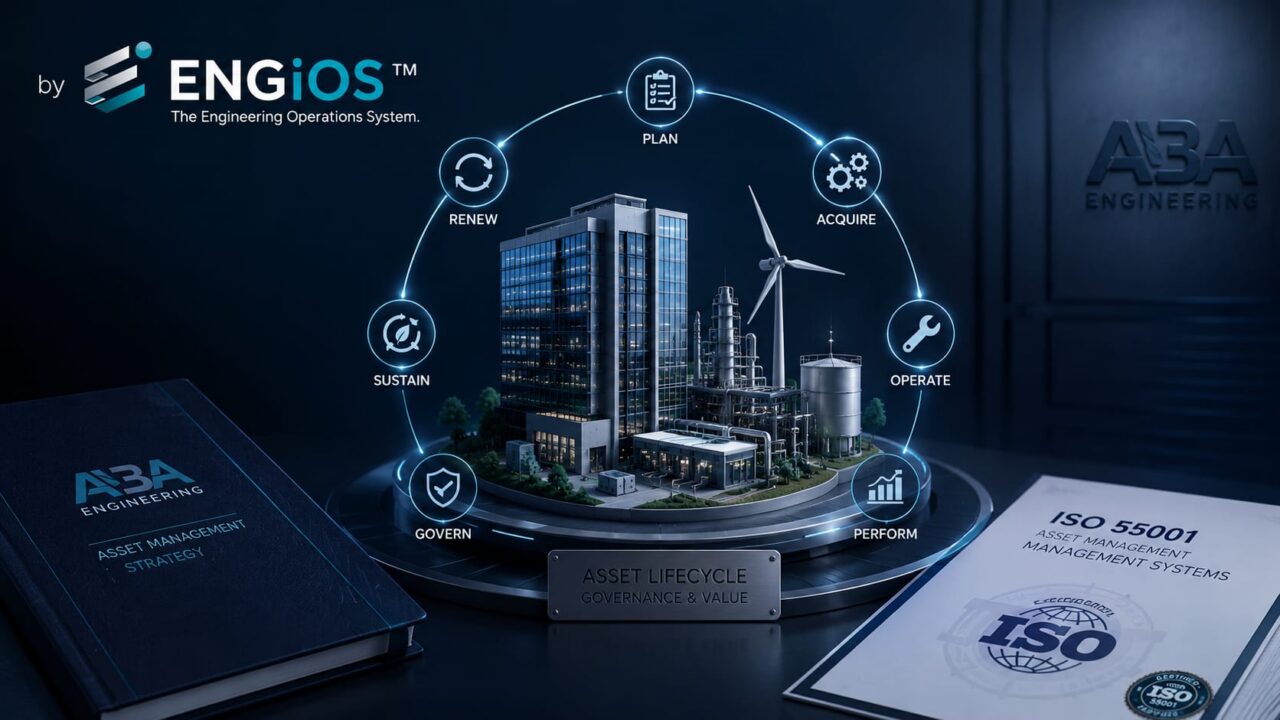
Understand ISO 55000 and asset management: ISO 55001, SAMP, value, risk, lifecycle, data, maintenance, BIM, implementation and system maturity.
Check it out!
Asset management is not an asset inventory, a maintenance plan, or the implementation of software. It is a management discipline that connects decisions about assets to organizational objectives, seeking to realize value throughout the lifecycle while balancing performance, risk, and resources.
The ISO 55000 series provides the international framework for this system. In July 2024, ISO 55000 and ISO 55001 received new editions, incorporating a decade of implementation experience and reinforcing topics such as decision-making, value realization, risks and opportunities, data, knowledge, and lifecycle operations.
For infrastructure-intensive organizations—industry, energy, water and sanitation, transportation, critical buildings, data centers, and public assets—asset management creates a common language across engineering, operations, maintenance, finance, procurement, risk, and leadership. The objective goes beyond preserving equipment and becomes deciding which assets are needed, what performance they must deliver, how much risk is acceptable, and where capital should be allocated.
Implementation, however, does not begin with certification. It begins with clarity regarding organizational objectives, asset scope, decision criteria, reliable information, responsibilities, and governance mechanisms. ISO 55001 can structure the management system; it does not replace the engineering required to define suitable technical strategies for each asset class.
What is asset management according to the ISO 55000 series
Asset management is a coordinated approach to realizing value from assets in support of organizational objectives. This requires looking beyond physical condition or acquisition cost: an asset needs to be understood through the function it performs, the service it supports, the associated risks, and the costs and benefits it produces throughout its lifecycle.
ISO 55000:2024 is the conceptual foundation of the family. It presents vocabulary, an overview, and principles, while also contextualizing the relationship between asset management and the asset management system. The 2024 edition also explicitly introduces asset management outcomes, expands the discussion of benefits, addresses integration among management systems, and incorporates the concept of organizational maturity in asset management.
Asset management is not the same as maintenance
Maintenance is one of the operational capabilities that supports asset management. It addresses interventions, inspections, failures, plans, resources, and equipment condition. Asset management operates at a broader decision layer: why to maintain, replace, refurbish, run to failure, add redundancy, modernize, decommission, or invest.
A technically excellent maintenance strategy may be economically inappropriate if the asset is no longer needed by the business. Likewise, a CAPEX decision may reduce initial cost while increasing downtime, consumption, risk, or OPEX for decades.
Asset management decides before maintenance is ordered. The question is not only how to preserve the equipment, but whether it is still needed, what performance it must deliver, what risk is acceptable, and which alternative produces the greatest lifecycle value.
Learn about Engineering Asset Management · Maintenance Engineering
Asset management is not software
EAM, CMMS, ERP, BIM, Digital Twin, GIS, and analytics platforms can support the discipline, but none of them by itself constitutes an asset management system. The management system includes policy, objectives, processes, responsibilities, decision criteria, information, controls, performance evaluation, and improvement.
| Layer | Core question | Examples |
| organizational strategy | what does the organization need to achieve? | service, production, safety, return, compliance |
| asset management | what value must the assets deliver? | performance, risk, cost, capacity, service life |
| asset plans | what will be done in each horizon? | maintain, renew, expand, replace, decommission |
| execution | how will the actions be carried out? | maintenance, projects, procurement, operations, inspections |
| information | how will the decision be supported? | asset register, condition, costs, failures, documents, operational data |
ISO 55000, ISO 55001, ISO 55002, and complementary standards
The expression “ISO 55000” is informally used to refer to the family, but each document has a different function. To properly structure an asset management program, it is important to distinguish concepts, requirements, and application guidance.
ISO 55000:2024 — fundamentals, vocabulary, and principles
It is the conceptual document. It helps establish common language, explain what asset management is, identify expected benefits, and show how the discipline relates to organizational objectives.
ISO 55001:2024 — asset management system requirements
ISO 55001 is the requirements standard. It specifies what an organization needs to establish, implement, maintain, and improve to operate an asset management system. The 2024 edition particularly reinforced decision-making and value, asset management planning, risks and opportunities, data and knowledge, and lifecycle operations.
The standard can be used by organizations of any size and for different types of assets; the organization itself determines the scope to which the system will apply.
ISO 55001 is a management system standard, not a technical manual for the asset. It structures how the organization governs decisions; engineering, maintenance, reliability, and design criteria still need to be technically defined.
Explore processes and governance · Reliability and Availability Engineering
ISO 55002:2018 — guidance for applying ISO 55001
ISO 55002 provides practical guidance for applying the requirements of ISO 55001. As of August 2026, the published edition remains ISO 55002:2018, corrected in 2020. A third edition is under development and is expected to replace it when published; therefore, project and audit documents should not treat the draft as a current requirement.
ISO/TS 55010:2024 — integration between financial and non-financial functions
Asset management fails when engineering and finance work with incompatible criteria. ISO/TS 55010 addresses alignment between financial and non-financial functions, connecting costs, risks, controls, and technical decisions.
ISO 55012:2024 — people, involvement, and competence
Plans do not produce results without people capable of executing them. ISO 55012 provides guidance on developing involvement, culture, competence, knowledge, and the organizational conditions required for the asset management system.
ISO 55013:2024 — data for asset management
ISO 55013 provides guidance on managing data that support asset management objectives. This contribution is important because data quality, governance, and usefulness directly influence criticality, risk analysis, planning, maintenance, CAPEX, and lifecycle decisions.
| Document | Primary function |
| ISO 55000:2024 | concepts, vocabulary, overview, and principles |
| ISO 55001:2024 | asset management system requirements |
| ISO 55002:2018 | guidance for applying ISO 55001 |
| ISO/TS 55010:2024 | financial and non-financial alignment |
| ISO 55012:2024 | people involvement and competence |
| ISO 55013:2024 | data management to support asset management |
How an asset management system works
An asset management system turns strategy into decisions and decisions into controlled actions. The central challenge is to create vertical coherence: organizational objectives need to cascade into asset management objectives, decision criteria, plans, and executable activities.
Policy, objectives, and SAMP
The asset management policy establishes direction and commitments. Objectives translate desired outcomes into targets that can be planned and evaluated. The Strategic Asset Management Plan—SAMP—bridges organizational strategy and the way asset management will be conducted.
The SAMP should not be an isolated document produced for audit purposes. It needs to guide real decisions about the asset portfolio, investments, renewals, risks, performance, information, and organizational capabilities.
Asset scope and hierarchy
Not every registered item needs the same level of management. The organization should define the system scope, asset classes, hierarchies, functions, and relevant relationships. This architecture needs to make it possible to trace how failures or limitations of an asset affect systems, processes, services, and business objectives.
Decision criteria
Decisions need to be comparable. This requires clear criteria for prioritizing investments, interventions, and risks. Depending on the context, criteria may include safety, availability, capacity, compliance, total cost, environmental impact, obsolescence, criticality, redundancy, schedule, and consequence of failure.
Good governance avoids two extremes: purely technical decisions without economic perspective and purely financial decisions without understanding operational risk.
Decision criteria are the bridge between engineering and capital. Prioritizing CAPEX, renewal, and maintenance requires making risk, performance, cost, consequence, and expected value explicit—and applying the same logic across functions.
Engineering risk management · Value Engineering and lifecycle cost
Governance and responsibilities
Asset management spans departments. Responsibilities therefore need to be explicit for the asset owner, engineering, operations, maintenance, finance, procurement, IT/OT, data management, and leadership. Without this definition, decisions become fragmented and databases conflict.
Value, risk, performance, and cost throughout the lifecycle
The discipline creates value when it changes the decision horizon. The asset is no longer assessed only by its current condition, but by the contribution it must deliver throughout its service life and by the alternatives available to sustain that contribution.
Lifecycle does not simply mean “service life”
The lifecycle includes decisions on need, concept, acquisition, design, construction, commissioning, operations, maintenance, renewal, modification, and decommissioning. Not every organization performs all of these stages internally, but it needs to control the interfaces that affect outcomes.
Criticality needs to connect the asset and the consequence
Criticality is not merely a fixed score in the register. It should reflect relevant consequences: safety, environment, production, service, financial impact, reputation, compliance, and operational continuity. The same equipment class may have different criticality depending on function, redundancy, and context.
Risk needs to guide priorities
Backlogs, CAPEX, and maintenance plans compete for limited resources. Asset management logic uses risk and value to prioritize. This makes it possible to distinguish what is urgent, what is important, what can be monitored, and what no longer justifies investment.
Lifecycle cost is not just adding up OPEX
A proper assessment may include acquisition, installation, energy, consumables, maintenance, downtime, parts, labor, replacements, modernization, disposal, and residual value within the defined horizon and assumptions. The goal is not to produce a sophisticated number, but to compare alternatives on a consistent basis.
Renewal planning needs to begin before failure
Obsolescence, degradation, parts unavailability, capacity changes, regulatory requirements, and increasing risk are signals that need to feed renewal plans. Waiting for failure before deciding turns asset management into emergency response.
Data, people, and integration with maintenance, BIM, and systems
Asset management depends on information that is sufficiently reliable to support decisions. This does not mean storing every possible data point. It means identifying which information is needed, who is responsible for it, how it is updated, and which decision it supports.
The asset register needs a purpose
Tag, class, location, manufacturer, and serial number are only the beginning. Depending on the use case, function, parent system, criticality, condition, dates, maintenance strategy, cost, documentation, parts, warranty, risk, operational parameters, and relationships with other assets may also be required.
Technical and financial data need to communicate
Engineering may understand condition and risk while finance sees book value, budget, and cash flow. Investment decisions require a bridge between these perspectives. This is exactly the problem ISO/TS 55010 seeks to reduce.
BIM and AIM can structure asset information
In built environments, BIM/AIM can provide identity, location, properties, spatial relationships, and documentation. This helps structure information for operations, but it does not replace the asset management system or the decision-making process.
Asset data only has value when it supports a decision. BIM, the asset register, maintenance history, and operational data need to share identity, responsibility, and update rules; accumulating unused fields only increases governance cost.
Information Management and ISO 19650 · BIM 7D and information for operations
Maintenance and reliability feed decision-making
Failure histories, condition data, work orders, inspections, MTBF, MTTR, availability, recurrence, and cause analysis are important inputs. Asset management uses this evidence to review strategies, justify renewal, and balance risk, cost, and performance.
People and competence are part of the system
A program fails when knowledge is concentrated in a few specialists, responsibilities are informal, or decisions leave no traceability. Competence, involvement, communication, and succession need to be treated as system capabilities, not as a parallel HR topic.
How to implement, assess maturity, and improve asset management
Implementation should begin with the organizational problem to be solved, not with a certification checklist. In many organizations, the first gains come from aligning priorities, addressing critical assets, making decisions traceable, and establishing a consistent process across engineering, operations, and finance.
Initial assessment
The assessment should evaluate objectives, context, governance, scope, processes, critical assets, information, competencies, investment decisions, maintenance, risks, and interfaces across functions. Maturity analysis is useful for identifying gaps and prioritizing development, but it should not become a score without an action plan.
Recommended implementation process
- define organizational objectives that depend on assets;
- establish the scope of the asset management system;
- map stakeholders, requirements, and obligations;
- define the asset management policy and objectives;
- structure governance, roles, and decision authority;
- organize asset hierarchies, classes, and criticality;
- define decision criteria for risk, performance, cost, and value;
- develop or review the SAMP and asset management plans;
- assess required data, quality, ownership, and systems of record;
- align maintenance, reliability, projects, procurement, and operations;
- align financial and non-financial functions;
- develop competencies and responsibilities;
- implement indicators, audits, and management review;
- address deviations and continually improve the system.
Indicators should show outcomes, not bureaucratic activity
The number of meetings, issued plans, or registered assets does not demonstrate maturity by itself. Indicators need to show whether decisions are improving performance, risk, cost, compliance, information availability, and value realization.
ISO 55001 certification does not replace technical performance
A system may demonstrate management-system conformity and still make weak technical decisions if assumptions, models, data, or engineering are inadequate. System audit and technical verification of assets are complementary activities.
When to start with a pilot
Large organizations may implement by asset class, facility, process, or business unit. A pilot is useful when it allows governance, data, decision criteria, and cross-functional integration to be tested before scaling. The pilot needs to be representative; choosing only a simple environment may mask problems that will emerge during expansion.
The expected outcome
A mature organization does not simply claim to “have ISO 55000”. It can demonstrate why it owns certain assets, the value it expects from them, which risks it accepts, how it prioritizes resources, how it measures performance, how it learns from failures, and how it decides to renew, modify, or retire assets based on coherent information and criteria.
Maturity is not the number of procedures; it is consistent decision quality. The system needs to produce traceable priorities, executable plans, evidence, performance review, and learning that feeds the next lifecycle decision.
Acceptance criteria and evidence · Assisted Operations and stabilization · Engineering Asset Management
Technical references
[1] INTERNATIONAL ORGANIZATION FOR STANDARDIZATION. ISO 55000:2024 — Asset management — Vocabulary, overview and principles. Geneva: ISO, 2024.
[2] INTERNATIONAL ORGANIZATION FOR STANDARDIZATION. ISO 55001:2024 — Asset management — Asset management system — Requirements. Geneva: ISO, 2024.
[3] INTERNATIONAL ORGANIZATION FOR STANDARDIZATION. ISO 55002:2018 — Asset management — Management systems — Guidelines for the application of ISO 55001. Geneva: ISO, 2018.
[4] INTERNATIONAL ORGANIZATION FOR STANDARDIZATION. ISO/TS 55010:2024 — Asset management — Guidance on the alignment of financial and non-financial functions in asset management. Geneva: ISO, 2024.
[5] INTERNATIONAL ORGANIZATION FOR STANDARDIZATION. ISO 55012:2024 — Asset management — Guidance on people involvement and competence. Geneva: ISO, 2024.
[6] INTERNATIONAL ORGANIZATION FOR STANDARDIZATION. ISO 55013:2024 — Asset management — Guidance on the management of data assets. Geneva: ISO, 2024.
Frequently asked questions
ISO 55000:2024 is the foundation standard of the asset management family. It presents vocabulary, an overview, and principles, and provides context for ISO 55001 and ISO 55002.
ISO 55000 presents concepts and principles. ISO 55001:2024 contains the requirements for establishing, implementing, maintaining, and improving an asset management system.
ISO 55001 is a requirements standard for management systems and can be used as a reference for conformity assessment. The decision to pursue certification does not replace the need for technical performance and effective asset management.
The current edition is ISO 55000:2024, published in July 2024. The 2014 edition was withdrawn.
The current edition is ISO 55001:2024, published in July 2024 and replacing the 2014 edition.
Yes. As of August 2026, ISO 55002:2018 remains published, although a third edition is under development to replace it in the future.
No. Maintenance is an important operational capability. Asset management is broader and connects assets to organizational objectives while balancing value, performance, risk, costs, and lifecycle decisions.
SAMP is the Strategic Asset Management Plan. It connects organizational objectives to asset management strategy and objectives, guiding plans, priorities, capabilities, and decision criteria.
Yes. BIM/AIM can structure asset identity, location, properties, and documentation, especially in built environments. It is an information source and structure, not the asset management system itself.
The starting point should define objectives, scope, stakeholders, governance, critical assets, decision criteria, SAMP, data, competencies, and interfaces with maintenance, finance, projects, and operations before treating certification as the primary objective.
Additional technical resources
Asset management, value, and governance
- Engineering Asset Management
- Processes and governance in engineering projects
- Risk management in engineering projects
- Value Engineering in Engineering Projects
- Project Lifecycle: phases and decision points
- Procurement in Engineering Projects
Maintenance, reliability, and operations
- Maintenance Engineering
- Reliability and Availability Engineering
- BIM 7D: operations, maintenance, Facility Management, and asset management
- Assisted Operations
- Assisted Operations in Engineering: transition and stabilization
- Lessons Learned in Engineering Projects
BIM, information, and asset data
- BIM Information Management: ISO 19650
- BIM Management and Engineering Information
- BIM Modeling in Engineering
- BIM Project: models, information, and deliverables
- BIM Information Classification — NBR 15965
- As-Built in Engineering