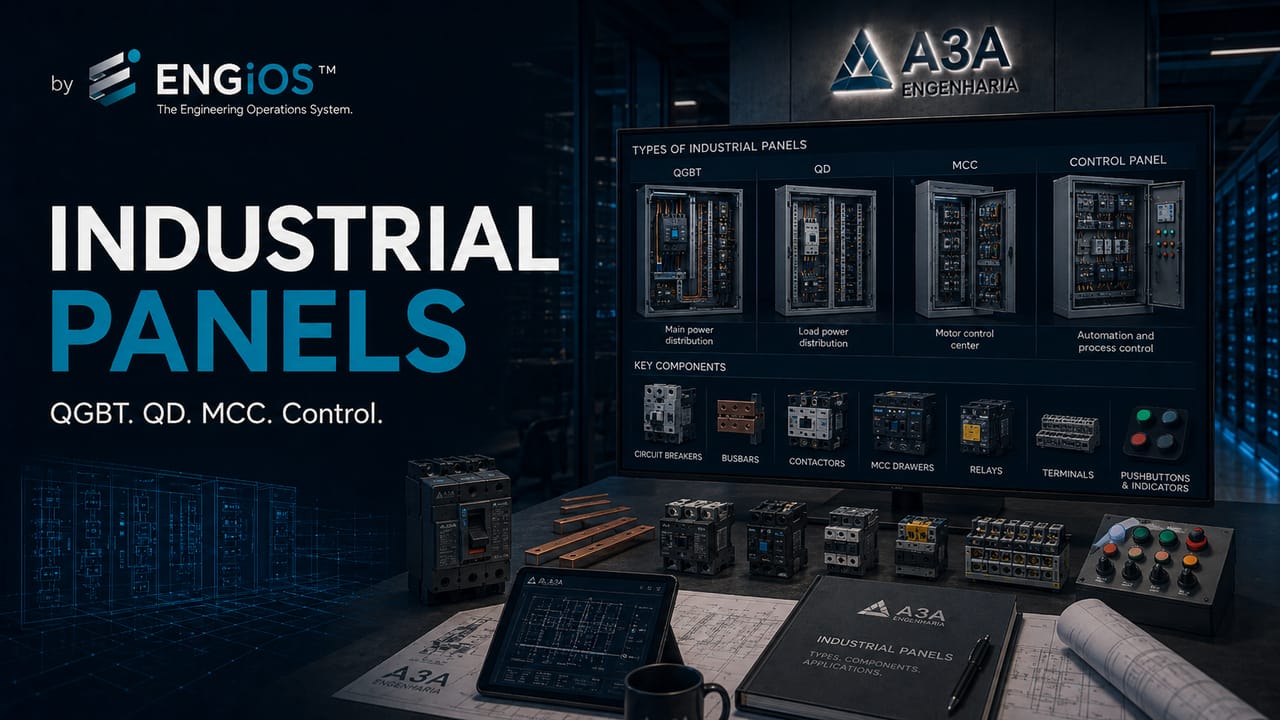
Learn the main types of industrial electrical panels and the differences between main low-voltage switchboards, distribution boards, MCCs, control panels and transfer panels.
Check it out!
An industrial electrical panel is an assembly that integrates protection, switching, distribution, control, metering or automation devices to perform a defined function in an electrical system or industrial process. Main low-voltage switchboards, distribution boards, motor control centers, control panels and transfer panels are not synonyms: they differ by predominant function, connected loads, current level, internal architecture and operation and maintenance requirements.
Correct classification must start from the single-line diagram and operating philosophy. A simple component list does not identify the assembly function or demonstrate its electrical, thermal, mechanical or environmental suitability.
Understanding these differences is important to avoid generic specifications, incompatible procurement and panels that do not meet the actual load, short-circuit, environmental, operating and maintenance conditions.
What is an industrial electrical panel?
An industrial electrical panel is an assembly of electrical devices, control components, busbars, connections, enclosure, protective elements and operating interfaces organized to perform a defined function.
The function may be power distribution, motor supply, process control, source transfer, machine control or automation integration. The panel should be designed as an assembly, considering electrical, thermal, mechanical and environmental characteristics.
ABNT NBR 5410 defines installation requirements — demand, circuit division, protection, isolation, grounding, external influences, documentation and verification. The ABNT NBR IEC 61439 series addresses the assembled unit — enclosure, busbars, components, temperature rise, short circuit, insulation, operation and verifications. Therefore, panel design must translate installation conditions into verifiable interface characteristics.
Main types of industrial electrical panels
Main Low-Voltage Switchboard
The main low-voltage switchboard receives the main low-voltage supply and distributes power to boards, panels, feeders and larger loads. It normally concentrates the main breaker, main busbars, outgoing devices, metering and signaling.
Its specification must consider demand, rated current, short-circuit level, busbars, protection, continuity, maintenance and expansion.
Distribution Board
A distribution board supplies specific circuits or sectors. It may receive power from the main low-voltage switchboard or another upstream board and distribute it to final circuits, equipment or smaller boards.
In building applications, it may supply lighting, socket-outlets and specific loads. In industrial installations, it may supply production sectors, utilities or support areas.
MCC — Motor Control Center
An MCC is intended for the supply, protection, control and supervision of motors. It can integrate circuit breakers, fuses, contactors, overload relays, soft starters, variable-frequency drives and communication systems.
The design must consider starting current, operating duty, component coordination, maintenance and process continuity.
Control and automation panel
A control panel concentrates control logic, relays, controllers, power supplies, interfaces, signaling, input/output modules and automation components.
Its primary function is not to distribute high currents, but to control equipment and processes. Even so, it must meet requirements for protection, segregation, EMC, ventilation, identification and maintenance.
Transfer panel
A transfer panel switches between sources such as utility power, generator, UPS or another alternative supply. It may include automatic control, interlocks and voltage and frequency supervision.
The transfer logic must prevent unintended paralleling and ensure that the operating sequence matches the electrical architecture defined in the design.
Differences between main switchboards, distribution boards, MCCs and control panels
| Panel type | Main function | Typical loads | Critical criteria |
| Main low-voltage switchboard | general distribution | boards, panels and large feeders | short circuit, busbars, selectivity, expansion |
| Distribution board | sector or final distribution | lighting, socket-outlets and specific loads | circuit division, protection and identification |
| MCC | motor control and protection | motors, pumps, fans, compressors | starting, coordination, duty and maintenance |
| Control panel | logic and automation | sensors, actuators, controllers and interfaces | EMC, power supplies, segregation and documentation |
| Transfer panel | source switching | essential feeders and critical loads | interlocking, sequence and continuity |
Classification depends on the predominant function. A single assembly may combine different functions, but this must be explicitly defined in the scope and diagrams.
Which components may be installed in an industrial panel?
The composition varies according to the application. Common components include:
- circuit breakers and fuses;
- busbars and distribution blocks;
- contactors and relays;
- motor starting and control devices;
- meters and current transformers;
- power supplies and auxiliary transformers;
- controllers and automation modules;
- terminals, connectors and interfaces;
- indicators, pushbuttons and selectors;
- ventilation, heating or air-conditioning;
- enclosures, doors, barriers and partitions.
The panel should not be assessed only by its component list. Internal arrangement, connections, thermal dissipation, clearances, protective circuit and short-circuit behavior are also part of its performance.
Are an electrical panel and a switchgear assembly the same thing?
In everyday use, “electrical panel” is a broad expression. From a standards perspective, many panels fall within the category of low-voltage switchgear and controlgear assemblies.
The ABNT NBR IEC 61439 series addresses these assemblies and establishes a framework based on interface characteristics, design, verification and application. The applicable part depends on the assembly type and purpose.
This means the specification should state the panel function and the conditions in which it will be used instead of simply requesting a box containing certain components.
The panel should be specified as a system, not as a parts list
The white paper on specification, design, verification and acceptance of main low-voltage switchboards presents the logic of interface characteristics, responsibilities and documentation applicable to low-voltage assemblies.
How do you choose the correct panel type?
The choice begins with the electrical architecture and the process being served.
Some questions help define the solution:
1. Does the panel receive the main supply or a branch circuit? 2. Does it distribute power or control equipment? 3. Are there motors and significant starting currents? 4. Is source transfer required? 5. What is the short-circuit current at the point? 6. Which devices need to be operated or adjusted? 7. Does maintenance require compartmentation or removable units? 8. Is the environment exposed to dust, water, corrosion, heat or vibration? 9. Which documents must be delivered? 10. Is future expansion expected?
The answers determine the assembly type, internal architecture and verification requirements.
Criteria for specifying an industrial electrical panel
A technically complete specification should include:
- panel function and limits;
- single-line diagram and control diagrams;
- voltage, frequency and earthing arrangement;
- rated current and circuit currents;
- prospective short-circuit current;
- protective devices and protection criteria;
- environment, temperature, IP and IK ratings;
- installation method and cable entry;
- operation, accessibility and maintenance;
- automation and communication interfaces;
- spares and expansion capability;
- verifications, tests and acceptance documentation.
Without this information, commercial proposals may use different construction solutions that are difficult to compare. Rated current, device breaking capacity and IP rating are not enough: prospective short-circuit current, assembly withstand, diversity factor, loading conditions, form of separation, cable entry and exit, accessibility, thermal dissipation, settings, interlocks and final documentation must also be defined.
NBR 5410 requires components to be suitable for external influences and the installation to be documented, verified and maintained. In industrial environments, dust, moisture, heat, corrosion, vibration, harmonics and electromagnetic interference can directly affect the selection of the enclosure, busbars, ventilation and devices.
Deepen the panel protection and grounding criteria
The white paper on circuit-breaker sizing details protection and coordination. The eBook Electrical Grounding explores PE and equipotential bonding in greater depth.
Does an industrial panel require design and verification?
Yes. The installation design defines the needs and interface characteristics: voltage and frequency, earthing arrangement, demand, circuit currents, prospective short-circuit current, protective devices, environmental conditions, cables, operation, maintenance and expansion. The assembler converts these data into a construction solution and performs the verifications applicable to the assembly.
Coordination among design current, conductor capacity and protective device must remain consistent with NBR 5410. In power panels, this includes assessing breaking capacity, busbar withstand, let-through energy, selectivity and the thermal effects of the assembly.
Design verification demonstrates that the solution meets the applicable standards requirements. Routine verification is performed on each assembled panel to identify assembly, material and functional defects.
At acceptance, the purchaser should verify that the panel corresponds to the drawings, lists, settings and specified characteristics.
Design, inspection and technical reports address different stages
The Low-Voltage Electrical Design defines the solution and criteria. The Electrical Installation Inspection checks the installed panel, and the Detailed Technical Report formalizes findings, risks and recommendations.
Common mistakes when procuring panels
The most frequent mistakes include:
- using main switchboard, distribution board, MCC and control panel as equivalent terms;
- procuring only by current and dimensions;
- not stating short-circuit current and earthing arrangement;
- not defining the installation environment;
- leaving the protection architecture to the assembler without design data;
- not planning for maintenance and expansion;
- accepting substitute components without equivalence analysis;
- not requiring final drawings and verification records.
Conclusion
Industrial electrical panels perform different functions within an installation. Main low-voltage switchboards, distribution boards, MCCs, control panels and transfer panels should be defined by their function, loads and operating conditions.
A clear specification reduces ambiguity, improves supplier comparison and ensures that the assembly is compatible with the electrical system, operation and maintenance.
Technical references
[1] ABNT IEC/TR 61439-0:2017 — Guidelines for specifying low-voltage switchgear and controlgear assemblies. Current international reference: IEC TR 61439-0:2022.
[2] ABNT NBR IEC 61439-1 — General rules for low-voltage switchgear and controlgear assemblies. Also see IEC 61439-1:2020.
[3] ABNT NBR IEC 60947-1 — Low-voltage switchgear and controlgear — General rules.
[4] ABNT NBR 5410 — Low-voltage electrical installations. Official catalog: ABNT Catalog.
Frequently asked questions
It is an assembly of devices, busbars, connections, enclosure and interfaces organized to distribute power, protect circuits, control machines or manage processes.
The main low-voltage switchboard performs general low-voltage distribution. The MCC is intended for motor supply, protection and control.
No. A distribution board supplies circuits. A control panel concentrates control, signaling and automation functions.
Many panels fall under the ABNT NBR IEC 61439 series, depending on the type and purpose of the assembly.
Not necessarily. Component integration, assembly design and applicable verifications must also be considered.
Additional technical materials
Related solutions
- Main Low-Voltage Switchboards and Low-Voltage Electrical Panels
- Low-Voltage Electrical Engineering
- Electrical Safety and NR-10 Compliance
Related engineering services
- Low-Voltage Electrical Design
- Short-Circuit, Selectivity and Protection Coordination Study
- Electrical Installation Inspection
- Commissioning and Acceptance of Electrical Installations
Related technical content
- Main Low-Voltage Switchboard: what it is, function and components
- NBR IEC 61439: requirements for main switchboards and panels
- Icw, Ipk and Icc in Main Low-Voltage Switchboards
- Forms of Internal Separation in Main Low-Voltage Switchboards
- Design and Routine Verification in Main Switchboards
- FAT and SAT: integrated tests and acceptance criteria
