Learn the technical criteria, occupancy rules, EMC care, and sizing practices that govern horizontal cabling in structured cabling projects.
Check it out!
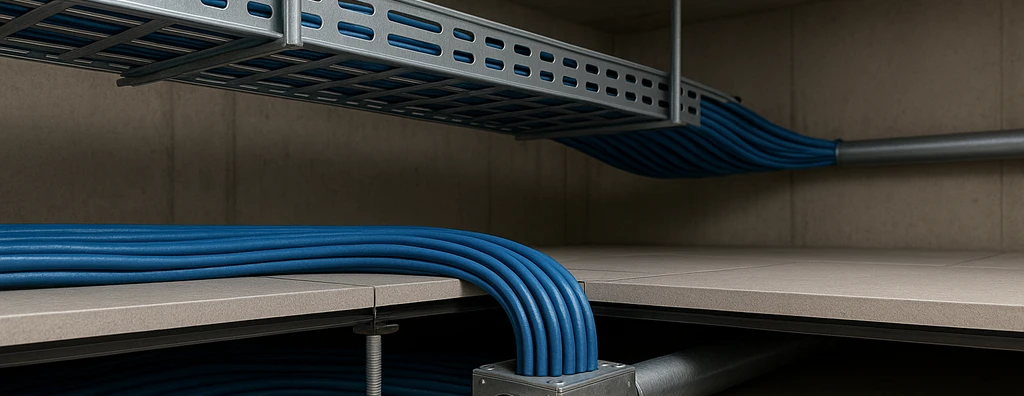
Horizontal cabling is the subsystem responsible for interconnecting the telecommunications room (IDF) to network outlets located in work areas, such as user stations, IP phones, and access points. According to NBR 14565, this cabling must follow clearly defined routes, have a maximum length of 90 meters, and use standardized media such as twisted-pair cables or optical fiber. It is one of the most critical elements of network infrastructure because it concentrates a large portion of the connections that directly affect system stability, performance, and maintainability.
The planning and installation of cable pathways in structured cabling projects require precision in sizing and in selecting physical media in order to ensure the integrity, performance, and long-term viability of the infrastructure throughout the building life cycle.
The proper fill ratio of cable trays, conduits, and ladder trays is essential to preserve cable integrity and the performance of structured cabling. NBR 16415 establishes specific criteria for sizing and occupancy rate in tray and ladder systems intended for communications networks. NBR 5410 addresses conduit occupancy in low-voltage electrical installations, and NBR 14565 complements these requirements by addressing physical routing in structured cabling projects. Failure to comply with these limits can cause constriction, electromagnetic interference, and data transmission failures.
In this article, the technical aspects, calculation criteria, and best practices involved in determining and applying occupancy rates in cable pathways are explored in depth.
The text also covers normative observations, practical examples, and recommendations for correct sizing across different construction alternatives.
Keep reading.
[elementor-template id=”24446″]
Horizontal Cabling: Technical Criteria and Applicable Standards
Horizontal cabling is the structured cabling subsystem responsible for interconnecting the telecommunications room (IDF) to network outlets in work areas. It must be designed and installed in accordance with the requirements defined in NBR 14565 and ANSI/TIA-568.2-D, which establish technical parameters such as:
- Maximum length of 90 meters for the permanent link, not including patch cords or equipment cords;
- Use of balanced twisted-pair cables (Cat5e, Cat6, Cat6A) or optical fiber in specific cases;
- Compliance with the minimum bend radius and the pathway occupancy rate;
- Proper separation from sources of electrical interference (EMI);
- Routing through continuous pathways with maintenance access, preferably using dry infrastructure such as cable trays and raceways.
Horizontal cabling is the most sensitive segment of the network and therefore requires strict attention to grounding, connector quality, and final link certification. Execution that does not comply with the standard may compromise overall network performance, even when active equipment is of high quality.
Occupancy Rate in Cable Pathways
The occupancy rate in cable pathways is technically defined as the ratio between the sum of the cross-sectional areas of the cables to be installed and the usable internal cross-sectional area of the pathway, whether a cable tray, conduit, raised floor, and so on. This ratio is expressed as a percentage, indicating the maximum allowable fill to guarantee accessibility, ventilation, and the physical performance of the infrastructure.
- Technical example: For a conduit, the maximum occupancy rate usually recommended is 40%. This means that the sum of the cross-sectional areas of inserted cables cannot exceed 40% of the conduit’s available internal area.
- Applying this concept avoids excessive cabling, minimizes mechanical stress, and facilitates future interventions, expansions, or maintenance.
- Higher occupancy levels tend to increase temperature, make heat dissipation more difficult, and raise the probability of cable deformation.
Impacts of Occupancy Rate on Performance and Safety
Control of the occupancy rate is vital to sustain system performance, protect the physical integrity of cables, and prevent failures caused by restricted space or increased conductor ambient temperature.
- Mechanical protection: A properly sized cable pathway prevents crushing, insulation ruptures, and excessive slack that can facilitate accidental damage.
- Signal transmission: Excessive fill can induce attenuation, electromagnetic interference, and signal loss, especially in pathways shared with electrical power.
- Future expansion: An occupancy margin should be provided for future growth, reducing the need for rework.
- Ease of maintenance: Cables organized in a pathway sized according to the occupancy rate facilitate routine inspections and interventions without damage.
EMC and EMI in Structured Cabling
Electromagnetic compatibility (EMC) is a critical aspect in the design of horizontal cabling, especially when cables run through trays, ladder racks, and other pathways shared with electrical circuits. The presence of electromagnetic interference (EMI), caused by energized conductors, motors, luminaires, or panels, can degrade the integrity of the signals transmitted by network cables, generating packet loss, instability, or communication failures. To mitigate these effects, NBR 14565 and TIA-569 recommend measures such as the use of separate infrastructures, application of minimum separation distances, shielding (FTP/STP) in the cables, and proper grounding of metallic pathways. EMI control is indispensable to ensure link performance and compliance with structured cabling standards.
Grounding System and Potential Equalization
The grounding system and potential equalization in a structured cabling installation are fundamental to network safety and performance in any type of building.
However, these precautions become especially critical in industrial environments, where the presence of motors, drives, power panels, and intense electromagnetic fields significantly increases the risk of interference and potential differences.
The use of shielded cables, such as STP, FTP, or S/FTP, is recommended to mitigate noise, provided the shielding is correctly grounded. In addition, metallic elements such as cable trays and ladder racks must be integrated into the equipotential bonding system in accordance with the guidelines of NBR 5410 and NBR 16415, ensuring the network’s electromagnetic compatibility, or EMC.
Normative Sizing Criteria: Conduits
For conduits, application of the occupancy rate follows normative parameters that establish strict and direct limits.
Technical procedure:
- Calculate the internal cross-sectional area of the conduit, considering its construction dimensions.
- Sum the cross-sectional areas of each cable to be installed.
- The sum of cable areas must occupy no more than 40% of the conduit’s internal area.
Example table based on standard conduit and cable diameters:
| Conduit | Nominal Diameter (mm) | Max. Qty. of CAT6A (U/UTP) Cables | Max. Qty. of CAT 5e Cables |
|---|---|---|---|
| 1/2″ | 12.7 | 3 | 4 |
| 3/4″ | 19.0 | 5 | 8 |
| 1″ | 25.4 | 8 | 13 |
| 1 1/2″ | 38.1 | 19 | 31 |
| 2″ | 50.8 | 31 | 49 |
These values are subject to the actual dimensions of the cables and conduits and should be treated as indicative examples for design guidance.
Normative Sizing Criteria: Cable Trays and Raised Floors
For cable trays, raceways, and raised floors, the criterion follows the same principle as conduits: the maximum allowable fill is parameterized by the usable internal area, while respecting established limits and the characteristics of the environment.
- The corresponding table sizes the maximum allowable number of cables according to the internal dimensions of the tray or floor, category, and cable construction type.
- Technical example: a 100 mm x 50 mm cable tray may, by way of illustration, accommodate a maximum number of Category 6 cables considering an appropriate occupancy rate and margin for routing and mechanical dissipation.
- It is essential to consider maximum stacking and bundle height as defined in specific normative tables to avoid deformation and facilitate inspection.
Planning, Expansion, and Critical Factors for Cable Pathways
Planning cable pathways involves careful analysis of architectural, usage, and infrastructure variables. The minimum factors normatively highlighted are:
- Existing structures and buildings: Verification of civil compatibility before defining the pathways.
- Expansion capacity: Anticipating future growth already in the design phase by reserving occupancy levels below the normative limit.
- Environment: Consideration of humidity, temperature, mechanical protection, environmental risks, and maintenance access.
- Cable route: Reduction of sharp bends and long routes, while respecting minimum bend radii and minimizing mechanical stress and electrical attenuation.
- System separation: Structured cabling must have dedicated infrastructure separated from electrical circuits, meeting spacing criteria to mitigate electromagnetic interference; sharing is only allowed when barriers are used in compliance with appropriate international IEC standards.
Implementation in Different Scenarios: Underground, Aerial, and Shared
Underground pathways: Excavation depth and the type of cable protection must comply with local regulation and environmental adaptability. Underground environments are usually dry, but may require additional sealing and reinforced protection.
Aerial pathways: The cable route design must ensure that there is no structural overload and that protection exists against weather exposure and external intervention. At multiple crossings, contact between different cables must be avoided and mechanical support limits must be respected.
Shared pathways: Use of the same shaft for structured cabling and electrical power is only permitted in accordance with applicable international IEC standards, and physical separation by barriers plus detailed analysis of electromagnetic interference risks should be prioritized.
Practical References: Technical Tables for Sizing
Safe sizing of cable pathways, whether in conduits, trays, or raised floors, is supported by normative technical tables that specify:
- Standardized pathway dimensions;
- Cable outer diameter according to category, such as CAT 5e, CAT6, CAT6A, CAT7, and so on;
- Maximum quantity allowed by cable type and pathway;
- Restrictions regarding stacking and cable accommodation methods;
Examples of text diagrams and tables must be consulted and applied directly during the design stage, serving as the basis for drafting design reports, execution drawings, and material lists in technical proposals.
Recommendations to Ensure Efficiency and Compliance
To comply with normative requirements and achieve maximum technical efficiency, the following is recommended:
- Always size cable pathways with safety margins, anticipating future growth in installed systems.
- Periodically assess infrastructure for occupancy level and physical condition of the routes.
- Use certified equipment, installation methods, and materials compliant with applicable national and international technical standards.
- Maintain physical segregation between structured cabling and electrical power, adopting mandatory barriers and minimum distances.
- Rigorously document design information, including occupancy calculations, sizing tables, and cable route maps.
Proper sizing of occupancy rates in cable pathways is decisive for ensuring the reliability, durability, and performance of structured cabling infrastructures. Strict application of technical criteria and alignment with the current and future demands of the enterprise result in more efficient interventions, reduced risk of failures, and maintenance of engineering quality standards. For robust projects aligned with best practices, the detailed approach in this article supports sound decisions regarding the selection, implementation, and maintenance of cable pathways in any mission-critical environment or corporate infrastructure.
Relevant Links (Complementary Technical Materials)
Telecommunications Network Design
Structured Cabling Project – Complete Guide
Technical Standards for Structured Cabling
Standard 14565 – Structured Cabling
eBook – Why Hire a Structured Cabling Project?
Fiber Optic Cable
Indoor Optical Distributor (DIO)
Testing and Performance
Network Certification for Structured Cabling Systems
Consulting in Structured Cabling Projects
Structured Cabling Installation
How to Avoid Common Problems in Structured Cabling Systems?
Components and Subsystems
Components of Structured Cabling
Dry Infrastructure / Cable Ladder Tray
Main Benefits of Structured Cabling
Topology and Architecture
Network Architecture and Topology – How to Ensure Performance
Network Topology: Types and Applications in Telecommunications Networks
Services
Normative References
“NBR 14565 – Structured Cabling for Commercial Buildings” – ABNT (Brazilian Association of Technical Standards)
“ISO/IEC 11801 – Generic Cabling for Customer Premises” – ISO/IEC (International Organization for Standardization) & (International Electrotechnical Commission)
“ANSI/TIA 568 – Generic Telecommunications Cabling for Customer Premises” – ANSI/TIA (American National Standards Institute) & (Telecommunications Industry Association)
“What are the structured cabling services and their corresponding technical responsibilities?” – CREA (Regional Council of Engineering and Agronomy)
“Structured Cabling Systems: the Fact File” – CommScope
Frequently Asked Questions
Occupancy rate is the maximum internal fill limit of a conduit, tray, or cable ladder, expressed as a percentage, defined by NBR 16415 and NBR 5410. Respecting this limit avoids overheating, interference, and physical damage to cables, while also ensuring space for future expansions.
A Structured Cabling System, or SCS, is a standardized infrastructure of cables, connectors, racks, cable ladders, patch panels, and network equipment that provides the foundation for a telecommunications network to operate efficiently.
Dry infrastructure is the set of physical elements used to route cables within a building, such as cable trays, conduits, ladder trays, and shafts. It ensures organization, mechanical protection, and proper separation between systems, including data, power, and control, and is essential for network performance and maintenance.
A structured cabling system is designed to meet connectivity needs in corporate, commercial, industrial, and residential environments, providing a reliable, high-performance network.
UTP, or Unshielded Twisted Pair, has no shielding. It is less expensive and used in environments with a low level of interference. STP, or Shielded Twisted Pair, includes shielding that reduces electromagnetic interference and is recommended for industrial environments or areas with high electromagnetic pollution.
The main standards are ABNT NBR 14565 in Brazil, ISO/IEC 11801 internationally, ANSI/TIA-568 in North America, and NBR 16264 for data centers. They define rules for installation, performance, and testing.
Horizontal cabling connects telecommunications outlets to distribution rooms on the same floor, while vertical cabling, or backbone, interconnects different floors or buildings, carrying data between main and floor distributors.
It is the main cabling that connects telecommunications rooms, data centers, or buildings to one another. It normally uses higher-capacity media such as optical fiber or higher-category copper cables.
Electrical engineers, network engineers, telecommunications technicians, network infrastructure designers, and companies specialized in corporate network design and deployment.
A cable ladder tray is used to physically support and distribute network, power, or automation cables in technical environments. It provides ventilation, facilitates inspection, and prevents excessive bends or cable crushing, making it recommended for larger volumes of horizontal cabling or backbone cabling.
