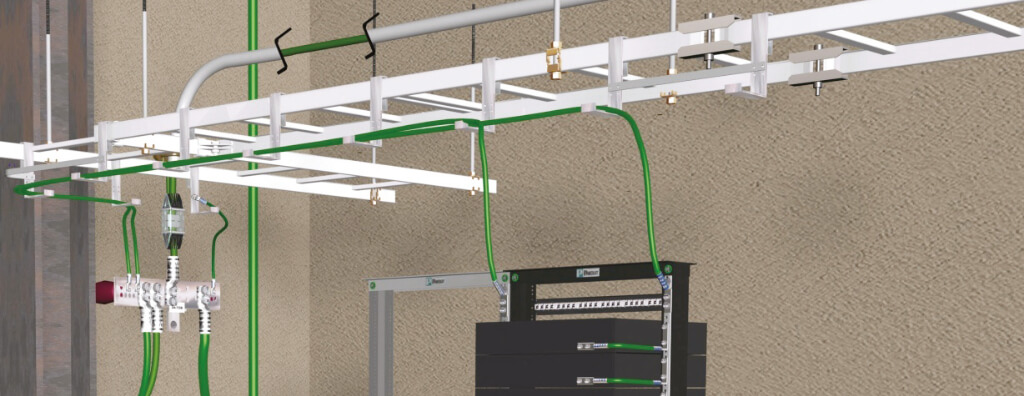
Understand why grounding and equipotential bonding are essential for network infrastructure, equipment protection, operational continuity, and regulatory compliance.
Check it out!
The implementation of grounding and equipotential bonding measures in network infrastructure is essential to ensure proper performance and prevent failures caused by electromagnetic interference, potential differences, and electrical discharges.
In this article, we will address the importance of relying on a specialized engineering company to ensure a safe and reliable system, minimizing operational risks and ensuring compliance with applicable technical standards.
Check it out!
[elementor-template id=”24446″]
Why Must Network Infrastructure Be Grounded and Equipotentially Bonded?
Grounding and equipotential bonding are essential technical requirements to ensure the operational integrity of the data network, minimizing possible failures caused by electrical surges, electrostatic discharges, and electromagnetic interference (EMI).
Equipment Protection
Without an efficient grounding and equipotential bonding system, switches, servers, routers, and storage systems are exposed to voltage variations that can compromise their operation, resulting in intermittent failures and accelerated degradation of electronic components.
The equipotential interconnection of conductive elements in the infrastructure reduces the impact of induced currents and prevents potential oscillations that could interfere with device operation.
Warranty Requirement Compliance
Manufacturers of network equipment often require a grounding and equipotential bonding system compatible with technical specifications as a criterion for warranty validity. Failure to observe these guidelines may result in the loss of coverage for failures caused by overvoltages, electromagnetic interference, and electrostatic discharges.
Proper sizing and installation of these systems ensure compliance with manufacturers’ recommendations, reducing the risk of damage and corrective maintenance costs.
Performance
Communication networks depend on an electromagnetically stable environment to ensure lossless data transmission and continuous equipment operation. The absence of a proper grounding and equipotential bonding system may generate electrical noise, resulting in packet loss, signal degradation, and connectivity failures.
Environments with a high density of electronic equipment require strategically positioned equipotential bonding bars, ensuring electrical potential uniformity and reducing the impact of electromagnetic interference and electrostatic discharges.
Availability
The reliability of network infrastructure depends on the electrical stability of systems. Grounding and equipotential bonding protect against unexpected outages, preventing interruptions caused by electrical faults or inductive couplings that may affect critical equipment.
The correct implementation of these systems reduces downtime caused by electrical disturbances and ensures service continuity, avoiding operational impacts that could compromise productivity and communication in corporate and industrial environments.
Safety
The absence of a proper grounding and equipotential bonding system can create dangerous potential differences between metallic surfaces in the infrastructure, increasing electrical risks for professionals who interact with the network.
Equipotential bonding reduces the risk of electric shocks, preventing metallic masses such as racks, ducts, and distribution panels from presenting different potentials.
In addition, a well-designed grounding system ensures that leakage currents and electrostatic discharges are safely dissipated, protecting both maintenance technicians and system users.
Regulatory Compliance
The implementation of grounding and equipotential bonding in network infrastructure must meet the requirements established by national and international technical standards, as well as applicable regulations, to ensure electrical safety, equipment protection, and operational continuity.
The installation and maintenance of grounding and equipotential bonding systems must follow the criteria defined by the following standards:
- ABNT NBR 5410 – Low-Voltage Electrical Installations
- ABNT NBR 14565 – Telecommunications Cabling for Commercial Buildings
- ABNT NBR 5419 – Lightning Protection Systems (LPS)
- ANSI/TIA-607-B – Grounding and Bonding Requirements for Telecommunications
- ANSI/TIA-568 – Structured Cabling Standard
- IEC 60364 – Electrical Installations of Buildings
- IEEE Std 1100 (Emerald Book) – Grounding and Protection for Sensitive Equipment
Components of the Telecommunications Grounding System
According to TIA-607-B, the telecommunications grounding system must contain the following components:
Telecommunications Main Grounding Busbar (TMGB)
- Central connection point between the telecommunications system and the building grounding system.
- Connected to the BCT (Bonding Conductor for Telecommunications).
Bonding Conductor for Telecommunications (BCT)
- Connects the TMGB to the grounding of the building’s main electrical system.
- Must be sized according to TIA-607-B specifications.
Telecommunications Bonding Backbone (TBB)
- Interconnects multiple grounding bars within a building.
- Reduces potential differences and improves protection against EMI (Electromagnetic Interference).
Telecommunications Grounding Busbar (TGB)
- Used to interconnect equipment and racks within technical rooms.
- Must be connected to the TBB and the TMGB.
Grounding Equalizer (GE)
- Interconnects multiple TBBs in multi-story buildings.
- Maintains uniform electrical potential.
Installation Requirements
Conductor Sizing
The sizing of grounding and equipotential bonding conductors must ensure that system impedance is minimized, reducing voltage drops and allowing the efficient dissipation of leakage currents, electrical surges, and electrostatic discharges.
Connections and Fixing Methods
The connections and terminals used in the grounding infrastructure must ensure low-resistance electrical contact and high mechanical reliability.
Identification and Labeling
The correct identification of grounding system components is essential for maintenance, auditing, and compliance with cabling and electrical safety standards.
Why Hire a Specialized Engineering Company?
The proper implementation of grounding and equipotential bonding in network infrastructure requires advanced technical knowledge and strict compliance with national and international standards.
Relying on a specialized engineering company is essential to ensure that the system is designed, installed, and maintained according to required standards, reducing operational risks and maximizing infrastructure efficiency.
- Protection against Lightning Discharges – Coordination with lightning protection systems.
- Reduction of Electromagnetic Interference – Minimization of EMI and ESD (electrostatic discharge).
- Operational Safety – Reduction of the risk of equipment failures due to electrical potential differences.
- Regulatory Compliance – Assurance of alignment with international standards.
Conclusion
Hiring a specialized engineering company is indispensable for the proper implementation of grounding and equipotential bonding in network infrastructure. In addition to ensuring safety and reliability, specialized technical support guarantees regulatory compliance, protects against interference and electrical discharges, and promotes equipment longevity, reducing maintenance costs and operational risks.
