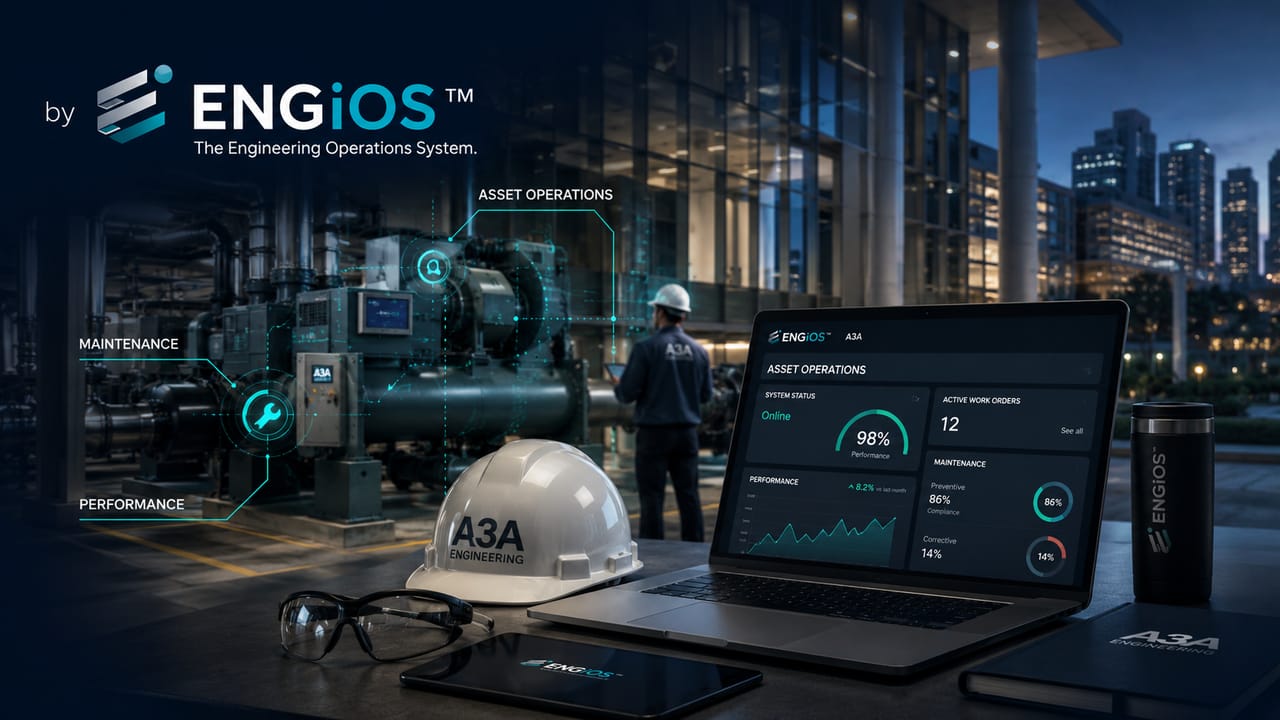
Understand Facility Management in depth: ISO 41001, strategy, hard and soft services, contracts, SLA, assets, maintenance, BIM, CMMS, indicators and implementation.
Check it out!
Facility Management (FM) is the discipline that integrates people, spaces, services, physical assets, technology, and processes so the built environment predictably supports organizational objectives. Its focus is not simply “taking care of the building,” but ensuring that infrastructure and services provide appropriate conditions of safety, continuity, performance, experience, compliance, and cost throughout use.
This definition changes the boundary of the discipline. Building maintenance is part of FM, but it does not exhaust its scope. The facilities manager also needs to deal with contracts, utilities, occupancy, user services, security, documentation, suppliers, operational continuity, sustainability, indicators, budget, changes, data, and interfaces with projects. In critical environments, FM must also integrate availability, redundancy, incident response, and risk-management requirements.
Facility Management performance starts before operations. Poorly defined design requirements, assets delivered without identification, incomplete documentation, lack of maintenance criteria, unintegrated systems, and contracts designed without indicators create costs that only appear after handover. For this reason, mature FM participates in defining requirements, procurement, commissioning, As-Built, and the transition to operations.
A tese central é simples: Facility Management deve ser tratado como sistema de gestão e capacidade operacional, e não como uma soma de contratos terceirizados. Estratégia, política, serviços, ativos, pessoas, informação, tecnologia, fornecedores e indicatores precisam formar uma arquitetura coerente. Quando isso acontece, a organização deixa de reagir a chamados e passa a governar desempenho.
What Facility Management actually manages
ISO 41011 structures the international vocabulary of the discipline, and the ISO 41000 series treats FM as an organizational function that integrates people, place, and processes within the built environment. This helps distinguish the concept from a purely building-oriented or maintenance-oriented view.
From business demand to service delivery
Facility Management existe para responder à demanda da organização usuária. Um hospital, um Data Center, uma indústria, um edifício administrativo e uma universidade não precisam do mesmo nível de disponibilidade, redundância, atendimento ou controle. O escopo de FM deve nascer do que a atividade principal necessita para funcionar.
A useful way to visualize the architecture is to separate five layers:
| Layer | Management question | Examples |
| Business | What does the organization need to preserve or achieve? | continuity, productivity, service, safety, compliance |
| Facilities | What conditions must the built environment deliver? | availability, comfort, environmental quality, capacity, access |
| Services | Which services support these conditions? | maintenance, cleaning, security, utilities, workplace, support |
| Assets and resources | What enables service delivery? | HVAC, power, elevators, staff, suppliers, spares |
| Information and control | How does the organization know whether it is working? | SLA, KPI, CMMS, BMS, inspections, audits, evidence |
This chain is important because it prevents the process from starting with a historical list of contracts. A service should only exist because it supports a relevant business requirement or controls an identified risk.
Facility Management starts with business demand, not the list of contracts. The service portfolio should exist to support outcomes, control risks, and preserve capabilities required by the organization.
Hard services, soft services, and cross-functional management
A divisão entre hard services e soft services é útil para organizar o portfólio, mas não deve virar silo operacional.
| Group | Typical scope | Risk if poorly managed |
| Hard services | electrical, HVAC, plumbing, fire protection, elevators, generators, UPS, automation, physical infrastructure | unavailability, safety, regulatory failure, loss of capacity |
| Soft services | cleaning, reception, landscaping, support, waste, workplace services | degraded experience, hygiene, image, productivity |
| Cross-functional management | contracts, budget, spaces, suppliers, risk, documentation, indicators, changes | low predictability, duplication, decisions without evidence |
The user experiences the integrated outcome. From the user’s perspective, it matters little whether the cause of discomfort lies in the design, the maintenance contract, filter cleaning, the BMS setpoint, or space occupancy. FM needs to coordinate the interfaces so the final outcome is controlled.
Facility Management is not synonymous with Property Management
Property Management usually focuses on the property and real-estate relationship: leases, real-estate contracts, commercial occupancy, revenues, common-area expenses, and property administration. Facility Management focuses on the performance of the environment and the services required for use. In some organizations the functions coexist; in others they are separate.
The same applies to asset management and maintenance. The disciplines are connected, but they have distinct decision centers.
ISO 41000: policy, strategy, sourcing, performance, and improvement
The ISO 41000 family makes it possible to structure FM far more robustly than a service catalog. In 2026, the standards architecture includes documents addressing the management system, strategy, sourcing, organizational behavior, technology, sustainability, and performance.
| Document | Role in the FM architecture |
| ISO 41011:2024 | vocabulary and fundamental concepts |
| ISO 41001:2018 + Amd 1:2024 | requirements for a Facility Management system |
| ISO 41012:2017 | strategic sourcing and development of FM agreements; a new edition is under development |
| ISO/TR 41013:2017 | scope, key concepts, and benefits of FM |
| ISO 41014:2020 | development of the Facility Management strategy |
| ISO 41015:2023 | organizational behavior, users, service providers, and facility outcomes |
| ISO/TR 41016:2024 | overview of technologies available for Facility Management |
| ISO 41018:2022 | development of the Facility Management policy |
| ISO/TR 41019:2024 | FM’s role in sustainability, resilience, and adaptability |
| ISO/TR 41030:2024 | overview of performance-management practices in FM organizations |
Policy, strategy, and operations need to be connected
An organization may have dozens of operational procedures and still lack a coherent FM system. The decision chain should be traceable:
business objectives → FM policy → FM strategy → objectives and risks → operating model → service catalog → contracts and resources → procedures → indicators → management review → improvement.
ISO 41018 helps structure the policy; ISO 41014 deepens strategy development; ISO 41001 establishes requirements for the management system. Connecting these levels prevents FM from becoming merely the execution of routines disconnected from organizational strategy.
Policy, strategy, and operations need to form a traceable decision chain. Local procedures only create value when they are connected to defined objectives, risks, responsibilities, and performance criteria.
Risk should guide priorities
Not all spaces, assets, and services have the same consequence of failure. FM needs to classify criticality considering, as applicable, impacts on people, continuity, production, revenue, compliance, safety, reputation, the environment, and operational capacity.
This logic needs to appear in concrete decisions: spare-parts inventory, redundancy, inspection frequency, SLA level, escalation, contingency plans, maintenance windows, and change approval.
A integration com Engineering Asset Management é particularmente importante porque risco, desempenho e custo competem por recursos limitados. O que recebe prioridade não deve ser definido apenas pelo volume de chamados ou pela percepção do último incidente.
Governance is more important than the organization chart
FM may be internal, outsourced, or hybrid. Regardless of the structure, certain authorities need to be explicit.
| Decision | Typical responsibility to define |
| FM policy and objectives | organizational leadership / sponsor |
| strategy and operating model | FM leadership with business stakeholders |
| service requirements | demand owner + FM |
| service execution | internal team or contracted supplier |
| acceptance and measurement | FM oversight/management |
| technical-standard change | engineering / defined technical authority |
| register and document change | data owner / document owner |
| risk and CAPEX prioritization | multidisciplinary governance |
The job title is less important than actual authority and decision traceability.
Operating model, contracts, SLA, and supplier management
A large part of Facility Management cost and risk lies in how services are designed and contracted. The decision is not simply whether to “outsource or internalize.” It is necessary to define the delivery model, interfaces, accountability for performance, and the information needed to govern the contract.
Make, buy, or hybrid model
| Model | Potential advantages | Main risks |
| In-house | asset knowledge, greater direct control, knowledge retention | fixed structure, difficulty achieving specialization and scale |
| Specialist outsourcing | access to specialists, flexibility, supplier scale | fragmentation, contractual dependency, loss of knowledge |
| Integrated FM | centralized coordination and simplified interfaces | concentration of dependency and need for strong performance governance |
| Hybrid | combines internal strategic functions with outsourced execution | responsibility matrix may become ambiguous if poorly designed |
A ISO 41012 trata sourcing e desenvolvimento de acordos como parte estratégica do FM. O contrato deve traduzir a necessidade do negócio para resultados mensuráveis, responsabilidades, limites, evidências e mecanismos de melhoria.
Service catalog: the basic unit of governance
A well-designed catalog reduces ambiguity among the user, management, and supplier. For each service, the organization should know at least:
- what outcome is expected and what is excluded;
- which areas, assets, or users are covered;
- what service regime and criticality apply;
- which responsibilities belong to each party;
- how the service is measured and accepted;
- how exceptions, emergencies, and escalations are handled.
The catalog prevents the contract from being measured only by hours worked or work-order volume.
SLA, KPI, and operational outcome
SLA, KPI, and user perception measure different things.
| Element | What it measures | Example |
| SLA | service-level commitment | response to a critical alarm within 15 min |
| KPI | process or system performance | availability, backlog, preventive-maintenance compliance |
| Experience indicator | user perception/outcomes | thermal comfort, satisfaction, ease of service |
| Risk indicator | residual exposure or trend | number of overdue critical assets, unavailable contingencies |
| Economic indicator | resource use | cost per m², specific consumption, maintenance cost by class |
Measuring only response time can produce poor behavior. A supplier may respond quickly without eliminating the root cause; close work orders to improve the indicator; or perform many corrective actions and appear productive while reliability worsens.
Meeting the SLA does not prove that the facility is performing well. Governance needs to combine service level, reliability, risk, recurrence, cost, and experience to avoid indicators that reward activity without outcomes.
Management routines need different time horizons
Contract and operations management should work at different rhythms.
| Cadence | Focus |
| real time / daily | alarms, incidents, priorities, unavailability |
| weekly | backlog, preventive work, resources, open items, maintenance-window coordination |
| monthly | SLA/KPI, cost, recurrence, suppliers, risk, action plan |
| quarterly/semiannual | strategy, capacity, renewal, benchmarking, budget, contracts |
| annual | policy, objectives, asset plan, investments, and system improvement |
This cadence turns operational data into medium- and long-term decisions.
Assets, maintenance, reliability, spaces, and sustainability within FM
Facility Management spans different disciplines. Management quality depends on recognizing the boundaries between them and building explicit interfaces.
FM, asset management, maintenance, and reliability
| Discipline | Decision center | Predominant question |
| Facility Management | environment, services, and business support | how can facilities and services remain fit for use? |
| Asset management | value, risk, performance, and lifecycle | how should assets generate value over time? |
| Maintenance Engineering | strategy and execution to preserve function | what should be maintained, how, when, and with which resources? |
| Reliability Engineering | probability of fulfilling the function and controlling failures | which failure modes threaten performance and how can risk be reduced? |
| Property Management | real-estate and property administration | how should the property, contracts, and occupancy be managed from a property perspective? |
A Engenharia de Maintenance executa uma capacidade essencial, mas FM também precisa coordenar espaços, serviços, pessoas, fornecedores e experiência.
Criticality needs to reach the maintenance plan
Critical assets deserve a different policy from low-impact assets. Criticality should influence maintenance strategy, spares, redundancy, inspections, condition, alarms, and operating windows.
The CMMS can automate schedules and work orders, but frequency should not be treated as an immutable rule. History, manufacturer recommendations, legal obligations, failure mode, condition, and performance need to feed plan reviews.
Technical indicators cannot be only activity volume
A mature FM dashboard combines process, outcome, and risk indicators. Useful examples include:
| Dimension | Possible indicators |
| Maintenance | backlog, preventive-maintenance compliance, recurrence, emergency corrective work, MTTR where applicable |
| Availability | unavailability by system, degradation hours, redundancy availability |
| Energy and water | total consumption, specific consumption, baseline deviations, demand and peaks |
| Spaces | occupancy, utilization, capacity, density, churn/changes |
| Contracts | SLA, nonconformities, recurrence, open items, and aging |
| Safety and compliance | overdue inspections, licenses, mandatory tests, critical deviations |
| Users | complaints, recurrence, comfort, satisfaction, and perceived resolution time |
Selection should consider context. An indicator with no associated decision becomes dashboard decoration.
Sustainability is operational
A building that is efficient by design can operate inefficiently for years. Inappropriate setpoints, poorly configured schedules, drifting sensors, equipment operating simultaneously, deficient maintenance, occupancy different from assumptions, and lack of consumption analysis can negate part of the expected performance.
O FM precisa conectar metas de energia, água, resíduos e emissões a rotinas operacionais. O Sustainable Construction article trata a estratégia no ciclo de vida; na operação, o desafio é transformar requisito em medição e ação contínua.
Resilience and continuity need to be tested
Emergency, contingency, and continuity plans cannot exist only as documents. There must be responsible parties, communication, resources, scenarios, recovery procedures, escalation criteria, and periodic tests.
In critical facilities, the ability to maintain service in a degraded condition can be as important as preventing the first failure. This brings FM closer to reliability, risk management, safety, and operations engineering.
Digital architecture: CMMS, CAFM/IWMS, BIM, BMS, IoT, and Digital Twin
Digitalização não significa colocar todas as informações em uma plataforma única. Systems diferentes existem porque executam funções diferentes. A arquitetura precisa definir system of record, identidade dos ativos, integration e governança de dados.
Which system does what
| System | Primary function | Typical information |
| CMMS | maintenance execution and history | assets, plans, work orders, failures, labor, parts |
| EAM | expanded enterprise lifecycle management | assets, capital, risk, finance, maintenance, planning |
| CAFM/IWMS | facilities and workplace | spaces, occupancy, reservations, contracts, services, portfolio |
| BMS | building automation and supervision | sensors, commands, setpoints, alarms, sequences |
| EPMS/EMS | energy and electrical/energy performance | measurements, demand, quality, consumption, alarms |
| DCIM | Data Center physical infrastructure | capacity, racks, power, thermal conditions, connectivity, assets |
| BIM/AIM | structured technical and spatial context | geometry, location, properties, documents, relationships |
| IoT/analytics | condition data acquisition and analysis | telemetry, trends, anomaly detection |
| ERP | corporate processes | procurement, inventory, finance, contracts, cost centers |
| GED/CDE | document governance and controlled information | documents, versions, revisions, approval, history |
Integration should reduce duplication and rework. The same equipment cannot be “AHU-01” in BIM, “UTA-001” in CMMS, “AHU_1” in BMS, and have a different asset code in ERP without an explicit mapping rule.
Digital integration starts with identity and data ownership, not with the API. Before connecting platforms, it is necessary to define taxonomies, identifiers, systems of record, and authority to change each information class.
Master data comes before integration
Before building APIs and dashboards, FM needs to organize fundamental data: site, building, floor, space, system, asset, tag, class, criticality, manufacturer, model, serial number, warranty, documentation, maintenance plan, and functional relationships.
No CMMS, governança deve existir antes da configuração. Sem ownership de dados e taxonomias estáveis, a organização automatiza inconsistência.
BMS and IoT should not generate an avalanche of work orders
Automation systems generate large volumes of events. Turning every alarm into a work order degrades the process. Integration needs to add context: persistence, criticality, equipment state, priority, suppression, correlation, window, and opening criteria.
The role of BMS/IoT is to report state and enable control; the CMMS remains the maintenance execution system when that architecture makes sense. Analytics or a Digital Twin may produce diagnoses or recommendations, but action governance needs to remain traceable.
BIM 7D and AIM: operations start before handover
Much of the operational information originates during design, procurement, installation, and commissioning. Manufacturer, model, serial number, warranty, installation date, documentation, parameters, tests, and spares should not need to be mannually reconstructed after handover.
BIM 7D e o Asset Information Model podem estruturar contexto, mas não substituem os sistemas operacionais. COBie pode apoiar uma transferência estruturada; CMMS/CAFM/IWMS executam processos; BMS fornece estado; o AIM preserva contexto de informação do ativo.
O ponto crítico é o handover: a operação precisa participar da definição do que será entregue e do aceite dessa informação.
How to implement, mobilize, and accept a Facility Management system
Implementing FM should not begin with hiring a supplier or selecting software. The first step is to understand what the business requires from the facility and which risks need to be governed.
Recommended implementation process
- Define objectives and expected outcomes. Translate business needs into availability, safety, experience, sustainability, capacity, and cost.
- Map facilities, spaces, systems, and stakeholders. Define physical scope, users, interfaces, and obligations.
- Establish the baseline. Survey asset condition, current contracts, performance, costs, data, documentation, and key risks.
- Classify criticality. Differentiate systems and services by consequence of failure.
- Define FM policy and strategy. Establish principles, priorities, decision criteria, and organizational alignment.
- Design the operating model. Define what will be in-house, outsourced, integrated, or specialist.
- Structure the service catalog. Turn needs into measurable scopes with boundaries and responsibilities.
- Define SLA, KPI, and evidence. Link service commitments, indicators, risk, and experience.
- Organize assets, spaces, and information. Define taxonomies, identifiers, ownership, and systems of record.
- Integrate maintenance, reliability, and continuity. Review plans, spares, contingencies, and response strategy.
- Define the digital architecture. Select CMMS/CAFM/IWMS/BMS/BIM and integrations based on processes.
- Prepare mobilization and transition. Transfer contracts, access credentials, passwords, documents, histories, open items, and resources.
- Train by role. Operators, maintainers, managers, suppliers, and users need different training.
- Test end-to-end scenarios. Requests, failures, emergencies, escalations, documents, work orders, dashboards, and integrations.
- Operate with assisted support. Support the initial phase, stabilize processes, address deviations, and consolidate autonomy.
- Implement management review and continual improvement. Use operational data to correct contracts, processes, projects, and lifecycle decisions.
FM maturity can be assessed by capability, not by the number of documents
A tabela abaixo é uma referência prática de diagnóstico — não uma escala normativa da ISO.
| Stage | Characteristic | Typical sign |
| Reactive | urgency-driven management | corrective work, scattered information, person-dependent decisions |
| Controlled | minimum processes and defined responsibilities | plans, asset register, contracts, and basic indicators |
| Integrated | coordinated services, assets, data, and suppliers | shared risk view, dashboards, and integrated workflows |
| Optimized | value- and evidence-based decisions | predictive analysis, continual review, learning, and lifecycle planning |
Maturity is not the number of procedures. A mature organization can explain priorities, retrieve evidence, anticipate risk, measure outcomes, and learn from occurrences.
Mobilization needs to be treated as a project
Supplier replacement or entry into operations is a high-risk phase. The organization needs to control the transfer of knowledge, personnel, access, tools, licenses, contracts, spares, documents, backlog, warranties, plans, data, and responsibilities.
A Assisted Operations deve produzir autonomia, não dependência. Seu encerramento não deveria ocorrer apenas porque o prazo contratual terminou, mas porque a organização demonstra estabilidade, documentação e capacidade operacional suficiente.
Acceptance must prove operational capability
An FM implementation should not be accepted because “the dashboard is ready” or because “all assets have been registered.” Acceptance needs to verify real processes.
| Acceptance scenario | Expected evidence |
| critical request | traceable record, priority, SLA, escalation, and closure |
| asset failure | correct identification, diagnosis, work order, resources, evidence, and history |
| preventive maintenance | valid plan, scheduling, execution, evidence, and deviation treatment |
| emergency | tested procedure, communication, responsibilities, and recovery |
| technical document | correct asset linked to the current document and accessible to the team |
| integration | data reconciled across systems without duplication or material loss |
| configuration change | approval, execution, testing, rollback where applicable, and document update |
| indicator | defined formula, source, owner, frequency, and associated action |
O Commissioning in Engineering demonstra por testes que sistemas e interfaces atendem aos requisitos. O FM assume a continuidade desse desempenho em operação. Por isso, comissionamento, handover, operação assistida e Facility Management devem formar uma sequência técnica coerente.
Facility Management acceptance should test end-to-end operations. Registers, contracts, and dashboards are means; what needs to be demonstrated is the ability to respond, execute, record, escalate, retrieve information, and learn from real operations.
Main implementation failures
The most frequent problems are not caused by a lack of software. They are management-architecture failures:
- outsource without defining demand and service criteria;
- implement CMMS/IWMS before organizing processes and data;
- measure activity volume instead of outcomes and risk;
- leave operations out of design, procurement, and commissioning;
- maintain incompatible tags and hierarchies across systems;
- complete mobilization without testing operational scenarios.
O resultado esperado de um bom sistema de Facility Management é previsibilidade. A organização conhece seus serviços, ativos, riscos, responsabilidades, custos, dados e desempenho cedo o suficiente para agir antes que a facility comprometa o negócio.
Technical references
[1] INTERNATIONAL ORGANIZATION FOR STANDARDIZATION. ISO 41011:2024 — Facility management — Vocabulary. Geneva: ISO, 2024.
[2] INTERNATIONAL ORGANIZATION FOR STANDARDIZATION. ISO 41001:2018 — Facility management — Management systems — Requirements with guidance for use. Geneva: ISO, 2018.
[3] INTERNATIONAL ORGANIZATION FOR STANDARDIZATION. ISO 41001:2018/Amd 1:2024 — Climate action changes. Geneva: ISO, 2024.
[4] INTERNATIONAL ORGANIZATION FOR STANDARDIZATION. ISO 41012:2017 — Facility management — Guidance on strategic sourcing and the development of agreements. Geneva: ISO, 2017.
[5] INTERNATIONAL ORGANIZATION FOR STANDARDIZATION. ISO/TR 41013:2017 — Facility management — Scope, key concepts and benefits. Geneva: ISO, 2017.
[6] INTERNATIONAL ORGANIZATION FOR STANDARDIZATION. ISO 41014:2020 — Facility management — Development of a facility management strategy. Geneva: ISO, 2020.
[7] INTERNATIONAL ORGANIZATION FOR STANDARDIZATION. ISO 41015:2023 — Facility management — Influencing organizational behaviours for improved facility outcomes. Geneva: ISO, 2023.
[8] INTERNATIONAL ORGANIZATION FOR STANDARDIZATION. ISO/TR 41016:2024 — Facility management — Overview of available technologies. Geneva: ISO, 2024.
[9] INTERNATIONAL ORGANIZATION FOR STANDARDIZATION. ISO 41018:2022 — Facility management — Development of a facility management policy. Geneva: ISO, 2022.
[10] INTERNATIONAL ORGANIZATION FOR STANDARDIZATION. ISO/TR 41019:2024 — Facility management’s role in sustainability, resilience and adaptability. Geneva: ISO, 2024.
[11] INTERNATIONAL ORGANIZATION FOR STANDARDIZATION. ISO/TR 41030:2024 — Facility management — Existing performance management in facility management organizations — State of the industry. Geneva: ISO, 2024.
[12] INTERNATIONAL ORGANIZATION FOR STANDARDIZATION. ISO 55000:2024 — Asset management — Vocabulary, overview and principles. Geneva: ISO, 2024.
[13] INTERNATIONAL ORGANIZATION FOR STANDARDIZATION. ISO 19650-3:2020 — Information management using BIM — Operational phase of the assets. Geneva: ISO, 2020.
Frequently asked questions
Facility Management is the discipline that integrates people, spaces, services, assets, technology, and processes so the built environment supports organizational objectives with safety, continuity, performance, experience, and controlled cost.
No. Maintenance is one of FM’s capabilities. Facility Management also covers contracts, spaces, utilities, user services, security, documentation, suppliers, indicators, sustainability, continuity, and governance.
ISO 41001 establishes requirements for a Facility Management system. In 2026, the published edition is ISO 41001:2018 with Amendment 1:2024, while a new edition is under development.
Hard services are linked to physical and technical systems such as electrical systems, HVAC, and elevators. Soft services cover support services for the environment and users, such as cleaning, reception, and workplace services. FM needs to coordinate both.
Facility Management focuses on the environment and services required by the business. Asset management focuses on realizing value through assets by balancing performance, risk, and resources throughout the lifecycle.
CMMS is maintenance-oriented; CAFM and IWMS typically cover a broader view of facilities, spaces, workplace, services, and portfolio. The choice depends on use cases and the information architecture.
An SLA establishes a service-level commitment. A KPI measures the performance of a process, system, or outcome. They should be complemented by risk, cost, and experience indicators where relevant.
Yes. Operational requirements influence design, specifications, procurement, commissioning, As-Built, asset data, and handover. Involving operations only at the end increases rework and information gaps.
It depends on the asset, but typically includes identification, location, criticality, manufacturer, model, serial number, warranty, documents, parameters, test results, maintenance plans, spares, and responsible parties.
Acceptance should test operational capability in real scenarios: requests, failures, preventive maintenance, emergencies, documents, integrations, indicators, escalations, and data updates. The existence of registers and dashboards is not sufficient.
Additional technical resources
Strategy, assets, and maintenance
- ISO 55000 and Asset Management
- Engineering Asset Management
- Engenharia de Maintenance
- Reliability Engineering e Availability
- CMMS: maintenance management system, BIM, and assets
Data, BIM, and digital operations
- BIM 7D: operations, maintenance, Facility Management, and asset management
- PIM and AIM in BIM
- COBie in BIM
- Digital Twin
- BIM Information Management and ISO 19650
- CDE BIM
- Internet of Things (IoT)
- DCIM, BMS, and EPMS in Data Centers
- Systems Integration, APIs, and Connectors
- Document Governance and Document Management System
Transition, commissioning, and acceptance
- Commissioning in Engineering
- Assisted Operations in Engineering
- Assisted Operations
- Acceptance Criteria in Engineering