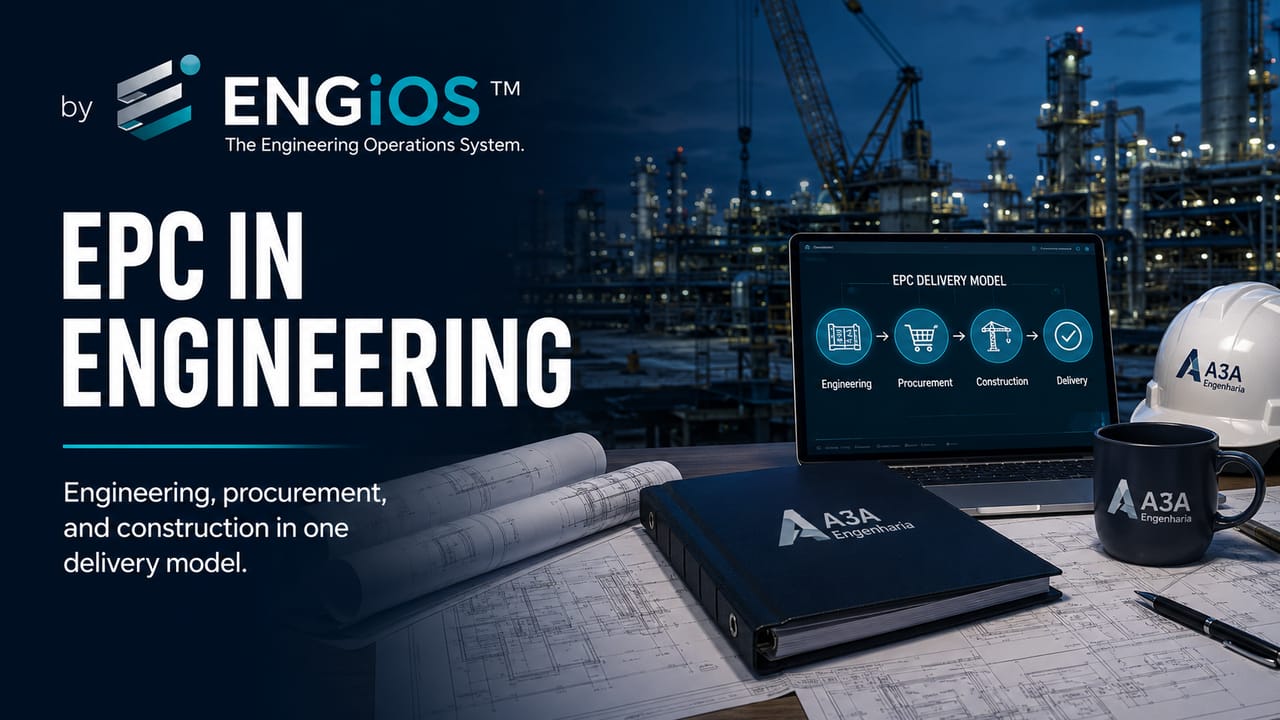
Understand what EPC means in Engineering, how Engineering, Procurement and Construction work as an integrated delivery model, what EPC solves, and which responsibilities remain with the owner.
Check it out!
EPC in Engineering is a delivery model in which one company assumes integrated responsibility for Engineering, Procurement and Construction — engineering, procurement, and construction — within the limits defined by contract. The core logic is not simply to place design, purchasing, and construction under the same company. The objective is to concentrate the project’s technical, commercial, and execution coordination within a contractual structure capable of turning owner requirements into a completed, integrated, tested installation fit for its intended use.
In practice, EPC seeks to reduce fragmentation among designers, suppliers, and contractors. The main contractor develops or coordinates engineering, specifies and procures materials and equipment, manages manufacturing and logistics, performs or subcontracts construction, integrates systems, conducts completion and commissioning stages, and delivers the required physical and documentary products. The exact extent of these responsibilities depends on the contract, owner requirements, reference engineering, risk matrix, supply boundaries, and performance and acceptance criteria.
For this reason, EPC should not automatically be understood as synonymous with fixed price, full risk transfer, or a turnkey contract. These elements may exist, but they need to be expressly structured. A well-defined EPC combines a technically mature scope, traceable responsibilities, defined interfaces, change-control mechanisms, quality requirements, objective testing criteria, and governance capable of verifying whether the obligation to deliver the required result is actually being fulfilled.
What EPC Means in Engineering
The acronym EPC stands for Engineering, Procurement and Construction. Each term represents a different dimension of the project, but the model’s value lies in their integration. The EPC contractor should not treat engineering, procurement, and construction as independent departments that merely follow one another. Engineering needs to generate information suitable for Procurement; Procurement needs to preserve engineering requirements and deadlines; construction needs to receive materials, documents, and releases at the right time; and commissioning needs to be planned from the beginning so that the installation can be verified and accepted at the end.
This integration differentiates EPC from a sequence of disconnected contracts. When the owner separately contracts design, supply, and construction, each company is primarily responsible for its own package and interfaces remain largely under owner management. In EPC, a significant share of these interfaces is internalized by the main contractor, which becomes responsible for overall coherence within the established boundaries.
The EPC project is therefore an integrated cycle: requirements become engineering, engineering becomes requisitions and procurement packages, equipment and materials become an installation, and the installation must demonstrate performance, documentation, and operational readiness before acceptance.
Engineering: The Project Engineering Function
The Engineering dimension begins before drawing detailing. It includes interpretation of owner requirements, validation of design bases, collection of input data, studies, calculations, architecture definition, specifications, design reports, equipment lists, design criteria, and multidisciplinary coordination. In complex projects, it also includes requirements management, interfaces, configuration, and technical review of manufacturer information.
Engineering needs to be developed with a clear operational purpose. A drawing may be graphically correct and still be insufficient for procurement, construction, testing, or operation. For this reason, EPC should establish document maturity states: issued for review, approved, released for procurement, released for construction, revised according to manufacturing, and consolidated As-Built, according to the adopted governance.
The Requirements Management in Engineering is particularly relevant because it makes it possible to trace the origin of each requirement to the document, equipment, test, or evidence that will demonstrate compliance. Without this traceability, the contract may concentrate responsibility on the EPC contractor, but the owner will still have difficulty objectively verifying the result.
In more complex projects, engineering also needs to control interfaces. Equipment is not just a purchased item: it has electrical supply, civil foundation, communications, drainage, ventilation, automation, access, maintenance requirements, and integration with other subsystems. Omitting an interface during Engineering often reappears in the field as rework, change, delay, or contractual dispute.
Procurement: Procurement Integrated with Engineering
Procurement is broader than issuing purchase orders. In the EPC context, it involves turning specifications and requirements into contractable packages, identifying capable suppliers, requesting proposals, technically equalizing alternatives, negotiating commercial terms, issuing orders, monitoring manufacturing, reviewing vendor data, expediting schedules, inspecting critical items, coordinating logistics, and managing warranties and documentation.
The link between Engineering and Procurement is the technical requisition. The Technical Requisition in Engineering needs to contain sufficient data for different suppliers to understand the same need and be compared on equivalent bases. When the package is vague, each supplier interprets the scope differently and apparent price competition loses technical meaning.
The procurement stage also controls schedule risks. Long-manufacturing, imported, or approval-dependent equipment may become long lead items and determine the project’s critical path. Identifying these items early makes it possible to advance inquiries, approve vendors, and release data without compromising engineering coherence. The article on Long Lead Items in Engineering Projects examines this relationship among schedule, information, and Procurement in greater depth.
Another point is quality. Procurement is technically complete only when the received item corresponds to what was specified and has sufficient evidence. Inspection plans, certificates, tests, approved datasheets, FAT reports, deviation lists, and manufacturing documentation may form part of the process. The Quality Management in Procurement addresses the layer that prevents manufacturing deviations from simply being transferred to the jobsite.
Construction: Construction, Erection, and Integration
Construction includes mobilization, field execution planning, work-front release, civil works, electromechanical erection, system installation, quality control, inspections, intermediate tests, nonconformity management, preservation, technical cleaning, completion, and preparation for commissioning.
Construction in EPC cannot be evaluated only by physical progress. A high percentage of installation may hide a large volume of pending items, missing documentation, unperformed tests, or incomplete interfaces. Management should therefore distinguish installed progress, inspected progress, system completion, punch list, readiness for energization, and readiness for commissioning.
The QA/QC in Engineering Construction provides the logic for handling inspections, records, NCRs, and acceptance. The objective is not to create document bureaucracy, but to produce evidence that anything to be concealed, energized, pressurized, or integrated has been verified before progressing to a condition that is difficult to correct.
In EPC, construction also needs to be organized by systems and subsystems, not only by disciplines. A project may have civil, electrical, telecommunications, electronic security, and automation work individually complete and still not be operational because the interfaces among them have not been verified. This transition from discipline-based progress to functional readiness is one of the critical points before commissioning.
EPC Is Not Just Design Plus Construction
The expression “design and construction” is insufficient to describe EPC because it omits the commercial, logistics, documentary, and functional integration that occurs among phases. Two contracts may have similar physical scopes and distribute responsibilities in completely different ways.
In conventional contracting, the owner may hire a designer, then directly purchase major equipment, and finally hire a construction or installation contractor. If equipment does not fit the planned space, if available power is incompatible, or if a requirement was not correctly transferred to the supplier, the owner needs to identify where the interface failed and coordinate its correction.
In EPC, the tendency is for these internal interfaces to belong to the main contractor. This does not eliminate all disputes: incorrect data supplied by the owner, requirement changes, unforeseen conditions, or external interfaces may remain outside the EPC contractor’s responsibility. The gain lies in reducing fragmentation where integration can be managed by a single organization.
The difference becomes clearer when we examine the evidence chain. A complete EPC does not end when the construction “looks finished.” It needs to demonstrate that requirements were converted into engineering, that equipment meets specifications, that the installation was executed and inspected, that tests were completed, that pending items were addressed, that documentation was consolidated, and that required performance was achieved.
| Question | Fragmented contracting | Integrated EPC |
| Who coordinates design, procurement, and execution? | Primarily the owner | EPC contractor, within scope |
| Who manages internal interfaces? | Owner + multiple contractors | EPC contractor and its supply chain |
| Who purchases equipment? | Owner or separate contracts | Normally the EPC contractor |
| Who is responsible for functional integration? | Distributed | More concentrated |
| Who consolidates documentation and tests? | Owner coordinates multiple sources | EPC contractor must deliver the contracted package |
| Does the owner stop governing? | No | Also no |
This logic explains why EPC contracting needs to be prepared as a technical and contractual system, not merely as hiring a contractor at a lump-sum price.
How Integrated Responsibility Works in EPC
Integrated responsibility means that the EPC contractor assumes a coordinated set of obligations and is responsible for compatibility among its own engineering, procurement, and construction decisions. The owner, in turn, defines requirements, provides information under its responsibility, manages external interfaces, approves the items provided for in the contract, and verifies the result.
The appropriate way to represent this relationship is through a combination of responsibility matrix, interface matrix and risk matrix. The first defines who performs, approves, provides information, or accepts. The second identifies technical boundaries among systems, disciplines, third parties, and existing assets. The third defines who bears the economic and schedule consequences of each event.
Responsibility for Interfaces
Interfaces are points where two obligations, systems, or organizations meet. They may be physical, functional, documentary, contractual, or time-based. Examples include connecting EPC-supplied equipment to existing owner infrastructure, integrating third-party software, interfacing civil works with electromechanical erection, or utility power availability.
A poorly defined interface can generate the classic “not in my scope” problem. To avoid this, EPC needs to record supply boundaries and responsibilities on each side. When the interface depends on third parties, there should also be a plan for required dates, input data, approvals, and contingencies.
The Interface Management in Engineering Projects is an important mechanism in multidisciplinary projects because it turns implicit boundaries into controllable items. In EPC, this allows correct separation between what should be absorbed by the main contractor and what requires owner action.
Responsibility for the Result
The obligation to deliver a result needs to be measurable. Generic expressions such as “deliver the system working” are inadequate when performance can be translated into capacity, availability, power, efficiency, flow rate, latency, coverage, autonomy, reliability, redundancy level, or another technical indicator.
The contract should link each performance requirement to a verification method. In some cases, the result is demonstrated through document inspection; in others, through FAT, SAT, functional testing, integrated testing, or performance testing under specified conditions. The absence of this link makes acceptance subjective and increases dispute risk.
The Requirements, Evidence, and Acceptance-Criteria Management solution is directly related to this problem: the requirement needs an owner, verification method, evidence, and acceptance decision.
How an EPC Project Works Throughout the Implementation Lifecycle
An EPC is not a rigid sequence in which all engineering finishes before any procurement and all procurement finishes before construction. Real projects have controlled overlap among activities. The challenge is to release each package with enough maturity not to transfer excessive uncertainty to the next phase.
The cycle normally begins with consolidation of requirements, site data, interfaces, and reference engineering. The EPC contractor then develops the engineering needed to release Procurement packages and construction fronts. Vendor data returns to engineering, which needs to incorporate actual dimensions, loads, connections, and characteristics of purchased equipment. In parallel, preliminary works may proceed according to approved documents.
As physical installation approaches completion, management logic changes. The control unit is no longer only the drawing or discipline and begins to include systems and subsystems. Construction tests, inspections, and completion feed readiness for pre-commissioning. Energization, start-up, functional tests, integrated tests, and performance then follow. The article on Commissioning of Construction and Buildings shows how this transition needs to be planned before the end of construction.
Finally, delivery requires document consolidation. As-Built documentation, manuals, certificates, reports, equipment lists, warranties, training, maintenance plans, and test records need to represent the actual delivered condition. The Technical Handover Framework for Construction and Systems examines the structured transition from implementation to operations in greater depth.
To understand this flow in greater detail, the content on EPC Project: From Engineering to Delivery specifically addresses the stages and deliverables of the lifecycle.
When EPC Is Commonly Used
EPC is particularly useful when there is value in concentrating interfaces and assigning a main integrator responsibility for coordinated delivery. This often occurs in industrial plants, energy, infrastructure, critical systems, data centers, utilities, automation, telecommunications, electronic security, and multidisciplinary modernization projects.
Suitability, however, depends less on the sector and more on project configuration. A project may be large and still not be suitable for EPC if the scope is highly uncertain or if the owner wants to directly contract major suppliers. Likewise, a smaller project may benefit from EPC when integration and performance are more relevant than physical volume.
Favorable situations include:
- performance requirements that can be specified and tested;
- numerous internal interfaces among engineering, equipment, and erection;
- an owner seeking to reduce direct execution contracts;
- a market with companies capable of integrating the package;
- need for a clearly identifiable primary responsibility;
- scope mature enough to be priced;
- a schedule that benefits from coordination among engineering, procurement, and construction;
- need to consolidate documentation, testing, and handover under a single governance structure.
EPC can also be used in retrofit and brownfield projects, but in these cases the risk of existing conditions requires additional attention. Field surveys, inspections, As-Built documentation, and interfaces with operations need to reduce uncertainties before risk allocation. If the contractor is required to price unknown conditions, the response may be higher contingency, broad exclusions, or claims during execution.
What EPC Solves for the Owner
The main problem EPC seeks to solve is fragmentation of responsibility. When each part of the project is contracted separately, the owner assumes the role of technical and contractual integrator. This may be appropriate when a strong internal structure exists, but it can also consume substantial coordination capacity and create gray areas among contracts.
EPC seeks to concentrate four recurring problems:
- Compatibility between engineering and supply: the designer needs to account for the actual characteristics of selected equipment.
- Compatibility between supply and installation: materials and equipment need to arrive with accessories, interfaces, documentation, and conditions suitable for installation.
- Coordination between execution and integration: different disciplines and subcontractors need to produce a functional system, not merely isolated completed services.
- Delivery consolidation: tests, documents, pending items, warranties, and performance need to converge on an objective acceptance criterion.
This does not mean the owner can disappear from the project. The model changes the nature of the owner’s role: from direct coordinator of multiple contractors to requirements setter, contract administrator, manager of external interfaces, and independent verifier of the result.
The Owner’s Engineering is frequently used to perform this role on behalf of the owner, preserving technical governance without assuming the EPC contractor’s responsibilities.
When the main project difficulty lies in fragmentation among design, procurement, installation, and integration, EPC can concentrate responsibilities and reduce gray areas among contracts. This concentration delivers value only when requirements, boundaries, and delivery criteria are clearly defined by the owner.
Does EPC Mean a Fixed Price?
No. EPC describes a responsibility structure; it does not by itself determine the compensation model. An EPC contract may use lump-sum pricing, unit prices, reimbursable portions, allowances, incentives, adjustments, variation formulas, or combinations of these mechanisms.
Lump-sum pricing is common in EPC because the owner often seeks predictability and transfers controllable risks to the contractor. However, predictability exists only when the pricing basis is technically understandable. If quantities, site conditions, interfaces, or requirements are undefined, the contractor will need to adopt assumptions and contingencies. These assumptions become as important as the number presented in the proposal.
The owner should analyze what the price actually covers:
| Element | Verification question |
| Engineering | Are all required documents and revisions included? |
| Equipment | Which brands, performance levels, and accessories are included? |
| Logistics | Are freight, insurance, importation, and storage included? |
| Construction | Are mobilization, support equipment, and tests included? |
| Risks | Which events were priced and which are excluded? |
| Commissioning | Are start-up, integrated tests, and performance included? |
| Documentation | Are As-Built documentation, data books, manuals, and training included? |
| Warranties | Which obligations remain after acceptance? |
The analysis of EPC Contracts in Engineering examines pricing, payment milestones, risks, performance, and acceptance in greater depth.
Does EPC Transfer All Risks to the Contractor?
No. No contractual model eliminates risk; it only identifies, allocates, controls, and prices it. Transferring a risk to a party that cannot control it may increase contract cost without improving the outcome.
Risks related to detailed engineering, subcontractor coordination, construction productivity, and logistics under the EPC contractor’s control may be allocated to it. Conversely, owner-requested changes, area unavailability, incorrect information provided by the owner, utility interference, permits under the owner’s responsibility, or exceptional events may remain wholly or partially with the owner.
Allocation should consider three questions:
- Who is best positioned to prevent the event?
- Who can reduce its consequences?
- Who can rationally estimate and price the risk?
The risk matrix should be connected to the scope and change process. Otherwise, the contract may state that a given risk belongs to the EPC contractor while the technical documents leave the event outside its ability to control.
The Engineering Contracting Strategy helps compare delivery models and risk allocation before deciding on EPC.
Are EPC and Turnkey the Same Thing?
The terms are related but not necessarily identical. EPC describes integration of Engineering, Procurement and Construction. Turnkey emphasizes the delivery condition: a project or system sufficiently complete to be handed over to the owner according to its intended function.
It is possible to structure an EPC with a strong turnkey obligation, including performance, commissioning, training, documentation, and operational readiness. It is also possible to use the term EPC in contracts whose scope ends before certain final activities. The contract title therefore does not replace reading the actual obligations.
In the market, EPC and Turnkey are often combined because integration of the three dimensions supports a functional-delivery obligation. Even so, the owner should verify whether the contract includes:
- functional and performance requirements;
- system integration;
- completion and punch list;
- pre-commissioning and commissioning;
- performance tests;
- training and documentation;
- spares and special tools, where applicable;
- acceptance criteria and warranty period.
The article on EPC Turnkey in Engineering specifically develops this turnkey-delivery obligation.
EPC and EPCM Follow Different Logic
EPCM stands for Engineering, Procurement and Construction Management. The EPCM company acts as an engineering and management service provider, while supply and construction contracts usually remain directly with the owner. This significantly changes risk allocation and the owner’s ability to intervene.
In EPC, the main contractor integrates its chain of designers, suppliers, and contractors and is responsible for the contracted package. In EPCM, integration is performed through management: the owner retains the contracts and uses a specialized company to coordinate engineering, Procurement, construction, cost, schedule, and interfaces.
For this reason, EPCM normally offers greater cost transparency and flexibility to divide the project into packages, but requires greater decision-making and contractual capability from the owner. EPC tends to concentrate responsibility and reduce direct contractual interfaces, but later changes may become more expensive once price and schedule have been committed.
The comparison EPC vs. EPCM should be used when the main question is choosing the implementation model rather than understanding EPC by itself.
What the Owner Needs to Define Before Contracting EPC
The quality of an EPC is limited by the quality of the definition that precedes it. Contracting “integrated responsibility” without establishing requirements, boundaries, and evidence transfers ambiguity, not responsibility. The owner needs to prepare a basis that allows the market to understand the same scope and price comparable risks.
Owner Requirements
Owner requirements describe what the project needs to achieve. They should combine functional, technical, capacity, performance, safety, availability, maintenance, integration, documentation, and operational requirements.
Vague requirements such as “modern system,” “high availability,” or “first-class materials” do not create verifiable criteria. Whenever possible, the requirement should include a condition, metric, and verification method. The Requirements Management in Engineering is useful for establishing this traceability.
Reference Engineering
Reference engineering reduces the gap between need and contracting. Depending on complexity, it may involve a needs program, concept development, studies, field surveys, preliminary design, Basic Design, or FEED.
The FEED in Engineering is particularly relevant in industrial or multidisciplinary projects because it allows design bases, alternatives, major equipment, interfaces, estimates, and implementation strategy to mature before detailed engineering is transferred to the EPC contractor.
Reference engineering should not detail the solution so extensively that it removes all optimization capability from the EPC contractor unless this is a deliberate owner decision. The balance is to specify the result, constraints, and interfaces sufficiently while clearly defining the technical freedom allowed.
Supply Boundaries
Battery limits and supply boundaries define where EPC responsibility begins and ends. They need to be described in documents, drawings, interface lists, and responsibility matrices.
For each boundary, it is advisable to record:
- delivery condition of the interface point;
- party responsible for terminal material or equipment;
- data each party must provide;
- required dates;
- required tests;
- responsibilities for energization, connection, and release;
- condition under which the interface is considered accepted.
Performance and Acceptance Criteria
Acceptance criteria need to be defined before contracting, not at the end of construction. Otherwise, the owner and EPC contractor may work with different concepts of “complete.”
It is advisable to build a verification chain that includes approved documents, inspections, FAT, installation tests, completion, SAT, commissioning, integrated tests, performance, and final documentation according to the nature of the project.
The Technical Acceptance in Engineering Projects helps separate physical execution from contractual acceptance and shows why acceptance needs to consider deliverables and evidence, not merely the presence of equipment on site.
The EPC Contracting in Engineering examines RFP preparation, prequalification, TBE, equalization, negotiation, and award in greater depth.
How to Control an EPC without Taking Responsibility Away from the Contractor
A recurring owner mistake is to oscillate between two extremes: abandoning governance because “the EPC contractor is responsible” or interfering in every decision to the point of effectively assuming the engineering that should remain the contractor’s responsibility.
Proper governance defines control points. The owner verifies whether requirements, risks, and interfaces are being addressed but avoids replacing the EPC contractor’s design obligation. This can be done through submittals, design reviews, interface meetings, release gates, inspections, audits, Procurement follow-up, schedule verification, and attendance at critical tests.
Owner approval of a drawing should not automatically be interpreted as transfer of engineering responsibility unless specifically stated in the contract. The purpose of the review is to verify compliance with requirements and known interfaces, not to assume the role of the design author.
The same logic applies to suppliers. If the owner mandates a specific brand or supplier, it needs to understand which performance or integration risks remain with the EPC contractor and which have effectively been removed from its sphere of control. Technical governance needs to be consistent with responsibility allocation.
The Project Assurance in Engineering and Owner’s Engineering are ways to maintain independent review without turning the owner into the executor.
Project Controls and Progress Measurement in EPC
EPC control needs to integrate scope, schedule, cost, Procurement, documentation, and risks. A schedule that measures only field activity may provide an inaccurate view of progress because engineering and manufacturing may be delayed even when the site appears active.
The Project Management and Project Controls should structure a WBS consistent with deliverables, engineering packages, critical equipment, construction fronts, and commissioning systems. Contractual milestones need to correspond to verifiable evidence, not percentages declared by the contractor.
One example is procurement of critical equipment. Progress may be divided into requisition approval, purchase-order issue, vendor-data approval, manufacturing, FAT, shipment, delivery, installation, and acceptance. Recording 100% Procurement progress when the purchase order is issued would hide much of the remaining risk.
Likewise, construction needs to progress according to objective criteria. Physical installation, completed inspection, intermediate tests, punch list, and completion are different states. Contractual measurement may use financial milestones different from physical progress, but the two need to be reconciled so the owner understands what it is paying for and what remains at risk.
The article Project Controls: Planning and Control of Engineering Projects examines schedule, cost, metrics, and forecasting structure in greater depth.
How Changes and Claims Arise in EPC
Concentration of responsibility does not eliminate changes. They may arise from revised requirements, encountered conditions, external interfaces, regulatory decisions, owner delays, supplier changes, optimizations, or necessary corrections.
The contract should establish a formal process to identify the event, record its origin, assess impact, determine responsibility, approve or reject the change, and update baselines. Without this mechanism, technical changes may be executed in the field and appear financially only months later.
It is also necessary to distinguish normal engineering development from change order. If the EPC contractor is obligated to detail a solution to meet an already-contracted requirement, the fact that a drawing changes during development does not automatically mean a scope change. Conversely, a new owner requirement that increases performance or functionality may constitute a compensable change.
The Claim Management in Engineering Projects shows how events, evidence, causation, and quantification need to be structured. In EPC, this discipline is especially relevant because committed price and schedule depend on a clear boundary between contracted risk and compensable events.
The Role of Owner’s Engineering in EPC
Owner’s Engineering technically represents the owner during definition, contracting, execution, and acceptance. Its role is not to compete with the EPC contractor or redesign the project, but to preserve the owner’s intent and verify whether integrated responsibility is producing the expected results.
Before contracting, the work may include requirements development, review of reference engineering, contracting strategy, package preparation, risk analysis, RFP, TBE, and negotiation support. During execution, it may involve design review, interface management, Procurement follow-up, change analysis, progress verification, technical oversight, participation in testing, and management of pending items.
In the final phase, attention shifts to completion, commissioning, performance, documentation, and handover. The Technical Acceptance of Engineering Construction and Services is a natural extension of this governance when the owner needs to verify whether installation, evidence, and documentation are ready for acceptance.
Independence also helps reduce conflicts of interest. The EPC contractor has a legitimate incentive to execute and close its contract. The owner needs a perspective that assesses the result in terms of operations, maintenance, lifecycle, and contractual compliance.
Transferring execution to an EPC contractor does not mean transferring project governance. The owner still needs to control requirements, decisions, changes, evidence, milestones, and acceptance criteria through technical representation capable of independently verifying the contract.
How to Determine Whether EPC Is the Right Model
The decision should consider scope maturity, market capability, interface complexity, need for flexibility, the owner’s internal structure, risk associated with existing conditions, and financing and schedule strategy.
EPC tends to be suitable when the owner can clearly define the result, the market has companies capable of assuming the integrated package, and concentration of responsibility generates value greater than the cost of transferring risks. When the scope will continue to change significantly, the owner wants to retain direct contracts, or the project needs to be divided into many independent packages, other models may be more efficient.
A practical assessment can use the following criteria:
| Criterion | Favorable indication for EPC | Cautionary indication |
| Requirements maturity | Stable and verifiable requirements | Need still being defined |
| Reference engineering | Known design bases and interfaces | Incomplete input data |
| Market | Technically capable integrators | Few qualified EPC contractors |
| Interfaces | Many interfaces internal to the package | Many interfaces external to the owner |
| Flexibility | Future changes unlikely | Scope expected to evolve during execution |
| Risk | Risks identifiable and priceable | Highly uncertain existing conditions |
| Governance | Owner wants a primary responsible party | Owner wants to control each supplier |
| Acceptance | Performance can be tested | Criteria still subjective |
The Project Readiness in Engineering can be used before the RFP to verify whether information, decisions, and interfaces are mature enough to proceed.
The final decision should not be “EPC because we want less work.” EPC still requires work from the owner, but of a different nature: definition, governance, verification, contract administration, and acceptance. When these functions are preserved and the technical basis is mature, the model can reduce fragmentation, concentrate responsibility, and create a clearer line between need and delivery.
The decision to use EPC should occur before the procurement process. Scope maturity, reference engineering, risks, interfaces, and acceptance criteria need to be sufficient for different bidders to price the same scope and for transferred responsibility to be verifiable during execution.
Final Considerations
EPC in Engineering is a model of integration and responsibility. Engineering, Procurement and Construction need to operate as a coordinated flow that turns requirements into a verifiable installation, not as three activities placed under the same contract merely for commercial convenience.
The value of EPC appears when engineering properly guides procurement and construction, when Procurement preserves requirements and schedule, when execution produces evidence and complete systems, and when commissioning, performance, documentation, and handover are planned from contracting. Without this chain, a contract may use the EPC acronym but remain subject to the same fragmentation the model is intended to solve.
For the owner, preparation is decisive. Requirements, reference engineering, boundaries, interfaces, risks, and acceptance criteria need to be sufficiently defined for transferred responsibility to be understandable and priceable. After contracting, Owner’s Engineering, Project Controls, requirements management, quality, and technical acceptance help verify whether the EPC contractor is actually delivering the contracted integrated result.
The choice among EPC, EPCM, multiple packages, or another strategy should derive from project characteristics and the owner’s governance capability. The acronym does not replace contracting engineering. When the technical basis is mature, however, EPC can be a powerful tool to reduce interfaces, integrate the implementation lifecycle, and hold one primary organization accountable for the final result.
Technical References
[1] INTERNATIONAL FEDERATION OF CONSULTING ENGINEERS — FIDIC. Conditions of Contract for EPC/Turnkey Projects — Silver Book. 2nd ed. Geneva: FIDIC, 2017. Available at: https://fidic.org/books/epcturnkey-contract-2nd-ed-2017-silver-book
[2] WORLD BANK. Procurement Framework and Standard Procurement Documents. Washington, DC: World Bank. Available at: https://www.worldbank.org/en/projects-operations/products-and-services/brief/procurement-new-framework
[3] PROJECT MANAGEMENT INSTITUTE — PMI. Standards and PMBOK Guide. Newtown Square: PMI. Available at: https://www.pmi.org/pmbok-guide-standards
Frequently Asked Questions
EPC is a delivery model in which a main contractor integrates Engineering, Procurement and Construction, assuming the defined responsibilities for engineering, procurement, construction, integration, and project delivery.
No. EPC primarily defines a responsibility structure. Compensation may be lump-sum, unit-price, reimbursable, or hybrid, depending on the contract and risk allocation.
EPC emphasizes integration among engineering, procurement, and construction. Turnkey emphasizes delivery in a condition ready for the intended function. Many contracts combine both logics, but actual obligations depend on scope and acceptance criteria.
No. Risks should be explicitly allocated. The EPC contractor tends to assume risks under its control, while owner changes, external interfaces, data supplied by the owner, and other events may remain with the owner.
Yes. Concentration of responsibility does not eliminate governance. The owner needs to define requirements, administer the contract, monitor risks and external interfaces, and verify evidence, tests, performance, and documentation.
When requirements and interfaces are sufficiently mature, the market has capable integrators, performance can be verified, and the owner values a primary responsible party to coordinate engineering, procurement, construction, and delivery.
To technically represent the owner, support definition and contracting, review deliverables and interfaces, follow execution and tests, and verify whether the EPC contractor meets requirements and acceptance criteria without assuming the contractor’s design responsibility.
Complementary Technical Materials
Related Solutions
- Project, Program, and Portfolio Governance
- Contract, Scope, and Deliverables Management
- Requirements, Evidence, and Acceptance-Criteria Management
- Process, Workflow, and Technical Approval Management
Related Services
- EPC — Engineering, Procurement and Construction
- Owner’s Engineering
- FEED — Front-End Engineering Design
- Technical Procurement
- Project Management and Project Controls
- Technical Acceptance of Engineering Construction and Services
Main Content on the Topic
- EPC Project: How It Works from Engineering to Project Delivery
- EPC Turnkey in Engineering: What It Solves and When to Use Turnkey Contracting
- EPC Contract in Engineering: Scope, Responsibilities, Risks, Price, Performance, and Acceptance
- EPC Contracting in Engineering: How to Define Requirements, Scope, and Contracting Criteria
- EPC vs. EPCM: Differences, Responsibilities, Risks, and When to Use Each Model
Related Technical Content
- FEED in Engineering: What It Is, Stages, and Deliverables
- Requirements Management in Engineering: Definition, Traceability, Changes, and Acceptance
- Procurement in Engineering Projects: Stages, Criteria, and Supplier Management
- QA/QC in Engineering Construction: Inspections, NCRs, and Technical Acceptance
- Project Controls: Planning and Control of Engineering Projects
- Commissioning: Complete Guide to Planning, Testing, Acceptance, and Handover
- Technical Handover Framework for Construction and Systems
- Engineering Management: Processes, Governance, Projects, and Performance