
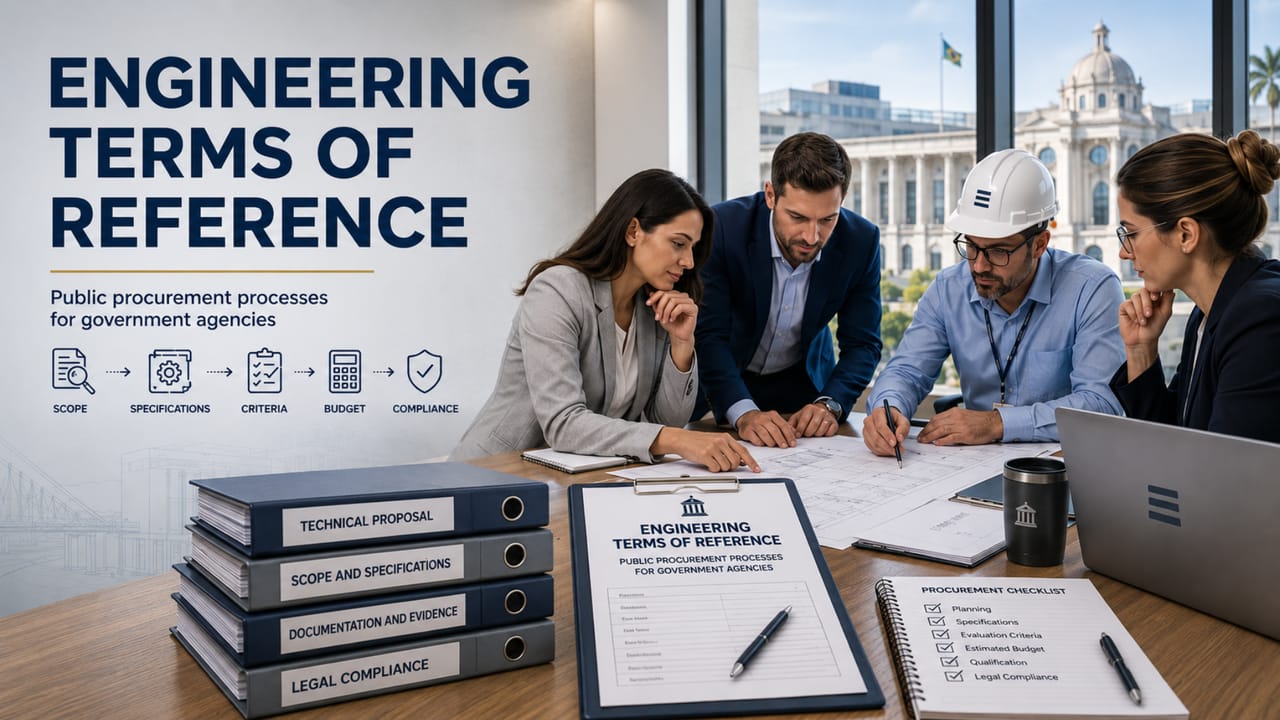
Learn how to structure engineering terms of reference with scope, technical requirements, deliverables, measurement criteria, risk matrix and technical acceptance.
Check it out!
An engineering terms of reference document is one of the most important documents for guiding a technical procurement. It defines what will be contracted, which requirements must be met, which deliverables will be required, how proposals will be evaluated, how the service will be measured and which criteria will be used for acceptance.
When this document is generic, incomplete or ambiguous, the procurement process tends to generate incomparable proposals, scope gaps, questions during execution, change orders, disputes over responsibilities and difficulty validating the final delivery.
For this reason, the terms of reference should not be treated merely as a documentary formality. In engineering, it is an instrument of technical governance.
This subject is directly connected to the Complete Guide to Engineering Consulting, Technical Procurement, Detailed Design and engineering technical proposal analysis.
What are engineering terms of reference?
Terms of reference are a document that describes a contracting need and establishes the minimum technical conditions so that suppliers, designers, integrators, consulting firms or service providers can submit proposals.
In engineering, the terms of reference should go beyond a generic description. They need to organize requirements, assumptions, responsibilities, documentation, execution criteria, measurement and acceptance.
Good terms of reference help answer:
- which technical problem needs to be solved;
- which scope must be covered;
- which minimum requirements are mandatory;
- which documents and evidence will be required;
- which deliverables will be produced;
- how proposals will be compared;
- how execution will be measured;
- how technical acceptance will be performed.
Without this structure, each supplier may interpret the demand differently, making the technical comparison fragile.
Terms of reference are not detailed design
Terms of reference and detailed design are not the same thing.
The terms of reference guide the procurement. They define the need, minimum requirements, execution conditions, evaluation criteria and expected deliverables.
The detailed design technically defines the solution to be implemented. It turns assumptions into detailed technical documentation, quantities, specifications, drawings, narratives, diagrams and execution conditions.
For simpler procurements, well-structured terms of reference may be sufficient to request proposals. For critical procurements, the terms of reference should be supported by detailed design, assessments, technical surveys, a risk matrix or due diligence.
The article Basic Design vs. Detailed Design explains this difference in greater depth.
Why terms of reference are critical for comparing proposals
The quality of the proposals received depends on the quality of the document sent to the market.
When the terms of reference are vague, each supplier builds its proposal based on its own assumptions. One may include installation, documentation, testing and training. Another may consider supply only. A third may exclude infrastructure, configuration, travel or commissioning.
In this scenario, comparison based on the lowest price becomes dangerous.
Technical terms of reference reduce this problem because they establish a common basis for engineering technical proposal analysis. They do not eliminate the need for technical equalization, but they improve the quality of the comparison.
Essential elements of technical terms of reference
Engineering terms of reference should be proportional to the complexity of the procurement. Even so, some elements are essential.
Contract object
The object should describe what will be contracted clearly, without unduly restricting the solution and without leaving excessive room for interpretation.
Context and technical justification
The justification should explain the contracting need, technical problem, current condition, risks involved and expected objectives.
Technical scope
The scope should indicate what is included, what is excluded, which interfaces exist, which boundaries apply and which responsibilities belong to the owner and the contractor.
Minimum technical requirements
Technical requirements define mandatory conditions for performance, compatibility, safety, documentation, integration, operation, maintenance and compliance.
Deliverables
The document should list the required deliverables: reports, technical opinions, designs, narratives, diagrams, as-built documentation, matrices, checklists, measurement reports, commissioning documentation or training records.
Measurement criteria
Measurement criteria define how execution will be monitored and recorded. In consulting services, measurement should be linked, whenever possible, to deliverable-based measurement and the measurement report.
Acceptance criteria
Acceptance criteria define how delivery will be validated. They should be connected to tests, evidence, documentation, outstanding items and minimum operating conditions. The article on technical acceptance in engineering projects explores this point in more depth.
Technical scope and limits of responsibility
One of the main roles of the terms of reference is to define responsibilities.
In engineering contracts, many conflicts arise because the scope does not clearly define who provides information, who approves documents, who installs infrastructure, who integrates systems, who delivers documentation, who performs tests, who corrects outstanding items and who validates delivery.
Therefore, the terms of reference should record:
- contractor responsibilities;
- owner responsibilities;
- third-party dependencies;
- assumptions regarding access, infrastructure and operation;
- known exclusions;
- interfaces with other systems, disciplines or contracts;
- criteria for handling scope changes.
This care reduces the risk of change orders, rework and disputes during execution.
Risk matrix in the terms of reference
A risk matrix can be used to record uncertainties, responsibilities, impacts and treatment measures.
In engineering, risks may be associated with site access, operational unavailability, lack of existing documentation, physical interferences, integration with legacy systems, supplier dependencies, aggressive schedules, regulatory requirements or environmental conditions.
When these risks are ignored in the terms of reference, they tend to emerge during execution, affecting schedule, cost and quality.
The content on risk matrices in engineering projects complements this analysis.
Terms of reference and technical procurement
The terms of reference are one of the foundations of technical procurement.
They guide suppliers, standardize information, reduce ambiguity and improve the quality of proposals received. In Technical Procurement, the terms of reference can be used together with an equalization matrix, clarification list, comparative matrix, technical recommendation and contracting criteria.
The logic is straightforward: the better the technical input, the better the comparison among suppliers.
Terms of reference in engineering consulting
For engineering consulting services, the terms of reference also need to indicate how demands will be organized.
When a contract involves recurring support, analyses, reports, technical opinions, due diligence, owner’s engineering, technical procurement or ongoing services, concepts such as HTE — Consulting Technical Hour, LPU in Engineering Consulting Services and OS-LPU and OS-CIC help structure scope, measurement and traceability.
Consulting procurement should not be defined solely by hours. It needs to specify deliverables, acceptance criteria, work orders, measurement method, scope boundaries and documentary evidence.
Common errors in terms of reference
Some errors frequently appear in technical procurements:
- an excessively generic object;
- absence of minimum requirements;
- scope without clear boundaries;
- missing measurement criteria;
- absence of acceptance criteria;
- final documentation not specified;
- commissioning not provided for;
- undefined responsibilities;
- missing risk matrix;
- requirements incompatible with the objective;
- proposal comparison without a common technical basis.
These problems do not only make contracting more difficult. They also compromise execution and technical closeout of the contract.
How A3A supports technical terms of reference
A3A supports private companies, industries, public agencies and institutions in structuring terms of reference, technical scopes, contracting requirements, risk matrices, measurement criteria and acceptance criteria.
This work may be provided as a specific service or integrated with:
- Detailed Design;
- Technical Procurement;
- Ongoing Engineering Consulting Services;
- Technical Due Diligence;
- Owner’s Engineering;
- EPCM.
The objective is to make contracting clearer, more comparable, traceable and technically defensible.
Recommended complementary content
To explore technical contracting in greater depth, also see:
- Engineering Technical Proposal Analysis;
- Basic Design vs. Detailed Design;
- Risk Matrix in Engineering Projects;
- Deliverable-Based Measurement in Engineering Consulting;
- Technical Acceptance in Engineering Projects;
- Measurement Report in Engineering Consulting.
Conclusion
Engineering terms of reference are a central instrument for responsible technical contracting.
When well structured, they organize scope, requirements, assumptions, deliverables, measurement criteria, risk matrix, required documentation and acceptance conditions.
This document improves proposal quality, reduces ambiguity, supports technical procurement and creates a basis for measurement, commissioning and technical acceptance.
In engineering, good contracting begins before the proposal. It begins with correctly defining what will be requested, measured and validated.
Talk to our Engineering Department
If your organization needs to structure terms of reference, technical scope, contracting criteria, a risk matrix or acceptance criteria, talk to A3A’s Engineering Department.
A3A supports private companies, industries, public agencies and institutions in structuring technical procurements with method, documentary traceability and engineering accountability.
Technical References
[1] A3A Consulting Engineering. Complete Guide to Engineering Consulting. Available at: https://a3aengenharia.com.br/conteudo/guias-tecnicos/guia-completo-sobre-engenharia-consultiva/.
[2] A3A Consulting Engineering. Engineering Consulting Procurement with Traceability, Governance and Cost Engineering. Available at: https://a3aengenharia.com.br/conteudo/whitepapers/contratacao-engenharia-consultiva-governanca-rastreabilidade/.
[3] PMI. PMBOK Guide.
[4] AACE International. Recommended Practices for Cost Engineering.
Frequently Asked Questions
They are the document that guides a technical procurement by defining the object, scope, requirements, deliverables, measurement criteria, required documentation and acceptance criteria.
No. The terms of reference guide the procurement. Detailed design technically defines the solution to be implemented through drawings, narratives, quantities and specifications.
Object, justification, scope, minimum requirements, responsibilities, deliverables, measurement criteria, acceptance criteria, required documentation and relevant risks.
Because they create a common basis for suppliers to respond, reducing different interpretations, hidden exclusions and incomparable proposals.
A3A supports the structuring of scopes, technical requirements, risk matrices, measurement criteria, acceptance criteria and documentation for engineering procurement.
