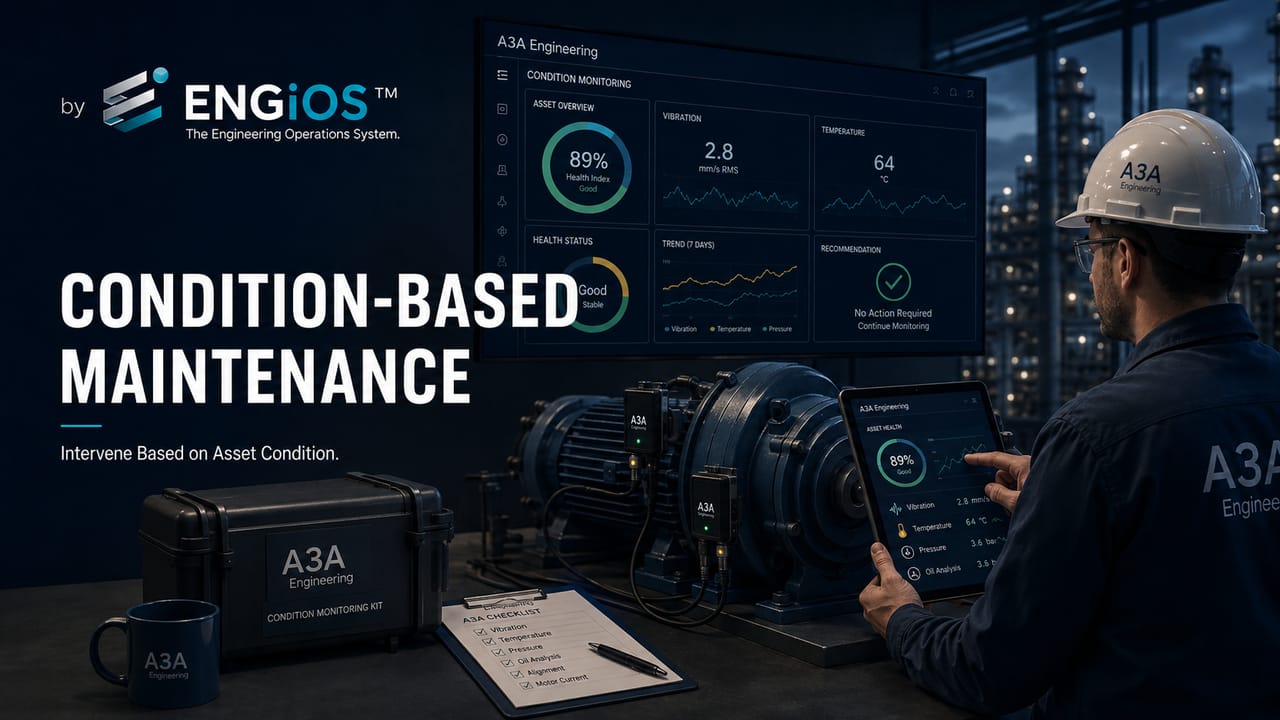
Understand Condition-Based Maintenance (CBM): condition variables, baselines, alarm thresholds, inspection frequency, data quality, analytics, diagnostics and intervention criteria.
Check it out!
Condition-Based Maintenance (CBM) is the strategy in which the decision to intervene depends on the observed condition of the asset rather than only on a fixed calendar. The organization measures, inspects, or tracks variables capable of indicating degradation and compares the results with technical criteria to decide whether to continue operating, intensify monitoring, investigate, schedule maintenance, or perform an intervention.
CBM is not synonymous with installing sensors. The strategy only works when there is a relationship between the observed variable and the failure mechanism, when data collection is reliable, and when decision thresholds are associated with asset criticality and risk. Without this structure, the result tends to be a succession of unprioritized alarms or reports without action.
The main advantage is avoiding time-based interventions when condition is still acceptable and anticipating actions when actual degradation requires a response. This reduces both unnecessary maintenance and exposure to failures that could be detected before the function is lost.
How condition-based maintenance works
The process begins with the asset’s required function and the failure modes capable of compromising that function. Parameters are then selected that actually change in an observable way as the degradation mechanism evolves.
These parameters may include temperature, vibration, current, insulation resistance, pressure, flow, ultrasonic noise, oil composition, particles, moisture, partial discharge, or other quantities compatible with the monitored physical phenomenon.
The value of the process lies in the decision. The same reading may receive different treatment depending on function, redundancy, failure consequence, degradation rate, and recovery capability.
CBM, predictive maintenance, and inspection are not the same thing
CBM uses observed condition as the trigger for action. Predictive maintenance may go further by seeking to infer trends, remaining useful life, or the likely time for intervention. Inspection, in turn, is a data-collection or verification activity that may be part of several strategies.
In practice, there is substantial overlap between CBM and predictive maintenance. The most useful distinction is that CBM emphasizes decision criteria based on current condition, while predictive maintenance emphasizes anticipating future evolution.
An isolated thermographic inspection, therefore, is not by itself a CBM program. It becomes part of the strategy when there is asset identification, load condition, evaluation criteria, history, criticality, responsibility, and a defined response for each class of finding.
How to select the right condition variable
The variable must have a plausible physical connection with the failure mechanism. Measuring what is easy but weakly related to degradation creates a sense of control without increasing reliability.
For a bearing, vibration and temperature may be relevant. For an electrical panel, temperature, current, power quality, or insulation condition may reveal different phenomena. For a hydraulic system, pressure, flow, contamination, and particles may be more representative.
Selection also needs to consider repeatability, accuracy, ease of collection, sensitivity to changes in load and environment, and the time available between detection and functional failure.
Baseline, trend, and alarm threshold
If the organization collects condition data but alarms do not generate priority, deadline, or ownership, the problem is no longer instrumentation but governance. Maintenance Engineering turns signals into criteria, decisions, and verifiable actions.
An absolute value may be less useful than comparison with historical behavior. For this reason, CBM programs typically need a baseline—a reference condition considered normal for that asset and operating regime.
Trend analysis helps distinguish a stable value from a degradation process. A parameter still within the limit may justify investigation if it is evolving rapidly; another above a generic reference may be acceptable if there is technical justification and consistent history.
Alarm thresholds therefore should not be treated as universal numbers. They may come from standards, manufacturers, design, documented experience, statistical history, or Reliability Engineering, but they always need to be interpreted in the context of function and risk.
Criticality defines the depth of monitoring
Continuously monitoring every asset is usually economically inefficient. Criticality helps concentrate instrumentation, inspection frequency, and analytical effort where a failure generates relevant consequences.
A critical asset may require permanent sensors, measurement redundancy, and rapid response. A lower-consequence asset may be monitored through periodic routes or even operated to failure, provided that decision is consciously accepted.
The Asset Criticality Analysis is therefore a natural step before expanding a CBM program.
How to define inspection frequency
The frequency should be short enough to detect degradation with useful lead time and long enough not to waste resources on measurements that add no information.
This interval depends on the rate of evolution of the failure mode, the sensitivity of the technique, and the time needed to confirm the diagnosis, mobilize resources, and perform the intervention.
When the interval is longer than the response window, the organization may measure correctly and still detect the problem too late.
Data quality and traceability
When asset registers, identification, and documentation are fragmented, there is no reliable basis for comparing history and condition. Structuring Asset Management is part of the CBM program, not a parallel activity.
Condition data needs to be linked to the correct asset, measurement point, date, instrument, operating condition, responsible party, and method. Without this, comparing readings may generate false trends or mask relevant changes.
Structuring the asset register and hierarchy is also essential. If the same equipment appears under different names in reports, CMMS, spreadsheets, and drawings, the organization loses traceability and the ability to consolidate history.
This is why CBM connects directly to Engineering Asset Management and document management.
From anomaly to diagnosis
An anomaly is not an automatic maintenance work order. The first step is to verify whether the data are reliable, whether the operating condition explains the deviation, and whether there is correlation with another parameter.
Engineering then assesses severity, criticality, and possible causes. In some cases, a new inspection confirms the trend. In others, specific tests, equipment opening, document analysis, or root-cause investigation are required.
This step avoids unnecessary component replacement or treating symptoms of a systemic problem.
CBM in electrical installations
Electrical installations are a natural field for condition-based maintenance, provided the technique is applied with appropriate criteria. Thermography may reveal abnormal heating; electrical measurements may indicate overload, imbalance, or improper behavior; testing may reveal insulation or contact degradation.
But a thermal finding, for example, should be interpreted together with loading, emissivity, environment, connections, equipment specification, and installation condition. Without context, severity may be overestimated or underestimated.
When evidence points to a systemic inadequacy, the response may move beyond maintenance toward design, study, remediation, modernization, or planned replacement.
How to integrate CBM into the maintenance plan
The plan needs to record which parameter will be observed, where it will be measured, under which condition, at what frequency, which criteria will be used, and which action corresponds to each class of result.
| Element | Required definition |
| Asset and function | What needs to be preserved |
| Failure mode | How the function may be lost |
| Condition variable | What will be observed |
| Method | How the data will be collected |
| Frequency | When to measure or inspect |
| Criterion | How to interpret the result |
| Owner | Who analyzes and decides |
| Action | What to do for each condition |
This structure turns inspection into a governed and auditable task within the Maintenance Plan.
Where analytics, sensors, and AI fit
Connected sensors, historians, analytics platforms, and AI models can expand the ability to detect patterns and correlations, especially when large volumes of data exist.
These technologies, however, do not eliminate the need for domain engineering. A model may detect a statistical deviation without understanding whether it represents functional risk. The program needs to maintain traceability among signal, failure mode, criticality, and decision.
Technology should reduce analysis time and improve consistency, not replace the criteria that justify intervention.
When CBM is not the best strategy
CBM may be unsuitable when there is no detectable variable before failure, when the failure mode evolves too quickly, when monitoring cost exceeds the benefit, or when a prescribed preventive intervention is mandatory and technically superior.
It may also be unsuitable when the consequence of failure is so high that monitoring alone does not provide sufficient protection. In that case, redundancy, fail-safe design, protective barriers, or redesign may be required.
When to engage Engineering support
The need arises when the organization has data, inspections, or alarms but cannot turn them into priorities; when there is divergence between field conditions and the asset register; when failures persist despite interventions; or when a complete condition-monitoring program needs to be structured.
The work may involve surveys, criticality, definition of variables, criteria, inspection plans, integration with documentation, risk analysis, monitoring specifications, supplier evaluation, procurement, and implementation follow-up.
When findings indicate a broader deficiency, an Engineering Technical Due Diligence can organize condition, risks, and the action plan before investment decisions are made.
How to establish CBM intervention criteria
A condition-based maintenance program is only useful when the organization knows how to turn an observed change into a decision. This requires intervention criteria defined before the alarm occurs. The criterion may be an absolute threshold, a rate of change, a combination of quantities, a comparison with equivalent assets, or a trend-based rule. The important point is that there is a relationship among the monitored indicator, the degradation mechanism, and the expected consequence.
Absolute thresholds are appropriate when there is a technically recognized value beyond which operation is no longer acceptable. Trends are more useful when parameter evolution carries more information than the isolated value. A temperature may remain below a nominal limit and still require investigation if it consistently increases under equivalent load conditions. The same reasoning applies to vibration, resistance, current, pressure, flow, oil quality, or any other quantity correlated with condition.
The criterion also needs to incorporate criticality. The same anomaly may result in intensified monitoring for a redundant asset and earlier intervention for an asset without contingency whose failure affects safety, production, or continuity. CBM therefore should not operate as an isolated sensor layer; it needs to interact with criticality analysis and the organization’s risk policy.
When a threshold is exceeded, the response should not automatically be “replace the component.” First it is necessary to confirm measurement quality, verify the operating context, compare with history, understand the failure mode, and assess severity. Only then does the organization decide whether the correct action is a new inspection, load reduction, planned intervention, complementary testing, a remediation project, or continued monitoring.
Alarms, false positives, and diagnosis: where CBM programs fail
One of the most common CBM problems is turning every deviation into a critical alarm. This creates alarm fatigue, loss of operator confidence, and growth in unprioritized work orders. The architecture should distinguish information, warning, confirmed anomaly, and critical condition. These levels need to be associated with responsibilities, deadlines, and escalation criteria.
False positives arise when the parameter varies due to normal process, environmental, or loading causes. An elevated thermal reading may be associated with increased current; a different vibration pattern may result from a speed change; pressure may fluctuate due to an operating-regime change. If the system does not record these contextual variables, the algorithm or analyst may interpret a normal operating-condition change as degradation.
False negatives also exist: condition degrades, but the selected indicator does not respond with sufficient lead time. This occurs when the monitored variable is not sensitive to the failure mechanism, the measurement point is inappropriate, or collection frequency does not capture the evolution. The program needs to continuously review its detection capability, especially after unanticipated failures.
For this reason, diagnosis should use multiple sources of evidence whenever risk justifies it. Thermography may be combined with current and physical inspection; vibration with temperature, rotational speed, and oil analysis; electrical tests with event history, protection, and loading. Correlation reduces hasty decisions and improves the ability to distinguish symptom, cause, and consequence.
Data architecture and traceability for condition-based maintenance
The more data a CBM program produces, the greater the need for governance. Each measurement needs to be associated with the correct asset, collection position, unit, instrument, method, date, operating condition, and responsible party. Without this link, historical series become inconsistent and comparisons among campaigns lose validity.
The asset hierarchy should be stable and sufficiently granular to enable traceability. It is not enough to register “main LV switchboard” or “motor” when multiple components, circuits, bearings, measurement points, and different functions exist within the same assembly. Identification needs to match the level at which the maintenance decision will be made.
Another requirement is to preserve information provenance. Supervisory systems, CMMS, spreadsheets, service-provider reports, and sensor databases often use different identifiers. Integration needs to establish correspondence among these sources and define which system is the system of record for the asset register, history, and maintenance work orders. Otherwise, the same asset may appear under different names and prevent consistent analysis.
Governance also means controlling quality. Impossible values, inconsistent units, collection gaps, uncalibrated sensors, incorrect timestamps, and changes in measurement point need to be identified. Technical data should have sufficient metadata so another person can understand how they were obtained and under what condition they can be compared.
How to demonstrate the economic value of CBM
The value of condition-based maintenance is not in the number of installed sensors or alarms generated. Benefit appears when information prevents relevant failures, reduces unnecessary interventions, improves planning, increases availability, or allows useful life to be used without increasing risk exposure.
An economic assessment should compare program cost with the costs it influences: inspection labor, instrumentation, licenses, data infrastructure, shutdowns, parts, unavailability, production losses, and failure consequences. For low-criticality assets, sophisticated monitoring may cost more than a simple replacement or planned corrective policy. For critical assets, anticipating a single failure may justify the entire program.
It is also important to measure decision quality. How many alarms resulted in confirmed findings? How many interventions were anticipated with useful lead time? How many preventive tasks could be reviewed based on condition? How many failures occurred without the system producing an indication? These questions help distinguish installed technology from effective performance.
As the program matures, it can adjust collection frequencies, eliminate low-value points, expand monitoring of critical assets, and review alarm criteria. This cycle turns CBM into an evidence-driven technical management system rather than a static collection of sensors and reports.
Final considerations
Condition-based maintenance is a decision strategy. The sensor, inspection route, or test are merely mechanisms for observing the asset.
The program creates value when it connects function, failure mode, condition, criticality, risk, and response. This integration makes it possible to reduce unnecessary interventions, anticipate relevant degradation, and turn operational evidence into Engineering decisions on maintenance, remediation, renewal, or replacement.
When diagnosis reveals obsolescence, design inadequacy, or systemic risk, continuing to monitor alone does not solve the cause. The next step may require expanded diagnosis, design, specification, and a remediation plan.
Technical references
[1] BRAZILIAN ASSOCIATION OF TECHNICAL STANDARDS. ABNT NBR 5462:1994 — Reliability and maintainability — Terminology. Available at: https://www.abntcatalogo.com.br/.
[2] BRAZILIAN ASSOCIATION OF TECHNICAL STANDARDS. ABNT NBR ISO 55001:2024 — Asset management — Management systems — Requirements. Available at: https://www.iso.org/standard/83054.html.
[3] U.S. DEPARTMENT OF ENERGY. Operations and Maintenance Best Practices: A Guide to Achieving Operational Efficiency. Available at: https://www.energy.gov/cmei/femp/articles/operations-and-maintenance-best-practices-guide-achieving-operational-efficiency.
Frequently asked questions
It is the strategy in which the decision to intervene depends on the observed condition of the asset, assessed through inspections, measurements, trends, and technical criteria.
They are closely related concepts. CBM emphasizes current condition as the trigger for intervention; predictive maintenance may include estimates of trend, evolution, or the probable time of failure.
No. Condition may be assessed through periodic inspections, measurement routes, tests, or continuous monitoring, according to criticality and degradation rate.
The threshold should consider standards, manufacturer guidance, design, baseline, history, operating condition, criticality, and failure mechanism. It should not be treated as a universal number without context.
When there is no detectable variable before failure, when degradation is too rapid, when monitoring is not economically justified, or when the consequence requires another protective barrier.
Additional technical resources
Related services
- Maintenance Engineering: strategies, reliability, plans, and indicators
- Reliability and Availability Engineering: criticality, failures, performance, and continuity
- Engineering Asset Management: asset register, criticality, lifecycle, and performance
Related solutions
- Field Applications, Inspection, and Technical Data Collection
- Requirements, Evidence, and Acceptance Criteria Management
Core content on the topic
- Predictive Maintenance: what it is, how it works, techniques, and application criteria
- Maintenance Plan: how to structure activities, frequencies, and criteria