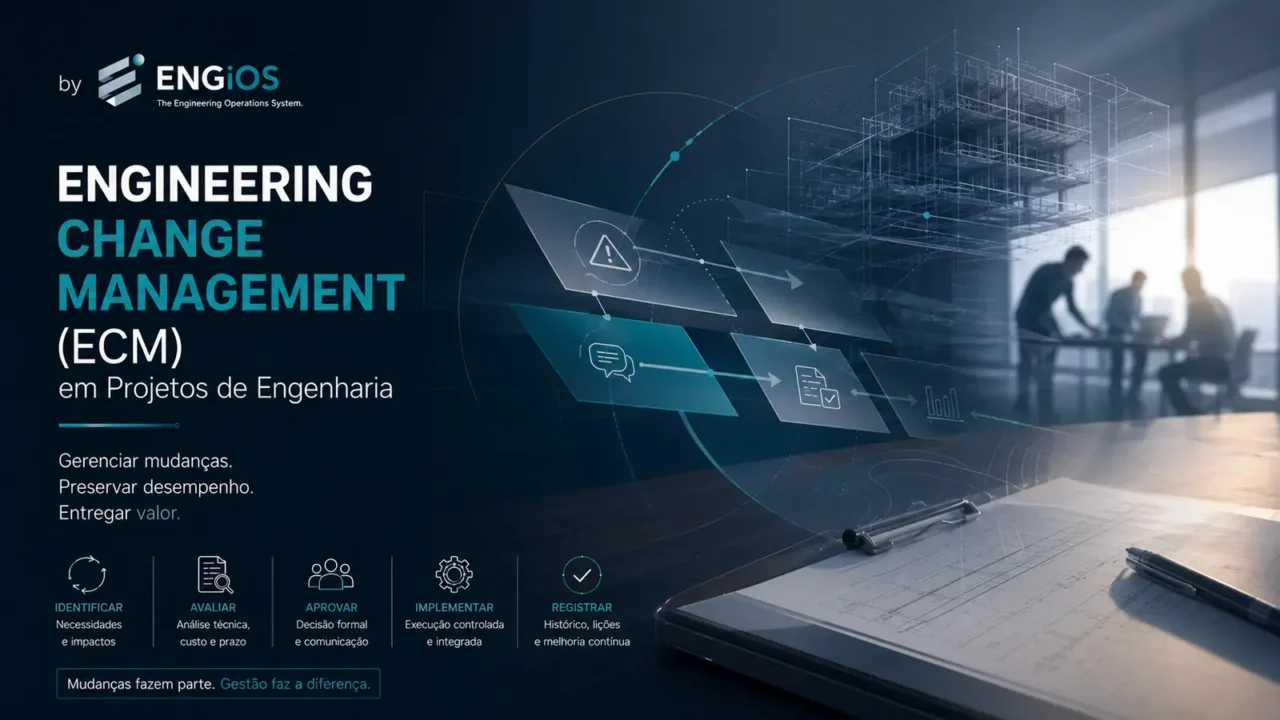
Understand how to apply Engineering Change Management (ECM) in engineering projects, from ECR through approval, impact assessment, implementation, configuration control, and traceability.
Check it out!
Engineering Change Management (ECM) is the process used to identify, record, analyze, decide, implement, and verify changes affecting project engineering. Its purpose is to prevent changes to requirements, drawings, specifications, equipment, interfaces, or execution methods from being incorporated informally without a complete assessment of technical, safety, schedule, cost, contractual, documentation, and operational impacts.
In this article, ECM means Engineering Change Management, or engineering change management. The acronym does not refer to Enterprise Content Management or organizational change management. The focus is on technical control of changes that modify configuration, baselines, or engineering-project deliverables.
A consistent ECM process connects engineering, Project Controls, procurement, contracts, construction, commissioning, and operations. It turns a need for change into a traceable decision: the change is formalized through a request, analyzed by affected disciplines, submitted to the competent authority, converted into an authorized instruction, propagated to documents, and verified before closure.
What Is Engineering Change Management (ECM) in Engineering Projects
Engineering Change Management is a technical-governance discipline that controls changes during project development and implementation. Its scope begins when a new condition, incompatibility, improvement opportunity, or additional requirement may modify the approved solution. The process ends only when the decision has been implemented, verified, documented, and reflected in the current configuration.
A change may appear small in the document that originated it and still produce systemic effects. Changing equipment power may require revisions to electrical supply, protection, cables, ventilation, structure, automation, signal lists, budget, purchase orders, schedule, tests, and operating procedures. ECM exists to identify these dependencies before the change is released for implementation.
ECM, Integrated Change Control, Configuration, and Documents
| Concept | Main function | Engineering application |
| Engineering Change Management — ECM | Control the complete engineering-change lifecycle | Requirements, solution, interfaces, equipment, execution, and final configuration |
| Integrated change control | Evaluate changes affecting the plan and baselines | Scope, schedule, cost, quality, risks, resources, and contracts |
| Configuration management | Keep functional and physical characteristics under control | Technical baselines, configuration items, versions, and approved state |
| Document control | Manage issue, revision, approval, and distribution | Drawings, design reports, specifications, lists, and records |
| Contractual change management | Formalize consequences between the parties | Scope, price, schedule, conditions, and responsibilities |
ECM acts as a bridge among these systems. An approved technical change needs to update the configuration; when it affects the plan, it goes through integrated change control; when it changes contractual obligations, it requires the mechanism established in the contract; and in every case, it must be distributed through controlled documents.
ECR, ECN, ECO, and CCB
Terminology varies among organizations. The acronyms below are common, but the project procedure should define the terms adopted.
| Acronym or term | Meaning | Function |
| ECR — Engineering Change Request | Engineering change request | Record need, justification, and initial assessment |
| ECN — Engineering Change Notice | Engineering change notice | Communicate an authorized or pending change |
| ECO — Engineering Change Order | Engineering change order | Technically authorize implementation |
| CCB — Change Control Board | Change control board | Evaluate and decide according to authority level |
| Change Register | Change register | Consolidate status, decisions, owners, impacts, and deadlines |
| Configuration Baseline | Configuration baseline | Represent the approved set of characteristics |
| Change Order | Contractual change | Formalize effects on obligations, price, schedule, or conditions |
ECR and ECO do not need to be separate forms in small projects. The essential requirement is to separate request, analyze, authorize, implement and verify, while preserving history, responsibilities, and evidence.
Why ECM Is Critical in Engineering Projects
Engineering projects are multidisciplinary and progressive. Definition evolves from feasibility through detailed design, while successive decisions commit resources, contracts, equipment, and construction. The later a change occurs, the greater the number of elements that tend to depend on the previous configuration.
In early phases, a change may require only a new analysis. After procurement, it may require renegotiation with suppliers. During execution, it may cause rework, loss of productivity, or stoppage. Near commissioning, it may invalidate tests and acceptance evidence. This relationship should be considered together with the project lifecycle.
Changes Need to Be Controlled, Not Avoided.
The value of ECM lies in allowing necessary changes to proceed with proportional analysis, defined authority, complete communication, and implementation verification.
Understand How the Lifecycle Changes the Cost and Risk of Changes
Which Changes Should Enter the ECM Process
Any change capable of modifying an approved requirement, expected performance, technical solution, interface, configuration item, baseline, safety condition, contractual obligation, or information used to manufacture, procure, install, test, operate, or maintain the system should enter ECM.
Not every editorial correction requires multidisciplinary analysis. However, classifying a change as “just a drawing revision” without examining its content is a mistake. The criterion should be the potential effect of the change, not the document format.
Sources of Engineering Changes
Changes may originate from the owner, designer, supplier, contractor, operator, oversight team, regulatory authority, or field condition. Major triggers include:
- modification of owner or user requirements;
- correction of error, omission, conflict, or incompatibility;
- need identified through risk or safety analysis;
- standards, regulatory, or licensing change;
- equipment unavailability or substitution;
- value engineering or constructability improvement;
- field condition differing from design information;
- interference among disciplines or systems;
- change of supplier, technology, material, or method;
- result of inspection, FAT, SAT, or commissioning;
- schedule, budget, logistics, or operational constraint;
- RFI, nonconformity, or pending item whose resolution changes the engineering.
An RFI may clarify without changing anything; a nonconformity may be corrected in accordance with the design; a risk may be treated without changing the baseline. When the response modifies the approved solution, the case should be linked to a controlled change.
Classification by Nature
| Class | Example | Analyses normally required |
| Requirement | New capacity, availability, or operating condition | Business case, architecture, validation, and acceptance |
| Technical | Change in sizing, topology, or specification | Calculations, compatibility, safety, and performance |
| Configuration | Substitution of component, material, firmware, or model | Equivalence, interoperability, documentation, and maintenance |
| Interface | Change in boundaries among disciplines or suppliers | Responsibilities, connections, data, sequence, and tests |
| Construction | Change in method, access, sequence, or assembly | Constructability, safety, resources, schedule, and quality |
| Regulatory | New legal, standards, or environmental requirement | Compliance, licenses, and evidence |
| Contractual | Addition, removal, or modification of an obligation | Scope, price, schedule, risks, and notices |
| Operational | Change in operation, maintenance, or contingency | Procedures, training, availability, and assets |
| Emergency | Immediate action to control severe risk | Exceptional authorization, temporary control, and regularization |
The same change may belong to several classes. Equipment substitution may affect interfaces, electrical consumption, heat dissipation, protocol, schedule, cost, warranty, and spares.
Change, Deviation, Nonconformity, and Revision
| Record | Characteristic | When to trigger ECM |
| Change | Proposes changing an approved condition or baseline | Always |
| Deviation | Records departure from a requirement or plan | When its acceptance changes the approved configuration |
| Nonconformity | Shows noncompliance with a requirement | When disposition is not simply correction according to the baseline |
| RFI | Requests clarification | When the response introduces a technical change |
| Pending item | Records an open action or decision | When the solution modifies a requirement or configuration |
| Document revision | New document version | When technical content is modified |
| Redline | Records a proposed or executed condition | When it differs from the released document |
| Editorial correction | Adjustment with no technical effect | Normally document control only |
The distinction avoids bureaucratizing simple corrections while preventing relevant changes from being executed as clarifications or field adjustments.
Materiality and Project Phase
A change is material when it affects function, safety, compliance, interfaces, budget, critical path, committed equipment, executed work, testing, operations, or released documents.
| Phase | Predominant impact | Recommended control |
| Feasibility and FEL | Assumptions, benefits, CAPEX, and risks | Update business case and continuation decision |
| Conceptual Design | Architecture, capacity, and interfaces | Compare alternatives and selection criteria |
| FEED and Basic Design | Requirements, bases, specifications, and estimates | Multidisciplinary analysis and contracting maturity |
| Detailed Design | Calculations, details, lists, and coordination | Strict configuration control |
| Procurement | Requisitions, equipment, manufacturing, and delivery | Assess commitments and suppliers |
| Execution | Field, method, rework, safety, and productivity | Approve before execution, except in emergencies |
| Commissioning | Tests, logic, performance, and evidence | Revalidate procedures and criteria |
| Closeout | Actual configuration and final documentation | Update As-Built, manuals, and asset records |
The content on FEED, Basic Design and Detailed Design detail maturity evolution. ECM should prevent late decisions from being treated as if the project were still in the conceptual phase.
The Impact of Change Increases as the Project Becomes More Committed.
A still-conceptual change may require only new analysis; after contracting, manufacturing, or execution, the same decision may generate rework, replanning, renegotiation, and repeated testing.
Explore How Project Controls Measures Schedule, Cost, and Baseline Impacts
How the Request, Analysis, and Approval Flow Works
An ECM workflow needs to be formal enough to protect configuration and agile enough not to paralyze decisions. The recommended structure separates identification, recording, triage, integrated analysis, decision, authorization, implementation, and verification.
ECR: Identification and Recording
The need should be recorded before being incorporated into documents or construction. The ECR receives a unique code and links origin, requester, date, discipline, affected item, current condition, proposal, justification, urgency, and evidence.
Coding may reflect project, system, and sequence, such as PRJ-ECM-ECR-001. The code remains stable even if the change results in several documents or orders.
Triage and Alternatives
Triage confirms whether the case is a change, checks for duplication, defines priority, identifies disciplines, and selects the workflow. It may return an incomplete request or link it to an RFI, nonconformity, risk, contract, or pending item.
Relevant changes should not reach decision with only one assumed solution. Engineering should compare alternatives, including maintaining the current configuration, explicitly stating requirements met, risks, interfaces, cost, schedule, reversibility, and operational implications.
Integrated Impact Analysis
Each affected area records its assessment in a common basis. The coordinator consolidates contributions, highlights disagreements, and confirms whether interfaces were consulted. The RACI matrix defines participation but does not replace technical, financial, or contractual authority levels.
Decision and ECO
Decisions should be standardized: approved, approved with conditions, rejected, returned, suspended, deferred to a future phase, or canceled. The record should identify the version analyzed, participants, justification, and conditions.
Approval needs to be converted into an executable instruction. The ECO — Engineering Change Order — defines the authorized alternative, affected documents and items, owners, deadline, restrictions, verifications, effects on baselines, and linkage to any contractual change order.
Implementation and Closure
The status “approved” does not mean “implemented.” Implementation includes engineering revision, document issue, procurement, manufacturing, construction, parameterization, testing, and communication. When several packages are involved, the change may be decomposed and linked to the WBS.
Closure confirms current documents, withdrawal of obsolete versions, consistency of materials and equipment, completion of tests, updates to contracts and baselines, As-Built documentation, manuals, asset records, and communication to stakeholders.
Minimum ECR Checklist
- ☐ Unique identification and date
- ☐ Requester, origin, and owner
- ☐ Current condition
- ☐ Proposed change
- ☐ Justification and expected benefit
- ☐ Affected requirements and items
- ☐ Related documents, contracts, and assets
- ☐ Disciplines and interfaces involved
- ☐ Criticality and urgency
- ☐ Alternatives considered
- ☐ Preliminary impacts
- ☐ Attachments and evidence
- ☐ Required decision and deadline
Emergency Changes
An emergency may justify immediate action when there is severe risk to people, the environment, the asset, continuity, or compliance. This does not eliminate ECM; it only changes the sequence. The emergency workflow should define authority, intervention limits, temporary controls, preservation of evidence, regularization deadline, verification, and update of the final configuration.
Approval Does Not Mean Closure.
The change can be closed only when current documents, the executed condition, tests, records, and communication to operations are consistent with the authorized decision.
See How the As-Built Consolidates the Configuration Actually Implemented
How to Assess Technical, Contractual, Schedule, and Cost Impacts
Impact analysis is the core of ECM. Deciding solely on direct cost can overlook incompatibilities, rework, delays, productivity loss, additional testing, contractual obligations, and operational consequences.
| Dimension | Main questions | Typical evidence |
| Requirements | Are function, capacity, and acceptance still satisfied? | Requirements matrix, Basis of Design, and calculations |
| Safety | Does the change introduce risk or alter compliance? | Risk analysis, technical opinions, and approvals |
| Engineering | Which disciplines, calculations, and interfaces change? | Document list and multidisciplinary analysis |
| Constructability | Can the solution be executed under the available conditions? | Method, field conditions, resources, and sequence |
| Procurement | Does it affect supplier, purchase order, manufacturing, or logistics? | Requisitions, orders, and promised dates |
| Schedule | Does it affect logic, critical path, float, or milestones? | Schedule, fragnet, and path analysis |
| Cost | What direct, indirect, and lifecycle costs arise? | Estimate, quotations, and forecast |
| Contract | Does it change obligations, price, schedule, or risk? | Contract, notices, and administrative opinion |
| Testing | Does it invalidate inspections, FAT, SAT, or acceptance? | ITP, protocols, and records |
| Operations | Does it affect training, maintenance, or continuity? | Manuals and operational analysis |
| Configuration | Which baselines and documents must be updated? | Propagation matrix and master list |
| Risks | Which risks are introduced or removed? | Risk register and responses |
The risk management in engineering projects must be updated. Risk and change are not synonymous: risk is uncertainty; change is a proposed or actual alteration. A change can be a response to risk and can also create new risks.
Schedule, Cost, and Cumulative Impact
Schedule analysis should insert the change into the current schedule and evaluate logic, resources, procurement, float, critical path, milestones, mitigation, and acceleration. The physical-financial schedule shows why schedule, measurement, and cost cannot be assessed separately.
The estimate should state scope, assumptions, exclusions, base date, sources, and degree of definition. It may include engineering, materials, order cancellations, manufacturing, logistics, labor, supervision, mobilization, rework, testing, extended presence, productivity, and lifecycle costs.
Direct impact belongs to the changed work. Indirect impact results from effects on other activities. Cumulative impact arises when several changes produce a combined effect that cannot be attributed to a single change. Successive small changes can fragment work fronts, reduce productivity, and consume engineering capacity.
Technical Change, Change Order, and Claim
An engineering change is not automatically a contractual change. First the technical need is identified and analyzed; then responsibilities are verified, effects are quantified, and the contractual mechanism is applied.
When there is agreement, the effect may be formalized through a change order, amendment, work order, or equivalent instrument. When there is disagreement over entitlement, responsibility, price, or schedule, the case may evolve into a claim. The content on EPC and EPCM helps explain risk allocation.
Technical approval does not replace commercial authorization, and commercial approval does not dispense with technical validation.
When to Revise the Baseline
Not every change justifies rebaselining. Changing the reference simply to eliminate variances destroys performance history. Revision is appropriate when a formally authorized change makes the previous baseline inadequate by changing scope, budget, schedule, milestones, or strategy.
History must be preserved. The system distinguishes the original baseline, authorized revisions, current schedule, and forecast. The Earned Value Management depends on this discipline.
Rebaselining Requires Formal Decision and Preserved History.
A new baseline should reflect an authorized change that materially changed scope, schedule, budget, or strategy, without erasing the original reference or turning a variance into planned performance.
Understand How Earned Value Management Depends on Reliable Baselines
How to Apply Change Control in Agile or Hybrid Management
An agile or hybrid approach does not eliminate Engineering Change Management. What changes is the speed of discovering, qualifying, and routing the change. Ideas, pending items, emerging requirements, and alternatives can be refined in short cycles; however, when a change affects a baseline, approved requirement, configuration, contract, safety, cost, or schedule, it must pass through the corresponding formal governance.
PMBOK Guide 8th Edition treats tailoring and hybrid approaches as part of the normal management architecture. For Engineering, this means separating two layers: an adaptive layer for exploring and qualifying work not yet authorized, and a formal decision layer for changes that alter approved commitments. This separation is detailed in the architecture of agile and hybrid management of Engineering projects.
| Situation | Recommended treatment | Required control |
| technical idea or hypothesis | refinement, study, or backlog | record and owner |
| clarification with no material impact | fast operational flow | document traceability |
| change affecting an interface or requirement | integrated impact analysis | ECR/CCB or equivalent workflow |
| change in baseline, contract, or budget | formal decision before execution | change control, authority level, and history |
| field emergency | predefined exceptional flow | authority, limit, evidence, and subsequent regularization |
A Change Backlog Is Not Change Authorization
A project backlog can organize requests, alternatives, studies, and pending items before a decision. It does not replace the ECR, CCB, change order, or any formal mechanism required by the contract and governance. An item may be prioritized in the backlog and still remain not authorized for implementation.
This separation avoids one of the main risks of superficial agile adoption: confusing the ability to react quickly with permission to change an approved reference without impact analysis.
Hybrid Change Control Should Accelerate Triage, Not Reduce Rigor
The gain from a hybrid approach lies in reducing idle time. Visual management, Kanban, classes of service, aging, and short cadences can make pending changes more visible and accelerate information gathering. Formal decision-making remains proportional to materiality: a simple document correction does not need to follow the same process as a change affecting CAPEX, contractual schedule, functional safety, or field configuration.
For this reason, hybrid ECM combines flow management with change governance. The first reduces queues and aging; the second protects the baseline, responsibility, and traceability.
How to Control Configuration, Documents, and Implementation
ECM produces results only when the decision reaches all affected elements. The change does not end in the CCB minutes or with issuance of a drawing. Requirements, documents, materials, equipment, software, parameters, construction, and operational records all need to be controlled.
Configuration Items and Baselines
A configuration item is a controlled element whose characteristics need to be identified, approved, and traceable. It may be a requirement, system, equipment, component, software, logic, parameter, interface, document, model, or installed assembly.
The configuration baseline represents the approved state. It may be functional, design, manufacturing, construction, or As-Built. The procedure defines when it is established, who approves it, and which changes require formal control.
Document Propagation Matrix
| Changed element | Potentially affected documents |
| Functional requirement | URS, OPR, Basis of Design, requirements matrix, and acceptance |
| Capacity or load | Calculations, balances, diagrams, lists, and specifications |
| Equipment | Datasheet, requisition, materials, drawings, and maintenance |
| Layout | Drawings, sections, supports, access, and safety |
| Electrical supply | Single-line diagram, demand, cables, protection, and selectivity |
| Automation | Narrative, I/O, cause and effect, software, and tests |
| Communications | Architecture, addressing, protocols, and cybersecurity |
| Execution method | Procedure, risk, planning, and inspection |
| Test criterion | ITP, FAT, SAT, commissioning, and acceptance |
| Operating condition | Manual, training, maintenance, and asset record |
In BIM projects, the ISO 19650 series supports information management, but ECM also applies without BIM.
Information States and Implementation Package
The system should distinguish states such as drafting, review, approved, released for procurement, manufacturing or construction, canceled, superseded, and As-Built. There must be no doubt about which version is valid for each purpose.
Relevant changes should generate a package containing the ECO, drawings, analysis memorandum, method, safety, materials, responsibilities, implementation window, inspection, testing, rollback where applicable, and completion criteria.
Field, Redlines, and Commissioning
The field team should not alter the solution for convenience without authorization. Redlines document a proposed or executed condition but do not constitute automatic approval. The final configuration needs to be consolidated in the As-Built.
Changes after testing may invalidate evidence. The commissioning should indicate which verifications need to be repeated and how the change affects technical acceptance.
Closure should distinguish physical, documentary, technical, contractual completion, and communication to operations.
The Authorized Configuration Must Reach the Field.
Drawings, lists, parameters, equipment, software, procedures, and test records need to represent the same approved solution; discrepancies between documents and installation keep the change open.
Explore How Commissioning Verifies Changes Before Acceptance
How to Structure ECM Governance, Metrics, and Audit
Governance defines policy, roles, authority levels, criteria, workflow, information, and oversight. ECM should be integrated with processes and governance, rather than operating as a parallel register disconnected from documents, schedule, costs, and contracts.
Policy, CCB, and Authority Levels
The policy establishes principles and responsibilities; the procedure describes types, materiality, urgency, status, documentation, roles, authority levels, deadlines, CCB, integrations, rebaselining, emergencies, metrics, and audit.
The CCB evaluates changes above delegated authority levels or with relevant multidisciplinary impact. It may include the owner, manager, engineering, Project Controls, contracts, procurement, construction, commissioning, operations, safety, and quality. The matrix should indicate who recommends, who decides, and who is consulted.
Authority levels may consider safety, requirements, value, schedule, critical path, disciplines, contracts, shutdown, reversibility, and operational exposure. A safety or compliance change should not be simplified merely because it has low cost.
Recommended Roles
| Role | Main responsibility |
| Requester | Record need and initial information |
| ECM Coordinator | Manage workflow, deadlines, and integration |
| Technical Lead | Develop alternatives and consolidate engineering |
| Affected disciplines | Evaluate interfaces and consequences |
| Project Controls | Analyze schedule, cost, baseline, and forecast |
| Procurement | Evaluate suppliers, orders, and logistics |
| Contracts | Verify obligations, change orders, and claims |
| Construction | Evaluate field conditions, method, safety, and rework |
| Commissioning | Evaluate tests and acceptance criteria |
| Operations | Evaluate maintenance, training, and assets |
| CCB or authority | Approve, reject, or impose conditions |
| Verifier | Confirm implementation and closure |
In projects with Owner’s Engineering, the role may include independent analysis, impact consolidation, evidence verification, and support for owner decisions without replacing the responsibilities of designers, suppliers, and contractors.
Metrics
| Metric | What it reveals |
| Open changes by status | Volume and bottlenecks |
| Backlog age | Risk of delayed decisions |
| Time from ECR to decision | Analysis efficiency |
| Time from approval to implementation | Execution capacity |
| Returned requests | Input quality |
| Emergency changes | Exposure and planning maturity |
| Unauthorized changes | Serious control failure |
| Cost and schedule impact | Cumulative consequence |
| Origin and discipline | Sources of instability |
| Reopening | Implementation quality |
| Documentation pending | Configuration discrepancy |
| Recurring causes | Effectiveness of lessons learned |
Audit, Errors, and Maturity
The audit should make it possible to reconstruct origin, baseline, analysis, decision, instruction, revisions, execution, tests, impacts, and closure. Independent assurance is useful for critical changes, significant rebaselining, disputes, or changes close to acceptance.
Recurring errors include executing before approval, analyzing only the originating discipline, ignoring procurement and operations, estimating only direct cost, changing the baseline to eliminate variance, closing without field verification, and failing to update As-Built documentation or manuals.
| Level | Characteristics |
| Reactive | Changes identified after execution and scattered records |
| Controlled | Form, register, and basic approval |
| Integrated | Engineering, schedule, cost, risk, contracts, and configuration connected |
| Managed | Authority levels, metrics, audit, and cause analysis |
| Optimized | Historical data, prevention, automation, and continuous improvement |
Implementation can start simply as long as essential controls are preserved. A complex form does not compensate for undefined authority or lack of verification. Recurring causes should feed lessons learned.
Mature ECM Integrates Engineering, Controls, and Governance.
Maturity lies not in form complexity, but in the ability to relate technical decisions, impacts, responsibilities, baselines, contracts, implementation, and closure evidence.
Technical References
[5] AACE INTERNATIONAL. Recommended Practice 10S-90: Cost Engineering Terminology.
[7] INTERNATIONAL ORGANIZATION FOR STANDARDIZATION. ISO 19650-1:2018 — Information management using BIM.
[8] FIDIC. Conditions of Contract for EPC/Turnkey Projects. 2. ed. Silver Book, 2017.
[9] FIDIC. Client/Consultant Model Services Agreement. 5. ed. White Book, 2017.
Frequently Asked Questions
It is the process of identifying, recording, analyzing, approving, implementing, and verifying changes affecting requirements, configuration, documents, equipment, interfaces, or execution of an engineering project.
ECR is the request that describes and justifies the change. ECO is the authorization to implement the approved alternative. Terminology varies, but requesting and authorizing should remain separate.
CCB is the committee or governance body that evaluates relevant changes and recommends, approves, conditions, or rejects their implementation according to authority levels.
No. Editorial corrections may remain within document control. Revisions that modify requirements, solution, interfaces, configuration, manufacturing, construction, testing, or operations should be evaluated through ECM.
No. ECM controls the technical change and its impacts. A change order is a contractual instrument when the change alters obligations, price, schedule, or conditions.
Through an exceptional workflow defining authority, intervention limits, temporary controls, evidence, regularization deadline, subsequent verification, and configuration update.
When an authorized change materially alters scope, budget, schedule, milestones, or strategy and makes the previous baseline inadequate. History should be preserved.
No. The process can begin with controlled records. Complex projects benefit from platforms that relate changes to requirements, documents, schedules, costs, contracts, risks, and configuration.
Complementary Technical Materials
Whitepapers
- Owner’s Engineering: framework executivo para contratação, governança e aceite
- Projeto: o investimento que reduz riscos, custos e retrabalho
Technical Articles
- Engineering Projects
- Project Lifecycle
- Project Controls
- Processes and Governance in Engineering Projects
- Risk Management in Engineering Projects
- Procurement in Engineering Projects
- Engineering Construction Execution
- As-Built in Engineering
Technical Guides
- Project Management: Complete Guide to Engineering, Governance, and Control
- Complete Guide to Engineering Consulting
Related Services
- Project Management: Owner’s Engineering from Start to Technical Acceptance
- Project Management: Schedule, Costs, and Earned Value
- EPCM: Integrated Implementation Management