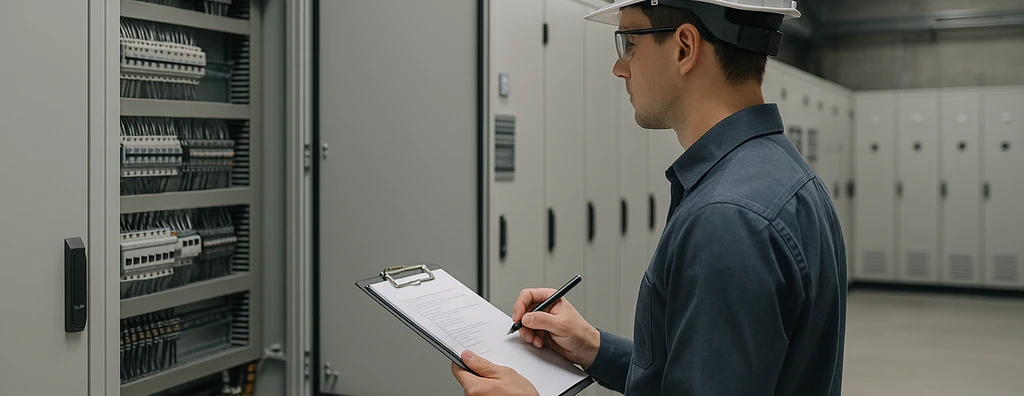
Understand the principles of electromagnetic compatibility, its impacts on engineering systems, and the requirements for compliance with ABNT NBR 5419.
Check it out!
Electromagnetic compatibility (EMC) plays a central role in contemporary electrical engineering projects, significantly affecting the reliability, safety, and operation of critical systems and equipment. Electromagnetic interference can compromise everything from the operation of sensitive devices to the overall integrity of infrastructure, requiring a systemic approach and strict alignment with technical standards to prevent failures, process shutdowns, and ensure operational continuity in industrial, building, and mission-critical environments.
This article explores in depth the fundamentals of electromagnetic compatibility, the relevance of controlling it in installations, the types of interference, their expected impacts, and, above all, the technical requirements and obligations for full compliance with ABNT NBR 5419, the reference standard for protecting structures and systems against lightning, including EMC criteria. It also presents regulatory methods, solutions, and recommendations applicable to the context of electrical installation engineering and integrated systems.
Check it out!
[elementor-template id=”24446″]
Definition and Classification of Interference
Electromagnetic compatibility is the ability of electrical and electronic equipment and systems to operate satisfactorily in an electromagnetic environment without causing or suffering unacceptable interference from other devices. This concept covers phenomena such as conducted and radiated emissions, immunity to interference, and noise mitigation, involving aspects of design, installation, and maintenance.
- Electromagnetic emission: the level of energy radiated or conducted by a device into the environment.
- Electromagnetic immunity: the ability of equipment to withstand external disturbance without functional degradation.
- Interference: subdivided into conducted oscillatory transients, low- and high-frequency electric and magnetic fields, electrostatic discharges, and ionizing radiation.
The presence of disturbance sources and sensitive equipment requires standards-based technical treatment to prevent equipment failures caused by inductive, resistive, or capacitive coupling.
Main Types of Interference Considered by NBR 5419
According to ABNT NBR 5419, in addition to currents resulting from lightning discharges, several other external influences must be considered to guarantee functional performance and safety. The main ones, classified by NBR 5410 and associated references, include:
- Conducted oscillatory transients: caused by switching operations, faults, or discharges, evaluated according to IEC 61000-4-12 and IEC 60255-22-1.
- High-frequency radiated phenomena: these affect electronic equipment and are subject to tests defined in IEC 61000-4-3.
- Electrostatic discharges: requiring immunity according to IEC 61000-4-2, as they may cause severe failures in electronic systems.
- Low-frequency induced voltages: generally linked to couplings with power systems, requiring high withstand capability in signaling and control systems.
- Radiated magnetic fields: problematic in industrial environments and under transmission lines, requiring physical protection and cable segregation according to IEC 61000-4-8.
- Electric fields and ionizing radiation: considered for installations in critical or special environments.
Identifying and carefully evaluating these influences is essential for correct infrastructure sizing and component selection.
How Interference Propagates and Its Impacts
Electromagnetic effects in installations may result from resistive, inductive, or capacitive coupling between emitting sources (discharges, power equipment, radio frequency) and receiving devices (ICT, automation, instrumentation equipment).
- Resistive Coupling: Occurs when two structures are physically connected or close enough to allow stray currents to circulate, intensified, for example, by direct lightning strikes on the structure.
- Inductive Coupling: Results from variations in magnetic flux carried by nearby conductors; switching operations in medium- and high-voltage systems may induce overvoltages in control and telecommunication circuits.
- Capacitive Coupling: Determined by the proximity and area between live conductors under different potentials, resulting in the transfer of unwanted charges.
In addition to coupling, the following stand out:
- Overvoltages transmitted by external lines, including power and signal cables coming from outside the environment; these require effective protection according to criteria defined in the relevant standards.
- Radiated magnetic fields that may affect devices that are not properly shielded or installed without correct physical separation.
According to international and national standards, functional integrity is only ensured if all components meet both emission and electromagnetic immunity requirements.
Regulatory Scope and Practical Application
The ABNT NBR 5419 family of standards, especially Parts 1, 2, and 4, establishes the requirements for protecting structures against lightning, explicitly addressing demands related to electromagnetic compatibility in electrical systems, internal electronic systems, and incoming/outgoing lines.
Main Technical Obligations
- Compliance with emission and immunity criteria defined in international EMC standards (for example, the IEC 61000 and IEC 60255 series).
- Implementation of protection against surges, transients, and electrostatic discharges in critical devices and systems.
- Adoption of shielding, functional grounding, protection zoning, and physical separation practices for power and signal cables, especially in complex industrial and building environments.
- Use of components and equipment that demonstrate compliance with immunity and emission limits, validated by laboratory testing within the EMC scope.
- Preparation of structured risk analyses and verification of external influences according to ABNT NBR 5410, with coding of exposure levels (AM6, AM8, AM9, etc.) and cross-checking with assembly and protection requirements.
- Detailed documentation of all measures implemented, maintaining traceability for inspections, audits, and scheduled maintenance.
Applied Solutions for Technical Compliance
To ensure compliance and performance compatible with the requirements of the standards mentioned, systems engineering adopts integrated practices. The main ones include:
- Layout Planning: Definition of cable routes with proper physical separation between power, signal, and data. Use of grounded metallic conduits and shielded partitions.
- Protection Zoning: Creation of electromagnetic zones (according to ABNT NBR 5419-4) with protected paths from the point of entry to secondary distribution and end equipment.
- Structured Grounding: A single and interconnected grounding system, reducing potential differences and enabling lower unwanted coupling.
- Shielding: Use of shielded cables, enclosed equipment, and metallic panels, as required for critical areas, especially in data centers and substations.
- Filters and Surge Suppressors: Installation of surge protection devices dimensioned according to the expected energy curve and the topology of the supply lines.
- Testing and Monitoring: Conducting laboratory tests and periodic measurements of electric and magnetic fields, in addition to verifying the condition of protection systems.
These actions, combined in a multidisciplinary approach, raise the immunity level of the system, minimizing risks of failures and interruptions.
Regulatory Aspects and Technical Requirements for Components
The choice of materials and components directly affects the effectiveness of electromagnetic compatibility measures. The following guidelines should be observed:
- EMC-certified components: They must comply with emission and immunity limits established by standards.
- Signal Cables: Give preference to shielded, low-capacitance versions with specifications for immunity to external fields, especially for instrumentation and automation lines.
- Circuit Breakers and SPDs: Select protection devices with compatible surge current capacity and ultra-fast response.
- Electrical Panels and Boards: Preferably metallic and grounded, positioned outside areas with high incidence of radiated electromagnetic fields.
- Automation and ICT equipment: Evaluate sensitivity and apply physical segregation, ensuring minimum distances from disturbance sources.
Technical Vulnerability Assessment
Risk analysis is mandatory and should include:
- Identification of all possible sources of internal and external interference in the installation;
- Determination of exposure levels and preferred coupling paths;
- Simulation and calculation of impacts for different protection strategies;
- Physical and functional zoning, defining areas with different shielding and grounding requirements.
ABNT NBR 5419-1 and 5419-4 detail how to prepare these analyses, providing matrices and reference tables for risk scoring, solution selection, and proof of compliance.
Recording, Audit, and Regulatory Update Processes
To maintain compliance and traceability of the implemented solutions, it is essential to:
- Prepare technical dossiers with descriptive memorials, details of executive projects, single-line and multiline diagrams, test reports, and equipment certifications;
- Maintain records of periodic measurements of electromagnetic fields and updates to protection systems;
- Schedule routine and exceptional inspections, monitoring natural wear and extraordinary events;
- Review projects whenever there are changes in the electromagnetic environment, layout modifications, or relevant regulatory updates;
- Promote ongoing training and technical instruction for operation and maintenance teams.
Electromagnetic compatibility represents one of the technical foundations for reliability and safety in electrical engineering installations, ensuring that systems operate as expected even under adverse exposure to electromagnetic phenomena. Compliance with ABNT NBR 5419 and associated standards is not only mandatory from a regulatory standpoint, but also translates into substantial gains in operational availability, asset durability, risk reduction, and optimization of maintenance processes. Designers, installers, and operators must remain attentive to regulatory rigor, technological updates, and evaluation and documentation procedures to ensure full protection and sustainable performance of their undertakings.
Thank you for reading this technical article on electromagnetic compatibility and the importance of NBR 5419 in electrical engineering projects. To deepen your knowledge, keep up with new developments, and share experiences, follow A3A Engenharia de Sistemas on social media.
