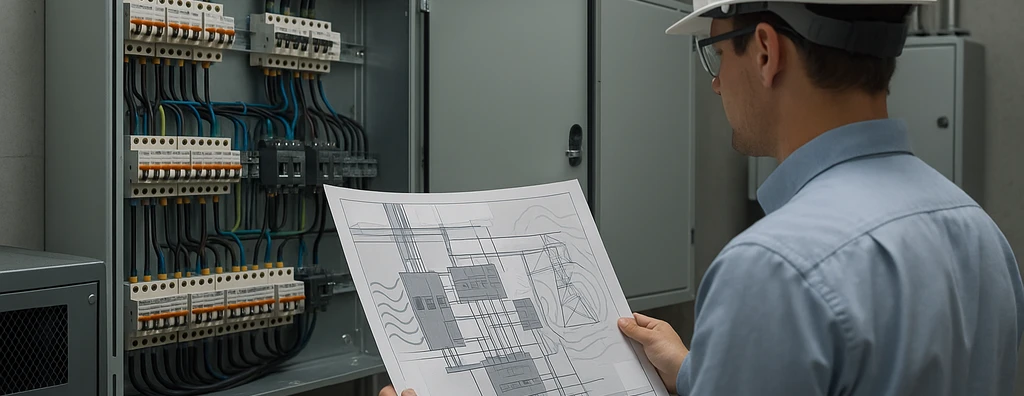
Electromagnetic compatibility (EMC) consists of ensuring that electrical systems and equipment operate together without causing unwanted disturbances to each other. The significant increase in the density of electronic devices, associated with the growth of automation installations, increases environmental susceptibility to electromagnetic interference.
Check it out!
Electromagnetic compatibility (EMC) consists of ensuring that electrical systems and equipment operate together without causing unwanted disturbances to each other. The significant increase in the density of electronic devices, associated with the growth of automation installations, increases environmental susceptibility to electromagnetic interference. This reality poses to electrical engineering the challenge of adopting strategies to mitigate risks of malfunction, intermittent failures, and system degradation, especially in industrial environments and high-technological density installations.
This article addresses the main hidden risks of electromagnetic incompatibility, applicable technical standards, mitigation methods, and best practices in electrical projects. Topics such as grounding, equipotential bonding, shielding, cable segregation, component specification, immunity testing, failure analysis, practical mitigation roadmaps, and integration of requirements into electrical design will be detailed. The goal is to provide technical support for robust projects in compliance with current standards.
Check it out!
[elementor-template id=”24446″]
Concepts and Fundamentals of Electromagnetic Compatibility
Electromagnetic compatibility is defined as the ability of electrical and electronic equipment to function properly in a common environment without generating or suffering harmful interference. In the context of electrical engineering, this objective covers:
- Reduction of conducted or radiated emissions that may affect neighboring systems;
- Mitigation of failures due to unwanted coupling;
- Maintenance of performance even under exposure to disturbances such as surges, discharges, or industrial noise.
The main international standards that ground the technical approach to EMC are the IEC 61000 series and IEC/CISPR 11, 12, 13, 14, 15, and 22, covering prescription, limits, and procedures for evaluating and mitigating interference.
Technical Standards and Applicable Regulations
Standardization ensures uniformity of criteria and safety in installations. For electrical projects subject to EMC, the following stand out:
- IEC 61000 (all parts): immunity testing methods, conducted and radiated emission, mitigation guidelines;
- ABNT NBR 5419: protection of structures against lightning, including risk analysis and equipotential protection zones (LPZ);
- ABNT NBR 5410: installation criteria and material specification for low voltage;
- IEC 61643: requirements and test methods for surge protective devices (SPD);
- IEC/TR 61000-5-2: guidelines for grounding and cabling arrangement;
- IEC/CISPR: procedures and limits for emission and immunity of industrial, commercial, and residential components.
Hidden Risks Associated with Electromagnetic Incompatibility
The lack of planning and EMC mitigation results in significant and often underestimated risks:
- Malfunction of sensitive equipment – controls, sensors, and automation systems may present random failures.
- Voltage and current surges – generated by lightning discharges or circuit switching.
- Interruptions and intermittent failures – creating difficulties for diagnosis and recovery of critical systems.
- Reduction of component life – due to exposure to noise, spikes, and repeated discharges.
- Operational and financial losses – resulting from production line downtime, equipment replacement, and unscheduled maintenance.
These effects make it essential to anticipate risks in the conception phase of the electrical project and implement robust mitigation practices.
Technical Specification of Components and Materials
Correct specification of components ensures low emission levels and adequate resistance to interference. Recommended techniques include:
- Use of devices certified according to IEC 61000 and IEC/CISPR: to attest compliance in emission and immunity;
- Choice of SPD according to IEC 61643: effective surge protection at installation entry and in critical panels;
- Use of shielded cables or twisted pairs: for sensitive instrumentation and communication circuits;
- Isolation devices or galvanic interfaces: separation between power and controls;
Choice documentation needs to detail plant, single-line diagram, constructive criteria, and technical justifications for each item used.
Grounding, Equipotential Bonding, and Equipotential Protection Zones
Implementation of grounding and equipotential bonding systems is a fundamental requirement facing regulatory demands:
- Grounding configuration: according to TN-S, TN-C, TN-C-S, TT, or IT arrangements, depending on the nature of risks and ABNT NBR 5419 requirements;
- Interconnection of grounding and equipotential bonding systems: functional connection between masses, metallic structures, and protection devices composing defined equipotential zones;
- Definition of LPZ (Lightning Protection Zones): in areas concentrating critical equipment, reducing differential potentials and unwanted coupling.
The detailing and execution of these practices are mandatory in projects and descriptive memorials.
Shielding, Physical Segregation, and Cable Organization
Physical shielding and cable segregation minimize electromagnetic field propagation and unwanted coupling between circuits:
- Metallic shielding (cages, trays, and ducts): fundamental for instrumentation circuits, control panels, and routes near noise sources;
- Physical cable separation: trays, troughs, or independent infrastructure for power and signal circuits;
- Maintaining minimum distances and orthogonal crossings: reducing coupling between high and low frequencies;
- Cable bundle identification and organization: facilitating audits and future maintenance.
Testing, Trials, and Validation of EMC Strategies
EMC validation requires rigorous testing according to appropriate parts of IEC 61000 and related standards:
- Immunity testing: subjecting systems to oscillating magnetic fields, conducted surges, electrostatic discharges, and other types of disturbance to prove robustness;
- Emission testing: measurement of radiated and conducted spectrum by equipment and infrastructures;
- Field testing: application of portable instruments for diagnosis after deployment;
All test results must be recorded, composing documentation proving adherence to the project.
Interference Mitigation in High-Technological Density Installations
High-complexity environments, such as automated industries and data centers, demand specific guidelines:
- Performing risk analysis according to ABNT NBR 5419: identifying critical points, emission sources, and zones of greater consequences;
- Implementing equipotential protection zones (LPZ): strategically designed for sensitive equipment;
- Modularization and compartmentalization of electrical panels: facilitating settings, maintenance, and disturbance containment;
- Real-time power quality monitoring: with recording devices allowing proactive actions.
Integration of EMC in Technical Documentation and Project Processes
Careful integration of EMC requirements into technical documentation increases traceability and standardization, as required by standard. It is recommended to include:
- Detailed plants, diagrams, and descriptive memorials explaining segregation, grounding, and shielding solutions;
- Representation of cable paths, protected zones, and SPD routing;
- List of validated components for emission and immunity limits;
- Archiving test reports for future compliance proof.
Practical Roadmap for Electromagnetic Risk Mitigation
- Survey and risk analysis: Identify critical loads, internal and external disturbance sources.
- Strategy definition: Specify SPD according to IEC 61643, plan grounding, shielding, and rigorous cable path segregation.
- Controlled execution: Implement according to project, detailing execution based on applicable standards.
- Validation and testing: Perform immunity and emission tests according to IEC 61000. Adjust strategies if necessary.
- Final documentation and follow-up: Record all results and maintain operational monitoring through continuous tracking.
Conclusion
Electromagnetic compatibility, when integrated into the electrical project, promotes robustness, safety, and longevity to systems, reducing operational failures and protecting investments. Adherence to IEC 61000, ABNT NBR 5419, ABNT NBR 5410, IEC 61643, and related standards, combined with implementation of rigorous grounding, shielding, segregation, and validation practices, consolidates the performance of enterprises of all sizes. Recognizing and mitigating hidden risks in each project stage are determining factors to ensure the reliability and integrity of installations in industrial, commercial, and critical environments.
Final Considerations
Systematic adoption of electromagnetic compatibility practices is crucial for excellence in electrical engineering. We thank you for reading the article and invite you to follow A3A Systems Engineering on social media to stay updated with reference technical content.
