
Understand how edge storage improves video surveillance resilience, enables failover recording, supports low-bandwidth environments, and integrates with VMS platforms.
Check it out!
Edge Storage, also known as local recording, is an efficient and cost-effective recording approach used mainly in video surveillance projects where network bandwidth is limited or unavailable.
Edge storage can improve system reliability by maintaining continuous recording and preserving complete video evidence during network or server failures. This use case is a form of contingency recording or failover.
[elementor-template id=”24446″]
Edge storage plays an important role in mobile and remote applications such as public transportation systems, trains and buses, and agricultural operations in remote locations where the network infrastructure may be unstable or unavailable.
“This technology enables high-resolution data to be captured locally while complementing lower-resolution transmission in bandwidth-constrained environments.”
Main Edge Storage Applications
Edge storage has two main applications in video surveillance systems:
- It is especially useful in mission-critical environments such as airports and major transit stations, where reliability and continuous data availability are essential;
- It allows data to be stored directly on the source device, enabling applications in environments with unstable network coverage.
Recording Redundancy
In this context, edge storage can form an essential part of a contingency strategy. It provides an additional layer of recording redundancy that complements centralized storage.
“Security cameras monitoring entrances and exits can use edge storage to maintain continuous video recording even during network failures. This helps prevent loss of critical data and supports uninterrupted operations.”
Edge storage can record video locally whenever the centralized system is unavailable, or it can operate in parallel with the Video Management System (VMS) while recording continuously.
One of the main benefits of edge storage is failover recording. During network outages or system maintenance, video can be stored temporarily on the camera’s SD card.
When the network connection is restored and the system returns to normal operation, the central VMS can automatically retrieve missing video clips from the camera and merge them with existing recordings.
This improves reliability and protects system operation by helping ensure that critical data are not lost.
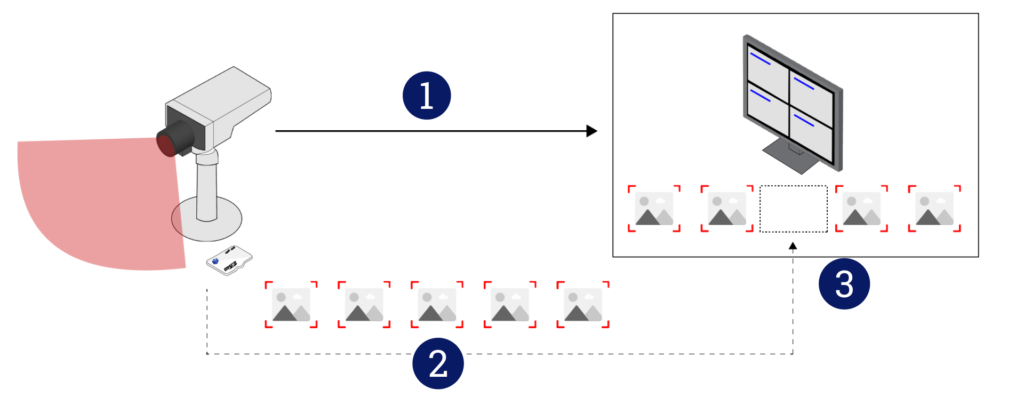
Recording to secondary storage during a failure:
- During normal operation, the camera streams video to the VMS for storage.
- If the network fails, video clips are temporarily stored on the camera’s SD card.
- When connectivity is restored, the VMS retrieves the missing clips and merges them into the recording timeline.
Edge-storage architectures for redundancy can also be integrated with many NAS (Network Attached Storage) solutions.
Low-Bandwidth Environments
Edge storage is particularly useful in video systems with limited bandwidth. In these environments, continuous transmission of high-quality video may be impractical.
Combined with edge storage, advanced video compression can significantly reduce bandwidth and storage requirements while preserving relevant forensic information.
An example is an onboard train deployment. In this scenario, edge storage enables continuous video recording while the vehicle is moving because data are stored locally, eliminating dependence on a constant network connection.
When the vehicle reaches a station and network connectivity becomes available, the recordings can be transferred to the central system.

Storage Cards for Video Surveillance
Storage cards used in video surveillance are predominantly based on Secure Digital (SD) technology, including SDHC (Secure Digital High Capacity) and SDXC (Secure Digital eXtended Capacity) variants.
These flash-memory devices are designed to provide high storage capacity for portable devices such as video cameras and smartphones.
In our Online Store, we offer SD cards designed specifically for video surveillance applications.
These cards are optimized for sustained performance in surveillance workloads. Industrial-grade models are designed for higher endurance and operation in demanding environments and temperatures.
Cameras with Edge Storage
Cameras with edge storage can store video directly on the camera through an SD card, improving system resilience and enabling high-performance surveillance applications in remote areas.
In our Online Store, we offer a broad range of cameras designed for reliable video surveillance applications.
Video Management Software
Os Video Management Software (VMS) são componentes essenciais em sistemas de videomonitoramento, proporcionando uma plataforma centralizada para gerenciar e analisar feeds de vídeo de múltiplas câmeras.
When integrated with edge storage, VMS platforms can significantly increase system resilience and flexibility.
We work with leading manufacturers and certified technology ecosystems to provide access to advanced and reliable solutions.
Contact our Engineering Department to evaluate VMS options and identify the architecture best suited to your video surveillance requirements.
