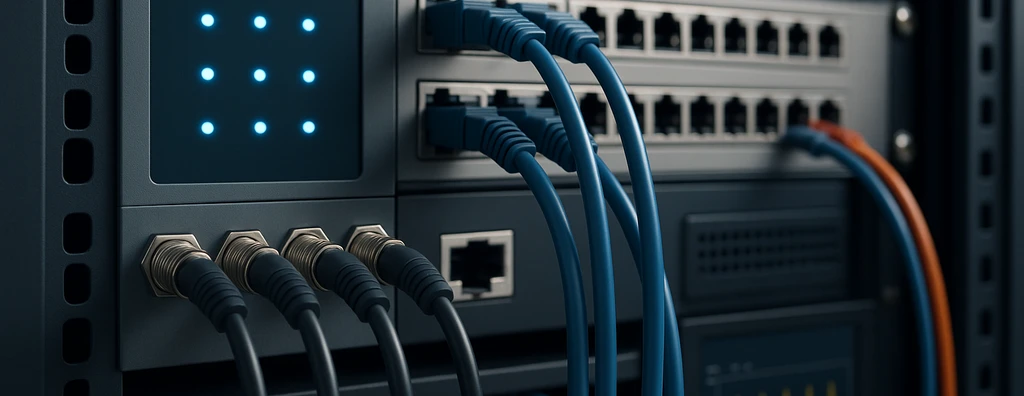
Digital modulation and multiplexing are fundamental pillars in the development and operation of modern data networks, directly influencing efficiency, reliability, and scalability.
Check it out!
Digital modulation and multiplexing are fundamental pillars in the development and operation of modern data networks. The efficiency, reliability, and scalability of digital transmissions depend directly on how these processes are implemented in order to maximize spectrum use, mitigate interference, and meet growing bandwidth demands across multiple wired, optical, and wireless networking scenarios. The technical challenges involve selecting suitable methods in light of channel variables, performance requirements, and established standards in the telecommunications sector.
This article examines in depth the principles of digital modulation, multiplexing techniques, their practical impact on projects, application examples, and normative considerations. The goal is to provide a solid theoretical basis combined with a systemic view for decision-making in network engineering and integration.
Check it out!
[elementor-template id=”24446″]
Technical Fundamentals of Digital Modulation
Digital modulation is the process by which digital signals representing binary information are converted into analog waveforms suitable for transmission over different physical media, such as copper cables, optical fibers, and radio channels. The classic methods of digital modulation include:
- NRZ (Non-Return-to-Zero): The simplest format, in which a positive voltage level represents bit 1 and a negative level represents bit 0. In optical systems, the presence or absence of light plays this role.
- Quadrature Amplitude Modulation (QAM): Combines multiple amplitude and phase levels to encode a larger number of bits per symbol, increasing spectral efficiency.
- Frequency Shift Keying (FSK) and Phase Shift Keying (PSK): Use changes in carrier frequency or phase to represent digital bits.
Practical example: A QAM-16 transmission makes it possible to encode 4 bits per symbol, mapped to different amplitudes and phases, offering higher data-rate density without a proportional increase in bandwidth.
These techniques are essential to adapt digital data to different communication channel characteristics, optimizing transmission performance in the face of noise, distortion, and bandwidth limitations.
Multiplexing in Data Networks
Multiplexing refers to the technique of combining multiple data streams into a single physical or logical channel, optimizing the use of transmission resources. Among the main methods employed, the following stand out:
- Frequency Division Multiplexing (FDM): Divides the total available spectrum into distinct frequency bands, each assigned to a logical channel. It is widely used in analog systems, such as AM radio, and in digital applications using passband modulation. For example, three voice channels can be multiplexed on separate frequencies, with bandwidth controlled by filters to avoid interchannel interference.
- Time Division Multiplexing (TDM): Allocates exclusive time intervals to each data stream over the same physical medium. Each user transmits in its own time slot in a round-robin scheme. This approach predominates in digital networks and telephony systems, allowing the aggregation of multiple users over high-capacity links.
- Orthogonal Frequency Division Multiplexing (OFDM): Implemented by means of the Fourier transform, this method divides a high-rate stream into several low-rate substreams transmitted over parallel orthogonal subcarriers. If one subcarrier is degraded by the channel, it may be excluded, providing robustness against selective interference. It is a key technique in standards such as IEEE 802.11, cable TV networks, and power-line transmission systems.
Through these techniques, it becomes possible to enable scalable, flexible, and high-performance networks, making the correct specification of methods indispensable according to traffic profile and physical-channel conditions.
Integration of Digital Modulation and Multiplexing in Network Projects
The proper combination of modulation and multiplexing techniques generates efficient transmission systems for local, metropolitan, and wide-area networks. Practical examples of integration include:
- Wired Networks: In Ethernet over copper, baseband NRZ modulation is commonly used together with TDM multiplexing in switches and routers to consolidate multiple data streams over physical links.
- Optical Networks: In optical systems, modulation may be performed through light amplitude, or on-off keying, integrating TDM and, in advanced applications, wavelength division multiplexing.
- Wireless Networks: Technologies such as Wi-Fi under IEEE 802.11 use OFDM, consolidating several parallel channels over the same spectrum, with each terminal receiving distinct subcarriers depending on channel quality.
- Digital Telephony: TDM is fundamental in E1 and SDH systems, where multiple digital voice and data channels share synchronous high-capacity links.
Systemic understanding of these integrations contributes to the definition of robust projects, maximizing spectral efficiency, throughput, and network resilience.
Technical Challenges and the Impact of Modulation and Multiplexing Choices
Selecting best practices in modulation and multiplexing requires consideration of factors such as:
- Available Bandwidth: More advanced methods, such as high-order QAM and OFDM, optimize spectrum use and enable higher transmission rates without proportional increase in occupied spectrum.
- Resilience to Interference: The use of orthogonal-subcarrier multiplexing and Gray coding in QAM modulation reduces the incidence of errors, especially in environments subject to noise and channel fading.
- Implementation Complexity: Techniques such as OFDM and TDM in high-speed systems require precise synchronization, robust digital processing, and latency control.
- Technical Standards: Established transmission-system standards require minimum levels of isolation, jitter control, and BER parameters, directly influencing the choice of modulation and multiplexing architectures.
Proper handling of these aspects is decisive for the success of integration projects, technology migration, and network expansion.
Evolution and Trends in Modulation and Multiplexing
The advancement of network technologies fosters the adoption of innovative digital modulation and multiplexing techniques, especially with regard to speed aggregation, improved spectral efficiency, and dynamic adaptation to channel state.
- OFDM in Next-Generation Networks: Its ability to divide the digital flow into multiple subchannels enables sophisticated mitigation of selective interference and channel variation, supporting communication systems in 4G and future 5G networks.
- Automation and Intelligence: Dynamic algorithms for subcarrier and time-slot allocation maximize performance in heterogeneous and adaptive scenarios, aligned with the demands of IoT and critical mission applications.
- Synergy with Media Access Control Protocols: The combined use of multiplexing with efficient physical-medium access protocols enhances performance and scalability in private and public networks.
The continued evolution of these techniques is essential to support, in a reliable way, the exponential growth of data traffic and the integration of new applications in distributed and convergent environments.
In summary, digital modulation and multiplexing are structuring elements for the engineering of data networks, enabling the optimization of physical resources and ensuring the viability of high-capacity transmission architectures. Mastery of the techniques, the associated challenges, and the regulatory parameters is indispensable for robust, scalable projects aligned with best practices in the telecommunications sector. It is recommended that the selection of methods always be guided by rigorous technical criteria, analysis of the application scenario, and compliance with normative requirements, thereby promoting efficiency, security, and continuous evolution of network infrastructures.