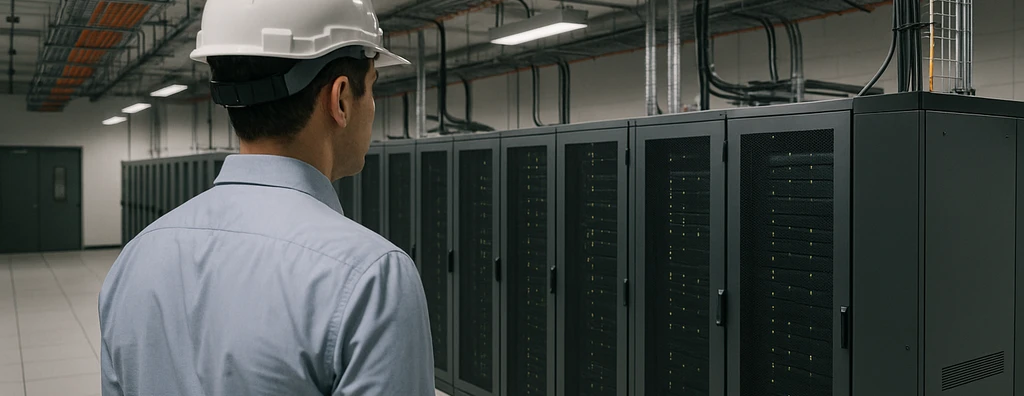
Understand the differences between CPDs and Data Centers, with technical guidance on networks, power, cooling, monitoring, and standards for critical environments.
Check it out!
Environments dedicated to data processing have evolved to meet increasing demands for availability, scalability, energy efficiency, and information security. From compact spaces dedicated to centralized processing, known as Data Processing Centers (DPC), these infrastructures have advanced to Data Centers, robust structures that house high-density computing systems and address rigorous requirements for operational continuity, redundancy, connectivity, and asset protection. The accelerated development of digital businesses and the advancement of critical applications themselves demand comprehensive architectural strategies to support both informational flows and the integrity of IT services.
This article addresses the technical and conceptual differences between DPCs and Data Centers, regulatory requirements, fundamental aspects of architectures, key vectors of technological evolution, and developments in electrical, network, climate control, electronic security, and environmental monitoring infrastructure. The goal is to provide a solid and systematic reference for engineering, architecture, IT professionals, and managers responsible for the design, updating, or expansion of these critical infrastructures.
Check it out!
[elementor-template id=”24446″]
Terminology and Definitions: DPC versus Data Center
Data Processing Centers (DPC) represent physical environments dedicated to the centralization of computing and network resources, typically implemented as dedicated areas within corporate buildings. Such spaces traditionally meet local processing and storage demands, generally presenting smaller scale, restrictions on redundancy, limited electrical capacity, and climate control solutions sized for moderate computational loads.
Data Centers are characterized by environments designed according to international standards for critical infrastructure, structured to ensure high availability, resilience, 24×7 operations, and modular scalability. They surpass traditional DPCs in terms of subsystem diversification, increasing levels of automation, redundant power architecture, environmental control, physical and logical protection, and integration with continuity and IT governance strategies.
The transition from DPCs to Data Centers involves the integration of specialized energy architectures (backup power, redundant UPS, generators, isolated distribution systems), precision climate control, fire detection and suppression systems, structured cabling according to ABNT NBR 14565:2013 and other sector standards, as well as advanced monitoring resources, access control, regulatory CCTV, and incident response mechanisms.
Infrastructure Evolution: Key Factors and Trends
The evolution of DPC infrastructures to Data Centers is driven by the following systemic needs:
- Availability and operational continuity: Presuppose redundancy architecture for power, climate control, connectivity, and critical equipment, supporting failures without service interruption.
- Physical and logical scalability: Adoption of modular layouts and expandable systems, allowing dynamic capacity increases without impacting continuous operation.
- Multidimensional security: Integration of environmental monitoring, strict physical and logical access control, video monitoring according to ABNT NBR IEC 62676 guidelines, and implementation of physical/virtual barriers against internal and external threats.
- Energy efficiency: Implementation of designs that favor rational energy consumption, use of high-efficiency UPS, free cooling, advanced thermal management, and air flow segregation through corridors or containment.
- Regulatory compliance: Adherence to ABNT, IEC, TIA standards, international requirements, and specific segment recommendations, including maintenance, operation, and incident tracking and records.
These demands give rise to an infrastructure whose management is supported by computerized systems, allowing auditing, traceability, and visibility over all critical components, from structured cabling to environmental and electrical performance.
Network Architecture, Communication, and Structured Cabling
Standards and Topologies in Critical Environments
Structured cabling for Data Centers follows principles detailed in standards such as ABNT NBR 14565:2013 and ABNT NBR 16264:2016, with physical subdivisions that include backbone, main area, and coverage cabling. The logical modeling employs hierarchical architecture, with redundant distribution of connection points, use of panels, modular outlets, fiber optic routes, and systematic identification of network and power elements.
- Optical backbone system for high bandwidth between racks and technical areas.
- Local access subsystems organized according to data flow, latency reduction, and minimization of single points of failure.
- Computerized management of records of points, connections, energy usage, and integration of environmental sensors for temperature, humidity, and status control.
External and Internal Communication
- Connectivity via WAN, MAN, and LAN lines, sized according to demand (SAN, NAS, application farms, industrial IoT, clusters).
- Dedicated networks with physical segregation and VLANs to mitigate broadcast risks and maximize security.
- Passive infrastructure installed in metal conduits, segregated routing, and regulatory grounding, supporting both network performance and electrical safety.
The effective management of cabling and technical spaces is supported by databases and digital inventory systems, ensuring traceability, documentation, and maintainability.
Electrical Infrastructure: Redundant Power, Protection, and Efficiency
Electrical Architecture for Mission-Critical Environments
The power supply in Data Centers adopts redundancy practices (N+1, 2N, 2N+1), combining normal sources (public distributor) and backup sources (generator sets, double conversion UPS, battery banks). Compliance with national and international standards, such as ABNT NBR 5410, IEC 61643-12, and ABNT NBR 5419, is essential for mitigating vulnerabilities to electrical failures, surges, and lightning strikes.
- Isolated distribution of critical loads, through exclusive panels and supervised trialhas.
- Adoption of Surge Protection Devices (SPD) in power and signal circuits, ensuring immunity according to IEC 61000-4-5.
- Equipotential bonding and standardized grounding, reducing overvoltage risks and promoting safety for people and equipment.
- Physical separation between power, signal, and grounding lines, including routing through armored conduits and optical interface between subsystems.
- Automated energy management, enabling real-time monitoring, failure alarms, and historical consumption data, assisting decisions on PUE (Power Usage Effectiveness) and operational efficiency.
The electrical architecture must be planned from the construction premises, incorporating expansion facilities, equitable distribution among redundant circuits, visual and physical identification of power paths, and integration with building automation systems.
Precision Climate Control and Environmental Monitoring
Climate Control Systems in Data Environments
Data Centers require precision air conditioning systems designed to maintain temperature, humidity, and air quality within strict limits, according to manufacturer recommendations and international standards. Climate control methods include air flow distribution through raised floors, cold/hot corridors, and containment, adjusted to the profile of thermal loads and their fluctuations.
- Distributed sensors monitor temperature, relative humidity, condensation points, air speed, and detection of harmful particles.
- Integration of climate control systems with other automation subsystems (BMS) for rapid response to environmental events and consumption optimization.
- Remote monitoring, automatic alarms, and redundancy of critical equipment increase resilience in the face of isolated failures.
Environmental control also encompasses pressurization, advanced filtration, segregation of sensitive areas, and periodic inspections to ensure continuous compliance throughout the operational lifecycle.
Electronic Security and Integrated Monitoring
Video Monitoring and Access Control Systems
The physical security of DPCs and Data Centers employs video monitoring according to requirements established by ABNT NBR IEC 62676, reinforced by the integration of access control systems, physical barriers, environmental sensors, and sector alarms.
- IP CCTV with coverage in critical areas, zone monitoring, intelligent video analysis, and redundant event recording.
- Multi-level access control (biometrics, cards, PIN), electronic records of entries and exits, and integration with other building security systems.
- Environmental sensors for early detection of smoke, thermal variation, and intrusion, minimizing risks of internal and external incidents.
- Segregated physical infrastructure, protected pathways for cabling, breach alarms, and integration of all events into a centralized management platform.
It is essential that the physical and logical access control meets the highest levels of auditability, traceability, and segmentation according to user profiles and internal security policies.
Management, Operation, and Maintenance
Management of Critical Infrastructures
The management of Data Centers is carried out by specialized platforms capable of integrating information from all subsystems: power, climate control, security, network, and computing assets. Such systems enable:
- Centralized monitoring of physical and logical parameters, alarms, performance levels, and equipment health.
- Incident management, planned interventions, preventive and corrective maintenance routines with detailed history.
- Process auditing, traceability of operations (including physical and logical access logs), dynamic asset inventory, and capacity management.
- Integration with corporate governance, continuity, and compliance processes, ensuring adherence to internal requirements and external regulations.
Technical Documentation and Strict Control
Documenting all operational stages and interventions is a fundamental component of robust and standards-oriented management. A database for managing cabling, electrical, and climate control, including performance indicators and configuration records, facilitates audits and optimizes the lifecycle of the infrastructure.
National and International Technical Standards
Regulatory compliance is an unavoidable requirement for the design, implementation, and operation of critical data infrastructures:
- ABNT NBR 14565:2013 – Structured cabling for commercial buildings and Data Centers;
- ABNT NBR IEC 62676 – Requirements and recommendations for video monitoring systems;
- ABNT NBR 5410 – Low voltage electrical installations;
- ABNT NBR 5419 – Protection against lightning strikes;
- IEC 61000-4-5 – Immunity to electrical surges in electronic equipment;
- IEC 61643-12 – Surge protection devices;
- Complementary international standards (TIA/EIA, ISO/IEC for Data Centers, IEEE for connectivity).
These technical references guide the sizing, specification, construction methods, material selection, and acceptable performance and safety parameters for all involved subsystems.
Conclusion
A precise understanding of the distinctions between traditional DPCs and modern Data Centers provides a secure basis for sound decisions in engineering, architecture, and IT management. The advancement of critical data infrastructures demands total integration of electrical, network, climate control, electronic security, and environmental control systems, all guided by strict regulatory guidelines and a systemic thinking that prioritizes availability, adaptability, and governance.
Successful projects depend on the accurate analysis of redundancy, resilience, energy efficiency, and constant technological update requirements, as well as strict control of operational risks and compliance. Mission-critical environments, when well-designed and managed, support not only the continuity of corporate operations but also foster innovation and deliver sustainable value to the business.
The appropriate choice of standards, construction methods, and technologies, combined with integrated monitoring and precise documentation of processes, is decisive for the longevity, safety, and operational efficiency of any contemporary data infrastructure.
Final Considerations
The understanding of the concepts, requirements, and particularities that distinguish DPC from Data Center is constantly evolving and is essential for professionals who wish to foster resilient and secure digital environments. We thank you for reading this article and invite you to follow A3A Engineering Systems on social media to stay updated on practices, trends, and solutions in the realm of critical data infrastructures.
Relevant Links (Complementary Technical Materials)
Telecommunications Network Design
Structured Cabling Design – Complete Guide
Technical Standards for Structured Cabling
Standard 14565 – Structured Cabling
eBook – Why Hire a Structured Cabling Project?
Fiber Optic Cable
Internal Optical Distributor (DIO)
Testing and Performance
Network Certification for Structured Cabling
Consulting on Structured Cabling Projects
Structured Cabling Installation
How to Avoid Common Problems in Structured Cabling Systems?
Components and Subsystems
Components of Structured Cabling
Subsystems of Structured Cabling
Main Benefits of Structured Cabling
Network Cabling in CAT5e vs CAT6
Network Cabling in CAT6 vs CAT6A
Topology and Architecture
Network Architecture and Topology – How to Ensure Performance
Network Topology: Types and Applications in Telecommunications Networks
Services
Regulatory References
“NBR 14565 – Structured Cabling for Commercial Buildings” – ABNT (Brazilian Association of Technical Standards)
“ISO/IEC 11801 – Generic Cabling for Customer Premises“- ISO/IEC (International Organization for Standardization) & (International Electrotechnical Commission)
“ANSI/TIA 568 – Generic Telecommunications Cabling for Customer Premises” – ANSI/TIA (American National Standards Institute) & (Telecommunications Industry Association)
“What are the structured cabling services and their respective RTs?” – CREA (Regional Council of Engineering and Agronomy)
“Structured Cabling Systems: the Fact File” – CommScope
Frequently Asked Questions
The Structured Cabling System (SCS) is a standardized infrastructure of cables, connectors, racks, cable trays, connection panels, and network assets that provides the foundation for a telecommunications network to operate optimally.
DPC (Data Processing Center) typically refers to a room or internal environment focused on the IT infrastructure of a single company. In contrast, Data Center is an environment designed for high availability, redundancy, and scalability, capable of hosting multiple clients, cloud services, and critical systems.
Restricted access control
Dedicated climate control system
Structured cabling according to standards
Stabilized power (UPS and/or generator)
Monitoring (CCTV, sensors)
Documentation and contingency plan
Total redundancy (power, climate control, links)
Compartmentalized environments (vault rooms, security zones)
International certifications (e.g., Tier, ISO 27001)
24/7 services and high SLA
Scalable operation and virtualized environments
Yes! Structured cabling is essential to ensure performance, organization, security, and ease of expansion, being required by technical standards (NBR 14565, TIA/EIA, ISO/IEC).
It is recommended to use at least Cat6A for metallic links (10Gbps), Cat8 for ultra-high-speed connections over short distances, and fiber optic OM3/OM4/OM5 for backbone or long-distance/high-density links.
Unexpected downtime
Data loss
Legal risks and non-compliance
Difficulty in expansion
High costs for emergency fixes
Evaluate growth requirements
Ensure complete technical documentation
Check regulatory compliance
Plan for redundancy and backups
Update cabling and equipment according to new demands
