
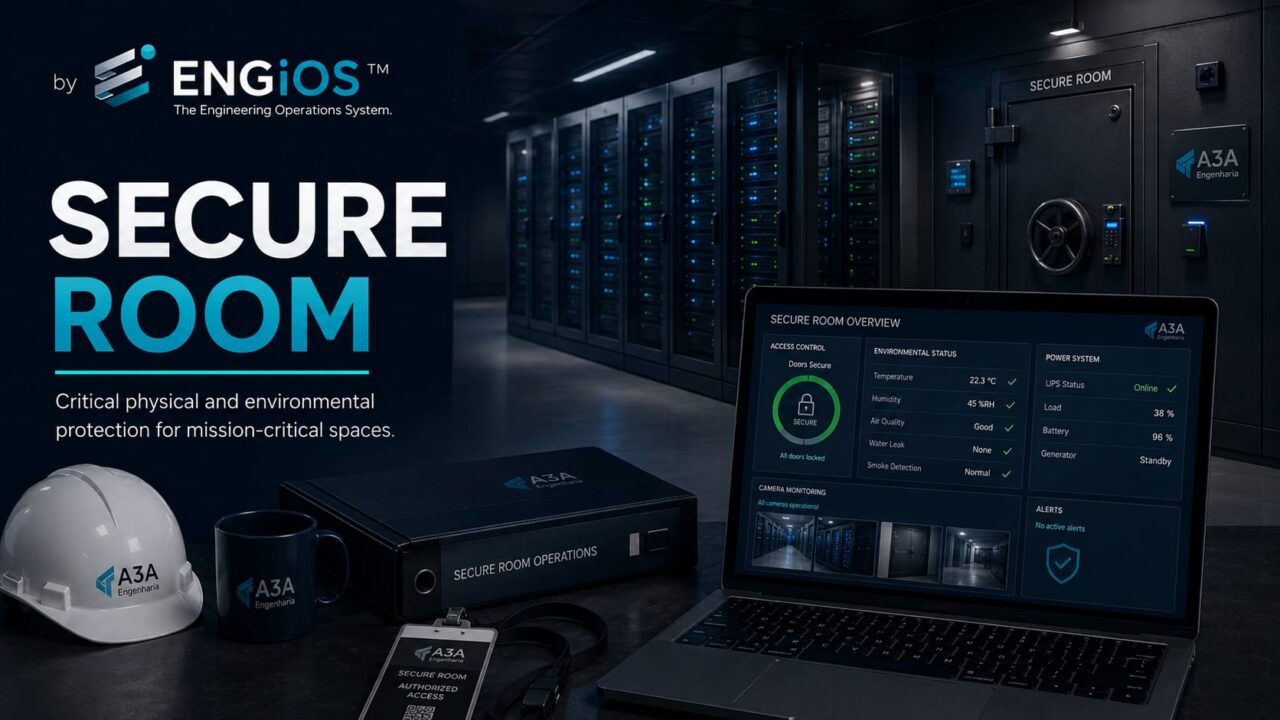
Understand what a data vault room is, how it differs from a secure room, applicable standards, fire and water protection, power, cooling, security, testing, and acceptance criteria.
Check it out!
A data vault room is a highly protected environment designed to house technology, telecommunications, and data-processing equipment when service continuity requires a level of physical and environmental protection above that of a conventional technical room. The solution combines a controlled-performance building envelope with doors, technical penetrations, cooling, power, fire detection, monitoring, and access control. The concept should not be reduced to a “fire-resistant room”: its effectiveness depends on integration between the protected cell and every system that crosses or supports the environment.
In Brazil, the Portuguese expression sala cofre also has established technical and regulatory usage. ABNT NBR 15247 is a national reference for classification and fire-resistance testing of vault rooms and hardware safes, while EN 1047-2 addresses data rooms and data containers internationally. Choosing a data vault room should result from risk analysis, availability requirements, asset criticality, and continuity strategy, not merely from a product specification.
What Is a Data Vault Room
A data vault room is an IT-environment protection solution designed to keep internal equipment within acceptable conditions when exposed to previously defined external threats. It creates an additional barrier between critical infrastructure and the building that houses it.
From an engineering standpoint, the logic is similar to the room-in-room concept: an independent cell is installed inside an existing building or incorporated into the design, with walls, ceiling, floor, door, and interfaces engineered to preserve envelope performance. This independence matters because a Data Center is not threatened only by internal failures. Fire in an adjacent area, water from building systems, smoke, unauthorized access, impact, or third-party interventions can compromise assets even while IT equipment itself is operating normally.
The complete infrastructure of a Data Center includes power, cooling, telecommunications, physical security, fire protection, automation, and operations. The data vault room acts as a protection layer for that infrastructure, not as a substitute for it.
Data Vault Rooms, Secure Rooms, and Server Rooms Are Not the Same Thing
The terms are often used interchangeably, but they represent different levels and approaches to protection.
A conventional server room is a room prepared for racks, network equipment, and servers. It may have precision cooling, UPS, access control, and fire detection, but its enclosure is normally part of the building itself and does not necessarily have performance tested as an integrated system.
A secure room is a modular construction, usually self-supporting and reassemblable, developed to increase the environment’s physical protection. Within Brazilian federal public administration ICT procurement rules, a secure room is described as a modular system of reassemblable panels intended to protect hardware and integrated with electrical, cooling, monitoring, and fire-protection subsystems.
A data vault room adds a requirement for certified or demonstrated performance according to the applicable standard. In the regulatory context cited, it is characterized as an environment that incorporates the features of a secure room and must meet certification based on ABNT NBR 15247, EN 1047-2, or another recognized equivalent standard.
| Environment | Typical protection | Dedicated enclosure | Cell certification | Most common use |
| Server room | operational | not necessarily | normally no | lower-criticality corporate IT |
| Secure room | enhanced physical and environmental | yes | depends on scope | additional protection in an existing building |
| Data vault room | high-performance physical and environmental | yes | central element of the solution | critical assets and high continuity requirements |
Correct terminology prevents generic specifications. Purchasing “a data vault room” without defining which threat must be mitigated, which performance criteria must be demonstrated, and how interfaces will be handled results in an incomplete procurement.
When a Data Vault Room Makes Sense
The decision should be based on the consequence of losing the environment and on the building’s exposure. The solution tends to be justified when interruption, destruction, or unavailability of the assets can create a high operational, economic, institutional, or security impact.
Typical situations include:
- corporate Data Centers concentrating critical applications;
- public agencies providing essential digital services;
- operations centers and NOCs;
- mission-critical telecommunications and network environments;
- financial institutions and sensitive-processing environments;
- hospitals and healthcare infrastructure with IT-dependent systems;
- industrial facilities where control and data systems contribute to process continuity;
- environments in existing buildings where external risk is incompatible with IT criticality.
The assessment should not start from the value of the servers. What matters is the impact of losing the supported function. A relatively inexpensive set of equipment may support a service with a very low allowable downtime.
When a Data Vault Room May Not Be the Best Solution
A data vault room is not automatically superior to every other architecture. In a new Data Center, it may be more efficient to design the building and its compartments with protection levels consistent with the risk, avoiding a second enclosure where it does not add proportional value.
The continuity strategy may also depend more on geographic redundancy, data replication, active-active architecture, or cloud use than on extreme protection of a single room. The decision must compare local protection with system-wide resilience.
In other situations, a modular Data Center solution may better address schedule, expansion, or deployment constraints. The central point is to select architecture based on risk and business requirements rather than on the commercial name of the solution.
Risk Analysis Must Precede the Specification
Before specifying panels, doors, or certification, define threats, criticality, required availability, and acceptance criteria. Engineering must convert risk into verifiable requirements.
The design begins by identifying events capable of causing loss of function. External and internal threats must be evaluated together.
Events that may justify specific measures include:
- fire in an adjacent area;
- temperature and humidity rise during a fire;
- smoke and corrosive gases;
- water ingress due to leaks, firefighting, or building-system failures;
- intrusion and unauthorized physical access;
- mechanical impact;
- cooling failure;
- power interruption;
- simultaneous failure of redundant equipment due to a common cause;
- dust or contaminant ingress;
- unauthorized intervention in cables, ducts, or piping;
- unavailability during maintenance.
The analysis must relate each threat to its consequences, existing barriers, and residual risk. This prevents the design from focusing on fire while leaving an electrical single point of failure or an untreated water pipe.
What ABNT NBR 15247 Represents in the Design
ABNT NBR 15247:2004, cited in recent official documents from Brazil’s Federal Court of Accounts and in federal ICT procurement regulations, addresses secure storage units, including vault rooms and hardware safes, with classification and test methods related to fire resistance.
Its relevance lies in the fact that hardware protection cannot be inferred solely from the fire resistance of an isolated wall. Expected performance involves the behavior of the assembly and the internal conditions imposed on equipment and storage media.
This changes the way the solution is specified. The designer should not add “fire-resistant” components and assume that the resulting room has the same performance as a tested system. Door, joints, panels, floor, ceiling, and penetrations must be consistent with the evaluated system.
EN 1047-2 and Data Room Protection
EN 1047-2 is an international reference specifically for data rooms and data containers. The 2019 version establishes protection classes and test procedures that assess the environment’s behavior during fire exposure and other requirements associated with the system.
The important engineering aspect is assessment of the environment as a unit. The standard considers elements such as room construction, flooring, and openings required for cables, piping, and ventilation. Altering a construction detail without evaluating its impact may invalidate the performance originally demonstrated.
Certification therefore should not be treated as a commercial document separate from the construction. It must be linked to the configuration actually supplied and installed.
EN 50600 and the Room-in-Room Concept
The EN 50600 family addresses Data Center facilities and infrastructures. Its building-construction part considers environmental risks, access, intrusion, fire protection, water damage, and construction quality. The room-in-room concept describes a physically independent chamber with its own walls and ceiling, inserted into a new or existing building.
The relationship with a data vault room is direct: creating a second barrier can increase separation between the critical environment and events in the host building. However, this works only when interfaces are handled consistently.
The Enclosure Is a System, Not a Collection of Panels
Walls, ceiling, and floor must form a continuous barrier. Assembly performance can be compromised by joints, intersections, gaps, deformation, technical penetrations, and connections to the existing structure.
The design should verify:
- enclosure continuity;
- joint behavior;
- compatibility among panels, door, ceiling, and floor;
- support and stability;
- installation tolerances;
- interfaces with existing slabs, columns, and walls;
- access for installation and maintenance;
- possibility of expansion or disassembly where applicable.
The condition of the host building itself must also be known. A protected cell installed below a roof vulnerable to water, for example, still depends on proper drainage and mitigation.
The Door Is a Critical Part of Protection
The door combines compartmentation, physical security, emergency, and daily operational functions. It must preserve the envelope’s intended performance without creating a barrier incompatible with egress, rescue, or maintenance requirements.
The design must coordinate:
- resistance and performance compatible with the cell;
- locks and locking mechanisms;
- access control;
- status contacts;
- door-open detection;
- emergency opening;
- fire-system integration;
- contingency procedures;
- logistics for bringing equipment in and out.
A technically robust door can become an operational problem if future racks, UPS systems, or equipment cannot pass through it. Dimensions and handling routes must be addressed from the concept stage.
Cable, Duct, and Pipe Penetrations Are Vulnerable Points
No IT room operates in isolation. Power, telecommunications, fiber, control cables, drainage, detection, and cooling must cross or interact with the enclosure.
Each opening represents a potential loss of performance. Engineering must define how penetrations will be sealed, identified, tested, and maintained. Expansion must also be planned, because improvised drilling after handover can destroy the protection characteristics originally designed.
Data Center cabling must be coordinated with architecture, fire protection, and physical security. Trays and pathways cannot be defined only for installation convenience.
Fire Protection Does Not End with Room Fire Resistance
The enclosure protects against external effects, but fire can also originate inside the environment. Power sources, cables, electronic equipment, batteries, and materials in the room must be considered.
The strategy may include:
- early smoke detection;
- point or aspirating detection as defined by the design;
- alarm integration;
- controlled shutdowns;
- cooling control;
- compartmentation;
- suppression agents where technically specified;
- emergency procedures;
- interfaces with the building’s fire-protection system.
The article on fire safety in Data Centers examines these interfaces in greater depth. It would be a mistake to specify the vault room as a substitute for a prevention, detection, and response strategy.
Water Must Be Treated as a Design Threat
Water can reach the environment through building piping, condensation, cooling drains, infiltration, firefighting systems, or interventions on upper floors.
The design must identify sources, paths, and consequences. Depending on risk, measures may include:
- leak sensors;
- drainage;
- physical barriers;
- separation from piping;
- alternative routes;
- containment trays;
- detailed joints and penetrations;
- response procedures.
Avoiding piping unrelated to the Data Center above the critical environment reduces risk, but does not eliminate the need to assess the building as a whole.
Smoke, Gases, and Contaminants Also Affect Continuity
Hardware can fail even without direct flame contact. Combustion products, particles, and corrosive gases can enter the environment and degrade boards, connectors, and equipment.
For this reason, airtightness, closure of openings, and ventilation behavior during events must be part of the operational sequence. Emergency logic must define when supply air is stopped, how contaminant spread is prevented, and how operation is restored after the event.
Cooling for the Data Vault Room
The protected cell continues to generate a high heat load. Cooling must maintain environmental conditions during normal operation and have a strategy consistent with the required availability.
Sizing cannot be based only on room area. It must consider:
- equipment heat load;
- rack density;
- planned growth;
- air distribution;
- aisle containment where applicable;
- equipment redundancy;
- maintenance without loss of critical capacity;
- cooling-system power supply;
- condensate and drainage;
- sensors and alarms;
- emergency behavior.
Data Center cooling must be designed together with the enclosure. Ducts, pipes, and units installed incompatibly can create interfaces that reduce the cell’s physical protection.
Electrical Power: a Protected Room Does Not Eliminate Single Points of Failure
Cell protection is effective only when power, cooling, telecommunications, fire protection, and physical security are treated as interfaces of the same system.
IT continuity depends on a complete electrical chain. A data vault room may withstand an external event and still become unavailable if the supply has a single transformer, a single panelboard, a single UPS, or an unidentified common path.
The architecture may include:
- normal and alternate supplies;
- UPS systems;
- battery banks;
- generator sets;
- ATS or transfer systems;
- A/B distribution;
- PDUs and busways;
- protection and selectivity;
- grounding and equipotential bonding;
- power monitoring.
The Critical Infrastructure Power solution addresses this chain. The data vault room must integrate with it while preserving the routes and penetrations required without creating hidden dependencies.
Redundancy Must Eliminate Common Failures, Not Just Duplicate Equipment
Two devices side by side, powered from the same panel and using the same penetration, do not necessarily form a resilient architecture. The analysis must identify common failure points among supposedly redundant components.
In a data vault room, this includes power routes, fiber, cooling, sensors, control panels, and penetrations. If they all cross the same vulnerable area, one event may eliminate both chains.
The logic is the same as in Data Center electrical architectures N, N+1, 2N, and A/B: redundancy must be evaluated across operating modes and physical paths.
Telecommunications and Route Diversity
Protecting servers has limited value if external connectivity depends on a single exposed route. Carrier entrances, fiber paths, distributors, and backbone must be evaluated from a continuity perspective.
Real diversity requires analyzing not only two cables but also their origins, building entrances, paths, boxes, shafts, and any shared segments. The data vault room should receive these routes in an organized, identified manner compatible with penetration protection.
Access Control and Physical Security
Room security begins before the door. A layered approach seeks to keep threats away from the asset through perimeter protection, controlled areas, internal zones, and authentication appropriate to criticality.
Physical security in Data Centers should integrate:
- access control;
- CCTV;
- intrusion detection;
- event logging;
- visitor management;
- privileged credentials;
- two-factor authentication where risk justifies it;
- maintenance and emergency procedures.
The data vault room is the last barrier, not the only one.
Environmental Monitoring and Alarms
Sensors turn physical conditions into operational information. Temperature, humidity, leakage, smoke, door status, power, UPS, cooling, and other parameters can be monitored according to criticality.
The architecture must define what constitutes a warning, alarm, and critical condition. Alarms without priority, ownership, and an associated procedure create noise rather than availability.
Integrations with BMS, DCIM, or supervisory systems must account for loss of communications. The protection system cannot depend exclusively on a central platform without a strategy for failure of the supervisory layer itself.
DCIM, BMS, and EPMS: Different Roles
Infrastructure management may involve different platforms. DCIM concentrates resources related to the Data Center environment and capacity; BMS supervises building systems; EPMS handles measurements and states of the electrical distribution.
Integration is useful when data and alarm governance exists. The content on DCIM, BMS, and EPMS in Data Centers details these differences.
For the data vault room, the essential requirement is that relevant states remain observable and that loss of a management system does not prevent essential local protections.
Design in an Existing Facility Requires a Rigorous Survey
Many data vault rooms are installed in existing buildings. This turns the project into a Brownfield intervention.
Before defining the solution, verify:
- actual dimensions;
- structure and load capacity;
- access and logistics;
- equipment routes;
- interferences;
- shaft and piping positions;
- existing electrical supply;
- cooling capacity;
- telecommunications pathways;
- existing fire protection;
- drainage and water risks;
- construction and working-hour restrictions;
- documentation condition.
The design should not assume that old drawings represent current conditions. Differences between drawings and field conditions can make panels, doors, routes, and installation unfeasible.
Structure and Loads Must Be Verified
Panels, raised floors where applicable, racks, UPS systems, batteries, and cooling equipment create loads that must be compatible with the existing structure.
In addition to distributed loads, there are concentrated loads and handling paths during implementation. The analysis must consider how components reach the location and whether elevators, corridors, and slabs can support the logistics operation.
A high-performance solution that cannot be installed safely is not a viable solution.
Expansion Must Be Planned Before Installation
Future expansion may require new panels, new penetrations, more racks, increased cooling, and greater electrical capacity. If these scenarios are not planned, each future change may compromise cell protection.
The design should establish capacity limits and review triggers:
- number of racks;
- total IT power;
- thermal density;
- electrical reserve;
- cooling reserve;
- distribution space;
- number and capacity of penetrations;
- available expansion area.
Retrofitting an Existing Data Vault Room
Older rooms may remain physically intact while their subsystems become obsolete. UPS systems, cooling, access control, sensors, panels, and fire systems have lifecycles different from the enclosure.
A retrofit should begin with diagnosis. Replacing a component without checking interfaces may alter openings, routes, or installation conditions that formed part of the original performance.
The electrical retrofit approach is especially relevant when IT capacity has increased and the electrical chain must be modernized without interrupting operations.
Data Vault Room Maintenance Is More Than Building Maintenance
Protection depends on preserving specific characteristics over time. Apparently small changes — installing a new cable, replacing a door, drilling a panel, changing a seal — can affect the system.
The maintenance plan should include inspection of:
- panels and joints;
- doors, hardware, and seals;
- penetrations and sealing systems;
- detection systems;
- cooling;
- environmental monitoring;
- power supply and UPS;
- access control;
- alarms and integrations;
- documentation of modifications.
In a 2024 technical note, Brazil’s Federal Court of Accounts highlighted the relevance of appropriate criteria in public procurement of data vault room maintenance services, including certification and demonstration of technical-operational capability.
Product Certification Does Not Replace Installation Acceptance
Certification of the reference system does not close the process. The installed solution must be inspected, tested, documented, and formally accepted before entering critical operation.
A solution may have reference tests and certifications, but the delivered installation still must be verified. Installation, interfaces, and field changes can introduce conditions different from the configuration originally evaluated.
The acceptance process should therefore verify at least:
- correspondence between specified and installed solution;
- component documentation;
- interface sealing;
- door condition;
- technical routes;
- subsystem operation;
- alarms;
- system integration;
- updated drawings;
- test records;
- formalized outstanding items and exceptions.
This logic is consistent with the principle that an installed system is not necessarily a delivered and accepted system.
FAT, Receiving Inspection, and Field Testing
When the solution includes prefabricated components, FAT may verify documentation, identification, components, and functionality before transportation. Not every room-performance attribute can be reproduced in a project FAT, particularly destructive tests associated with type certification.
In the field, inspection should focus on installation compliance and system integration. Functional tests can verify doors, alarms, sensors, cooling, power supply, transfer, monitoring, and emergency sequences.
Integrated Testing Is Essential for Operations
Subsystems may pass individually and fail when an event crosses multiple disciplines. One example is a fire alarm that requires coordinated action involving detection, cooling, access control, power, supervision, and operating procedures.
Integrated tests should use realistic scenarios with expected outcomes and predefined acceptance criteria. The objective is to demonstrate responses and interfaces, not simply that each piece of equipment turns on.
The Data Center commissioning and acceptance service structures this type of verification.
Technical Documentation Required at Handover
Final documentation must allow the environment to be operated, maintained, and modified without losing traceability. Depending on scope, the Data Book may include:
- design narratives and specifications;
- certificates and conformity reports;
- drawings and construction details;
- As-Built documentation;
- route and penetration drawings;
- electrical diagrams;
- cooling documentation;
- alarm matrix;
- monitoring point list;
- FAT and SAT records;
- commissioning reports;
- manuals;
- maintenance plan;
- configuration backups;
- training and acceptance records.
Missing documentation turns future interventions into field investigations and increases the risk of changes incompatible with the existing protection.
How to Specify a Data Vault Room in a Procurement Process
The Terms of Reference or specification should define the problem to be solved and verifiable criteria. Avoid lists of brands or solutions disconnected from risk and performance.
A robust scope should address:
- environment objective and criticality;
- existing conditions;
- threats considered;
- reference standard or criterion;
- required class or performance where applicable;
- IT capacity;
- power and cooling requirements;
- physical security;
- fire protection;
- monitoring;
- interfaces and penetrations;
- required documentation;
- certificates and evidence;
- implementation plan;
- testing and acceptance criteria;
- maintenance and lifecycle.
Do Not Turn Certification into an Unjustified Competitive Restriction
In public procurement, the specification should relate certification requirements to the subject matter and allow technically equivalent evidence when legislation and the applicable context so require. Brazilian federal ICT regulation and decisions by the Federal Court of Accounts address the need to avoid unduly restrictive requirements in data vault room maintenance procurement.
This does not mean reducing the technical requirement. It means specifying performance and evidence rather than creating a commercial barrier disconnected from risk.
Data Vault Room Cost Should Be Evaluated Across the Lifecycle
CAPEX includes the enclosure, auxiliary systems, design, installation, building adaptations, testing, and documentation. Lifecycle cost also includes maintenance, replacement, energy, cooling, inspections, and future expansions.
A proper comparison should consider:
- implementation cost;
- operating cost;
- preventive and corrective maintenance;
- parts and technological dependence;
- expansion;
- service life;
- impact of unavailability;
- cost of a future migration.
The objective is not to find the lowest-cost initial solution, but an architecture whose risk and cost are consistent with the protected function.
Data Vault Rooms and Business Continuity
Physical protection is one layer of continuity. Even an extremely resistant room does not solve application failures, data corruption, telecommunications outages, staff loss, regional disasters, or cyberattacks.
ISO 22301 treats continuity as an organizational capability to prepare for, respond to, and recover from disruptions. A data vault room can reduce the probability or consequence of certain physical threats, but it must be part of a broader strategy.
This view avoids concentrating all investment on protecting one room when the critical function depends on multiple distributed resources.
Change Governance Is Essential
After acceptance, any change to walls, doors, penetrations, cables, cooling, panels, or security systems should follow change management.
The process should record:
- need for the change;
- impact on protection and availability;
- affected documentation;
- technical approval;
- controlled execution;
- testing;
- update of As-Built records and documentation.
Without this process, the environment may continue to be called a data vault room while its actual configuration progressively departs from the condition originally designed.
How to Decide: Data Vault Room, Data Center Modernization, or a Distributed Strategy
The final decision should compare alternatives. A sound analysis answers three questions: what must continue operating, against which events, and for how long?
From there, alternatives may include:
- data vault room inside the current building;
- renovation of the existing environment;
- new Data Center at the same site;
- modular Data Center;
- colocation;
- redundancy at a second site;
- combination of on-premises infrastructure and cloud.
The selection should demonstrate how each alternative addresses risk, availability, CAPEX, OPEX, schedule, and expansion.
Final Considerations
A data vault room is an engineering solution for protecting technology environments whose physical loss can compromise critical functions. Its value lies in combining a controlled-performance enclosure with properly coordinated power, cooling, telecommunications, fire protection, security, and monitoring.
The main difference between a robust solution and purchasing “security panels” is the systems approach. Risk analysis defines requirements; design resolves interfaces; certifications demonstrate reference performance; implementation preserves the configuration; commissioning verifies functions; documentation and maintenance sustain protection throughout the lifecycle.
For organizations operating critical infrastructure, the question should not simply be “do we need a data vault room?”. The technically correct question is: which architecture reduces the risk to the critical function to an acceptable level, and how will that performance be demonstrated throughout the lifecycle?
Technical references
[1] ASSOCIAÇÃO BRASILEIRA DE NORMAS TÉCNICAS. ABNT NBR 15247:2004 — Unidades de armazenagem segura — Salas-cofre e cofres para hardware — Classificação e métodos de ensaio de resistência ao fogo.
[2] TRIBUNAL DE CONTAS DA UNIÃO. Technical Note No. 1/2024 — Control strategy for public procurement of maintenance services for Data Center vault rooms. Available at: https://portal.tcu.gov.br/data/files/81/22/C2/BD/1B7249100FB48339F18818A8/Nota%20Tecnica%2001.2024%20-%20Estrategia%20de%20Controle%20sobre%20contratacoes%20publicas%20de%20servicos%20de%20manutencao%20de%20salas-cofre%20para%20data%20centers.pdf
[3] BRAZIL. Digital Government. SGD/ME Normative Instruction No. 1, April 4, 2019, consolidated — definitions applicable to secure rooms and vault rooms. Available at: https://www.gov.br/governodigital/pt-br/contratacoes-de-tic/legislacao/processo-de-contratacao-de-solucoes-de-tic-regido-pela-lei-ndeg-8-666-de-1993
[4] EUROPEAN COMMITTEE FOR STANDARDIZATION. EN 1047-2:2019 — Secure storage units — Classification and methods of test for resistance to fire — Part 2: Data rooms and data container. Available at: https://www.standards.iteh.ai/catalog/standards/cen/84fd6262-c928-4c05-9ab7-8f4c9b8664e3/en-1047-2-2019
[5] DIN. DIN EN 50600-2-1:2021-09 — Information technology — Data centre facilities and infrastructures — Part 2-1: Building construction. Available at: https://www.dinmedia.de/en/standard/din-en-50600-2-1/342178378
[6] INTERNATIONAL ORGANIZATION FOR STANDARDIZATION. ISO 22301:2019 — Security and resilience — Business continuity management systems — Requirements. Available at: https://www.iso.org/standard/75106.html
Frequently asked questions
It is a highly protected environment for IT and telecommunications equipment, formed by a building enclosure and integrated subsystems intended to reduce physical and environmental risks. Its performance must be defined by requirements, standards, and verifiable evidence.
Not necessarily. Brazilian federal ICT regulation distinguishes a secure room, characterized as a modular protection system, from a data vault room, which incorporates those characteristics and adds a certification requirement under an applicable standard such as ABNT NBR 15247 or EN 1047-2.
ABNT NBR 15247:2004 is the Brazilian reference cited in official documents for vault rooms and hardware safes, addressing classification and test methods related to fire resistance.
No. It protects the room, but the Data Center still depends on power, UPS, generators, cooling, telecommunications, security, fire protection, automation, operations, and continuity.
The design strategy must evaluate water as a threat, including leaks, building systems, firefighting, drainage, and condensation. The protection level must be defined according to risk and the certified or specified solution.
Acceptance should compare the installation with the specification, verify certificates and the supplied configuration, inspect doors, panels, joints, and penetrations, test subsystems and integrations, and require As-Built documentation and test records.
Yes, but any change to the enclosure, penetrations, cooling, power, or security must be evaluated for its impact on the originally designed and documented performance.
When risk analysis shows that physical loss of the environment can create a high impact and enhanced local protection is an efficient measure within the continuity strategy. The decision should be compared with alternatives such as a new Data Center, colocation, modularization, or geographic redundancy.
Complementary technical materials
Related solutions
- Critical Infrastructure Power: redundancy, UPS, generation, and continuity
- Physical Security for Data Centers: access control, CCTV, and layered protection
Related services
- Data Center Design: study, Basic Engineering Design Package, and Detailed Engineering Design Package
- Data Center Commissioning and Acceptance: integrated testing and operational readiness
- Data Center and CPD Diagnostics and Modernization: capacity, risks, and retrofit
- Owner’s Engineering for Data Centers: governance, implementation, and acceptance
Main content on the topic
- Data Center: What It Is, How It Works, and Which Systems Make Up the Infrastructure
- Physical Security in Data Centers: zones, access control, CCTV, and perimeter
