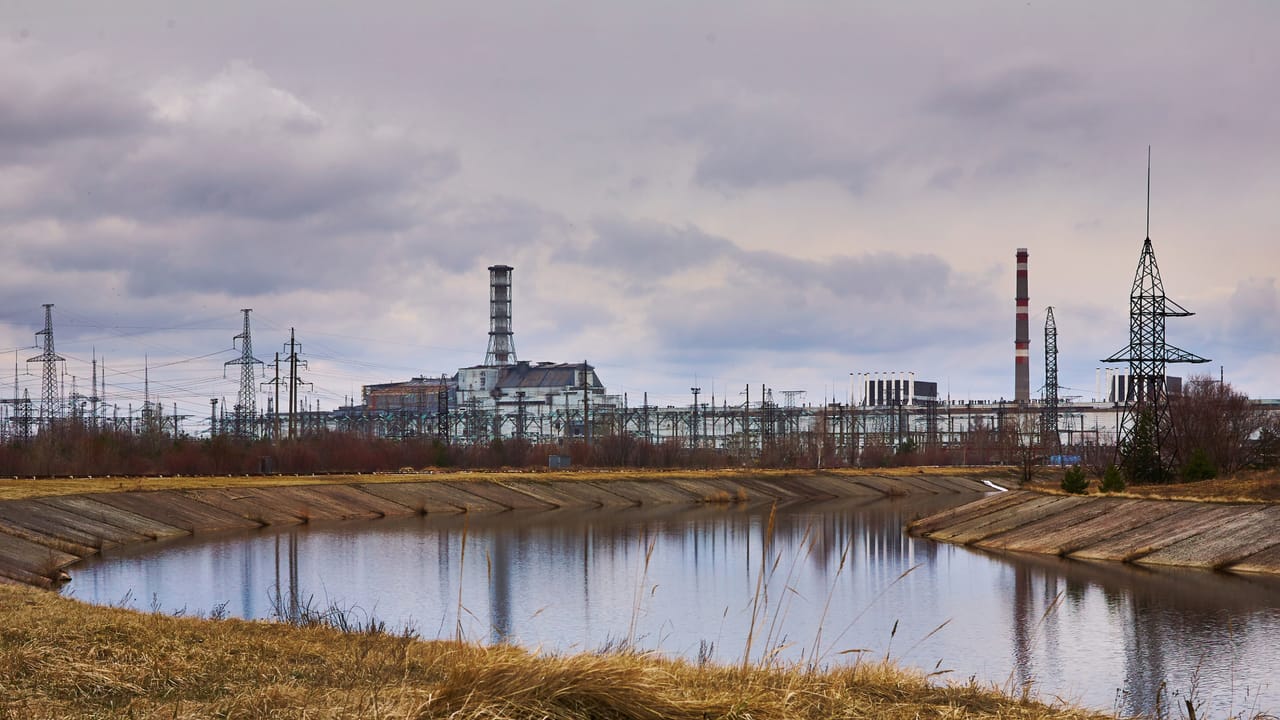
Learn about the Chernobyl plant and Pripyat before 1986, the choice of the RBMK, expansion of the complex, and lessons for critical-infrastructure projects.
Check it out!
Before April 26, 1986, Chernobyl was not an abandoned city or a symbol of disaster. It was a major Soviet energy complex comprising the Vladimir Ilyich Lenin Nuclear Power Plant, four RBMK-1000 reactors in operation, two additional units under construction, transmission lines, cooling systems, workshops, railways, roads, and a planned city built to house workers: Pripyat.
On the eve of the accident, the plant had about 4,000 MW of installed electrical capacity and was integrated into the Soviet power system as a baseload generating source. Pripyat had approximately 49 thousand residents, a young population, and an urban structure created around plant operations. The historic city of Chernobyl had existed long before the plant and was not the same place as Pripyat.
Therefore, the direct answer to what Chernobyl was like before the accident is: an expanding critical-infrastructure project in which the plant, technology, power grid, water resources, city, workforce, and political decisions formed a single system. To understand the later sequence, see the main article on what happened at Chernobyl.
In terms of scale, four RBMK-1000 units were operating, Reactors 5 and 6 were advancing in construction, and Pripyat functioned as the plant’s satellite city. The project brought together generation, transmission, cooling, logistics, civil construction, maintenance, telecommunications, and urban services.
For this reason, understanding Chernobyl before 1986 requires looking beyond the Reactor 4 building. The plant was part of an energy-expansion policy and an institutional chain involving design organizations, manufacturers, operators, planning authorities, and regulatory structures.
What Was Chernobyl Like Before the Accident?
In April 1986, the complex was a strategic installation under expansion. Four reactors produced electricity, two new units were being built, and thousands of professionals worked in plant operation, maintenance, construction, and support.
Pripyat was a young, planned city with residential buildings, schools, hospitals, shops, cultural centers, and public services. Its population was strongly linked to the plant. Local daily life depended on operation of the complex, while the plant depended on an urban network capable of training, housing, and sustaining its workforce.
Where Was the Chernobyl Nuclear Power Plant Located?
The complex was built in the north of what was then the Ukrainian Soviet Socialist Republic, approximately 130 km north of Kyiv and about 20 km south of the border with Belarus. The region combined available land, rail and road access, proximity to water, and the possibility of connection to the power system.
The planned city of Pripyat was about 3 km from the reactors. The historic city of Chernobyl, which gave the plant its name, was approximately 15 km to the southeast. In 1986, Pripyat had about 49 thousand residents and Chernobyl approximately 12.5 thousand.
The total population within a 30 km radius was estimated at between 115 thousand and 135 thousand people. These figures show that, although the region had low overall population density, the plant was connected to cities, communities, transportation routes, and public services that needed to be included in territorial and emergency planning.
Images of abandoned residential buildings, schools, hotels, and parks usually show Pripyat. The name “Chernobyl” came to identify the plant, the accident, and the exclusion zone, although the city most directly linked to workers’ daily lives was Pripyat.
The Role of the Pripyat River and Cooling Pond
Southeast of the plant, an artificial reservoir of approximately 22 km² was built next to the Pripyat River, a tributary of the Dnieper. The reservoir provided water for rejection of heat produced by the units and formed part of the plant’s thermal infrastructure.
Each RBMK-1000 produced about 3,200 MW of thermal power to deliver approximately 1,000 MW of electrical power. The difference between these quantities had to be dissipated by the thermal cycle and cooling system. For this reason, intake, circulation, pumps, channels, and the reservoir were central elements of operational continuity.
The hydraulic system interfaced with electrical power, automation, maintenance, and operations. Pumps depended on reliable power; flows, pressures, and temperatures had to be monitored; equipment had to be isolated for maintenance; and configuration changes had to be communicated among different teams.
This arrangement shows that a generating plant is never just its main equipment. It depends on auxiliary services, normal and emergency power, instrumentation, protection, telecommunications, transportation, workshops, spare-parts inventory, and teams capable of interpreting the integrated behavior of the installation.
When Was the Plant Built?
The decision to install RBMK reactors at Chernobyl was made in 1969. In 1972, the program was consolidated to reach approximately 4,000 MW of electrical capacity through four units. The choice formed part of a broader policy of expanding nuclear generation and meeting growth in the Soviet power system.
Units 1 and 2 were built during the 1970s. Units 3 and 4 formed a second stage of the complex and were completed in the early 1980s. Reactor 4, involved in the accident, was a relatively new unit and had been operating for just over two years.
Phased implementation allowed capacity to be added to the system while new work continued at the same site. It also meant dealing with different design generations, configuration changes, active construction sites, shared equipment, and interfaces among operation, construction, and commissioning.
In April 1986, Reactors 5 and 6 were under construction. The plant was not regarded as a completed project: the complex remained under expansion, with new units, auxiliary infrastructure, and human resources being mobilized to further increase capacity.
What Was the Plant’s Capacity?
Each RBMK-1000 had a nominal thermal power of about 3,200 MWt and an electrical output of approximately 1,000 MWe. The steam produced supplied two turbines of about 500 MWe per unit. With four reactors in operation, the complex reached approximately 4,000 MW of installed electrical capacity.
The scale helps explain the plant’s economic and political importance. An installation of this size influenced generation planning, system dispatch, implementation of lines and substations, regional development, workforce training, and government decisions on expansion.
Rated power, however, does not describe all the necessary infrastructure. Auxiliary services, supply to pumps and controls, external connection, synchronism, protection, operational communications, maintenance of turbines and generators, and the ability to respond to power losses or grid changes also had to be ensured.
Implementation decisions need to consider the life cycle, not only capacity and schedule.
A3A structures alternative studies, assumptions, interfaces, risks, implementation strategy, and decision criteria before the project advances to higher-investment phases.
How Was the Plant Organized?
A plant of this size was not merely the reactor building. The complex brought together thermal, electrical, hydraulic, automation, telecommunications, protection, maintenance, logistics, radiation-protection, fire-protection, and civil-construction systems.
Each unit connected the reactor to steam separators, turbines, generators, condensation systems, pumps, and auxiliary services. Around this functional core were workshops, warehouses, laboratories, power networks, communication systems, access routes, railways, and structures for handling components and fuel.
Continuity depended on interfaces among disciplines. A change in the power grid could alter the unit schedule; pump unavailability affected the process; maintenance required isolation and documentation; and a temporary change had to reach the control room, supervision systems, and teams on the next shift.
In current installations, telemetry, historians, alarms, event recording, and time synchronization help consolidate data from different systems. These resources do not replace design and procedures, but they make installation status more visible and traceable.
The central principle remains the same: reactor, turbine, generator, auxiliary services, external grid, automation, protection, and operations need to function as a single architecture. When each discipline sees only its own boundary, interface risks may remain without an owner.
Integrated operation requires a shared view of installation status.
Supervisory systems organize variables, alarms, trends, events, and commands to support operators and engineering teams in distributed and critical environments.
What Was the RBMK-1000?
The RBMK-1000 was a Soviet reactor cooled by water, moderated by graphite, and built with a large number of individual pressure channels. This architecture allowed refueling during operation and could be built using industrial capabilities available in the Soviet Union.
A complete description of the core, channels, graphite, water, pumps, steam separators, rods, and electrical generation is provided in the chapter How the RBMK Reactor at Chernobyl Worked.
Why Did the Soviet Union Choose the RBMK?
The RBMK was apparently not the first technical option considered for the Chernobyl site. Nikolaus Muellner’s analysis, based on Soviet reports appended to INSAG-7, indicates that the concept ranked third in a feasibility study.
Even so, the design was selected because the necessary components and industrial capabilities were available, while other alternatives would have depended on slower manufacturing. The decision shows how productive capacity, schedule, and energy policy can alter the technical hierarchy of a project.
Development involved specialized design and engineering organizations, state construction and planning structures, and approval at the government level. The technology resulted from an institutional chain with distributed responsibilities, not from an isolated choice by the team that would operate the plant.
This principle applies to any large project: the selected solution results from technical requirements and economic, industrial, logistical, and institutional constraints. Risk increases when these constraints reduce margins, when known limitations do not reach users, or when expansion proceeds without sufficient independent verification.
Technology Selection Needed to Consider More Than Capacity and Schedule
The RBMK offered industrial advantages: high output, the possibility of refueling during operation, and construction without depending on an extremely large pressure vessel. These characteristics were aligned with Soviet productive capacity and expansion targets.
But selection of a critical technology must also assess behavior under abnormal conditions, operational complexity, maintenance, human factors, failure consequences, future modifications, and protection capability. A solution that is economically attractive during implementation may require much higher levels of control and governance over decades.
The evaluation should cover not only nominal performance but also clarity of operating limits, ability to detect degraded states, ease of modernization, spare-parts availability, team competencies, and independence of technical analysis.
The subject is explored in depth in the article on design failure, political pressure, and governance at Chernobyl, which separates technical, organizational, and institutional factors.
Selecting a technology also means choosing its failure modes, required competencies, and protection barriers.
Owner’s Engineering adds independent review to project decisions, following requirements, interfaces, risks, suppliers, documents, and acceptance criteria throughout the life cycle.
Pripyat: The City Built for the Plant
Pripyat was founded in 1970 to house workers from the plant and other projects in the region. It was a young, planned city associated with the idea of scientific and industrial progress. In April 1986, it had approximately 49 thousand residents.
Its population included operators, engineers, technicians, construction workers, electricians, mechanics, healthcare professionals, teachers, public employees, and their families. The city provided residential buildings, schools, a hospital, shops, cultural facilities, transportation, and services needed by a growing community.
Proximity to the plant reduced commuting and concentrated technical competencies. At the same time, it created a relationship of dependence: the city existed to support operation and expansion of the complex, while the plant depended on the urban capacity to house, train, and retain its workforce.
This relationship makes urban planning part of engineering for a critical installation. Routes, transportation, hospitals, public communication, supply, power, water, and mobilization capability need to be assessed together with the project’s industrial risks.
The City of Chernobyl Was Not Pripyat
Chernobyl was an older historic city with approximately 12.5 thousand residents, located about 15 km from the complex. Pripyat had been created specifically to support the plant and was approximately 3 km from the reactors.
The distinction matters because “Chernobyl” referred to the nuclear complex and administrative region, while the workers’ daily lives were concentrated mainly in Pripyat. After the accident, the planned city became the primary visual symbol of the evacuation.
For this reason, the name Chernobyl came to identify the plant, the accident, the exclusion zone, and urban images that belong mainly to Pripyat. To understand the event, it is useful to separate the four elements: historic city, satellite city, nuclear plant, and surrounding territory.
What Was Work at the Plant Like?
The plant operated continuously and required shift teams, scheduled maintenance, inspections, testing, radiation protection, and monitoring of thousands of parameters. Reactor and turbine operators worked alongside engineers, electricians, mechanics, chemists, instrumentation technicians, maintenance teams, firefighters, and supervisors.
Teams had to maintain production, prepare shutdowns, perform interventions, and respond to changes in the power system. A scheduled activity could simultaneously involve operations, maintenance, automation, electrical systems, protection, safety, and coordination with external dispatch.
Safety depended on clear procedures, training, communication between shifts, and access to reliable information. INSAG-7 later showed that relevant RBMK limitations had not been adequately transferred from designers to operators.
This was not merely a documentation problem. When a team does not understand the physical reason for a limit, the rule may be interpreted as an operational formality. Safety information needs to explain what must be done, why the requirement exists, which signals indicate degradation, and who has authority to stop an activity.
Shift Handover as an Operational Interface
In continuously operated installations, transfer of responsibility between teams is a critical stage. Unavailable equipment, temporary changes, tests, deviations, recurring alarms, and assumptions need to be communicated without loss of context.
The 1986 test was delayed and extended into another operating period, showing how schedule changes can alter the human and technical conditions of an activity. The team executing a task is not always the same team that planned, prepared, or started the process.
Today, electronic records, time synchronization, alarm histories, work orders, and operational communications help preserve the sequence of events. Even so, handover quality depends on defined responsibilities and confirmation of understanding.
Remote operation requires coherent communication, telemetry, and operational evidence.
Remote assistance integrates supervision, telecommunications, video, alarms, and procedures to support decisions and confirm the states of distributed installations.
The Plant, the City, and the Grid Formed a Single Critical System
Before the accident, Chernobyl could be understood as an integrated architecture:
- reactors and generation systems;
- cooling water and hydraulic infrastructure;
- substations and transmission lines;
- control rooms, instrumentation, and protection;
- maintenance, supplies, and transportation;
- city, housing, and public services;
- training, procedures, and operational organization;
- design organizations, operators, and regulatory structures.
This systemic view is essential because complex accidents rarely result from an isolated component. They emerge when technical, human, and organizational vulnerabilities cross multiple layers of the system.
In distributed installations, operational telecommunications connect control rooms, field teams, protection, supervision, and remote centers. The design must provide availability, physical routes, synchronization, power, and procedures for normal and degraded conditions.
Visual evidence complements process data. operational CCTV, access control, and integrated electronic security help confirm presence, position, access, and equipment conditions.
Applications such as disconnect-switch monitoring demonstrate the same logic: telemetry, images, electrical state, and time-stamped records need to form coherent operational evidence.
Expansion to Reactors 5 and 6
In 1986, four units were operating while two new units were under construction. The complex combined power production, maintenance of existing units, and implementation of new blocks at the same site.
This coexistence increased interfaces between construction and operations. Team access, movement of materials, temporary networks, shared systems, documentation, field changes, and partial energizations needed to be coordinated without compromising units in service.
In phased projects, each new unit may also incorporate design revisions, suppliers, and solutions different from earlier stages. Without configuration management, the overall complex ceases to have a single up-to-date technical reference.
Construction of Reactors 5 and 6 shows that, on the eve of the accident, Chernobyl was viewed as a long-term expansion platform. The event of April 26 would abruptly interrupt that trajectory.
What Warning Signs Already Existed Before 1986?
INSAG-7 concluded that important RBMK vulnerabilities had already appeared before the accident. An event at Leningrad Unit 1 in 1975 indicated that local reactivity effects could cause significant damage. The experience was not converted into a sufficiently broad review for all plants of the same type.
In 1982, Chernobyl Unit 1 itself experienced a fuel failure that also pointed to limitations in behavior and operation. According to INSAG-7, information exchange among operating organizations was insufficient, and the Chernobyl team did not receive a complete understanding of the nature of the Leningrad event.
In 1983, during activities at the Ignalina plant, it was identified that rod insertion could initially produce an effect opposite to that expected under certain configurations. The information reached responsible organizations, but promised design changes and operating restrictions were not effectively implemented before 1986.
The problem, therefore, was not a total absence of warning signs. It was the inability to transform operating experience, calculations, anomalies, and alerts into concrete barriers: design modification, automatic limit, clear procedure, training, communication among units, and independent verification.
This chain is analyzed in greater depth in Chernobyl: Design Failure, Political Pressure, or Governance Failure?.
Earlier warning signs reduce risk only when they are converted into verifiable actions.
Technical Auditing compares requirements, documents, installed configuration, evidence, pending items, and risks to identify gaps before they become normalized by operational routine.
What Does Chernobyl Before 1986 Teach Engineering?
The period before the accident shows that project reliability does not arise only from robust equipment. It depends on coherent decisions across planning, design, manufacturing, construction, operation, maintenance, expansion, and regulation.
Critical Infrastructure Must Be Analyzed as a System
It is not enough to verify the main equipment. Reliability depends on interfaces among process, power, automation, telecommunications, cooling, protection, operation, maintenance, and emergency response.
Interface requirements need owners, verification criteria, and evidence. When two disciplines assume the other will address a particular condition, a gap arises that may remain invisible until a failure, test, or operational change occurs.
Technology Selection Must Consider the Life Cycle
Manufacturing capability, cost, and construction speed are legitimate criteria, but they cannot hide operating risks, protection limitations, maintenance difficulties, or excessive dependence on human procedures.
Evaluation should include spare-parts availability, obsolescence, required competencies, ease of diagnosis, modernization potential, behavior under degraded states, and the cost of maintaining technical barriers over decades.
Growth Requires Technical Governance
Simultaneous construction of new units shows a project under expansion. The larger the scale, the greater the need for independent review, configuration management, operating-experience feedback, and clear communication among designers, manufacturers, operators, and regulators.
Expansions also require change control. Drawings, signal lists, logic, procedures, installed assets, and operating documents need to represent the actual configuration, including temporary phases of construction and energization.
The City Is Also Part of the Emergency Plan
Pripyat’s proximity shows that urban planning, routes, public communication, transportation, and evacuation capability are part of risk engineering for an installation with major potential impact.
The plan needs to consider permanent residents, visitors, shift teams, hospitals, schools, people with reduced mobility, warning channels, assembly points, transportation alternatives, and continuity of essential services.
How Do These Lessons Appear in Current Engineering?
Complex projects use Front-End Loading to mature alternatives and assumptions before the largest investments. Owner’s Engineering follows decisions, interfaces, and deliverables from the owner’s perspective.
Technical audits verify compliance, gaps, and risks; commissioning and technical acceptance demonstrate that systems and interfaces meet defined criteria before entry into operation.
At the operational layer, SCADA, supervisory systems, telemetry, telecommunications, and synchronization increase visibility into states, alarms, and events. The value of these resources depends on the quality of requirements, instrumentation, and data governance.
In physical and operational protection, electronic security, CCTV, access control, and remote monitoring need to integrate with procedures and the decision center. Technology should reduce uncertainty, not merely produce more screens and records.
What Happened After 1986?
The accident halted expansion, led to the evacuation of Pripyat, and profoundly transformed the territory. The other reactors were not immediately and permanently shut down; the plant remained partially operational until December 2000. Slavutych was built to house workers and sustain the plant’s later activities.
These subjects belong to the post-accident period and will be explored in dedicated content. Here they appear only to show the contrast between the expansion project existing in April 1986 and the long process of containment, residual operation, and decommissioning that followed.
Why Did the Other Reactors Continue Operating?
Reactor 4 was destroyed, but the other units were not shut down immediately. Existing infrastructure, the need for generation, the work of thousands of professionals, and the complexity of permanent shutdown influenced temporary continuation of plant operations.
The remaining units underwent assessments and modifications. Shutdowns occurred at different times, and the last operating unit was closed in December 2000.
Slavutych and Workforce Continuity
With Pripyat evacuated, Slavutych was built to house workers and families connected to the plant. Continuity of activities required organized transportation, radiological monitoring, access control, decontamination procedures, and a new urban structure.
What Happened to Reactors 5 and 6?
Expansion was halted and the structures remained partially completed. Halting a project of this scale creates challenges involving preservation, construction-site safety, disposition of equipment, documentation, sunk costs, and management of liabilities.
From Generation to Decommissioning
Closure of the last reactor did not end activities at the site. Decommissioning involves fuel management, decontamination, waste treatment, monitoring, maintenance of structures, gradual dismantling, and long-term records. The complex shifted from a generation facility to a technical containment and demobilization project.
How to Continue the Chernobyl Learning Journey
The next chapter explains how the RBMK reactor worked. The journey then follows the power drop, xenon poisoning, ORM reduction, the void coefficient, control rods, the test, activation of AZ-5, and root-cause analysis.
The complete map is available in Chernobyl: What Happened and Why Reactor 4 Exploded.
Technical References
[1] INTERNATIONAL ATOMIC ENERGY AGENCY. The Chernobyl Accident: Updating of INSAG-1. Safety Series No. 75-INSAG-7. Vienna: IAEA, 1992.
[2] SHTEYNBERG, N. A. et al. Report by a Commission to the USSR State Committee for the Supervision of Safety in Industry and Nuclear Power. In: INTERNATIONAL ATOMIC ENERGY AGENCY. INSAG-7, Annex I. Vienna, 1992.
[3] ABAGYAN, A. A. et al. Causes and Circumstances of the Accident at Unit 4 of the Chernobyl Nuclear Power Plant and Measures to Improve the Safety of Plants with RBMK Reactors. In: INTERNATIONAL ATOMIC ENERGY AGENCY. INSAG-7, Annex II. Vienna, 1992.
[4] MUELLNER, Nikolaus. Three Decades after Chernobyl: Technical or Human Causes? In: HAAS, R. et al. The Technological and Economic Future of Nuclear Power. Springer, 2019.
[5] UNITED STATES NUCLEAR REGULATORY COMMISSION. Report on the Accident at the Chernobyl Nuclear Power Station. NUREG-1250. Washington, DC, 1987.
[6] INTERNATIONAL ATOMIC ENERGY AGENCY. Safety Culture. Safety Series No. 75-INSAG-4. Vienna: IAEA, 1991.
[7] OECD NUCLEAR ENERGY AGENCY. Chernobyl: Chapter I — The Site and Accident Sequence. Paris: OECD/NEA.
[8] OECD NUCLEAR ENERGY AGENCY. Chernobyl: Assessment of Radiological and Health Impacts. 2002 update. Paris: OECD/NEA, 2002.
[9] SCHMID, Sonja D. When Safe Enough Is Not Good Enough: Organizing Safety at Chernobyl. Bulletin of the Atomic Scientists, v. 67, n. 2, p. 19–29, 2011.
[10] CHERNOBYL NUCLEAR POWER PLANT. History of the ChNPP and Construction of the Units. Institutional documentation.
[11] WORLD NUCLEAR ASSOCIATION. RBMK Reactors. Technical document on RBMK reactor architecture, operation, and modifications.
Frequently Asked Questions
It was an expanding energy, industrial, and urban complex with four RBMK-1000 reactors in operation, two units under construction, and Pripyat as a planned city for workers.
No. Pripyat was about 3 km from the plant and had been built for workers. The historic city of Chernobyl was approximately 15 km southeast of the complex.
Pripyat was founded in 1970 to house plant workers and their families, providing housing, schools, healthcare, shops, transportation, and services near the installation.
The complex was located in northern Soviet Ukraine, about 130 km north of Kyiv and approximately 20 km south of the border with Belarus.
The four operating units totaled approximately 4,000 MW of electrical capacity. Each RBMK-1000 produced about 3,200 MW of thermal power to deliver approximately 1,000 MW of electrical power.
The choice combined high capacity, industrial availability of components, the possibility of refueling during operation, and shorter implementation times than other alternatives considered.
Yes. Both units were under construction, showing that Chernobyl was part of a long-term Soviet generation expansion program.
Yes. Events at Leningrad, Chernobyl Unit 1, and Ignalina had indicated vulnerabilities, but the information was not sufficiently converted into design changes, procedures, and training.
Additional Technical Materials
Solutions
- SCADA Systems
- Digital Supervision and Control Systems
- Requirements, Evidence, and Acceptance-Criteria Management
Engineering Services
Chernobyl Learning Journey
