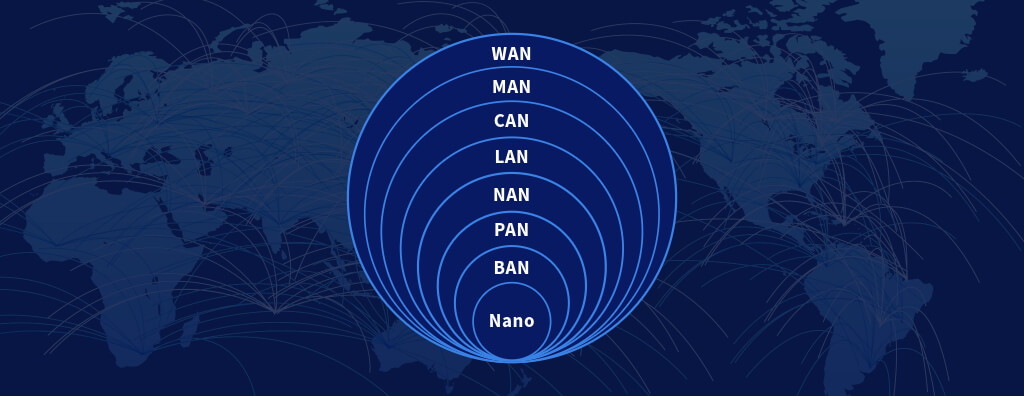
Computer networks can be classified as Personal Area Networks (PANs), Local Area Networks (LANs), Metropolitan Area Networks (MANs), Wide Area Networks (WANs), and other categories. Understand how geographic scope affects network architecture and design.
Check it out!
Computer networks can be classified as Personal Area Networks (PANs), Local Area Networks (LANs), Metropolitan Area Networks (MANs), Wide Area Networks (WANs) and many others. When the criterion is geographic scope, the classification identifies the physical or territorial extent served by the network — from the immediate proximity of one person to the interconnection of units distributed across cities, states, or countries.
In this article, we examine each type of scope-based classification. It is also important to distinguish scope from other criteria: VLAN describes logical segmentation, SAN describes a specialized storage network, and NFC is a short-range communication technology. These terms may exist in the same ecosystem, but they do not answer exactly the same classification question.
In practice, understanding PAN, LAN, CAN, MAN, and WAN helps organize requirements for connectivity, topology, physical media, backbone, redundancy, routing, and operational responsibility. Classification is therefore a conceptual starting point for decisions that later need to be materialized in architecture and design. Read on!
What are the four main types of networks by scope?
When classification considers geographic scope, the four most commonly cited network types are PAN, LAN, MAN, and WAN. A PAN connects devices close to one person; a LAN serves a home, room, building, or facility; a MAN interconnects networks across a metropolitan area; and a WAN connects units distributed across long distances.
- PAN — Personal Area Network: short-range personal network;
- LAN — Local Area Network: local network for a building or limited area;
- MAN — Metropolitan Area Network: network covering a city or metropolitan region;
- WAN — Wide Area Network: long-distance network connecting cities, states, or countries.
[elementor-template id=”24446″]
This division does not replace other criteria. A network can also be classified by topology, transmission medium, architecture, purpose, and how resources are shared. For a broader view of the categories, see the content on types of computer networks.
Geographic scope is only one decision within a network architecture.
In corporate and industrial environments, topology, segmentation, physical media, redundancy, security, capacity, documentation, and acceptance criteria must also be defined.
How are networks classified by geographic scope?
Computer networks can be classified by geographic extent, which directly influences architecture and the specific implementation and management challenges associated with each type of network.
These classifications range from extremely small networks at the nanoscale to vast global networks such as the Internet. Each network type has distinct characteristics and is used for different applications:
Nanonetworks
Nanonetworks consist of communication infrastructure among nanomachines, devices designed to operate at molecular scale.
Several challenges are associated with implementing these networks, including the need for new approaches to modeling, simulation, experimentation, and technology standardization.
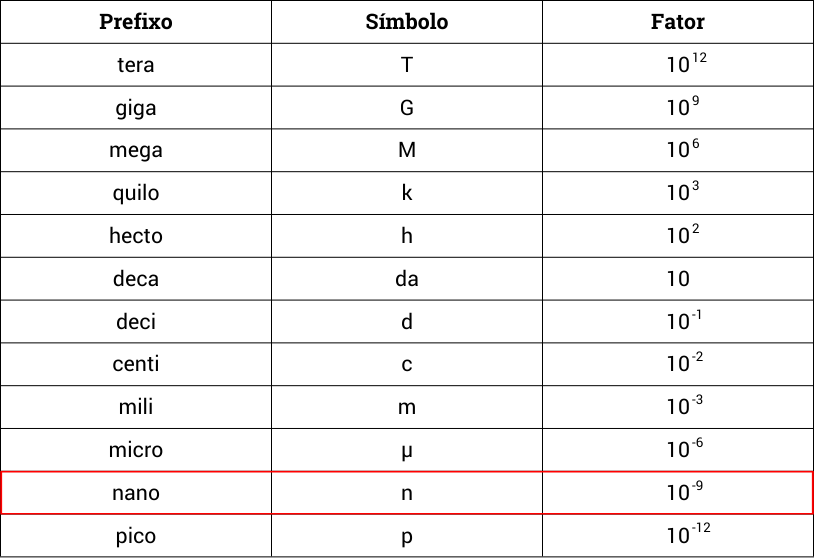
With the potential to transform disease treatment and ecosystem preservation, nanonetworks are an active multidisciplinary research topic involving fields such as Physics, Chemistry, Biology, Engineering, and Computer Science.
Key implementation challenges include reducing component size, efficient energy management, mitigating interference at molecular scale, and developing communication protocols appropriate to the specific requirements of these systems.
NFC (Near-field Communication)
Near-field communication networks, or NFC, use short-range wireless communication to exchange data between devices only a few centimeters apart.
This technology is widely used in everyday applications such as contactless payments, device authentication, and access-control systems using NFC and BLE mobile credentials.
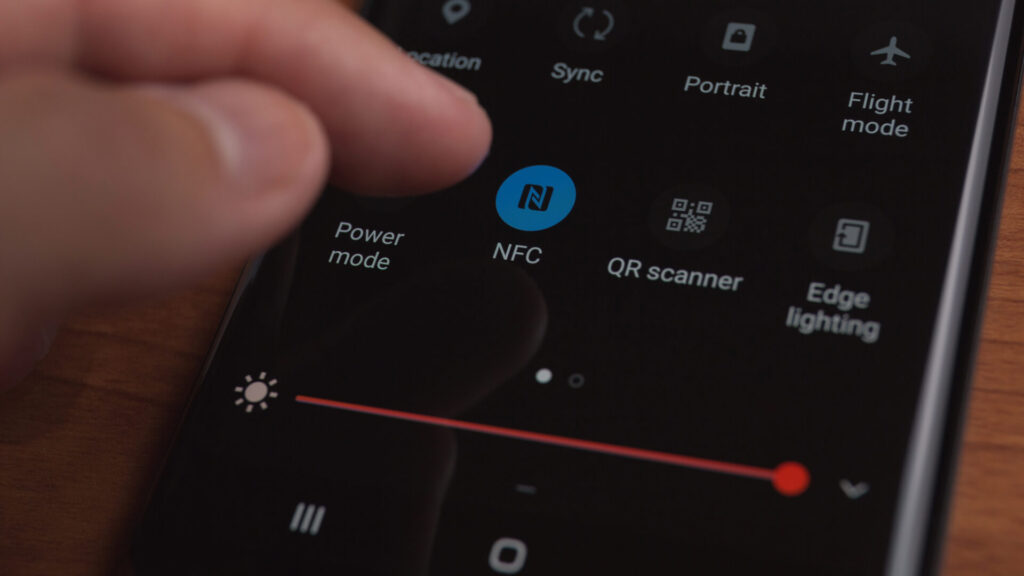
NFC provides a convenient and efficient way to transmit information quickly, including small-file sharing and configuration of smart devices with a simple tap.
BAN (Body Area Network)
Body Area Networks, or BANs, refer to communication among portable electronic devices used on or in the human body.
These devices may be wearable, such as smartwatches, fitness bands, and augmented-reality glasses, or implanted, such as medical sensors and vital-sign monitoring devices.

Recent advances in this field have enabled innovative technologies that may transform medical procedures.
There are already prototypes of ingestible devices capable of traveling through the gastrointestinal tract, capturing and transmitting real-time images to external devices and offering a less invasive alternative to traditional endoscopic methods.
PAN (Personal Area Network)
Personal Area Networks, or PANs, are short-range communication networks designed to interconnect electronic devices in the user’s immediate vicinity, generally within a radius of up to 10 meters.
PANs support direct communication among devices such as smartphones, computers, speakers, headphones, and remote controls.
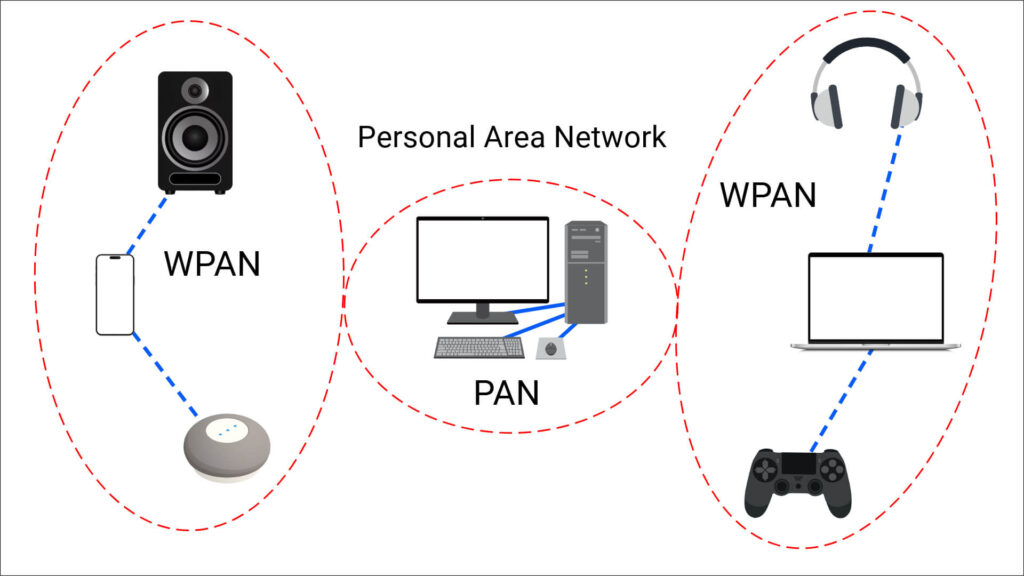
These networks predominantly use wireless technologies such as Bluetooth and Zigbee, optimized for low energy consumption and data rates suitable for synchronization and device control. They can also use wired technologies such as USB for direct device connections.
NAN (Near-me Area Network)
Near-me Area Networks, or NANs, describe communication that enables direct interaction among nearby devices without requiring centralized network infrastructure.
NANs can support automatic configuration, with devices connecting autonomously. In a supermarket, for example, a NAN could disseminate promotional information directly to customer devices without requiring manual connection to the local Wi-Fi network.
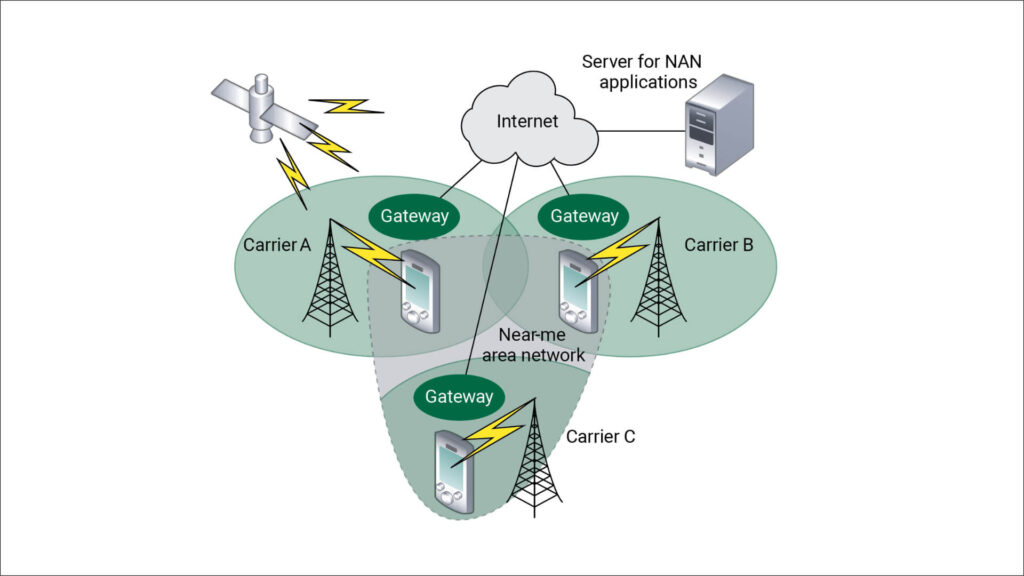
This approach enables fast, efficient communication for applications ranging from interaction in public spaces to advanced security and automation solutions.
LAN (Local Area Network)
Local Area Networks, or LANs, interconnect computers and electronic devices within a limited geographic area such as a home, school, laboratory, or commercial building.
A LAN architecture is defined by a combination of topologies, access technologies, and communication protocols. These components are designed to support interconnectivity and data transmission with integrity, security, and high availability.
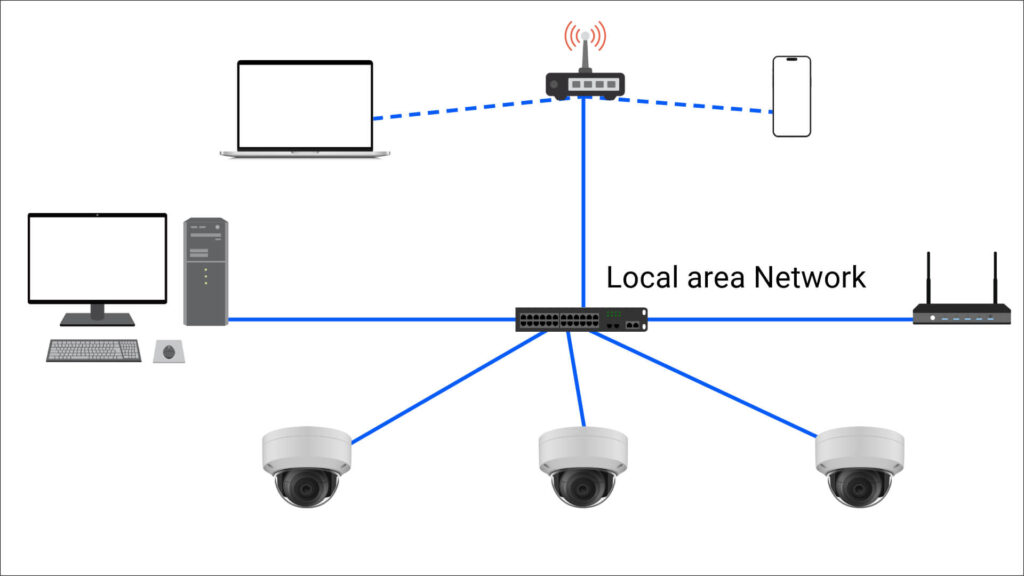
LANs facilitate the sharing of hardware, software, and services among connected devices, including printers, servers, files, and Internet connections.
They can be divided into several categories according to their structure:
WLAN (Wireless Local Area Network)
A Wireless Local Area Network, or WLAN, enables communication among devices in a local area without direct cabling between endpoints.
This network type provides mobility and relatively straightforward installation, allowing users to connect from different locations within the coverage area.
As Wi-Fi technologies continue to evolve, WLANs have improved in speed, security, and capacity. They are particularly useful where direct cabling is impractical, such as difficult-access areas, historic buildings, or temporary facilities.
In corporate and industrial environments, exclusive dependence on wireless networks is less common when stability and deterministic performance are important.
Although Wi-Fi provides convenience, wired networks offer advantages in performance and reliability.
Wired connections use a dedicated physical medium for data transmission, typically providing lower latency, higher transfer rates, and more stable communications with less susceptibility to interference.
For this reason, LANs frequently combine wired and wireless technologies, using each where it is most appropriate to meet connectivity requirements and optimize overall network performance.
HAN (Home Area Network)
Home Area Networks, or HANs, are local networks that interconnect devices within a residence. They often use a central device supplied by an Internet service provider that combines router, switch, and Wi-Fi access-point functions, simplifying home network infrastructure.
Many devices can now connect to a home network, including computers, televisions, smartphones, appliances, and security cameras. This integration expands residential connectivity and functionality and is driven by the evolution of the Internet of Things (IoT).
HANs continue to evolve with automation and intelligent-control technologies, improving convenience, energy efficiency, and security for users.
VLAN (Virtual Local Area Network)
VLANs (Virtual Local Area Networks) are a network-segmentation technique that creates virtual local networks over existing physical infrastructure.
This segmentation organizes data traffic logically without requiring devices to be physically separated into different networks.
A VLAN can align with subnetting logic, but with a critical distinction: Ethernet frames can carry additional identification called a VLAN ID or VLAN Tag. This identifier groups devices into virtual networks regardless of their physical connection to network hardware.
A common VLAN application is network segmentation for monitoring systems. Isolating video traffic in a dedicated VLAN can help prevent other critical applications from being affected while preserving performance and control.
CAN (Campus Area Network)
A Campus Area Network (CAN) is a type of local network designed to cover an area larger than a single building, such as a university campus or corporate complex.
MAN (Metropolitan Area Network)
A Metropolitan Area Network (MAN) is a computer network designed to interconnect users and computing resources across a geographic area that covers a metropolitan region.
The term “metropolitan” refers exclusively to geographic extent and does not imply any demographic characteristic of the area served.
In geographic terms, a MAN covers a larger area than a Local Area Network (LAN) and a smaller area than a Wide Area Network (WAN).
A MAN may span an entire city or large urban area, interconnecting multiple LANs and linking buildings, university campuses, corporate facilities, and other locations distributed throughout the metropolitan area.
WAN (Wide Area Network)
A Wide Area Network (WAN) interconnects multiple local networks (LANs) across a large geographic area, potentially spanning cities, states, or countries.
Consider a company with a manufacturing plant in Manaus and an office in São Paulo. The company needs an efficient way to share information between these two locations. A WAN allows it to do exactly that.
The company does not need to install its own cable between Manaus and São Paulo, which would be expensive and impractical. Instead, it can contract a telecommunications service provider to supply the necessary network infrastructure.
The telecommunications provider owns and operates infrastructure that connects the company’s LANs in Manaus and São Paulo, forming the WAN.
The Internet is the best-known example of a WAN. It connects billions of devices worldwide, allowing users and computers in one location to communicate with users and computers elsewhere.
Some authors refer to the Internet as a Global Area Network (GAN) because of its truly global reach. Terminology varies, however, and the Internet is also commonly described as a WAN.
SAN (Storage Area Network)
Storage Area Networks, or SANs, are specialized networks designed to provide high-performance access to storage devices such as disks and storage arrays over dedicated network infrastructure.
IAN (Internet Area Network)
An Internet Area Network (IAN) is an advanced telecommunications concept that uses Internet Protocol (IP) to connect voice and data endpoints through a cloud environment, replacing traditional LAN and WAN constructs in some service architectures.
In an IAN, communication services and applications are hosted in the cloud by a Managed Service Provider (MSP).
The IAN allows endpoints to communicate and exchange information securely over the public Internet, reducing dependence on a specific physical location.
This is possible because applications and communication services are virtualized. Endpoints need only a broadband connection to access the network and its services.
Service virtualization is a fundamental IAN characteristic, with communication services such as VoIP, videoconferencing, e-mail, and collaboration applications virtualized and accessible from the cloud. This allows dynamic scalability and efficient resource allocation according to demand.
Interplanetary Networks
An interplanetary network is a communications network that connects devices on different planets or celestial bodies using technologies such as radio, laser, or satellites.
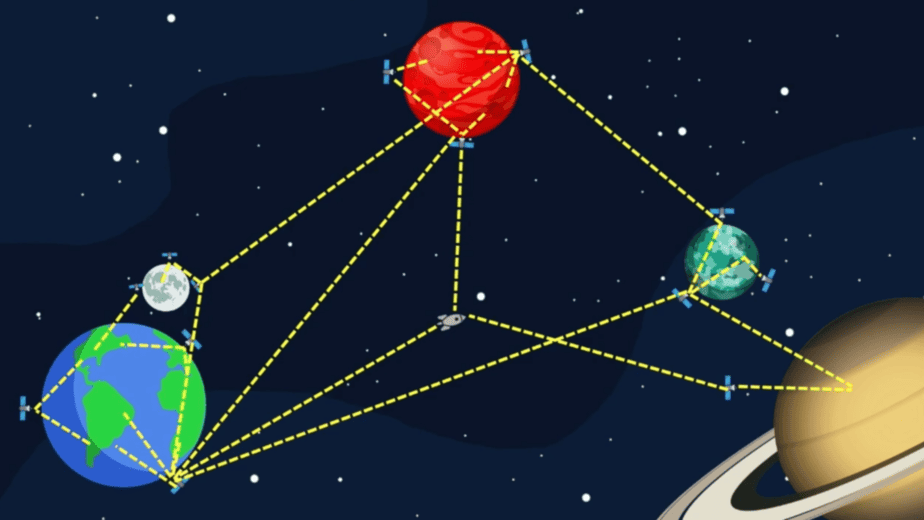
Interplanetary networking is a challenge for science and engineering because it involves issues such as delay, loss, interference, and security in data transmission between network nodes.
NASA (National Aeronautics and Space Administration) is among the organizations developing and testing interplanetary networking concepts, including the IPN (Interplanetary Internet). Related technologies have supported communication with space missions such as the Mars Science Laboratory, which carried the Curiosity rover to Mars, and Deep Impact.
Successful implementation of an Interplanetary Internet may transform how space is explored by enabling more effective communication between Earth and space missions.
This could support more complex and ambitious future missions, including human exploration of other planets.
How does geographic scope affect network design?
Scope-based classification becomes more than a conceptual exercise when the network must be designed. Distances among users, buildings, campuses, and sites change the transmission media, topology, equipment, redundancy, routing, security, operations, and responsibility for links. A LAN in one building and a WAN between branches may carry the same applications but require very different architectures and controls.
| Scale | Predominant engineering decision | Typical infrastructure | Recurring risk |
|---|---|---|---|
| PAN | proximity, power, compatibility, and security of the personal link | Bluetooth, USB, and other short-range interfaces | interference, improper pairing, or limited battery life |
| LAN | switching, VLANs, Wi-Fi, cabling, PoE, addressing, and local availability | Ethernet, structured cabling, switches, and access points | undersized uplinks, PoE, or segmentation |
| CAN | interconnection among buildings, distribution, backbone, and resilient routes | optical fiber, distribution racks, and inter-building links | single points of failure and shared physical routes |
| MAN | metropolitan interconnection, carrier dependency, and path diversity | Metro Ethernet, optical links, and telecommunications services | logical redundancy without true physical diversity |
| WAN | routing, multiple providers, security, inter-site performance, and continuity | MPLS, SD-WAN, VPN, Internet, and dedicated circuits | latency, carrier outages, and inadequate failover design |
In campus networks and distributed environments, the physical medium becomes a decisive architectural element. Structured Cabling Design organizes pathways, spaces, balanced copper links, and physical distribution, while Fiber Optic and Optical Network Design addresses backbones, distances, optical budgets, redundancy, and certification.
As scope increases, the need to document external dependencies, failure domains, availability requirements, routing policies, and monitoring criteria also increases. This documentation allows geographic classification to be converted into verifiable architecture and implementation decisions.
When a network extends beyond a single environment, the architecture must explicitly define how each domain connects and how failures are contained.
Topology, backbone, segmentation, redundancy, routing, security, and growth criteria should be defined before assets are purchased or implementation is contracted.
Scope, topology, and architecture classification: what is the difference?
The same network can receive different classifications because each criterion answers a specific question. Scope indicates which geographic area is served; topology shows how nodes and links are organized; and architecture defines how functions, layers, services, and controls are distributed.
| Criterion | Question answered | Examples | Related content |
|---|---|---|---|
| Geographic scope | What territorial extent does the network serve? | PAN, LAN, CAN, MAN, and WAN | This article |
| Topology | How are devices and links organized? | Star, ring, bus, tree, and mesh | Network Topology |
| Architecture | How are layers, modules, and functions structured? | Access, distribution, core, and specialized modules | Corporate Network Architecture |
| Logical organization | How are users, devices, and traffic segmented? | VLANs, subnets, zones, and domains | Logical Network |
| Engineering process | How are requirements converted into a documented solution? | Survey, design, specification, implementation, and acceptance | Network Design |
This distinction avoids confusing a LAN, which is a scope classification, with a star topology or hierarchical architecture. In a real project, criteria are combined: a corporate LAN may use a physical star topology, VLAN segmentation, an optical-fiber backbone, and an access/distribution/core architecture.
To move from conceptual classification to physical and logical components, see the content on network infrastructure, network cable types, and network architecture.
Correctly classifying the network reduces isolated decisions and helps define a coherent architecture.
A3A Engenharia develops network and telecommunications designs covering requirements assessment, architecture, topology, cabling, optical fiber, Wi-Fi, segmentation, redundancy, documentation, and validation criteria.
Understand the stages of Network Design or explore the Telecommunications Design service
Conclusion
Network classification is essential for understanding different forms of communication and device interconnection and for matching requirements for performance, security, scalability, and reach.
“Understanding the different network-classification criteria is essential to correctly size any communications solution. A well-defined classification improves planning, security, and systems integration and helps prevent errors and bottlenecks in Corporate Network projects.”
— Eng. Altair Galvão, network and telecommunications infrastructure specialist
Relevant Links
eBook – Why hire a Structured Cabling Design?
Structured Cabling Technical Standards
Network Certification for Structured Cabling Systems
Structured Cabling Design Consulting
Structured Cabling Installation
How to avoid common problems in Structured Cabling Systems
Technical references
[1] ASSOCIAÇÃO BRASILEIRA DE NORMAS TÉCNICAS. ABNT NBR 14565 — Structured cabling for commercial buildings and data centers. Available at: https://www.abntcatalogo.com.br/.
[2] ISO/IEC. ISO/IEC 11801 — Information technology — Generic cabling for customer premises. Available at: https://www.iso.org/.
[3] TELECOMMUNICATIONS INDUSTRY ASSOCIATION. ANSI/TIA-568 — Telecommunications cabling standards. Available at: https://tiaonline.org/.
[4] CREA-MG. Which structured cabling services require responsible technical professionals? Available at: https://www.crea-mg.org.br/faq/quais-os-servicos-de-cabeamento-estruturado-e-respectivos-rts.
[5] COMMSCOPE. Structured Cabling Systems: The Fact File. Available at: https://www.commscope.com/globalassets/digizuite/918042-scs-the-fact-file-EB-115769-EN.pdf.
Frequently asked questions
Networks can be classified primarily by geographic scope (LAN, MAN, WAN, PAN), connection method (wired, wireless), topology (star, ring, bus), and functionality (client-server, peer-to-peer).
In addition to scope, networks can be classified by physical or logical topology, transmission technology, purpose, protocols used, and security level.
They usually refer to:
LAN (Local Area Network)
MAN (Metropolitan Area Network)
WAN (Wide Area Network)
PAN (Personal Area Network)
In the TCP/IP model, the four layers are:
Application
Transport
Internet
Network Access
These are the layers of the OSI Model:
Physical
Data Link
Network
Transport
Session
Presentation
Application
The main elements are:
Devices (hosts, computers, servers)
Transmission media (cables, radio waves)
Communication protocols
Network software
The main structured cabling standards include ABNT NBR 14565 (Brazil), ISO/IEC 11801 (international), and ANSI/TIA-568 (United States).
In Brazil, structured cabling projects should primarily consider two standards: ABNT NBR 14565 and ABNT NBR 16869.
ABNT NBR 14565 is the principal standard and establishes general requirements for design, installation, administration, and performance of structured cabling systems in commercial, industrial, and residential environments. It addresses topology, cable categories, identification, documentation, and practices intended to support network performance and interoperability.
ABNT NBR 16869 complements NBR 14565 with additional guidance for infrastructure planning, testing, optical and balanced copper links, and automated infrastructure management. It is especially relevant to complex environments such as data centers and large corporate facilities, but may be applied in
ABNT NBR 14565 is the Brazilian standard that establishes requirements and best practices for the design, installation, and administration of structured cabling systems in commercial, industrial, and residential environments. It covers topology, performance, identification, and documentation.
In addition to NBR 14565, ABNT has other standards relevant to network infrastructure, including NBR 16264 (optical cabling), NBR 16415, NBR 5410 (low-voltage electrical installations), and others related to infrastructure and safety.
ISO/IEC 11801 is a major international structured cabling standard specifying design, installation, and performance requirements for cabling systems in commercial buildings, industrial environments, and data centers. It is a global reference for many national standards.
ANSI/TIA-607 is a US standard addressing grounding and bonding requirements for telecommunications and structured cabling systems. It defines practices intended to support electrical safety and reduce electromagnetic interference.
Complementary technical materials
Network fundamentals and classification
- Telecommunications: systems, networks, and infrastructure
- Types of Computer Networks
- Network Topology
- Logical Network
