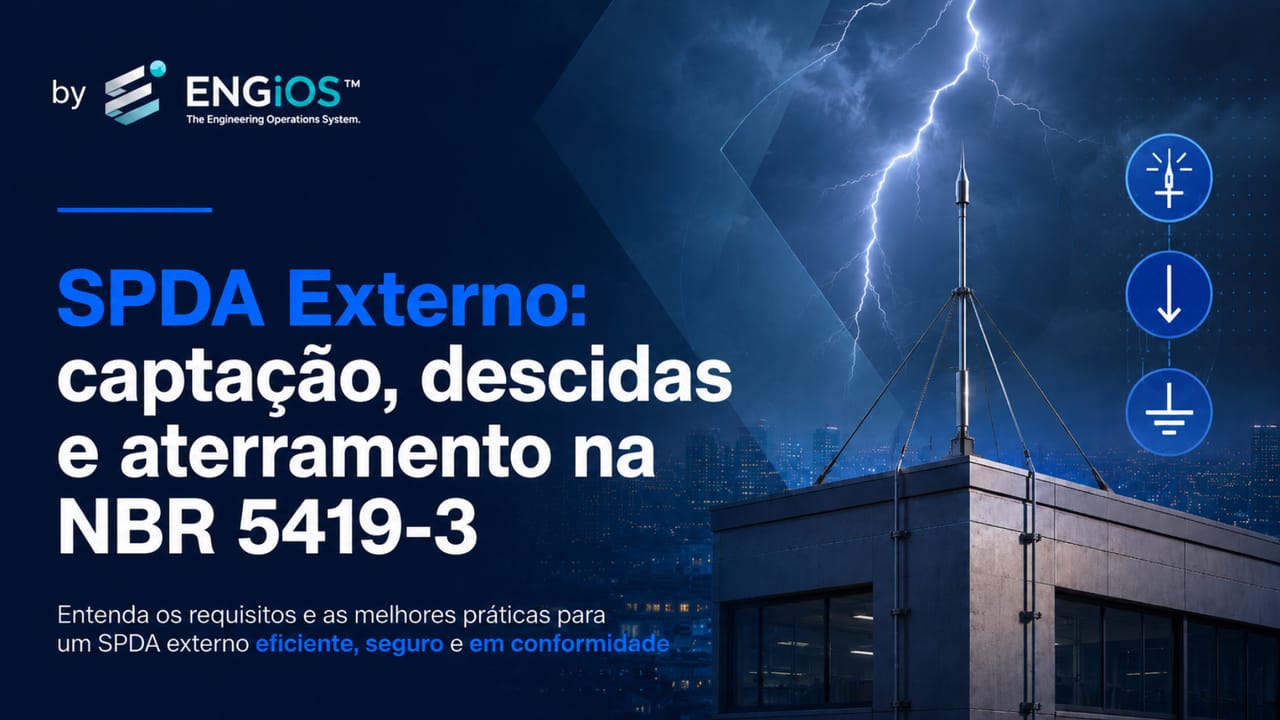
Understand the external LPS according to NBR 5419-3, including air-termination, air terminals, down conductors, grounding, separation distance, inspection and technical documentation.
Check it out!
NBR 5419-3 addresses protection against physical damage to structures and hazards to people, with a practical focus on the external LPS. It is the part of the NBR 5419 series most directly associated with the visible physical elements of the system: air-termination, down conductors, grounding, connections, natural components, separation distance, inspection, maintenance and technical documentation.
The external LPS is not limited to air-termination on the roof. Its performance depends on electrical continuity, down conductors, grounding, equipotential bonding, SPDs, documentation, inspection and maintenance.
How to read this article within the NBR 5419, NBR 5410 and LPS content cluster.
NBR 5419-3 structures the external LPS. NBR 5410 applies at the interface with low-voltage electrical installations, grounding, protective conductors, equipotential bonding, panels and protective devices. NBR 5419-4 complements the analysis when internal LPS measures, SPDs and protection of electrical and electronic systems are involved.
NBR 5419-3 should be understood as the part that translates the need for protection into an external LPS: air-termination, down conductors, grounding, natural components, separation distance, inspection and technical documentation.
Even so, NBR 5419-3 should not be understood merely as a standard for positioning air terminals on a roof. The external LPS must be assessed as part of an integrated strategy connected to NBR 5419, the NBR 5419-2 risk assessment, LPS grounding, the grounding grid, equipotential bonding, SPDs and protection of internal systems.
Technical note: this content is technical and interpretive in nature and does not reproduce tables, formulas or protected excerpts from ABNT NBR 5419. For application in design, reports, inspections or upgrades, the current version of the standard should be consulted from an official source or licensed standards collection, with analysis by a qualified professional.
What is NBR 5419-3?
NBR 5419-3 is the part of the NBR 5419 series focused on the external LPS and protection measures against physical damage to structures and hazards to life. It provides criteria for conducting lightning current in a controlled manner, from the interception point to the grounding system.
In practice, this part of the standard helps answer questions such as:
- how to physically protect the structure against direct lightning strikes;
- where to position air-termination elements;
- how to define and distribute down conductors;
- how to integrate the system with grounding;
- when to consider natural components of the building;
- how to reduce the risk of dangerous sparking;
- how to document, inspect and maintain the system.
The article How the LPS is structured according to NBR 5419 examines the system components in greater depth. This article focuses specifically on the logic of Part 3.
The external LPS is not only roof air-termination
A recurring mistake is to reduce the external LPS to the installation of rods, cables or air terminals at the top of the building. Air-termination is important, but it does not work in isolation.
External LPS performance depends on continuity of the current path. The intercepted current must be conducted through suitable down conductors, connected to grounding, integrated with equipotential bonding and coordinated with the structure, metallic systems, electrical panels and internal installations.
For this reason, a system with visible air terminals can still be technically weak if it has poorly distributed down conductors, inadequate connections, undocumented grounding, lack of equipotential bonding, incompatibility with internal systems or no inspection program.
Relationship between NBR 5419-3 and risk assessment
NBR 5419-3 should not be applied in isolation. Before defining the physical solution for the external LPS, it is necessary to understand the building’s need for protection and the applicable protection level.
This decision is related to NBR 5419-2: risk assessment in LPS designs. The risk assessment considers the structure, occupancy, exposure, incoming lines, internal systems and possible consequences of a lightning strike.
When the client is still determining whether protection is necessary, the best starting point is the article When does a building need an LPS?. Once the need is established, NBR 5419-3 guides how to translate that decision into a physical external protection solution.
Air-termination in the external LPS
The air-termination subsystem provides preferred points or regions for intercepting a lightning strike, reducing the probability of direct impact on vulnerable parts of the structure.
Air-termination design depends on the characteristics of the building, roof geometry, height, construction elements, installed equipment, exposure and the protection level defined in the design.
In a technical design, air-termination may involve different solutions, such as:
- individual air terminals;
- mesh conductors;
- natural metallic elements of the structure, when technically applicable;
- protection of rooftop equipment;
- coordination with architecture, waterproofing and maintenance;
- integration with down conductors and grounding.
The article on the Rolling Sphere Method for LPS examines one of the methods used to assess protected zones. For a specific analysis of individual air terminals, mesh air-termination and the Faraday cage concept, also see Franklin Air Terminal in LPS: lightning rods, Faraday cage and air-termination system. Under NBR 5419-3, the key point is that air-termination must result from design, not arbitrary component placement.
Need to turn the NBR 5419-3 criteria into an executable design?
A3A Engenharia develops LPS Designs including risk assessment, air-termination study, down conductors, grounding, equipotential bonding, SPDs, ART, design narrative, drawings and technical documentation.
Down conductors in the LPS
Down conductors carry lightning current from the air-termination subsystem to the grounding system. They form the physical path between the upper portion of the building and the current dissipation system.
Defining down conductors involves criteria such as quantity, positioning, electrical continuity, connection to the air-termination system, connection to grounding, coordination with façades, architectural interferences, metal structures and inspection conditions.
Poorly positioned or interrupted down conductors can compromise system performance. They can also increase the risk of sparking, potential differences and damage to internal systems.
In existing buildings, it is common to find exposed down conductors without documentation, modifications after renovations, corroded connections, interrupted sections, route changes, lack of demonstrated continuity or incompatibility with the original grounding system.
Grounding in the external LPS
Grounding is an essential part of the external LPS. Its function is to receive the current conducted by the down conductors and contribute to its dissipation into the soil, reducing hazardous potential differences and integrating the system with the building’s overall protection strategy.
A common mistake is to treat grounding only as a resistance measurement. Although measurements are important in the technical context, LPS grounding performance involves geometry, continuity, interconnections, equipotential bonding, corrosion, documentation, inspection and coordination with electrical installations.
For this reason, the LPS should be analyzed together with the grounding design, grounding grid, grounding report, equipotential bonding and the NBR 5410 criteria for low-voltage electrical installations.
There is no complete LPS without documented and integrated grounding. Likewise, there is no effective SPD protection without an adequate grounding and equipotential bonding reference.
To examine this point in greater depth without turning the external LPS article into a generic grounding guide, see the specific content on LPS Grounding: function in NBR 5419-3 and the external LPS.
Natural components of the structure
NBR 5419-3 allows, in certain technical contexts, metallic parts or construction elements of the building to be considered natural components of the LPS. This possibility, however, requires careful assessment.
Natural components should not be assumed automatically. Electrical continuity, dimensions, connections, durability, accessibility, corrosion, compatibility with the intended function and inspectability must be assessed.
In reinforced-concrete buildings, steel structures, metal roofs, façades, guardrails, piping and structural support elements, integration with the LPS may be technically relevant, but it must be documented in the design.
When this assessment is not performed, the system may depend on unverified current paths, inaccessible connections or elements that have changed over time.
Separation distance and risk of dangerous sparking
Separation distance is an important concept for reducing the risk of dangerous sparking between parts of the LPS and metallic elements, electrical installations, piping, cables, internal structures or electronic systems.
In practice, this precaution prevents lightning current from finding unintended paths inside the building. This is especially relevant in environments with electrical panels, data cabling, CCTV, access control, automation, telecommunications, IT, industrial systems and sensitive equipment.
Separation distance should be addressed in the design and coordinated with architecture, electrical installations, metallic systems and technical infrastructure. When adequate separation cannot be ensured, equipotential bonding and controlled integration measures may be required.
This point connects NBR 5419-3 with the internal protection addressed in NBR 5419-4, SPDs, SPD coordination and surge protection measures.
The external LPS must be integrated with grounding and surge protection.
A3A Engenharia assesses air-termination, down conductors, grounding, equipotential bonding, electrical panels, SPDs, documentation and technical interfaces so the system can be designed coherently.
Materials, connections and electrical continuity
External LPS performance also depends on the materials, connections and electrical continuity of the system. Air terminals, conductors, connections, supports, fasteners, interconnections, busbars and test points must be compatible with the application and environmental conditions.
Corrosion, loose connections, unjustified material changes, lack of mechanical protection, inadequate fastening and poor accessibility for inspection can compromise system reliability.
In designs and upgrades, documentation should specify materials, routes, connections, inspection points, installation criteria and interfaces with other building systems.
Inspection and maintenance of the external LPS
NBR 5419-3 is also directly related to inspection and maintenance. An external LPS can lose performance over time due to corrosion, roof work, façade changes, equipment replacement, broken conductors, damaged connections or missing records.
For this reason, an LPS inspection should assess not only the visible presence of components, but also continuity, physical condition, compatibility with the design, grounding, equipotential bonding, SPDs, documentation and the need for corrective action.
When an existing system has defects, lacks traceability or no longer matches the current condition of the building, it may be necessary to engage LPS maintenance and upgrades, a technical report or redesign.
After understanding the external LPS structure, the next step is to verify the actual condition of the system.
When there are questions about air-termination, down conductors, grounding, equipotential bonding, SPDs, documentation or building modifications, the assessment can proceed to an LPS inspection, LPS technical report or document review.
Technical documentation for the external LPS
Application of NBR 5419-3 should generate verifiable technical documentation. In a proper handover, the external LPS should not depend only on installation memory or construction photographs.
Documentation may include:
- risk assessment;
- air-termination drawings;
- down-conductor routes;
- connection details;
- grounding details;
- design narrative;
- material specifications;
- ART;
- installation criteria;
- inspection points;
- measurement records;
- maintenance recommendations;
- upgrade report or technical report.
This traceability is essential for procurement, supervision, maintenance, audits, insurers, regulatory regularization and the building life cycle.
Common mistakes in applying NBR 5419-3
Among the most common mistakes are:
- installing air terminals without a risk assessment;
- defining air-termination without studying roof geometry;
- ignoring equipment installed on the roof;
- using insufficient, poorly distributed or unverified down conductors;
- treating grounding only as a resistance value;
- failing to integrate grounding and equipotential bonding;
- ignoring separation distance and dangerous sparking risk;
- assuming natural components without technical evidence;
- leaving connections inaccessible for inspection;
- failing to coordinate the LPS with architecture, electrical systems, telecommunications, CCTV, automation and IT;
- executing without design documentation or ART;
- keeping an old system without inspection, documentation or upgrades.
These errors reduce system reliability and can create a false sense of protection.
How A3A applies NBR 5419-3 in LPS designs
A3A Engenharia treats NBR 5419-3 as part of a complete lightning protection solution. The objective is to turn standards requirements into a documented, coordinated and executable technical design.
The scope may include:
- technical survey of the building;
- risk assessment;
- definition of protection premises;
- air-termination study;
- definition of down conductors;
- integration with grounding;
- assessment of natural components;
- equipotential bonding;
- interfaces with panels, SPDs and internal systems;
- drawings, design narratives, specifications and ART;
- reports, inspection, maintenance and upgrades of existing systems.
This approach is especially important in corporate, industrial, public, educational and healthcare buildings, condominiums, warehouses, data centers and environments with critical electronic systems.
Conclusion
NBR 5419-3 is essential for translating the technical decision to provide lightning protection into a physically coherent external LPS. It addresses air-termination, down conductors, grounding, natural components, separation distance, materials, connections, inspection and documentation.
A reliable external LPS is not merely a set of air terminals on the roof. It depends on a continuous current path, integration with grounding, equipotential bonding, protection of internal systems, technical documentation, inspection and maintenance.
For companies, condominiums, industries, institutions and critical buildings, correct application of NBR 5419-3 should be treated as part of system engineering, with technical responsibility, multidisciplinary coordination and document traceability.
Technical references
[1] ABNT NBR 5419 — Lightning protection. Consult the current version from an official source or licensed standards collection.
[2] ABNT NBR 5410 — Low-voltage electrical installations. Consult the current version from an official source or licensed standards collection.
[3] A3A Engenharia. NBR 5419: LPS, risk assessment, grounding, SPDs and technical documentation.
Frequently asked questions
NBR 5419-3 is the part of the NBR 5419 series related to the external LPS, with criteria for protection against physical damage to structures and hazards to life, including air-termination, down conductors, grounding, natural components, separation distance, inspection and maintenance.
An external LPS is the set of physical measures designed to intercept, conduct and dissipate lightning current in a controlled manner through air-termination, down conductors and grounding integrated with the building system.
No. NBR 5419-3 guides the physical design of the external LPS, but the need for protection and the applicable protection level must be defined from the risk assessment addressed in NBR 5419-2.
Yes. Grounding is an essential part of the external LPS because it receives the current conducted by the down conductors and contributes to its dissipation into the soil, integrated with equipotential bonding, electrical installations and technical documentation.
Not necessarily. Compliance depends on design, risk assessment, adequate air-termination, down conductors, grounding, connections, electrical continuity, separation distance, inspection, maintenance and technical documentation.
Additional technical materials
- Lightning Protection
- Grounding and Equipotential Bonding
- Surge Protective Devices
- Surge Protection Measures
- Low-Voltage Electrical Installations
- LPS Design
- Grounding Design
- LPS Technical Report
- LPS Inspection and Technical Documentation
- LPS Maintenance and Upgrades
- Grounding Report and Technical Measurement
- NBR 5419: LPS, risk assessment, grounding, SPDs and technical documentation
- NBR 5419-2: risk assessment in LPS designs
- When does a building need an LPS?
- How the LPS is structured according to NBR 5419
- LPS Grounding: function in NBR 5419-3 and the external LPS
- NBR 5419-4: internal LPS, SPDs and protection of electrical and electronic systems
- Rolling Sphere Method for LPS
- LPS Design: example, NBR 5419, risk assessment and ART
- Grounding Grid: design criteria, LPS and equipotential bonding
- Equipotential Bonding or Potential Equalization
- SPD: surge protection, NBR 5410, LPS and grounding
- SPD Coordination
- SPDs for Data Lines, CCTV, Automation and Telecommunications
