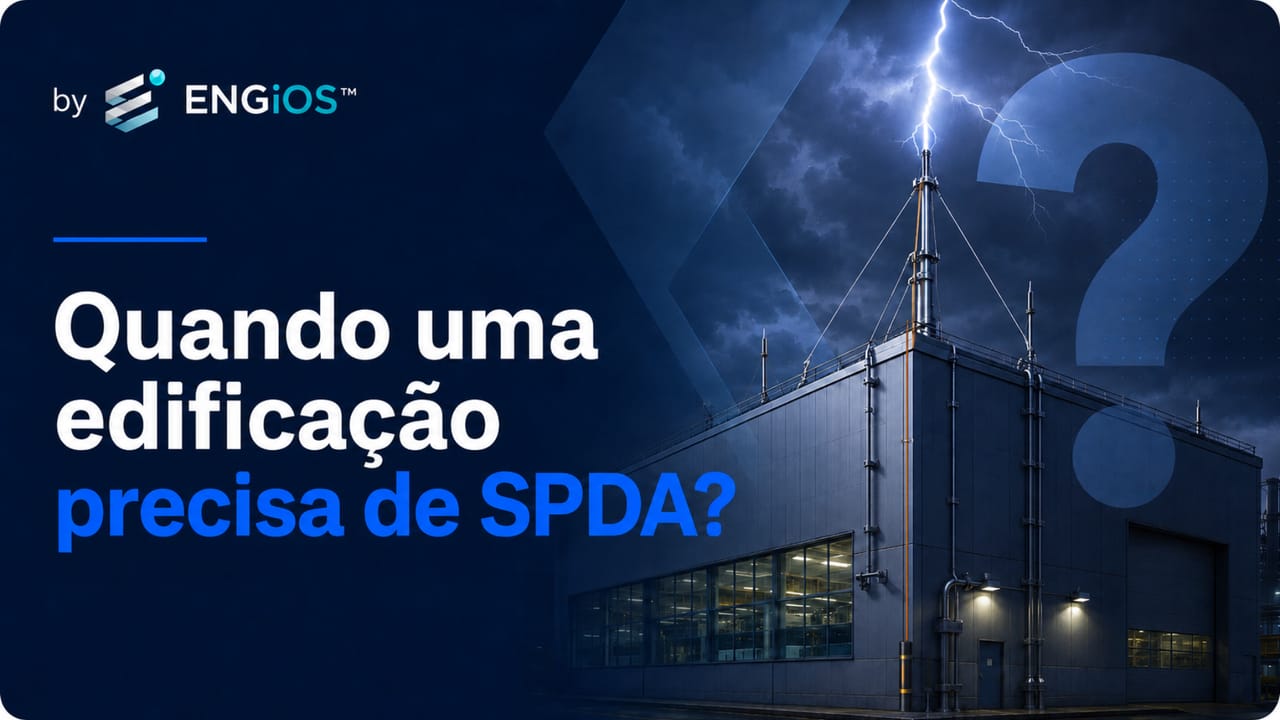
Understand when a building requires a lightning protection system (LPS), how NBR 5419 risk analysis applies, and when to contract design, inspection, technical reporting, or adaptation.
Check it out!
Is an LPS mandatory? The answer depends on technical assessment and risk analysis in accordance with NBR 5419. A building must be assessed to determine whether it requires an LPS, the Lightning Protection System, considering the characteristics of the structure, occupancy, exposure, internal systems, possible losses, and applicable protection measures.
LPS existente não significa LPS conforme. Sem projeto, laudo, inspeção, aterramento, equipotencialização, DPS e documentação técnica, o sistema pode não oferecer a proteção esperada.
A necessidade de LPS não deve ser definida por achismo. A decisão técnica depende de risk analysis, levantamento da edificação, ocupação, exposição, sistemas internos e consequências possíveis de uma descarga atmosférica.
In practical terms, the correct question is not merely “does the building need a lightning rod?”, but rather what is the building’s risk and which lightning-protection measures are necessary to reduce it in a technically consistent manner?
Precisa saber se sua edificação exige LPS, revisar um sistema existente ou regularizar documentação técnica? A A3A Engenharia realiza Projeto de LPS, risk analysis, laudo de LPS, inspeção de LPS, grounding, equipotential bonding, SPDs, ART, and adaptation according to the building’s needs.
Technical note: this content is technical and interpretive in nature and does not replace consultation of the current ABNT NBR 5419 in an official source or licensed standards collection, such as ABNT. A definição de necessidade de LPS deve ser feita por profissional habilitado, com base em levantamento técnico e análise de risco.
Is an LPS mandatory? The technical answer depends on risk analysis
The need for an LPS should not be defined by guesswork, a simplified rule, or comparison with a neighboring building. The building must be analyzed as a system, considering its exposure, use, occupancy, electrical and electronic interfaces, and the possible consequences of a lightning discharge.
NBR 5419-2 specifically addresses risk analysis applied to lightning protection. This analysis helps determine whether the structure requires protective measures, which protection level should be adopted, and which complementary measures are required for an effective solution.
This means that two visually similar buildings may have different needs. An office building, industrial facility, school, hospital, condominium, logistics warehouse, and a facility with critical electronic systems can have different risk profiles.
Situations indicating the need for an LPS assessment
Some situations do not automatically establish that an LPS is mandatory, but they indicate that the building should undergo technical assessment.
Main indicators include:
- a tall, isolated, or exposed building;
- high circulation or occupancy of people;
- commercial, industrial, educational, public, or institutional activity;
- presence of sensitive electrical and electronic systems;
- electrical panels, automation, CCTV, access control, telecommunications, or IT systems relevant to operations;
- equipment installed on the roof;
- history of equipment damage, surges, or electrical failures;
- absence of LPS design, technical report, or documentation;
- renovation, expansion, or change in building use;
- requirements from an insurer, audit, inspection authority, compliance process, or regularization process.
In these cases, the correct decision is to perform a technical survey and risk analysis rather than simply install components without a design. When the assessment indicates the need for protection, the next step is to translate the conclusion into an LPS design, detailed documentation and acceptance criteria.
Is an LPS mandatory in every building?
It is not appropriate to state generically that every building needs an LPS. The need must be technically verified according to risk-analysis criteria and the building context.
It is also inappropriate to state that only very tall buildings need an LPS. Height can be a relevant factor, but it is not the only one. Use, exposure, occupancy, internal systems, incoming lines, operational continuity, and consequences of failure also influence the decision.
Therefore, the question “is an LPS mandatory?” must be treated carefully. In many cases, the obligation appears indirectly through design requirements, fire-department requirements, insurers, audits, technical standards, internal maintenance policies, building regularization, an LPS technical report or professional responsibility.
Need to confirm whether the building requires an LPS?
A3A Engenharia performs technical assessments, risk analysis following the logic of NBR 5419, document verification, and definition of the appropriate path: design, technical report, inspection, or system adaptation.
An existing LPS does not mean a compliant LPS
The existence of air terminals, down conductors, or visible cables does not guarantee that the building is adequately protected. The article on how the LPS is structured according to NBR 5419 helps explain why the system cannot be assessed solely by the presence of visible components.
An existing system may present problems such as:
- absence of risk analysis;
- lack of technical design;
- missing or lost ART and documentation;
- interrupted or poorly connected down conductors;
- undocumented grounding;
- absence of equipotential bonding;
- missing, inadequate, or uncoordinated SPDs;
- roof modifications without system review;
- corrosion, weak connections, or damaged components;
- incompatibility with internal electrical and electronic systems;
- lack of periodic inspection and maintenance.
Is an LPS installed but there is no design, technical report, or reliable documentation? A3A Engenharia can assess the existing system through LPS inspection, document review, verification of grounding, equipotential bonding, SPDs, and recommendations for LPS maintenance and adaptation.
When is it a case for design, technical report, inspection, or adaptation?
The client’s need may arise at different stages. Therefore, it is important to distinguish the services.
The LPS design é indicado quando a edificação é nova, está em reforma, será ampliada ou precisa de uma solução técnica documentada para execução, contratação ou regularização. The artigo LPS Design: Example, NBR 5419, Risk Analysis, and ART explores this difference between technical intent and contracting a design in greater depth.
The LPS technical report is indicated when a system is already installed and its technical condition, documentation, compliance, nonconformities, and need for corrections must be assessed. There is also specific content on LPS technical report conforme a NBR 5419.
An LPS inspection is indicated to visually and documentarily verify the system, including air terminals, down conductors, connections, grounding, equipotential bonding, SPDs, construction changes, and existing records.
An LPS maintenance and adaptation is indicated when the system has failures, is outdated, has been modified, has lost traceability, or needs correction to meet the building’s current needs.
Do grounding, SPDs, and equipotential bonding affect the decision?
Yes. A common mistake is to treat the LPS decision only as a choice between installing or not installing air terminals on the roof.
Lightning protection needs to consider:
- external LPS;
- grounding design;
- grounding grid;
- equipotential bonding;
- DPS;
- SPD coordination;
- protection of power, signal, and data lines;
- electrical panels;
- sensitive internal systems;
- telecommunications, CCTV, automation, access control, and IT.
Uma edificação pode até possuir proteção física contra impacto direto, mas continuar vulnerável a surtos, falhas internas, diferenças de potencial e danos em equipamentos se aterramento, DPS e equipotential bonding não forem analisados em conjunto. Esse é o ponto de conexão com as soluções de Grounding and Equipotential Bonding, Surge Protective Devices e Surge Protection Measures.
Commercial, industrial, and critical buildings
Assessing the need for an LPS becomes even more important in buildings where a failure can cause significant impacts.
In commercial buildings, risk involves people, operations, equipment, security systems, telecommunications, automation, and continuity of activities.
In industrial facilities, the analysis should consider production processes, machines, panels, instrumentation, automation, operational shutdowns, and damage to control systems.
In critical buildings, such as hospitals, schools, public buildings, data centers, operational centers, and facilities with essential services, the assessment should consider not only material damage but also safety, availability, and service continuity.
This perspective also connects to the topic of risk management in LPS projects, especially when the building has critical systems, high occupancy, or operational-continuity requirements.
Technical documentation and professional responsibility
Determining whether an LPS is required should produce technical traceability. This means the decision must be documented, especially in corporate, industrial, public, institutional buildings, or those subject to compliance requirements.
The documentation may include:
- technical survey report;
- risk analysis;
- drawings and design reports;
- basic or detailed design;
- ART;
- material specifications;
- execution criteria;
- technical report;
- inspection records;
- grounding measurements and documentation;
- adaptation and maintenance recommendations.
Without documentation, the building is technically and administratively vulnerable. Even if components are installed, it may be difficult to demonstrate that the system was properly designed, installed, inspected, and maintained.
An LPS without technical documentation is not a reliable condition of compliance.
If the building lacks risk analysis, design, ART, technical report, inspection records, grounding documentation, or SPD verification, A3A can structure the diagnosis and indicate the path for technical regularization.
How A3A assesses the need for an LPS
A3A Engenharia assesses the need for an LPS from an integrated view of the building. The objective is not merely to determine whether a system is installed, but to verify whether the protection is technically consistent with NBR 5419, the electrical infrastructure, grounding, SPDs, and internal systems.
The work may include:
- technical survey of the building;
- analysis of existing documentation;
- risk assessment;
- verification of the existing LPS;
- analysis of grounding and equipotential bonding;
- assessment of SPDs and surge protection;
- identification of nonconformities;
- adaptation design;
- technical report, inspection, ART, and technical documentation;
- guidance for execution, maintenance, and technical acceptance.
This approach avoids isolated decisions and transforms the initial question into a clear technical path: assess, document, design, adapt, and maintain. For a broader view of the solution, also see the page on Lightning Protection.
Conclusion
A building requires an LPS when technical analysis demonstrates that lightning-protection measures are necessary to reduce risks associated with the structure, people, internal systems, operations, and building documentation.
The decision should not be based solely on height, roof appearance, or visible cables. The correct approach is to perform risk analysis, assess the building context, and integrate the external LPS, grounding, equipotential bonding, SPDs, documentation, inspection, and maintenance.
For companies, condominiums, industrial facilities, institutions, and critical buildings, the question “does it need an LPS?” should be treated as an engineering decision, with technical responsibility and appropriate documentation.
Technical references
[1] ABNT NBR 5419 — Lightning protection. Consultar versão vigente em fonte oficial ou acervo normativo licenciado.
[2] ABNT NBR 5410 — Low-voltage electrical installations. Consultar versão vigente em fonte oficial ou acervo normativo licenciado.
[3] A3A Engenharia. NBR 5419-2: risk analysis in LPS projects.
Frequently asked questions
It is not appropriate to state generically that every building needs an LPS. The need must be defined through technical risk analysis considering characteristics of the structure, occupancy, exposure, internal systems, and possible consequences of a lightning discharge.
The requirement depends on the building’s technical, regulatory, and documentary context. In many cases, it arises from technical standards, risk analysis, fire-department requirements, insurers, audits, compliance, regularization, or professional responsibility.
The correct approach is to perform a technical survey and risk analysis following the logic of NBR 5419. The assessment should consider the building, occupancy, incoming lines, internal systems, grounding, SPDs, equipotential bonding, and existing documentation.
Not necessarily. The existence of air terminals or down conductors does not guarantee compliance. Design, risk analysis, grounding, equipotential bonding, SPDs, documentation, inspection, maintenance, and actual system conditions must be verified.
An LPS technical report is indicated when a system is already installed and its compliance, documentation, physical condition, grounding, SPDs, equipotential bonding, nonconformities, and need for adaptation must be assessed.
Complementary technical materials
- Solution: Lightning Protection
- Solution: Grounding and Equipotential Bonding
- Solution: Surge Protective Devices
- Solution: Surge Protection Measures
- Service: LPS Design
- Service: Grounding Design
- Service: LPS Technical Report
- Service: LPS Inspection and Technical Documentation
- Service: LPS Maintenance and Adaptation
- Service: Grounding Technical Report and Measurement
- Standards hub: NBR 5419
- NBR 5419-2: Risk Analysis in LPS Projects
- Complete Guide to LPS and SPM
- How the LPS Is Structured According to NBR 5419
- Risk Management in LPS Projects
- LPS Design: Example, NBR 5419, Risk Analysis, and ART
- Grounding Grid: Design Criteria, LPS, and Equipotential Bonding
- Equipotential Bonding
- SPD: Surge Protection, NBR 5410, LPS, and Grounding
- SPD Coordination
