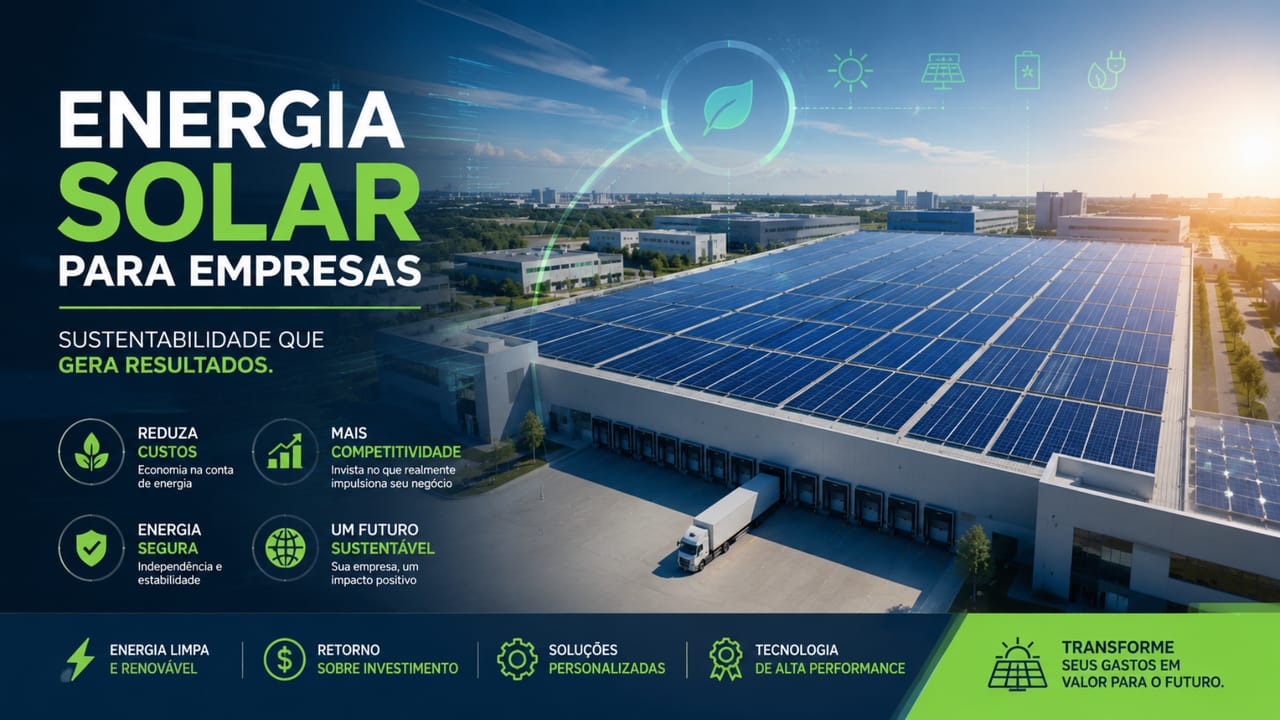
Understand how to evaluate solar energy for companies, considering feasibility, consumption, electrical infrastructure, technical risks, distributed generation, and design quality.
Check it out!
Solar energy for companies can be a strategic solution to reduce costs, improve energy predictability, and strengthen sustainability initiatives. But the decision to install a photovoltaic system should not be based only on promised savings or the value of a commercial proposal.
In companies, electrical energy is linked to operations, production, comfort, safety, service continuity, and recurring business costs. For this reason, a solar energy system must be evaluated as technical infrastructure.
Before installing panels, inverters, and protection devices, it is necessary to understand consumption, demand, load profile, the condition of the electrical installation, grid connection, risks, maintenance, warranties, technical standards, and design quality.
This article explains how to evaluate solar energy for companies, which technical precautions should be considered, and why engineering is decisive in transforming photovoltaic generation into a safe and viable solution.
Why solar energy for companies requires technical analysis
In a residence, the decision to adopt solar energy is usually closely related to reducing the electricity bill. In companies, the analysis is broader.
A company may have different operating shifts, critical loads, sensitive equipment, contracted demand, complex electrical panels, transformers, substations, HVAC systems, production processes, electronic security, IT, lighting, and administrative areas.
This means that solar energy must fit the operational reality of the business.
A poorly sized photovoltaic system may generate less savings than expected. A poorly integrated system can cause protection problems, shutdowns, maintenance difficulties, or electrical risks. An incomplete commercial proposal may hide upgrade costs that appear later.
For this reason, technical analysis should come before contracting. It helps answer objective questions: Is the site suitable? Can the electrical installation support the system? Does the expected generation make sense? Is there a shading risk? Does the company need upgrades? Is the estimated return realistic?
To understand the basics, also see How solar energy works.
Consumption, demand, and load profile
The first point when evaluating solar energy for companies is actual consumption.
It is not enough to look only at the final amount of the electricity bill. It is necessary to assess consumption history, seasonality, peak-use periods, contracted demand, tariff structure, expected growth, and operating characteristics.
Companies that operate during the day tend to make better use of instantaneous solar generation. Companies with consumption concentrated at night may depend more heavily on compensation rules, storage, or complementary strategies.
It is also important to distinguish energy consumption from power demand. The bill may involve different charges depending on the tariff category, contract, and consumer-unit profile.
Some points that should be evaluated include:
- monthly consumption history;
- seasonal variation;
- operating hours;
- load peaks;
- contracted demand;
- planned expansions;
- critical loads;
- opportunities for energy efficiency before the investment.
A good feasibility study does not begin with the number of panels. It begins with the company’s energy behavior.
Available area, roof, ground, and shading
After understanding consumption, it is necessary to evaluate where the system can be installed.
Solar panels can be installed on roofs, slabs, metal structures, carports, parking areas, or ground-mounted structures depending on the type of facility and available space.
But not every free area is technically suitable.
The design needs to consider orientation, tilt, shading, maintenance access, structural capacity, additional loads, wind, corrosion, waterproofing, and existing interferences.
In companies, common obstacles include HVAC equipment, antennas, skylights, water tanks, parapets, exhaust systems, ducts, walkways, and maintenance areas.
Partial shading can reduce performance and affect the configuration of photovoltaic arrays. Depending on the solution, it may be necessary to adjust the layout, divide strings, choose a different inverter architecture, or reconsider part of the available area.
This stage is essential to prevent a commercial estimate from becoming a system with lower-than-expected performance.
Existing electrical infrastructure: can the system support it?
Solar energy for companies must be integrated with the existing electrical installation.
This requires assessing panels, busbars, circuit breakers, cables, conduits, grounding, service entrance, transformers, substations, metering, protection devices, and connection capacity.
In some companies, the electrical infrastructure is ready for expansion. In others, there may be limitations, aging equipment, missing documentation, lack of space in panels, inadequate protection, or the need for upgrades before photovoltaic installation.
The analysis should consider:
- capacity of electrical panels;
- condition of conductors;
- existing protection devices;
- grounding and equipotential bonding;
- compatibility with inverters;
- connection point;
- need for isolation;
- impact on operation and maintenance;
- utility requirements.
If the existing infrastructure is not evaluated, the solar system may end up being installed on a weak technical foundation.
This concern is directly connected to photovoltaic design.
Technical feasibility and economic feasibility are not the same thing
A project may appear economically attractive on a spreadsheet and still have significant technical constraints.
Economic feasibility considers investment, expected savings, payback period, tariffs, compensation rules, maintenance costs, and equipment life.
Technical feasibility considers whether the system can be installed safely, with adequate performance and compliance, in the available location.
The two analyses need to move together.
A proposal may promise a high return while ignoring the cost of structural reinforcement, electrical upgrades, panel replacement, grounding improvements, documentation updates, safe maintenance access, or connection restrictions.
There may also be a difference between estimated and actual generation, especially when shading, losses, dirt, temperature, monitoring failures, or downtime are not properly considered.
For this reason, companies should evaluate proposals beyond price. It is necessary to understand assumptions, scope, responsibilities, exclusions, warranties, equipment, and technical criteria.
For a deeper discussion of this type of decision, see Engineering Technical Proposal Analysis.
Technical risks before installing solar energy
The most common technical risks in corporate photovoltaic systems appear when the design is oversimplified.
Among the main risks are:
- sizing incompatible with actual consumption;
- overly optimistic generation estimates;
- unconsidered shading;
- roof without adequate assessment;
- insufficient electrical infrastructure;
- poorly specified protection devices;
- inadequate grounding;
- lack of LPS assessment;
- poorly sized string box;
- inverter incompatible with the application;
- maintenance difficulties;
- incomplete documentation;
- missing or poorly configured monitoring.
These risks do not mean that solar energy is inherently risky. They mean that it must be approached methodically.
The larger the system and the more critical the company’s operation, the greater the care required in design, implementation, commissioning, and maintenance.
Grid connection, distributed generation, and utility requirements
A large share of corporate solar systems operates connected to the electrical grid.
In this model, photovoltaic generation interacts with the internal installation and the distribution utility’s grid according to applicable distributed-generation rules.
The connection requires technical requirements, utility standards, documentation, metering, protection, and in many cases formal approval before operation.
It is also necessary to ensure that the system operates safely in shutdown, maintenance, fault, or grid-outage conditions.
Standards such as ABNT NBR 16149 and ABNT NBR IEC 62116 are important references for discussing the grid interface and anti-islanding requirements for grid-connected inverters.
For the company, grid connection should not be seen only as bureaucracy. It affects safety, operation, approval, and system continuity.
An error at this stage can delay commissioning or require technical rework.
Electrical protection, grounding, and LPS
Corporate photovoltaic systems require special attention to electrical protection.
There are direct-current circuits, outdoor modules, cables in external areas, inverters, integration with electrical panels, and the possibility of surges.
Protection should consider circuit breakers, isolation, SPDs, fuses where applicable, string boxes, grounding, equipotential bonding, and LPS where required.
ABNT NBR 16690 is an important reference for photovoltaic-array design requirements. The ABNT NBR IEC 61643 series supports the selection of surge protective devices, including on the DC side.
The relationship with ABNT NBR 5410, ABNT NBR 5419, and NR-10 must also be evaluated.
When these points are ignored, the installation may generate energy, but it may not necessarily be adequate in terms of safety and reliability.
For technical support, also see Surge protection in photovoltaic systems, Electrical Grounding, and Electrical Safety.
Contracting: what to evaluate in solar-energy proposals
Companies normally receive proposals from different suppliers. Comparing these proposals requires more than looking at price and installed capacity.
It is important to verify:
- consumption assumptions used in the study;
- estimated generation and calculation method;
- specified equipment;
- brand, model, and warranty of the modules;
- type and quantity of inverters;
- included protection devices;
- mounting structure;
- scope of electrical upgrades;
- technical documentation;
- utility approval;
- schedule and responsibilities;
- maintenance and monitoring;
- contractual exclusions.
A cheaper proposal may exclude essential services. A more expensive proposal may include important upgrades that reduce risk.
The comparison must be technical and commercial at the same time.
For relevant projects, an independent proposal review can prevent weak contracting decisions and reduce future disputes.
Maintenance, monitoring, and long-term performance
Solar energy does not end at installation.
After commissioning, the system must be monitored to ensure performance and safety.
Monitoring helps identify generation failures, stopped inverters, underperforming strings, communication problems, dirt, new shading, or operation of protection devices.
Preventive maintenance helps preserve cables, connections, modules, structures, string boxes, inverters, grounding, and protection devices.
In companies, downtime or low generation can affect return on investment and raise questions about implementation quality.
For this reason, the contract should clearly define who monitors, who responds to failures, inspection frequency, which items are checked, and how generation data will be tracked.
A system without maintenance is an asset without management.
When a technical audit makes sense
A technical audit can make sense at different stages.
Before contracting, it helps evaluate proposals, assumptions, risks, and scope.
During implementation, it helps verify whether the design is being executed as specified.
After installation, it helps assess performance, safety, compliance, documentation, and possible failures.
It can also be useful when the company notices lower-than-expected generation, approval difficulties, maintenance problems, warranty questions, or conflicts with suppliers.
In corporate systems, technical auditing reduces uncertainty and improves contracting governance.
It does not replace the supplier responsible for execution, but gives the contracting party an independent view of risks, technical compliance, and delivery quality.
Solar energy as a strategic engineering decision
Solar energy for companies should be viewed as a strategic engineering decision.
It can reduce costs, improve predictability, support sustainability goals, and add value to the business infrastructure.
But to deliver these results, it must be well studied, well designed, well contracted, and well maintained.
The question should not be only “how much will I save?”
The right questions include: Can the installation support the system? Is the design adequate? Were protection measures considered? Is the generation estimate realistic? Is maintenance planned? Was grid connection handled correctly? Were risks assessed?
When these answers are developed methodically, solar energy stops being merely a commercial opportunity and becomes reliable infrastructure for the company.
Where A3A Engenharia fits into this context
A3A Engenharia works with technical consulting, design, diagnostics, audits, infrastructure, commissioning, maintenance engineering, and project management.
In solar energy for companies, technical analysis supports decisions about feasibility, contracting, electrical infrastructure, risks, protection, documentation, implementation, performance, and maintenance.
Related technical content
Related services
Technical references
- ABNT NBR 16690 — Electrical installations of photovoltaic arrays — design requirements.
- ABNT NBR 16149 — Photovoltaic systems: characteristics of the interface for connection to the electrical distribution grid.
- ABNT NBR 16150 — Photovoltaic systems: conformity test procedure.
- ABNT NBR IEC 62116 — Anti-islanding test procedure for grid-connected photovoltaic-system inverters.
- ABNT NBR 5410 — Low-voltage electrical installations.
- ABNT NBR 5419 — Protection against lightning.
- ABNT NBR IEC 61643-31 — SPDs for specific use in direct-current circuits.
- ABNT NBR IEC 61643-32 — SPDs connected to the DC side of photovoltaic installations.
- NR-10 — Safety in electrical installations and services.
Recommended complementary materials
FAQ
1. Is solar energy worthwhile for companies?
It can be, but it depends on consumption, load profile, tariff, available area, electrical infrastructure, implementation cost, maintenance, and design quality.
2. What should be evaluated before installing solar energy in a company?
Consumption, demand, roof or available area, shading, electrical infrastructure, protection, grid connection, expected return, documentation, and maintenance.
3. Does corporate solar energy require technical design?
Yes. The technical design defines sizing, equipment, protection, connection, safety, performance, and compatibility with the existing installation.
4. What is the risk of contracting solar energy only by lowest price?
The risk is receiving an incomplete solution with reduced scope, insufficient protection, unrealistic estimates, or unplanned upgrade costs.
5. Does the company need to upgrade the electrical installation before solar energy?
It may. This depends on the condition of panels, cables, protection devices, grounding, service entrance, transformers, and the connection point.
6. What is distributed generation?
It is the model in which energy is generated close to the point of consumption and interacts with the distribution grid according to applicable rules.
7. Is a technical audit recommended for a photovoltaic system?
Yes, especially for companies. It helps evaluate proposals, execution, performance, safety, documentation, and technical compliance.
Conclusion
Solar energy for companies can be a highly relevant decision, but it must be treated as engineering infrastructure.
Feasibility depends on consumption, demand, available area, electrical infrastructure, photovoltaic design, protection, grid connection, maintenance, and risk analysis.
When properly planned, a photovoltaic system can contribute to savings, predictability, and sustainability.
When poorly contracted or poorly designed, it can create losses, rework, and technical risks.
For this reason, before installation, the company should evaluate not only price but the technical quality of the solution.
Is your company evaluating solar energy?
Before contracting, it is essential to analyze consumption, electrical infrastructure, risks, protection, feasibility, the technical proposal, and implementation quality.
