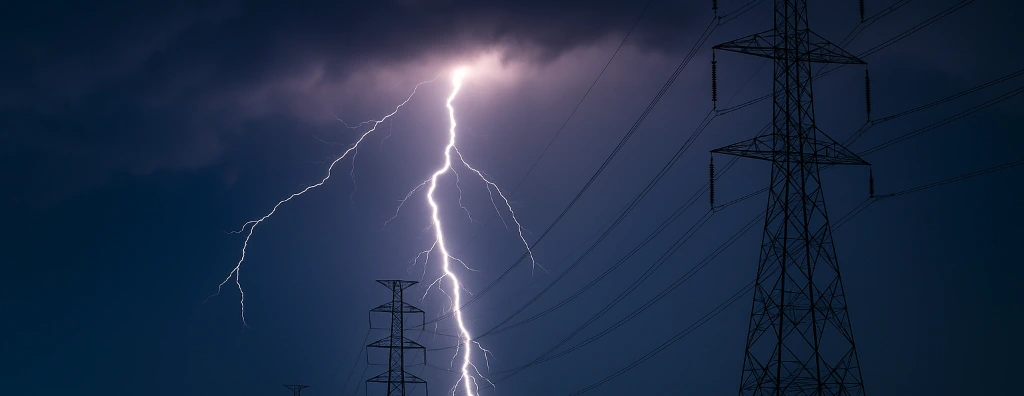
Understand how NBR 5419-1:2026 structures the effects of lightning discharges into damage sources S1–S4, damage types D1–D3, losses, risk, damage frequency, and protection measures.
Check it out!
Lightning discharges can produce very different effects on a structure: electric shock to people, fire, explosion, mechanical damage, overvoltages, and failures in electrical and electronic systems. ABNT NBR 5419-1:2026 organizes this analysis by separating three concepts that should not be confused: damage source, type of damage, and type of loss.
This distinction is important because protection design does not begin by choosing an air-termination device, an SPD, or a grounding grid. First, it is necessary to understand where the discharge can occur, what damage mechanism it can produce, and which consequence needs to be controlled. The NBR 5419-2 risk assessment follows this logic.
For new designs, renovations, or modifications capable of affecting existing protection, the 2026 edition of the NBR 5419 series should be treated as the current technical reference. Content based on the previous classification needs to be reinterpreted in light of this current framework.
Damage Sources S1, S2, S3, and S4
NBR 5419-1:2026 considers four positions of the lightning strike point relative to the structure. They are identified as S1 through S4.
| Source | Situation | Typical effect to consider |
| S1 | Lightning strike to the structure itself | Direct current, thermal and mechanical effects, step and touch voltages, sparking, and LEMP |
| S2 | Lightning strike near the structure | Electromagnetic coupling and failure or malfunction of internal systems |
| S3 | Lightning strike to electrical lines or metallic pipes connected to the structure | Currents and overvoltages conducted into the installation |
| S4 | Lightning strike near connected electrical lines or pipes | Overvoltages induced in lines entering or leaving the structure |
The S1–S4 classification therefore describes the physical origin of the hazardous event. It does not represent the damage itself.
What a Lightning Strike to the Structure Can Cause
An event classified as S1 can simultaneously impose different stresses on the installation. These include resistive heating, electric arcing, electrodynamic forces, dangerous sparking, potential rise in the grounding system, and coupling effects that affect internal systems.
In an industrial facility, for example, a single event can cause physical damage at the strike point, create dangerous voltages for people, and also introduce surges into power, automation, instrumentation, telecommunications, or electronic security circuits.
For this reason, external SPDA and protection of internal systems should not be treated as independent disciplines. The complete system needs to coordinate air-termination, down conductors, grounding, equipotential bonding, separation distances, and surge protection measures.
Damage D1, D2, and D3 in NBR 5419-1:2026
The 2026 edition consolidates three basic types of damage.
D1 — injury to living beings due to electric shock
D1 is associated with electrical effects capable of injuring people or animals, especially due to potential differences resulting from the flow of lightning current.
In engineering practice, this highlights step and touch voltages, equipotential bonding, the geometry and continuity of the grounding system, and measures intended to reduce human exposure.
Protection does not depend on a single component. It results from the combination of the SPDA, equipotential bonding, soil conditions, insulation, physical restrictions, and other measures defined for the existing risk.
D2 — physical damage
D2 covers physical effects such as fire, explosion, mechanical destruction, and release of hazardous products, among other consequences caused by lightning current and associated sparking.
This type of damage is particularly critical in industrial facilities, areas containing combustible materials, processes with explosion risk, structures with high concentrations of people, and installations whose unavailability could cause significant external consequences.
To reduce D2, NBR 5419 directs physical protection to the SPDA, addressed in detail in Part 3 of the series.
D3 — failures of internal systems due to LEMP
D3 corresponds to failures or malfunction of electrical and electronic systems caused by LEMP — lightning electromagnetic pulse.
This damage can occur even when lightning does not strike the structure directly. Nearby discharges can induce overvoltages, while discharges to connected lines can conduct surges into the installation.
Data centers, automation systems, PLCs, industrial networks, telecommunications, video surveillance, access control, instrumentation, and supervisory systems are examples of loads whose continuity depends on a coherent internal protection strategy.
The engineering response consists of surge protection measures (MPS): lightning protection zones, equipotential bonding, shielding, suitable routing and segregation, isolating interfaces, and coordinated SPD systems.
Damage Source Is Not the Same as Type of Damage
One of the most useful interpretations for design is to clearly separate these concepts.
S1–S4 answer “where did or can the discharge occur?” while D1–D3 answer “what damage can this event produce?”.
An S1 source, for example, can produce D1, D2, and D3. An S2 source is especially associated with D3 because the electromagnetic field generated by a nearby discharge can affect internal systems without a direct strike to the structure.
This relationship makes it possible to build the analysis chain:
hazardous event → damage source → probability of damage → consequence → risk/frequency → protection measure.
What About Losses? What Changed in the 2026 Edition
In Part 1:2026, normative consequences are treated differently from the framework many professionals memorized from the previous edition. For the purposes of Part 1, L1 is related to loss of human life, including permanent injury, and L3 is related to loss of cultural heritage.
The 2026 edition also reinforces damage frequency F for assessing the availability of services and equipment. In the risk framework, the former R2 was replaced by damage frequency F, while R4 became informative and optional according to Part 2.
This point is relevant in critical infrastructure. An installation may present acceptable risk for certain human losses and still require additional measures because the expected frequency of equipment failures or service interruptions is incompatible with the required availability.
How Risk and Frequency Enter the Design
NBR 5419-1 establishes that risk R should be evaluated considering the number of hazardous events, probability of damage, and consequence of loss. The detailed methodology is provided in NBR 5419-2:2026.
Damage frequency F performs a complementary role for equipment and service availability. The design therefore moves beyond a simple “does it have a lightning rod or not?” decision and becomes a quantitative decision about which measures are necessary to achieve tolerable risk and frequency.
> Practical engineering application: in an existing installation, diagnosis should verify more than the physical presence of the SPDA. It is necessary to compare the risk assessment, changes in use, internal systems, grounding, equipotential bonding, SPDs, documentation, inspections, and actual installation conditions.
Protection Measures Associated with Different Effects
The complete protection architecture combines different measures because D1, D2, and D3 have different mechanisms.
| Objective | Associated engineering measures |
| Reduce injury to people | SPDA, equipotential bonding, control of step/touch voltages, insulation, and physical restrictions |
| Reduce physical damage | External and internal SPDA, separation distances, equipotential bonding, and coordination with fire protection |
| Reduce failures of internal systems | MPS, LPZ, coordinated SPDs, shielding, segregation, isolating interfaces, and equipotential bonding |
The choice should result from the risk assessment and the characteristics of the structure, rather than from a standardized solution applied indiscriminately.
Relationship with External SPDA, Internal SPDA, and MPS
The external SPDA has three fundamental functions: intercept the lightning discharge, conduct its current safely, and dissipate it into the ground. This involves air-termination, down-conductor, and grounding subsystems.
The internal SPDA seeks to prevent dangerous sparking, mainly through separation distance and equipotential bonding.
MPS protect internal systems against the effects of LEMP. They include coordinated SPDs, organization into lightning protection zones, shielding, and other electromagnetic compatibility measures.
In practice, a robust design should verify the interfaces among these three fronts. An excellent air-termination system does not compensate for inadequately coordinated SPDs; likewise, SPDs do not replace a required SPDA or correct deficient grounding or equipotential bonding.
Example of a Technical Assessment of an Industrial Facility
Consider an industrial facility with a metallic roof, low-voltage panels, an automation network, video surveillance, telecommunications, and external power and data lines.
A direct strike to the roof is an S1 source. It can create electric-shock risk (D1), physical damage or fire (D2), and failures in electronic systems (D3).
A discharge near the building may be S2 and produce mainly D3 through electromagnetic coupling. A discharge to the external network may be S3, conducting current and overvoltage into the installation. A discharge near that network is characterized as S4, with induced overvoltages.
The result is that the design needs to combine risk assessment, SPDA, grounding, equipotential bonding, SPDs, segregation, and interface coordination. Assessing only the air-termination device or only grounding resistance does not represent the systemic analysis required.
What Should Be Verified in Existing Installations
In audits, inspections, Due Diligence, or upgrade processes, some points require special attention:
- version of the risk assessment and assumptions used;
- changes in occupancy, process, layout, or construction characteristics;
- existence and condition of air-termination, down-conductor, and grounding subsystems;
- continuity of connections and equipotential bonding;
- separation distances and risk of dangerous sparking;
- interfaces involving power, telecommunications, data, automation, and photovoltaic systems;
- specification, installation, and coordination of SPDs;
- drawings, design reports, inspection records, tests, and ART documentation;
- compatibility among design, installed condition, and current condition.
This diagnosis creates an objective basis for deciding among maintenance, partial upgrading, design revision, or system reengineering.
Conclusion
The effects of lightning discharges should not be treated as a generic list of consequences. NBR 5419-1:2026 provides a logical engineering framework: identify sources S1–S4, understand damage D1–D3, assess consequences, risk, and frequency, and then select the appropriate protection measures.
This interpretation directly connects Part 1 to the risk assessment in Part 2, the SPDA in Part 3, and the measures for internal systems in Part 4. The result is integrated, verifiable protection compatible with the actual risk of the installation.
Technical references
[1] BRAZILIAN ASSOCIATION OF TECHNICAL STANDARDS. ABNT NBR 5419-1:2026 — Lightning protection — Part 1: General principles. Rio de Janeiro: ABNT, 2026.
[2] BRAZILIAN ASSOCIATION OF TECHNICAL STANDARDS. ABNT NBR 5419-2:2026 — Lightning protection — Part 2: Risk assessment. Rio de Janeiro: ABNT, 2026.
[3] FEDERAL COUNCIL OF ENGINEERING AND AGRONOMY. Technical Responsibility Annotation — ART. Brasília: Confea.
Frequently asked questions
S1 is a discharge to the structure; S2, near the structure; S3, to electrical lines or metallic pipes connected to the structure; and S4, near those lines or pipes. They describe the location of the hazardous event, not the type of damage.
D1 corresponds to injury to living beings due to electric shock; D2 to physical damage such as fire, explosion, or mechanical destruction; and D3 to failures of internal systems caused by the electromagnetic effects of lightning.
No. SPDs are part of the surge protection measures for internal systems. When the assessment indicates that an SPDA is required, protection should coordinate external SPDA, internal SPDA, grounding, equipotential bonding, and MPS.
Reassessment is particularly important after renovations, changes of use, construction changes, or electrical-installation modifications that can affect protection, as well as when documentation is incomplete, failures recur, or the design differs from the installed condition.
Complementary technical materials
- NBR 5419: SPDA, risk assessment, grounding, SPDs, and technical documentation
- NBR 5419-2: risk assessment and SPDA risk management
- SPDA Design: example, NBR 5419, risk assessment, ART, and drawings
- Electrical Grounding: function, types, NBR 5410, SPDs, SPDA, and technical report
- SPD: what it is, what it does, and how to install it | NBR 5410