Understand the main LPS types, including Franklin air terminals, Faraday cage, rolling sphere method, air-termination, down conductors, grounding, and NBR 5419 criteria.
Check it out!
LPS types is an expression used to compare different ways of protecting structures against lightning. In engineering, however, Franklin rods, Faraday cages, meshes, and the rolling sphere do not simply represent equivalent ready-made models: some terms describe air-termination arrangements, while others correspond to positioning and protection-verification methods.
An LPS is a complete system formed by external and internal measures. In addition to air-termination, it includes down conductors, grounding, equipotential bonding, surge protection, separation criteria, documentation, inspection, and maintenance.
The appropriate solution depends on the geometry and use of the structure, the defined protection level, the risk analysis, and integration among all these subsystems. Therefore, the choice should not be made only by the shape of the air terminal or by construction preference.
What Does It Mean to Talk About LPS Types?
Talking about LPS types can be confusing because the standard should not be interpreted as a simple list of ready-made models. In many cases, what is called a “type” is actually an air-termination arrangement, a method for positioning air terminals, or a combination of external LPS components.
The complete system must consider:
- risk analysis;
- adopted protection class or level;
- building geometry;
- air-termination system;
- down conductors;
- grounding;
- equipotential bonding;
- protection of internal systems;
- documentation, inspection, and maintenance.
Therefore, Franklin rods, Faraday cages, rolling sphere, and other arrangements must be compared within a technical design, not only by the visual choice of a component installed on the roof.
Difference Between a Lightning Rod and an LPS
The term lightning rod is better known to the general public. It usually refers to an air terminal installed at the top of a building, intended to intercept lightning and conduct the current to earth through conductors and a grounding system.
An LPS is broader. It involves the coordinated set of external and internal measures used to reduce risks associated with lightning. This includes the physical air-termination and down-conductor system, but also grounding, equipotential bonding, SPDs, line protection, inspection, technical reports, and documentation.
This distinction is important because a building may have a visible air terminal and still present design, grounding, down-conductor, equipotential-bonding, or surge-protection failures.
Franklin-Type LPS
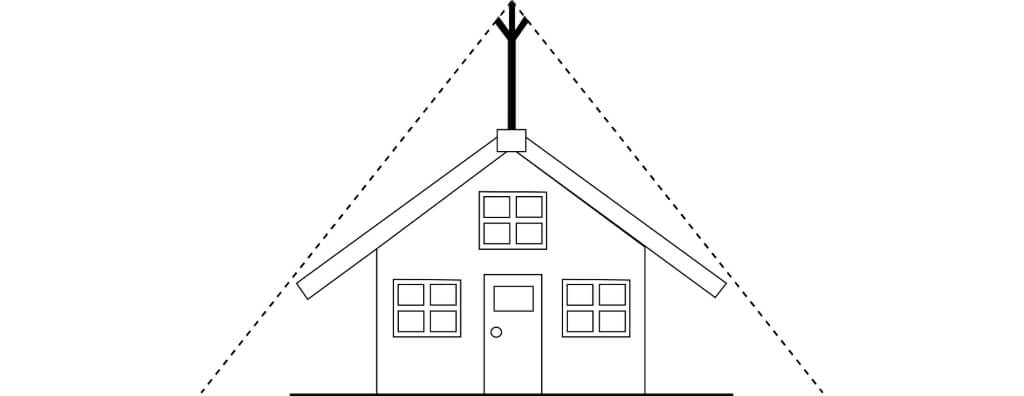
The so-called Franklin-type LPS is a solution based on point air terminals, generally installed at elevated points of the structure. The objective is to create a protected region based on the position, height, and distribution of the air terminals according to design criteria.
This type of solution is commonly associated with the Franklin air terminal. It can be applied to different buildings, but its feasibility depends on roof geometry, structure height, protection class, and integration with down conductors and grounding.
The critical point is that the Franklin air terminal should not be treated as a universal solution. The resulting protection must be technically verified. For more detail, see Franklin Air Terminal in LPS: Lightning Rods, Faraday Cage, and Air-Termination System.
Need to determine whether Franklin, Faraday cage, or a combined solution is appropriate for the building?
A3A Engenharia develops LPS Designs including risk analysis, definition of the air-termination system, down conductors, grounding, equipotential bonding, SPDs, technical documentation, and ART.
Faraday-Cage-Type LPS
The Faraday cage applied to an LPS uses a logic based on an air-termination mesh and conductors distributed across the building. Instead of relying only on a point air terminal, protection is organized through a network of connected metallic elements distributed in a planned manner.
This arrangement is common in buildings with large roofs, complex geometries, technical areas, metallic structures, or the need for distributed protection. The solution may involve meshes, perimeter conductors, air terminals, natural components, and connections to down conductors and grounding.
A Faraday cage does not eliminate the need for design. The mesh must be sized, positioned, and integrated with the rest of the system. Interference with roofs, parapets, rooftop equipment, metallic structures, photovoltaic systems, antennas, cameras, ducts, and technical walkways must also be evaluated.
Rolling Sphere Method
The rolling sphere method is not exactly an “LPS type,” but a method for verifying the protected zone. It is used to evaluate where lightning could strike the structure and, based on that, to position air terminals, meshes, or other air-termination components.
In simplified terms, the method considers an imaginary sphere rolling over the building. Points touched by the sphere represent regions susceptible to a direct lightning strike. Areas not touched remain within the protection zone defined by the air-termination arrangement.
This method is especially relevant for roofs with technical volumes, tanks, machinery, antennas, metallic structures, façades, parapets, and elevation differences. For more detail, see Rolling Sphere Method in LPS.
External LPS: Air-Termination, Down Conductors, and Grounding
Regardless of the adopted air-termination arrangement, the external LPS must form a technically coherent path for lightning current. This path begins at the air-termination system, passes through the down conductors, and reaches the grounding system.
The air-termination system intercepts the lightning strike. The down conductors carry the current to ground. The grounding system helps dissipate the current into the soil and must be integrated with the installation’s equipotential bonding.
In design, these three subsystems cannot be treated separately. A good air terminal with poorly distributed down conductors, inadequate connections, or deficient grounding compromises the reliability of the whole system. For more detail, see External LPS: Air-Termination, Down Conductors, and Grounding in NBR 5419-3 and LPS Grounding.
Down Conductors in an LPS
Down conductors connect the air-termination system to grounding. They may be specific components installed for this purpose or, when technically feasible, natural components of the structure.
The number, distribution, route, electrical continuity, mechanical protection, connections, and inspection points of down conductors directly influence LPS performance. In existing buildings, it is common to find interrupted down conductors, unidentified conductors, degraded connections, missing documentation, or no clear integration with grounding.
This topic deserves specific attention in designs and inspections because many LPS failures appear precisely at the transition among air-termination, down conductors, and grounding.
Grounding in an LPS
The LPS grounding system receives and dissipates the current carried by the down conductors. It must be analyzed as part of the complete system, considering resistance, continuity, connections, integration with other grounding systems, equipotential bonding, and soil conditions.
A recurring mistake is to treat LPS grounding as something isolated from the electrical installation. In many cases, improper separation of grounding systems can create dangerous potential differences and make protection of internal systems more difficult.
Therefore, grounding must be coordinated with the building protection strategy, NBR 5419, NBR 5410, equipotential bonding, and SPDs. For more detail, see LPS Grounding: Function in NBR 5419-3 and in the External LPS.
Internal LPS and SPDs
LPS types should not be evaluated only by the physical protection of the structure. In modern buildings, internal electrical and electronic systems also need protection against conducted and induced surges.
This is especially important in installations with CFTV, access control, automation, telecommunications, data centers, data networks, security systems, BMS, industrial equipment, and critical infrastructure.
Internal protection involves lightning protection zones, cable routing, shielding, equipotential bonding, and surge protective devices. For more detail, see NBR 5419-4: Internal LPS, SPDs, and Protection of Electrical and Electronic Systems and SPDs: Surge Protection, NBR 5410, LPS, and Grounding.
Does the building have CFTV, automation, telecommunications, or critical IT?
Lightning protection must also consider surges, SPDs, data lines, grounding, and equipotential bonding. Learn about Surge Protection Measures.
How to Choose the LPS Type?
The choice of LPS type depends on technical criteria. It is not advisable to decide based only on cost, appearance, construction tradition, or the prior existence of an old air terminal.
The definition should consider:
- risk-analysis results;
- required protection class;
- building geometry;
- roof height and shape;
- presence of technical areas, antennas, tanks, solar panels, and equipment;
- materials and usable natural components;
- possible routes for down conductors;
- existing grounding system;
- need for internal protection and SPDs;
- documentation and ease of inspection.
NBR 5419-2 is the part of the standard related to risk analysis. NBR 5419-3 addresses the external LPS, including air-termination, down conductors, and grounding.
LPS Types in Existing Buildings
In existing buildings, analysis of LPS types often reveals old systems, incomplete documentation, roof alterations, equipment installed later, unidentified down conductors, grounding systems without continuity evidence, or lack of adequate protection for internal systems.
In these cases, the first step is not always to replace the system. It is often necessary to conduct a technical survey, inspection, document review, route verification, grounding assessment, identification of nonconformities, and definition of a corrective-action plan.
This process makes it possible to separate what can be retained, what must be corrected, and what requires redesign. The decision should be based on technical evidence, not merely on the visible presence of air terminals or conductors.
Common Mistakes When Choosing an LPS
Common mistakes include:
- assuming every LPS with an air terminal is a properly designed Franklin-type system;
- installing air terminals without verifying the protected zone;
- ignoring the rolling sphere method on complex roofs;
- using meshes without proper integration with down conductors;
- treating grounding as separate from the LPS;
- failing to coordinate the LPS with photovoltaic systems, antennas, CFTV, and telecommunications;
- failing to provide inspection points;
- failing to record materials, connections, routes, and evidence;
- failing to integrate SPDs and internal protection;
- keeping an old system without reassessing renovations and expansions.
When Should an LPS Design or Inspection Be Contracted?
Contracting a design or inspection is recommended when there is doubt about the need for the system, when the building has undergone renovation, when new rooftop equipment has been installed, when documentation is missing, when a technical report identifies pending issues, or when required by an insurer, audit, inspection authority, condominium, public agency, or facilities management.
It is also recommended in corporate, industrial, hospital, educational, logistics, commercial, and critical environments where failures in electrical and electronic systems can create risk to life, physical damage, operational downtime, or significant losses.
Is an LPS installed, but you are unsure whether the system fulfills its technical purpose?
A3A Engenharia performs LPS Inspection, LPS Technical Reports, and evaluation of documentation, grounding, air-termination, down conductors, SPDs, and required corrective actions.
Conclusion
LPS types should be understood as technical ways of organizing lightning protection, not as isolated models selected generically. Franklin rods, Faraday cages, the rolling sphere method, air-termination, down conductors, and grounding are all part of the same design logic.
The appropriate solution depends on risk analysis, building geometry, protection class, existing infrastructure, protection of internal systems, and technical documentation. Therefore, the LPS should be selected by a qualified professional based on NBR 5419 and the actual conditions of the building.
Technical references
[1] BRAZILIAN ASSOCIATION OF TECHNICAL STANDARDS. ABNT NBR 5419 — Protection against lightning. Consult the current series in the ABNT Catalog.
[2] INTERNATIONAL ELECTROTECHNICAL COMMISSION. IEC 62305 — Protection against lightning. Consult the official series in the IEC Webstore.
[3] BRAZILIAN ASSOCIATION OF TECHNICAL STANDARDS. ABNT NBR 5410 — Low-voltage electrical installations. Consult the current version in the ABNT Catalog.
Frequently asked questions
In practice, the main LPS arrangements involve Franklin air terminals, meshes or Faraday cages, natural components, and solutions verified using methods such as the rolling sphere. The definition depends on risk analysis, building geometry, protection class, air-termination, down conductors, and grounding.
No. A Franklin-type LPS is associated with point air terminals. A Faraday cage uses a mesh and distributed-conductor approach. Many projects may combine solutions, provided they are technically verified according to NBR 5419.
Not exactly. The rolling sphere method is a method for verifying the protected zone and helps position air terminals and evaluate vulnerable points of the building. It can be used with different air-termination arrangements.
Grounding is not an LPS type, but it is an essential part of the system. The air-termination system intercepts lightning, the down conductors carry the current, and grounding helps dissipate it into the soil, always integrated with equipotential bonding and protection of internal systems.
The choice should consider risk analysis, protection class, building geometry, height, roof, materials, down conductors, grounding, internal systems, SPDs, inspection, and documentation. It is not advisable to choose an LPS type only by appearance or lowest cost.
