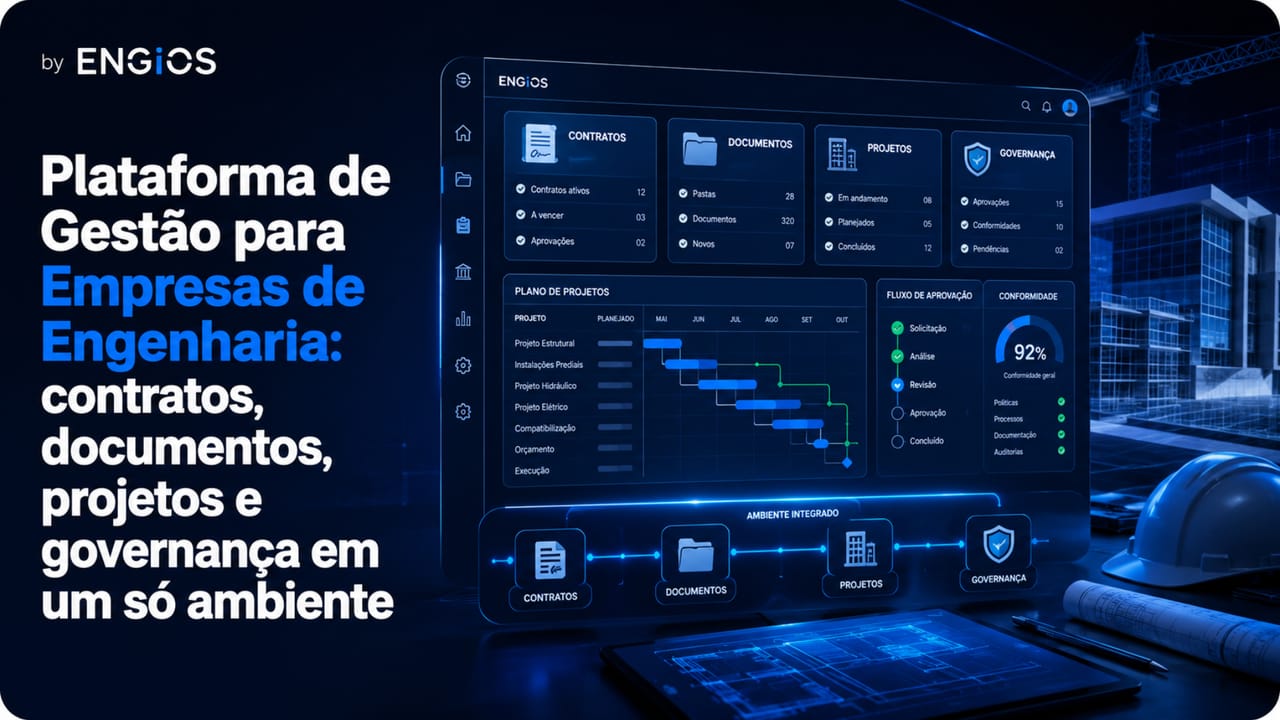
Understand how a management platform for engineering companies can integrate contracts, technical documents, projects, open items, reports, governance, and AI in a traceable environment.
Check it out!
Engineering companies do not operate only with tasks. They operate with contracts, proposals, designs, technical documents, revisions, activities, open items, measurements, reports, evidence, responsibilities, and a history of decisions.
That is why choosing project management software or a management platform for an engineering company requires a broader analysis than simply organizing tasks into lists, boards, or schedules.
Engineering management involves scope, documentation, traceability, technical responsibility, contract control, project governance, and operational maturity. When these elements are scattered across spreadsheets, folders, emails, messages, commercial systems, task tools, and isolated files, operations may still function, but they are rarely fully governed.
This is where the need arises for a technical-management platform for engineering companies: an environment capable of integrating contracts, documents, projects, open items, reports, institutional knowledge, and indicators into a traceable structure.
This article explains what a platform of this kind should solve, how it differs from generic tools, and why ENGiOS is positioned as a response for companies that need to transform fragmented technical information into operational governance.
1. The management challenge in engineering companies
The operation of an engineering company is naturally multidisciplinary. A commercial opportunity may generate a technical proposal. The proposal may evolve into a contract. The contract defines scope, deadlines, deliverables, responsibilities, and acceptance criteria. Execution produces documents, revisions, reports, open items, measurements, evidence, and technical records.
Each stage depends on the previous one.
When this cycle is not integrated, common problems emerge:
- proposals disconnected from execution;
- contracts with no clear link to activities and deliverables;
- technical documents without consistent revision control;
- open items tracked in parallel spreadsheets;
- reports produced manually from scattered sources;
- technical decisions lost in emails or messages;
- low traceability among scope, execution, evidence, and acceptance;
- technical knowledge dependent on specific individuals.
This scenario is not only an administrative problem. In engineering, lack of traceability can generate rework, contractual disputes, documentary inconsistencies, nonconformity risk, and difficulty in technically demonstrating execution.
That is why management in engineering companies requires more than visual task organization. It requires governance.
2. Why generic project management software does not solve everything
Project management software can help organize schedules, tasks, responsibilities, and deadlines. For many companies, that is already an important improvement.
The issue is that engineering project management has requirements that usually extend beyond the scope of a generic tool.
An engineering project is not just a sequence of tasks. It involves:
- contracted scope;
- technical assumptions;
- responsibility matrix;
- work breakdown structure;
- technical documents;
- reviews and approvals;
- field records;
- RFIs;
- nonconformities;
- open items;
- measurements;
- reports;
- technical acceptance;
- decision history;
- lessons learned.
If a tool controls tasks but does not connect documents, contracts, evidence, open items, and reports, it solves part of management but does not structure the technical operation as a whole.
An engineering company can therefore use project management software and still have low governance. The central point is not only knowing “who is doing what,” but understanding how each activity connects to scope, contract, document, evidence, report, and acceptance.
3. What is a management platform for engineering companies?
A management platform for engineering companies is a digital environment structured to organize technical operations in an integrated manner.
Unlike an isolated task tool, a platform needs to connect the main dimensions of the operation:
- commercial;
- contracts;
- projects;
- technical documents;
- activities;
- work orders;
- open items;
- revisions;
- reports;
- indicators;
- institutional knowledge;
- communication;
- governance;
- digital assistance or governed AI.
The logic is simple: technical information cannot remain disconnected.
A proposal must be connected to scope. A contract must be connected to deliverables. A document must be connected to the project, revision, and status. An open item must have an owner, deadline, evidence, and history. A report must reflect real operational data. A decision must be traceable.
This is the difference between using several digital tools and having a technical-management platform.
4. Contract management: the axis of technical operations
In engineering, a contract is not only an administrative or legal document. It is the axis of technical operations.
The contract, proposal, terms of reference, or equivalent instrument defines scope, obligations, deadlines, deliverables, responsibilities, measurement conditions, and acceptance criteria.
When contract management is disconnected from execution, recurring problems arise:
- activities performed without a clear link to scope;
- deliverables requested without objective criteria;
- measurements without sufficient evidence;
- changes without formal history;
- open items unrelated to contractual obligations;
- technical acceptance based on perception rather than criteria.
A management platform for engineering companies should therefore allow contracts, projects, documents, activities, measurements, and reports to be connected.
Engineering contract management should not be treated only as control of deadlines and signed documents. It should serve as a basis for technical governance, traceability, and accountability.
5. Document management and technical-document control
Document management is one of the foundations of engineering operations.
Design narratives, technical specifications, drawings, diagrams, bills of materials, technical opinions, minutes, reports, test protocols, measurement certificates, and acceptance records are not merely files. They represent decisions, criteria, evidence, and responsibilities.
Engineering document control therefore needs to answer questions such as:
- which document is current;
- which version was superseded;
- who reviewed it;
- who approved it;
- which project it relates to;
- which open item the document resolves;
- which delivery it demonstrates;
- which history must be preserved.
A generic DMS can store documents and support document control. But in engineering companies, electronic document management needs to be connected to operations: projects, contracts, revisions, responsible parties, evidence, reports, and acceptance.
This connection is what transforms document storage into technical governance.
6. Engineering project management: scope, WBS, activities, and deliverables
Engineering project management requires scope decomposition, clear deliverables, and control of execution.
The WBS, or Work Breakdown Structure, is an important tool in this process because it allows the project to be decomposed into manageable parts, making it easier to organize phases, work packages, responsibilities, and deliverables.
But the WBS alone does not solve governance. It needs to be integrated with execution.
A management platform for engineering companies should allow the decomposed scope to connect to:
- activities;
- documents;
- responsible parties;
- revisions;
- open items;
- reports;
- milestones;
- evidence;
- technical acceptance.
Without this connection, the company may have planning but will still struggle to demonstrate the link among what was planned, executed, documented, and validated.
In engineering, project management cannot be only a schedule. It must provide technical control of scope, documents, records, and deliverables.
7. Open items, work orders, measurements, and technical acceptance
A large part of engineering operations revolves around requests, activities, work orders, open items, measurements, and validations.
These elements need to be treated as technical records, not merely as operational tasks.
An open item, for example, should have:
- objective description;
- origin;
- responsible party;
- deadline;
- impact;
- evidence required for closure;
- status;
- update history.
A measurement should indicate what was measured, which criterion was used, which evidence supports progress, and which contractual item or deliverable is related.
Technical acceptance should demonstrate that a delivery was validated based on objective criteria, applicable documents, evidence, addressed open items, and completion records.
When this information is scattered, the company loses control. When it is integrated, it becomes part of the technical history of operations.
8. Reports, indicators, and project governance
Reports are management instruments, but their quality depends on the quality of the records that feed them.
When operations are fragmented, reports require substantial manual effort. The team must search for information in spreadsheets, emails, documents, messages, meetings, and different systems. This increases inconsistency risk and reduces traceability.
In a governed operation, reports should reflect real data:
- project status;
- documents issued;
- pending reviews;
- completed activities;
- open items;
- relevant risks;
- measurements performed;
- milestones achieved;
- recorded decisions;
- evidence collected;
- pending approvals.
Project governance depends on this visibility. Recording activities is not enough. Records must be transformed into indicators, indicators into decisions, and decisions into operational improvement.
A management platform for engineering companies should support this management view without losing the technical basis supporting the data. The same logic applies to technical inspection reports and evidence-based executive records.
9. Difference between CRM, DMS, ERP, Kanban, and a technical-management platform
Many companies try to structure their operations by combining generic tools. This may work for a while, but it tends to create limitations as complexity increases.
A CRM organizes opportunities and commercial relationships.
A DMS organizes documents.
An ERP organizes administrative, financial, and tax aspects.
A Kanban organizes activity flows.
Project management software organizes tasks, deadlines, and schedules.
All of these tools can be useful.
But a technical-management platform for engineering companies needs to integrate dimensions that are normally separated:
- proposal and scope;
- contract and deliverables;
- project and documents;
- activity and responsible party;
- open item and evidence;
- measurement and acceptance;
- report and indicator;
- knowledge and history;
- AI and governed sources.
The value lies in the connection among these capabilities. The platform does not replace engineering methods; it digitally structures their governance.
10. AI for engineering: when artificial intelligence needs governance
Artificial intelligence has significant potential for engineering companies. It can support document search, information analysis, report summarization, draft preparation, knowledge organization, and demand triage.
But AI without governance can amplify risks.
An AI-generated answer without controlled sources, the correct project context, the correct document revision, or technical review may appear useful while being misaligned with the scope, contract, or responsibility involved.
AI applied to engineering therefore needs to be connected to:
- reliable documents;
- project history;
- traceable sources;
- permissions;
- human review;
- execution records;
- usage boundaries;
- technical governance.
The question is not whether to use AI. The question is how to use AI within a governed technical environment.
11. How to assess technical-operation maturity
Before adopting a platform, a company needs to understand its current maturity level.
Some questions help with this assessment:
- Are contracts linked to deliverables?
- Do documents have version and revision control?
- Do open items have responsible parties, deadlines, and evidence?
- Are reports generated from reliable data?
- Are technical decisions recorded?
- Can project knowledge be reused?
- Can the company reconstruct the history of a delivery?
- Do commercial and technical teams work with shared context?
- When AI is used, does it operate with governed sources?
The more negative answers there are, the greater the need for structuring.
Operational maturity in engineering does not depend only on technology. It depends on methods, processes, responsibilities, documentation, and governance. Technology should support this structure, not replace it.
12. How ENGiOS connects to this need
ENGiOS is positioned in this context as a technical-management platform for engineering companies.
Its purpose is to organize operations around governance, traceability, documentation, knowledge, indicators, and intelligent assistance. Rather than treating commercial, engineering, documents, reports, communication, and knowledge as separate environments, ENGiOS creates a common operational layer to connect these elements.
ENGiOS should not be understood as a generic CRM, generic DMS, generic Kanban, ERP, or ordinary productivity software.
Its distinction lies in starting from the real logic of engineering:
- proposals need to connect to scope;
- contracts need to connect to deliverables;
- projects need to connect to documents;
- documents need revision and status;
- open items need evidence;
- reports need to reflect operational data;
- knowledge needs to be retrievable;
- AI needs to operate within governance.
ENGiOS is therefore more than a tool. It is a modular platform for structuring technical management in companies that need to transform scattered information into governed operational context.
13. Additional technical resources
In addition to the contextual links throughout the article and the technical references maintained in the final block, it is useful to explore specific operational topics that make up engineering governance.
These additional materials help detail topics such as measurement, acceptance, handover, inspection, terms of reference, integrated testing, and technical procurement. These subjects are directly related to technical-operation maturity and to the type of control that a management platform for engineering companies needs to support.
14. Conclusion
Engineering companies do not simply need more software. They need a management structure capable of connecting contracts, documents, projects, activities, open items, reports, indicators, and institutional knowledge.
Project management software can solve part of the problem. A DMS can organize documents. A CRM can support the commercial front. An ERP can handle administrative processes. But technical engineering operations require integration among these elements.
This integration is what sustains governance.
A management platform for engineering companies should allow the organization to know not only what is being done, but why it is being done, on what basis, by whom, in which revision, under which contract, with which evidence, and against which acceptance criterion.
This is the path toward a more mature, traceable operation prepared for the responsible use of technology and artificial intelligence.
Technical Governance and Operational Adherence Assessment
Adopting a management platform for engineering companies should begin with an analysis of current operations.
A3A Consulting Engineering can support this assessment by identifying traceability gaps, fragmentation points, document risks, critical workflows, integration needs, and opportunities for operational structuring.
ENGiOS connects to this journey as a technical-management platform for engineering companies, integrating contracts, proposals, projects, documents, activities, knowledge, reports, and governed AI in a modular, traceable environment.
Learn about ENGiOS on the A3A website or visit engios.a3aengenharia.com.
Technical references
[1] Project Management Institute. PMBOK Guide — 7th edition, Portuguese version, 2021. Reference for principles, performance domains, and project management applied to the engineering context.
[2] Project Management Institute. PMBOK 8th Edition, 2025. Complementary reference for updated concepts on project management, governance, delivery, and value.
[3] AACE International. Recommended Practice 008-18R-97 — Cost Estimate Classification System in EPC for Process Industries. Technical reference for estimate classification and information maturity in EPC projects.
[4] AACE International. Recommended Practice 36R-08 — Cost Estimate Plans in EPC for Process Industries, 2019. Reference on estimate planning, cost engineering, and information structuring for projects.
[5] AACE International. Recommended Practice 40R-08 — Contingency Estimating: General Principles. Reference for contingency analysis, risks, and estimate bases in technical projects.
[6] AACE International. Recommended Practice 42R-08 — Risk Analysis and Contingency Determination Using Parametric Estimating. Reference for risk analysis, contingency, and decision structuring in projects.
[7] SINAENCO. Management Doctrine. Technical material on management, procurement, and organization of consulting engineering services.
[8] SINAENCO. Pricing Guide, 2011 version. Industry reference for composition, pricing, and structuring of consulting engineering services.
[9] SINAENCO. Good Practices Guide for BIM Procurement — General Guidelines. Reference for procurement, scope structuring, information, and requirements in a BIM environment.
Frequently asked questions
It is a structured digital environment for integrating contracts, projects, technical documents, activities, open items, reports, indicators, and institutional knowledge into a traceable, governed operation.
Additional technical resources
- Terms of Reference in Engineering
- Measurement Certificate in Consulting Engineering
- Technical Acceptance Certificate in Engineering
- Acceptance Criteria in Engineering
- Provisional and Final Acceptance in Engineering
- Technical Inspection of Engineering Works and Services
- Deliverable-Based Measurement in Consulting Engineering
- FAT, SAT, and Integrated Testing in Critical Systems
- Technical Procurement
