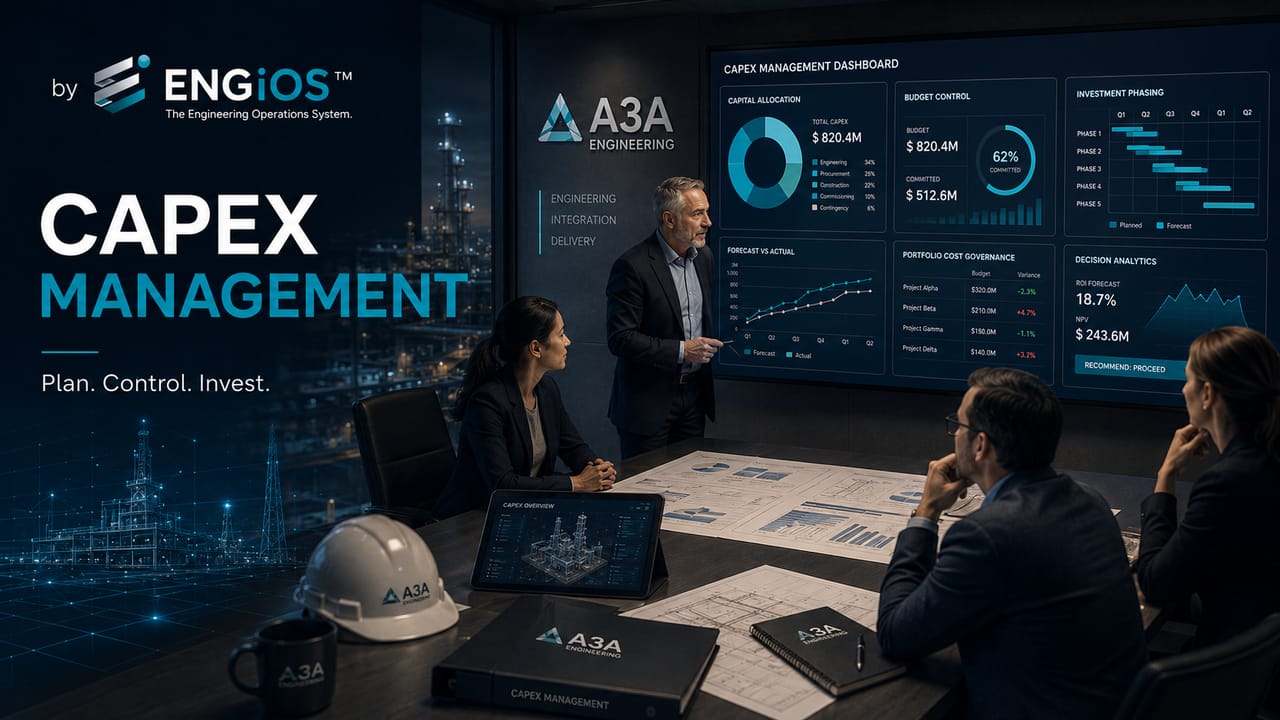
CAPEX management applied to engineering projects: business case, maturity, estimates, contingency, FEL, Project Controls, procurement, changes, and forecasting.
Check it out!
CAPEX management in engineering projects organizes the decision, authorization, planning, and control of capital investments throughout the project lifecycle. It is not limited to the accounting record of expenditures: it involves turning a business need into a project that is technically defined, economically justified, contractable, controllable, and capable of generating the expected result after entering operation.
In Engineering, CAPEX is typically associated with the implementation, expansion, modernization, adaptation, or replacement of physical and technological assets. The management challenge is to decide where to invest, with what level of definition, what cost estimate is compatible with each decision, which risks and contingencies must be considered, and how to protect the baseline after investment authorization.
Therefore, managing CAPEX does not mean simply “spending within budget.” A project may respect the authorized amount and still destroy value through delay, inadequate scope, low technical maturity, unrealized benefits, or excessive future operating costs. Management must connect strategy, business case, Engineering, estimates, risks, Project Controls, procurement, changes, commissioning, and operations.
From strategy to investment: CAPEX starts before the project is authorized
A capital investment should originate from a clearly characterized need, opportunity, or obligation. Engineering Management creates the connection between that need and the technical processes that will develop the solution.
ABNT NBR ISO 21500 presents the relationship between strategy, opportunities and threats, requirements, business cases, portfolios, programs, projects, operations, and benefits. This logic is especially useful for CAPEX because it avoids treating the project as an end in itself: the investment exists to produce a change or capability that contributes to organizational objectives.
A coherent decision sequence can be represented as follows:
need → requirements → alternatives → business case → prioritization → technical definition → estimate → authorization → execution → commissioning → operations → benefits
Each transition should increase the quality of the available information. The greater the irreversibility of the decision and the capital committed, the greater the maturity that should be required.
CAPEX, OPEX, and lifecycle cost should not be analyzed in isolation
CAPEX represents investment in long-term assets or capabilities; OPEX represents operating costs associated with recurring activity. The exact accounting boundary depends on the organization’s policies and applicable standards, but Engineering needs to look beyond that classification.
An alternative with lower initial CAPEX may increase energy consumption, maintenance, downtime, spare-parts requirements, or future intervention needs. Value Engineering helps compare alternatives with a focus on function and lifecycle cost, avoiding decisions driven only by the lowest initial investment.
| Perspective | Decision question |
| CAPEX | how much capital must be committed to implement the solution? |
| OPEX | which recurring costs will be generated after entry into operation? |
| risk | which uncertainties may change cost, schedule, or performance? |
| lifecycle | what are the expected cost and value over the useful life? |
| benefits | will the asset produce the results that justified the investment? |
CAPEX governance should balance these dimensions according to the project objective.
The level of technical definition conditions the quality of the estimate
One of the most important errors in capital projects is demanding budget accuracy that is incompatible with Engineering maturity. Early estimates are necessary for screening and comparing alternatives, but they do not have the same technical basis as an estimate prepared after the scope has been developed further.
AACE International structures estimate classification systems that relate class, use, and deliverable maturity. In Recommended Practice 18R-97, applied to the process industries, the classification ranges from Class 5, with very early definition, to Class 1, with a high degree of definition. The most important principle is that the class is determined by the maturity of the information and deliverables that define the scope, not simply by a declared percentage of Engineering progress.
For the process industries, AACE practice typically presents:
| Class | Indicative definition maturity | Typical use |
| Class 5 | 0% to 2% | screening, initial planning, alternatives |
| Class 4 | 1% to 15% | studies, feasibility, preliminary budgeting |
| Class 3 | 10% to 40% | budget authorization and initial control |
| Class 2 | 30% to 75% | detailed control, tendering, or proposal |
| Class 1 | 65% to 100% | detailed estimate, check estimate, changes, and claims |
These percentages and ranges should not be transplanted automatically to every sector. AACE itself has industry-specific practices. The broadly applicable concept is the need to relate the intended use of the estimate to the actual maturity of the definition.
CAPEX authorization must be compatible with the maturity of the technical evidence. Increasing the apparent precision of the number without increasing scope definition does not reduce project uncertainty.
Basis of Estimate: the estimate needs to explain where it came from
An isolated value is not a sufficient basis for decision-making. The estimate needs to be accompanied by documentation that makes it possible to understand the scope, assumptions, exclusions, methodology, references, market conditions, and uncertainties.
AACE treats the Basis of Estimate (BOE) as an essential part of the estimate. In CAPEX projects, it is particularly important because different budget versions may use very different assumptions and definition bases.
A consistent BOE should record, as applicable:
- included scope and estimate boundaries;
- documents and revisions used;
- estimating methodology;
- productivity and pricing bases;
- quotations and market references;
- logistics and execution assumptions;
- taxes, freight, mobilization, and indirect costs considered;
- exclusions;
- escalation and reference currency;
- contingency and risk approach;
- base date and information validity.
Without this traceability, comparing two estimates may mean comparing numbers built on different scopes.
Contingency should not be the “amount needed to close the budget”
Contingency exists to address uncertainties and risks within the defined scope, according to the adopted policy and methodology. It should not be used to hide undeveloped scope, compensate for a previously imposed budget, or create a reserve unrelated to risk drivers.
AACE Recommended Practice 40R-08 establishes principles for contingency estimating and quantitative risk impact. These include identifying risk drivers, relating risks to cost and schedule impacts, using methods appropriate to the context, and communicating probabilistic results in a way that supports decision-making.
This matters because estimate class and contingency are related but different concepts. Early-stage projects have greater definition uncertainty, but contingency should not be determined simply by selecting a percentage corresponding to the class.
Risk management in engineering projects should feed economic analysis and CAPEX control throughout the lifecycle.
FEL, FEED, and stage-gates reduce premature capital decisions
The early phase of a project has a major influence on future decisions. Front-End Loading (FEL), feasibility studies, conceptual design, and FEED in Engineering progressively increase definition before significant resources are committed.
The objective is not to eliminate uncertainty — that would be impractical — but to bring each decision to a level of information compatible with its impact. A feasibility gate does not need the detail of an EPC procurement package, but it does need enough information to prevent clearly inadequate alternatives from advancing simply because they have already consumed internal effort.
Stage-gates in engineering projects can structure criteria such as:
- strategic alignment and need;
- alternatives assessed;
- key requirements and assumptions;
- maturity of technical deliverables;
- estimate compatible with the decision;
- risks and contingency;
- contracting strategy;
- execution capability;
- readiness for the next stage.
The gate should operate as an investment decision, not as a status meeting.
CAPEX baseline: an approved budget is more than a number
After authorization, the project needs a control reference. The baseline should break down the authorized capital into a structure that can be related to scope, schedule, contracts, commitments, and changes.
Depending on the organization, concepts such as approved budget, committed cost, actual cost, accruals, estimate to complete, and estimate at completion may be used. Vocabulary may vary, but the logic remains: governance needs to know how much was authorized, how much has already been committed, how much has been incurred, and what the final forecast is.
| Information | Management function |
| authorized budget | limit and initial investment reference |
| committed | contracts, purchase orders, and obligations assumed |
| actual | cost effectively incurred/recognized |
| ETC | estimated cost required to complete |
| EAC / forecast | projected final cost |
| contingency | risk provision according to the adopted methodology |
| approved changes | changes formally incorporated into the baseline |
Without an integrated structure, a project may appear to be within budget simply because future commitments have not yet been recorded.
Project Controls turns CAPEX data into forecasts
Effective control is not comparing actual cost with budget after the variance has already occurred. Project Controls seeks to identify trends and forecast the final outcome while there is still room for decision-making.
Schedule and cost also need to be analyzed together. A delay can increase mobilization, site administration, rentals, financing, escalation, and contractual exposure. An early purchase may protect price, but increase inventory, insurance, or obsolescence risk.
Earned Value Management can support integrated analysis of scope, schedule, and cost when suitable baselines and measurement are in place. It does not replace the analysis of technical maturity, risks, or contractual commitments.
Baseline and forecast must remain conceptually separate. The baseline records the approved reference; the forecast must show the best available prediction, including when it indicates a variance from the authorized capital.
Procurement and contracting strategy directly influence CAPEX
The estimate cannot be built without considering how the project will be contracted. EPC, EPCM, multiple packages, design-bid-build, or unit-price contracts distribute risks and responsibilities in different ways.
Procurement in engineering projects needs to consider technical maturity, market sounding, lead times, supplier availability, bid equalization criteria, and commercial conditions.
An inadequate strategy may create apparent price reduction while increasing total cost through interfaces, claims, changes, or additional coordination needs. Therefore, contracting decisions and budgeting need to evolve together.
Change control protects investment authorization
Capital projects change. The problem is not the existence of change, but incorporating it without assessing origin, need, impact, and authority.
Engineering Change Management should relate technical change to scope, schedule, costs, contracts, documents, and risks. A seemingly minor Engineering change may create repurchasing, field rework, or delayed commissioning.
A change workflow should distinguish at least:
- correction of an error or omission;
- requirement change;
- optimization or value engineering;
- unforeseen site condition;
- regulatory requirement;
- supplier or constructability decision;
- commercial or contractual change.
This classification helps explain the causes of CAPEX growth and improve future projects.
The forecast must be independent of pressure to “hold the number”
A useful forecast must represent the best available estimate of the final outcome. If the forecast is adjusted to remain artificially equal to the approved budget, the organization loses the primary management function of forecasting.
The process should separate reference and expectation: the baseline shows what was authorized; the forecast shows where the project is heading. The variance between them is decision information, not necessarily a failure of the control system.
This discipline also prevents problems from being recognized only after they become unavoidable.
Indicators for CAPEX governance
The indicator set should make it possible to understand not only expenditure, but also definition, commitment, risk, and readiness.
| Dimension | Examples of indicators |
| portfolio | CAPEX approved, requested, committed, and available |
| definition | Engineering maturity and estimates by class/stage |
| cost | baseline, actual, committed, ETC, EAC, and variance |
| schedule | decision, procurement, execution, and startup milestones |
| risk | exposure, available contingency, and trend |
| change | value requested, approved, rejected, and by cause |
| contracts | commitment, claims, amendments, and exposure |
| benefits | indicators defined in the business case and readiness for realization |
Indicators need to retain a link to their source and update frequency. Dashboards do not replace governance if the data is unreliable.
Recurring errors in CAPEX project management
Some errors appear across different sectors:
- authorizing investment with insufficient technical definition;
- demanding estimate accuracy incompatible with project maturity;
- using contingency as an arbitrary percentage;
- confusing budget, committed, actual, and forecast;
- contracting packages before stabilizing critical requirements;
- keeping Engineering, cost, and schedule in disconnected structures;
- recognizing changes only after execution;
- optimizing CAPEX while ignoring OPEX and lifecycle cost;
- measuring success only by financial closeout without verifying outcomes and benefits.
The common pattern is the loss of connection between the capital decision and technical information.
When to hire external support for CAPEX management
External support may be appropriate when the owner needs to structure governance, review maturity, develop or validate estimates, implement Project Controls, coordinate multiple suppliers, or obtain an independent technical view before relevant decisions.
The model depends on the gap. Engineering Project Management addresses integrated project coordination; Project Management and Project Controls deepens planning and control; Owner’s Engineering adds representation and technical assurance on behalf of the owner.
Engagement can also be focused on specific decision points: feasibility study, FEL/FEED, Design Review, technical proposal analysis, risk assessment, procurement planning, or commissioning preparation.
Mature CAPEX management preserves investment logic through operations
A capital project does not end from a management perspective when the budget is closed. The organization needs to demonstrate that the asset was delivered, entered operation, and remains connected to the objectives that justified the investment.
This requires traceability from the business case through requirements, alternatives, Engineering, estimates, contracts, changes, testing, and acceptance. At the end, transition to operations should transfer documentation, responsibilities, and indicators needed to verify performance and benefits.
CAPEX maturity is evident when the organization can answer, at any time: why are we investing, what was authorized, based on what definition, what is the current forecast, what risks still exist, and what result must the asset produce?
Technical references
[1] AACE INTERNATIONAL. Professional Guidance Document No. 01 — Guide to Cost Estimate Classification Systems. AACE International.
[2] INTERNATIONAL ORGANIZATION FOR STANDARDIZATION. ISO 21500:2021 — Project, programme and portfolio management — Context and concepts. Geneva: ISO, 2021.
[3] INTERNATIONAL ORGANIZATION FOR STANDARDIZATION. ISO 21505:2017 — Project, programme and portfolio management — Guidance on governance. Geneva: ISO, 2017.
Frequently asked questions
It is the management of the decision and control cycle for capital investments, connecting business case, technical definition, estimates, authorization, risks, contracts, execution, forecast, and entry into operation.
No. CAPEX is a category of capital investment. Its management involves much more than the construction budget and may include Engineering, equipment, implementation, indirect costs, and other components according to the scope and the organization’s policies.
The greater the maturity of the deliverables that define the scope, the greater the ability to use detailed estimating methods. The estimate class should reflect the actual maturity of the definition and the intended use.
Not automatically. Estimate class and contingency are distinct concepts. Contingency should reflect uncertainties and risks according to an appropriate methodology, rather than being a fixed percentage selected by class.
The baseline represents the authorized control reference. The forecast represents the best current prediction of the final outcome. Comparing the two helps anticipate variances and support decisions.
It integrates planning, progress, costs, commitments, trends, and forecasts to turn project data into decision information before variances become irreversible.
Complementary technical materials
Related solutions
- Project, Program, and Portfolio Governance
- Requirements, Evidence, and Acceptance Criteria Management
- Engineering PMO Implementation and Structuring
Related engineering services
Related technical content
- Project Controls: planning and control of engineering projects
- Earned Value Management in engineering projects
- Risk management in engineering projects
- Value Engineering in Engineering Projects
- FEED in Engineering
Guides and references
