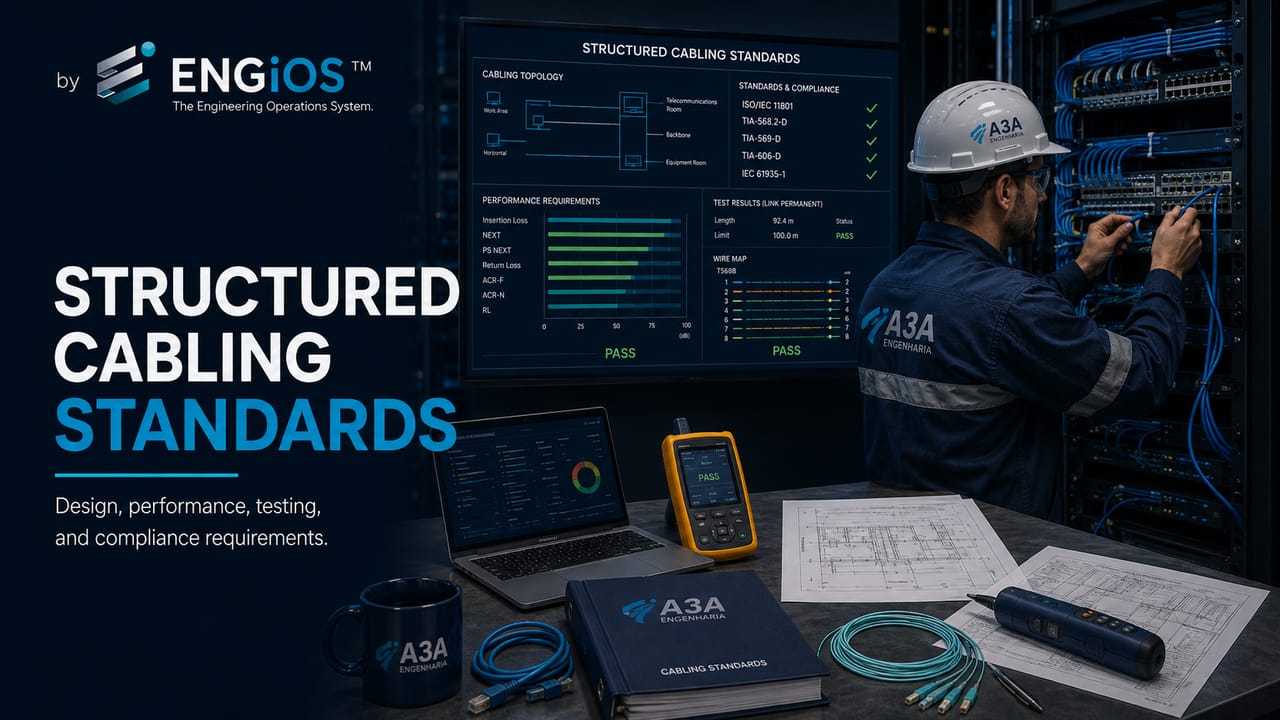
Understand which structured cabling standards to consider in engineering designs and how to apply ABNT NBR 14565, NBR 16415, NBR 16869, NBR 17040, ISO/IEC 11801, and ANSI/TIA standards in procurement, installation, certification, and technical acceptance.
Check it out!
Structured cabling standards are technical references used to standardize the design, installation, identification, certification, documentation, and acceptance of telecommunications infrastructure in commercial buildings, industrial facilities, data centers, residential complexes, schools, hospitals, public agencies, and corporate environments.
They help turn the physical network into a predictable system, with criteria for topology, distances, components, pathways, spaces, grounding, bonding, performance, testing, and documentation. Without standards, procurement tends to depend on installer preferences, isolated material prices, and improvised decisions during construction.
This article explains the main structured cabling standards, how they relate to one another, and how to apply them in engineering designs, specifications, terms of reference, inspection, certification, and technical acceptance. The objective is to provide technical guidance without replacing the original standards, which are protected normative documents and should be acquired through official channels when required.
What are structured cabling standards?
Structured cabling standards are technical documents that establish requirements, criteria, classifications, methods, and good practices for designing, installing, testing, and administering telecommunications cabling systems.
In practice, they help answer questions such as:
- which topology should be adopted;
- which subsystems make up the infrastructure;
- which maximum distances must be respected;
- how to specify cables, connectors, patch panels, racks, and optical distribution frames;
- how to size pathways and spaces;
- how to identify outlets, ports, cables, and technical rooms;
- how to test and certify links;
- how to document the delivered infrastructure;
- which criteria to use for technical acceptance.
Standards do not exist merely to “satisfy bureaucracy.” They reduce technical risk, increase compatibility among suppliers, facilitate maintenance, and make the network more auditable throughout its life cycle.
Main structured cabling standards
The table below summarizes the main references used in structured cabling designs.
| Standard | Main role in structured cabling |
| ABNT NBR 14565 | Central Brazilian reference for structured cabling in commercial buildings |
| ABNT NBR 16415 | Pathways and spaces for structured cabling |
| ABNT NBR 16264 | Residential structured cabling |
| ABNT NBR 16521 | Industrial structured cabling |
| ABNT NBR 16665 | Structured cabling for data centers |
| ABNT NBR 16869 | Planning, testing, and special structured cabling configurations |
| ABNT NBR 17040 | Bonding of cabling infrastructure for telecommunications |
| ABNT NBR 5410 | Low-voltage electrical installations, a related reference for electrical interfaces |
| ISO/IEC 11801 | International reference for generic cabling in customer premises |
| ISO/IEC 14763 | Implementation, operation, administration, and testing of cabling |
| ANSI/TIA-568 | Telecommunications cabling requirements |
| ANSI/TIA-569 | Telecommunications pathways and spaces |
| ANSI/TIA-606 | Administration and identification of telecommunications infrastructure |
| ANSI/TIA-607 | Telecommunications grounding and bonding |
The table above provides an initial map for the sections that follow.
ABNT NBR 14565: a central reference in Brazil
ABNT NBR 14565 is one of the main Brazilian references for structured cabling in commercial buildings. It guides system organization, cabling subsystems, components, interfaces, performance criteria, and standardization of telecommunications infrastructure.
In engineering designs, NBR 14565 should be considered when structuring decisions such as:
- cabling architecture;
- horizontal cabling;
- backbone;
- technical rooms and distributors;
- copper cabling categories;
- use of optical fiber;
- telecommunications outlets;
- connections to patch panels, outlets, and racks;
- documentation and performance criteria.
It should not be used merely as a generic citation in a specification. The design must reflect its criteria in drawings, quantities, specifications, identification, tests, and acceptance requirements.
ABNT NBR 16415: pathways and spaces
ABNT NBR 16415 addresses pathways and spaces for structured cabling. It is especially important because many network problems begin before cables are installed: undersized cable trays, overloaded conduits, shafts with no spare capacity, poorly located technical rooms, and inaccessible routes.
The standard relates to:
- cable trays;
- conduits;
- ladder racks;
- shafts;
- pull boxes;
- technical rooms;
- rack spaces;
- maintenance accessibility;
- separation between power and telecommunications;
- reserve capacity for expansion.
In construction projects, pathway infrastructure must be coordinated with architecture, electrical systems, LPS, video surveillance, access control, automation, HVAC, and other disciplines. See also Pathway infrastructure: pathways and spaces for structured cabling.
ABNT NBR 16869: planning, testing, and special configurations
ABNT NBR 16869 is a fundamental series for planning, testing, and special structured cabling configurations. It complements practical system implementation, especially when the design needs to define test criteria, specific arrangements, and conditions that require greater technical control.
In designs and acceptance processes, it can support discussions involving:
- installation planning;
- field testing;
- special configurations;
- measurement criteria;
- link performance;
- technical documentation;
- acceptance verification.
The standard is especially relevant when the owner requires traceability, technical reports, certification reports, and objective criteria for accepting or rejecting an installation.
ABNT NBR 17040: bonding of cabling infrastructure
ABNT NBR 17040 addresses bonding of cabling infrastructure for telecommunications and structured cabling. This subject is critical for racks, metallic cable trays, shields, optical distribution frames, technical rooms, external links, IP video surveillance, automation, industrial environments, and locations with LPS or surge risk.
Proper bonding helps reduce hazardous potential differences, improves infrastructure safety, and supports the reliability of connected systems.
Practical application involves interfaces with electrical systems, grounding, surge protective devices, LPS, telecommunications, and metallic infrastructure. For this reason, the subject should not be treated as an installation detail. See also Grounding and Bonding in Network Infrastructure and Surge Protection for Data Lines, Video Surveillance, Automation, and Telecommunications.
Standards for specific environments
In addition to general standards, there are references for specific environments.
ABNT NBR 16264 addresses residential structured cabling. It appears in related searches because many users look for a telecommunications infrastructure reference for homes, residential developments, and housing units.
ABNT NBR 16521 is focused on industrial structured cabling, where greater attention is given to interference, robustness, installation environment, operational continuity, and integration with automation.
ABNT NBR 16665 applies to data centers, where capacity, availability, organization, redundancy, documentation, pathways, spaces, and topologies require tighter control.
These standards help prevent the mistake of applying the same solution to every environment. A conventional administrative network, an industrial plant, a data center, and a residence have different requirements.
International standards: ISO/IEC and ANSI/TIA
In addition to ABNT standards, structured cabling designs frequently consider international references, especially ISO/IEC and ANSI/TIA.
ISO/IEC 11801 is an important international reference for generic cabling in customer premises. It structures classes, categories, physical media, subsystems, and performance criteria.
ISO/IEC 14763 complements implementation, operation, administration, and testing topics.
ANSI/TIA standards are widely used as technical references, especially:
- ANSI/TIA-568, for telecommunications cabling;
- ANSI/TIA-569, for pathways and spaces;
- ANSI/TIA-606, for administration and identification;
- ANSI/TIA-607, for telecommunications grounding and bonding.
For projects in Brazil, use of these references must be coordinated with applicable ABNT standards. The design should explicitly define which standards are adopted, for which scope, and with what technical priority.
Which cabling standard applies at each project stage?
Standards do not operate in isolation. Each reference covers part of the infrastructure life cycle, and the design should state how its requirements will be transformed into drawings, specifications, tests, and handover documents.
| Reference | Stage where it contributes most | Expected evidence in the design or acceptance |
|---|---|---|
| ABNT NBR 14565 | System architecture and specification | Topology, subsystems, categories, outlets, distributors, and performance criteria |
| ABNT NBR 16415 | Pathway and space planning | Cable trays, conduits, shafts, technical rooms, fill, and expansion reserve |
| ABNT NBR 16869 | Planning, testing, and special configurations | Test plan, parameters, link identification, and certification reports |
| ABNT NBR 17040 | Interfaces with grounding and metallic infrastructure | Bonding of racks, cable trays, shields, and metallic elements |
| ISO/IEC 11801 and ISO/IEC 14763 | International complement for performance and implementation | Classes, categories, administration, installation, operation, and testing |
| ANSI/TIA-568, 569, 606, and 607 | Complementary cabling, spaces, identification, and bonding requirements | Component standards, pathways, nomenclature, administration, and bonding |
The standards matrix should be defined according to the environment, contract, and scope. A corporate installation, an industrial plant, a data center, and a residential unit do not have the same requirements. The specification should state the adopted references, their field of application, and their priority in case of conflict.
Technical standards must be converted into verifiable design criteria.
A3A develops structured cabling designs with drawings, diagrams, specifications, quantities, identification, certification requirements, and acceptance criteria.
How should standards be applied in structured cabling designs?
Applying standards means more than citing a list in the specification. Normative content must appear in design decisions.
A well-structured design should translate standards into criteria such as:
- number and location of outlets;
- cable and component categories;
- horizontal cabling and backbone topology;
- rack and technical-room positioning;
- pathways and spaces;
- bend radius and pathway fill;
- separation between power and data;
- identification of outlets, cables, ports, and racks;
- certification criteria;
- as-built documentation;
- technical acceptance criteria.
See also Structured Cabling Design: stages, standards, and deliverables and Structured Cabling Components.
Standards in terms of reference, procurement, and inspection
Standards are also fundamental to procurement. When a term of reference does not define technical criteria, supplier proposals may appear equivalent in price while being substantially different in quality.
A term of reference should state:
- applicable standards;
- supply scope;
- categories and reference brands where appropriate;
- minimum component criteria;
- identification standards;
- required certification reports;
- final documentation;
- acceptance criteria;
- contractor responsibilities;
- criteria for correcting nonconformities.
During inspection, standards make it possible to evaluate whether the installation is being executed in accordance with the approved design and whether field changes maintain technical compliance.
This is important for owners seeking quality, standardization, governance, and risk reduction in network-infrastructure projects.
Standards compliance must be demonstrated during technical acceptance.
Certification reports, link identification, conformity with the design, as-built documentation, and treatment of nonconformities should form part of acceptance.
Standards, certification, and technical acceptance
Technical acceptance of a network should not depend only on apparent connectivity. An outlet may “work” while still failing to meet the specified category, lacking proper identification, having no traceability, or being undocumented.
Certification helps turn acceptance into objective evidence. It should be linked to the design, standards, outlet identification, and final documentation.
During technical acceptance, the following should be verified:
- certification reports for each outlet;
- link identification;
- consistency among the report, drawing, and patch panel;
- tested category;
- test equipment and applied configuration;
- open items and nonconformities;
- as-built documentation;
- consistency with the specification and design.
For further detail, see Cable Certification Parameters and Network Cabling Certification.
Standards and component selection
Standards directly influence component selection. It is not enough to purchase cable, connectors, patch panels, and patch cords separately. The system must be compatible.
Practical examples:
- Cat6A cable with a Cat5e patch panel limits channel performance;
- a lower-category patch cord compromises the complete channel;
- a poorly organized rack impairs maintenance and traceability;
- undersized pathway infrastructure may make Cat6A installation impractical;
- lack of identification makes acceptance unreliable;
- lack of bonding may create risk in shielded and metallic systems.
For this reason, content such as Network Cable Types, UTP Cable, Cat6 vs. Cat6A, Patch Panel, and Network Rack complements the practical application of standards.
Standards and technical documentation
Technical documentation is one of the most important ways to materialize the application of standards. Without documentation, infrastructure becomes dependent on operational memory and informal knowledge.
Documentation may include:
- outlet drawings;
- rack diagrams;
- patch-panel port maps;
- switch port maps;
- outlet identification tables;
- certification reports;
- technical specifications;
- quantities;
- backbone diagrams;
- as-built documentation.
In larger environments, tools such as NetBox can support inventory, IPAM, documentation of racks, ports, equipment, connections, and infrastructure governance.
Common errors when applying structured cabling standards
The most common errors are:
- citing standards only generically;
- not stating the adopted edition or normative scope;
- copying requirements without converting them into design criteria;
- procuring installation without detailed engineering design;
- mixing component categories;
- ignoring pathways and spaces;
- failing to provide standardized identification;
- not requiring certification reports;
- accepting outlets based only on connectivity testing;
- not verifying as-built documentation;
- failing to coordinate telecommunications with electrical systems, LPS, automation, and electronic security.
Standards-based standardization requires consistent technical documents across units, projects, and suppliers.
Guidelines, specifications, typical details, identification standards, test matrices, and acceptance criteria reduce variation and facilitate infrastructure governance.
How can an organization standardize the application of standards?
Organizations with multiple sites, recurring projects, or continuing contracts should convert standards into internal technical standards.
This may involve:
- design guidelines;
- minimum component standards;
- technical specification templates;
- identification standards;
- certification criteria;
- inspection checklists;
- as-built documentation templates;
- nonconformity matrices;
- technical acceptance criteria;
- an update routine aligned with standards evolution.
This standardization reduces variation among suppliers, facilitates maintenance, and improves network-infrastructure governance.
How standards complement one another in a real project
A professional engineering design is rarely governed by a single standard. Engineering must assemble a coherent set of references because topology, pathways, spaces, installation, identification, testing, bonding, and special environments are addressed by different documents.
ABNT NBR 14565 serves as a central reference for cabling architecture in commercial buildings. ABNT NBR 16415 expands on pathways and spaces. The ABNT NBR 16869 series takes the system into installation planning, quality, testing, special configurations, and management. ABNT NBR 17040 specifically addresses bonding of telecommunications infrastructure. For residential environments, NBR 16264 applies; for industrial environments, NBR 16521; and for data centers, NBR 16665.
This changes how designs and terms of reference should be written. Rather than placing a generic list of standards on the first page of the specification, the document should relate each reference to the requirements it actually governs. The designer must know, for example, which document defines topology, which supports room and pathway sizing, which establishes the test model, and which guides identification and final documentation.
| Engineering decision | Most directly related Brazilian references |
|---|---|
| Architecture, subsystems, links, channels, and components | ABNT NBR 14565 and environment-specific standards |
| Pathways, rooms, racks, spaces, and routing infrastructure | ABNT NBR 16415 |
| Installation planning, quality, identification, inspection, and acceptance | ABNT NBR 16869-1 |
| Optical cabling testing | ABNT NBR 16869-2 |
| MPTL, point-to-point, and direct connection | ABNT NBR 16869-3 |
| Automated infrastructure management | ABNT NBR 16869-4 |
| Passive optical networks and test models | ABNT NBR 16869-5 |
| Bonding of telecommunications infrastructure | ABNT NBR 17040 |
| Industrial cabling | ABNT NBR 16521 |
| Data center cabling | ABNT NBR 16665 |
ABNT NBR 16521:2025 and the evolution of industrial cabling
An important update for this content cluster is ABNT NBR 16521:2025, the second edition of the industrial structured cabling standard, which replaced the 2016 edition. The revision shows how industrial cabling has moved beyond the idea of being merely a “more robust” version of corporate cabling.
Industrial architecture may include a campus backbone, building backbone, intermediate backbone, and industrial horizontal cabling. The standard also addresses specific interfaces and configurations for automation environments and industrial networks, including MPTL, direct connection, and single-pair balanced cabling in compatible applications.
MICE classification brings the environment into the specification
One of the most important concepts is the MICE environmental classification. The environment is analyzed according to four groups: mechanical conditions, ingress of contaminants, climatic and chemical conditions, and the electromagnetic environment. Each channel segment may be exposed to a different combination of these factors.
In practice, this prevents simplistic specifications such as “use industrial cable” without characterizing where the cable will be installed. An electrical room, process area, administrative corridor, and proximity to motors or variable-frequency drives may require different protection levels. Cable, connector, enclosure, pathway, and installation-method selection should reflect the actual environment or incorporate technically defined mitigation measures.
This approach also connects cabling with multidisciplinary engineering. The design becomes dependent on information about process, layout, interference sources, chemical agents, washdown, vibration, temperature, and mechanical risk, not merely on the number of network outlets.
The ABNT NBR 16869 series should be treated as a set
Referring only to “NBR 16869” without identifying the applicable part can conceal important differences. The series currently covers distinct stages and configurations in the cabling life cycle.
Part 1: planning, quality, documentation, and acceptance
NBR 16869-1:2020 is especially relevant for those who procure, inspect, or accept projects. It addresses installation specifications, environmental conditions, scope of work, responsibilities, quality planning, identification, documentation, testing, and inspection.
The quality plan should connect design requirements, installation specifications, component compatibility, test equipment, calibration, test procedures, and treatment of nonconforming or marginal results. The installation is no longer evaluated only by its final result; it becomes subject to a documented quality-assurance process.
The same standard reinforces infrastructure administration: cables, terminations, racks, cabinets, pathways, spaces, and bonding elements should have consistent identifiers and records. Changes must be recorded so that as-built documentation does not become obsolete shortly after handover.
Part 2: optical cabling testing
NBR 16869-2:2021 goes deeper into optical-fiber cabling verification. It addresses procedures, equipment, test conditions, and documentation for parameters such as continuity, polarity, attenuation, and length, as well as methods using optical source/power meter and OTDR according to the measurement objective.
This is particularly important in backbones and data centers because a report stating only “fiber OK” does not demonstrate the loss budget, events along the link, or conformity with the test model defined in the design.
Part 3: MPTL, point-to-point, and direct connection
NBR 16869-3:2022 covers configurations that have become more relevant with the growth of distributed IP devices such as access points, cameras, sensors, and automation equipment. These include modular plug terminated links (MPTL), point-to-point links, and direct-connection cabling.
These configurations do not eliminate the need for testing. The standard establishes reference models and performance parameters for verifying balanced cabling according to the configuration actually installed.
Part 4: AIM and automated management
NBR 16869-4:2023 addresses automated management systems for telecommunications, network, and IT infrastructure. The topic is relevant in extensive or critical installations where manually administering thousands of ports, patch cords, and changes becomes an operational risk.
AIM can support inventory, connection tracking, capacity, changes, incidents, and integration with other operational platforms. The standard does not require every infrastructure to become automated; it establishes requirements when this management model is adopted.
Part 5: passive optical networks
NBR 16869-5:2024 addresses passive optical networks in structured cabling, including distribution topologies, configurations, and test models for optical channels and links. This part is relevant when the architecture uses optical splitters and PON/PO-LAN distribution instead of a conventional Ethernet topology based exclusively on access switches.
National and international standards: how to define priority
ISO/IEC and TIA are important references, but the specification must clearly establish the hierarchy among documents when differences exist in terminology, architecture, or requirements. In Brazilian projects, applicable ABNT standards should form the national baseline; international references may complement technical requirements when they add detail or when the project follows a global corporate standard.
The ISO/IEC 11801 family organizes generic cabling for customer premises across different environments. The current Part 1 is ISO/IEC 11801-1:2017, which received Amendment 1 in 2025. This matters because older material on the internet still cites ISO/IEC 11801:2002 as though it were current; that edition has been withdrawn and should not be treated as the current baseline for a new project.
Within the ANSI/TIA family, the TIA-568 series addresses cabling infrastructure and works together with documents such as TIA-569 for pathways and spaces, TIA-606 for administration, and TIA-607 for bonding and grounding. In contracts that adopt TIA references, the edition and addenda should be identified in the documentation, avoiding generic expressions such as “comply with TIA” without stating which requirement is being incorporated.
From the standard to the term of reference: the requirement must be verifiable
One of the greatest differences between a robust technical specification and a list of standards is verifiability. The requirement must allow the designer, installer, inspector, and owner to reach the same conclusion during construction and acceptance.
| Weak wording | Technically verifiable approach |
|---|---|
| “Install in accordance with standards” | Define architecture, category/class, pathways, identification, test model, documentation, and applicable acceptance criteria |
| “Certify all outlets” | State the test model, applicable limit, equipment, calibration, native results format, and failure treatment |
| “Provide an adequate rack” | Size capacity, organization, circulation, power, cooling, grounding/bonding, and expansion |
| “Use fiber in the backbone” | Define fiber type, count, topology, connectivity, loss budget, tests, reserve, and identification |
| “Comply with industrial cabling requirements” | Characterize the environment, applicable classification, architecture, and components compatible with local conditions |
NBR 16869-1 reinforces this logic by requiring the installation specification to address responsibilities, pathways, spaces, terminations, identification, inspections, tests, documentation, and treatment of results. The result is a scope that can be procured and inspected with less ambiguity.
Citing a standard does not replace an engineering design.
The design converts normative requirements into drawings, specifications, quantities, certification criteria, and procurement documents. This translation is what allows suppliers to be compared and the infrastructure to be technically accepted.
Standards, inspection, and Owner’s Engineering
During inspection, the function of the standard changes again. It ceases to be only a design reference and begins to support inspections, material analysis, change evaluation, nonconformity treatment, and acceptance. The inspector must compare the installation against the approved design and the performance criteria defined for the contract.
This work is particularly important when installation proposes component substitutions or route changes. Equivalence cannot be decided only by brand, price, or nominal category: performance, compatibility, environment, system warranty, connectivity, channel impact, and documentation must be verified.
In an Owner’s Engineering model, the owner maintains a technical representative capable of reviewing designs, analyzing proposals, responding to RFIs, monitoring implementation quality, evaluating certification results, and organizing acceptance. The objective is not to duplicate the installer’s work, but to protect the owner’s requirements throughout the procurement and delivery cycle.
Standards updates should be part of governance
Standards change. The publication of NBR 16521:2025, the evolution of the NBR 16869 series, and revisions to international families show why a standards library must be actively managed rather than merely archived.
Organizations with recurring projects should maintain a matrix containing the standard, adopted edition, affected discipline, dependent internal documents, and review owner. When a standard changes, the update should reach design templates, specifications, technical requirement books, checklists, certification models, and procurement documents.
This governance prevents two extremes: repeating obsolete references for years or adopting a new edition without analyzing its impact on existing projects, contracts, and systems. Engineering should record the standards baseline applicable to each project and control changes in a traceable manner.
Conclusion
Structured cabling standards are fundamental to ensuring quality, performance, traceability, and standardization of telecommunications infrastructure. They should not be treated as a decorative list in a specification, but as a basis for decisions involving design, procurement, installation, certification, and technical acceptance.
For companies, institutions, and public agencies, correctly applying standards reduces technical risk, improves comparability among proposals, facilitates inspection, improves documentation, and extends network service life. In critical projects, the difference between a network that was simply installed and infrastructure specified according to standards becomes visible in maintenance, expansion, and technical acceptance.
Technical references
[1] ABNT. ABNT NBR 14565:2019 — Structured cabling for commercial buildings. Available at: ABNT Catalog.
[2] ABNT. ABNT NBR 16264:2016 — Residential structured cabling. Available at: ABNT Catalog.
[3] ABNT. ABNT NBR 16415:2021 — Pathways and spaces for structured cabling. Available at: ABNT Catalog.
[4] ABNT. ABNT NBR 16521:2025 — Industrial structured cabling. Available at: ABNT Catalog.
[5] ABNT. ABNT NBR 16665:2019 — Structured cabling for data centers. Available at: ABNT Catalog.
[6] ABNT. ABNT NBR 16869-1:2020 — Structured cabling — Part 1: Planning requirements. Available at: ABNT Catalog.
[7] ABNT. ABNT NBR 16869-2:2021 — Structured cabling — Part 2: Optical cabling testing. Available at: ABNT Catalog.
[8] ABNT. ABNT NBR 16869-3:2022 — Structured cabling — Part 3: Configurations and testing of point-to-point links, modular plug terminated links, and direct connection. Available at: ABNT Catalog.
[9] ABNT. ABNT NBR 16869-4:2023 — Structured cabling — Part 4: Automated infrastructure management system. Available at: ABNT Catalog.
[10] ABNT. ABNT NBR 16869-5:2024 — Structured cabling — Part 5: Passive optical networks — Distribution topologies, configurations, and test models. Available at: ABNT Catalog.
[11] ABNT. ABNT NBR 17040:2022 — Bonding of cabling infrastructure for telecommunications and structured cabling. Available at: ABNT Catalog.
[12] ABNT. ABNT NBR 5410:2004 Corrected Version:2008 — Low-voltage electrical installations. Available at: ABNT Catalog.
[13] ISO/IEC. ISO/IEC 11801-1:2017 — Information technology — Generic cabling for customer premises — Part 1: General requirements. Available at: ISO.
[14] ISO/IEC. ISO/IEC 11801-1:2017/Amd 1:2025 — Amendment 1. Available at: ISO.
[15] ISO/IEC. ISO/IEC 14763-2:2019 — Information technology — Implementation and operation of customer premises cabling — Part 2: Planning and installation. Available at: ISO.
[16] TIA. TIA-568 — Commercial Building Telecommunications Cabling Standards. Available at: TIA Standards.
[17] TIA. TIA-569 — Telecommunications pathways and spaces. Available at: TIA Standards.
[18] TIA. ANSI/TIA-606-C — Administration Standard for Telecommunications Infrastructure. Available at: TIA.
[19] TIA. TIA-607 — Telecommunications bonding and grounding. Available at: TIA Standards.
Frequently asked questions
Key references include ABNT NBR 14565, NBR 16415, NBR 16264, NBR 16521, NBR 16665, NBR 16869, NBR 17040, ISO/IEC 11801, and ANSI/TIA standards such as TIA-568, TIA-569, TIA-606, and TIA-607.
ABNT NBR 14565 is one of the main Brazilian references for structured cabling in commercial buildings and should be considered in engineering design, specifications, installation, and documentation.
ABNT NBR 16415 addresses pathways and spaces for structured cabling, including cable trays, conduits, shafts, boxes, technical rooms, and the infrastructure required for cable routing and organization.
ABNT NBR 16869 supports planning, testing, and special structured cabling configurations and is relevant to test criteria, certification, and technical acceptance.
ABNT NBR 17040 addresses bonding of telecommunications cabling infrastructure, including racks, cable trays, shields, metallic systems, and grounding interfaces.
The obligation depends on the contract, type of project, legal requirements, term of reference, and technical responsibilities. Even when not explicitly required, standards are fundamental references for good engineering practice and technical quality.
No. Standards must be translated into design criteria, specifications, quantities, identification, testing, documentation, and technical acceptance.
Standards guide performance and testing criteria. Certification demonstrates whether installed links meet the category and requirements specified in the engineering design.
Standards guide categories, performance, topology, and technical criteria, but the choice between Cat6, Cat6A, optical fiber, or another solution depends on the application, environment, distance, and engineering design.
The term of reference should state applicable standards, scope, minimum component requirements, identification standards, certification reports, final documentation, and acceptance criteria.
For projects in Brazil, ABNT standards should be considered the national reference. TIA and ISO standards can technically complement the design when scope and priority are defined.
Because they show that the subject goes beyond installation or purchasing materials and includes engineering design, standardization, quality, certification, governance, and technical risk reduction.
Complementary technical materials
Related solutions
- Structured Cabling
- Industrial Structured Cabling
- Data Centers
- Optical Networks
- NetBox for Network Infrastructure
Engineering services
Guide and core content
- Complete Guide to Structured Cabling
- Structured Cabling Design: stages, standards, and deliverables
- Structured Cabling Subsystems
- Structured Cabling Components
- Horizontal Cabling
Brazilian standards and standards-related topics
Cables, categories, and components
Certification, testing, and technical acceptance
- Cable Certification Parameters
- Network Cabling Certification
- Network Cable Certifier
- How to certify a structured cabling network