
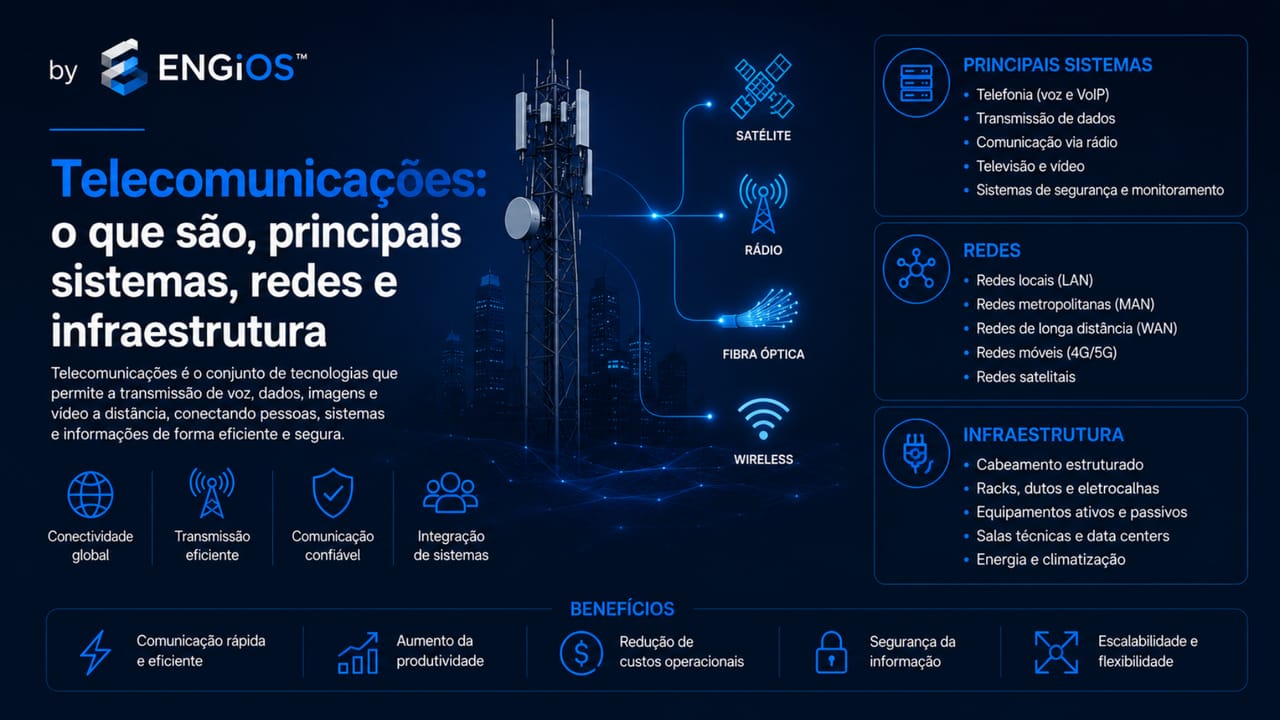
Understand telecommunications, main systems, transmission media, networks, infrastructure, performance, security, applications and engineering design.
Check it out!
Telecommunications are the processes, technologies and infrastructures used to transmit information between separate points. Voice, data, video, commands, alarms, telemetry and protection signals can be carried through metallic cables, optical fiber, radiofrequency, IP networks, dedicated links and other communication media.
In companies, industries, utilities, data centers, hospitals, educational institutions and mission-critical facilities, telecommunications are not limited to internet access or telephony. The domain includes local and wide-area networks, structured cabling, fiber optics, Wi-Fi, voice over IP, radio, electronic security systems, automation, supervision, teleprotection and integration among platforms.
This article provides an overview of telecommunications systems, their components, transmission media, architectures, performance requirements and applications. It also shows how these disciplines connect within an integrated technical design.
What are telecommunications?
Telecommunication is the transmission of information over distance by means of electrical, optical or electromagnetic signals. The information may represent voice, text, images, video, measurements, operational states or commands.
A telecommunications system must transform information into a signal suitable for the medium, carry it, control losses and interference, and recover the content at the destination. In digital systems, this process involves coding, protocols, synchronization, addressing, error control and security mechanisms.
Point-to-point communication and network communication
Point-to-point communication directly connects two endpoints. A network, on the other hand, allows multiple devices to share resources and transmission paths through switching, routing, addressing and access policies.
Corporate and industrial networks typically combine different domains: access, distribution, core, inter-building links, data-center connections, cloud services, wireless networks and communications with remote sites.
Telecommunications are not just the internet
Internet access is only one possible service. A telecommunications infrastructure can also support telephony, videoconferencing, CCTV, access control, intercom, alarm systems, building automation, SCADA, telemetry, time synchronization and operational communications.
In critical environments, some of these services may operate independently of the internet through private networks, dedicated circuits or segmented architectures.
Elements of a telecommunications system
Despite the diversity of technologies, most systems can be understood through a few fundamental elements.
Information source
The source generates the content to be transmitted. It may be a person speaking on a telephone, a camera producing video, a sensor measuring temperature, a relay issuing an event or an application sending data.
Transmitter
The transmitter converts the information into a signal compatible with the medium. This function may involve digitization, coding, modulation, compression, encapsulation and power control.
In an Ethernet network, for example, the physical interface converts digital data into electrical or optical signals. In a radio link, the equipment modulates an electromagnetic carrier.
Channel or transmission medium
The channel is the path traveled by the signal. It may be a copper cable, optical fiber, free space in a radio link, a cellular network, satellite or a combination of technologies.
Every channel has limitations. Attenuation, noise, interference, dispersion, bandwidth, distance, latency and availability need to be considered in the design.
Receiver
The receiver detects the signal and recovers the information. It must operate within the power, quality and timing levels specified for the technology in use.
Protocols and control
Protocols define how devices identify messages, initiate communications, control errors, confirm deliveries and share resources. In modern networks, different protocols operate in complementary layers.
Analog and digital signals
Analog communication
Analog signals vary continuously and can directly represent quantities such as audio, voltage or light intensity. Traditional radio systems, voice circuits and analog instrumentation are historical examples that are still present in some applications.
Digital communication
In digital communication, information is represented by discrete states. This makes it possible to apply coding, error correction, encryption, compression and software processing.
Digitization made it possible to transport voice, video, data and automation over converged infrastructures. However, convergence increases dependence on the network and requires appropriate capacity, segmentation, security and availability.
Conversion and integration between domains
Gateways, converters, controllers and servers can integrate analog, digital, serial and IP systems. This integration must consider protocol compatibility, timing, quality, failure behavior and cybersecurity.
Transmission media
The choice of medium depends on distance, capacity, environment, interference, availability, security and life-cycle cost.
Twisted-pair cables
Twisted-pair cables are widely used in local networks, IP telephony, cameras, access points and security systems. Pair balancing helps reduce interference.
Cable category, length, termination quality, temperature and installation determine performance. Power over Ethernet applications also require analysis of resistance, heating and power.
Optical fiber
Fiber transmits information using light and offers high capacity, long distances and immunity to electromagnetic interference. It is used in backbones, data centers, inter-building links, industrial networks, substations and metropolitan links.
The design must define fiber type, wavelength, optical budget, connectors, splices, redundancy, routes and testing criteria.
Coaxial cables
Coaxial cables are still used in radiofrequency systems, antennas, signal distribution and specific applications. Impedance, frequency-dependent loss, connectors and grounding influence performance.
Radio links
Radio makes it possible to connect points without continuous cable deployment. It can be used in point-to-point links, mobile networks, operational communications, telemetry and coverage of large areas.
The design needs to evaluate frequency, channel width, power, antennas, Fresnel zone, interference, licensing, availability and weather conditions.
Cellular networks and satellite
Cellular networks can support mobility, backup and remote sites. Satellite is useful in locations without terrestrial infrastructure, but has its own latency, availability and cost characteristics.
In critical systems, these media should be analyzed in terms of provider dependency, coverage, redundancy, addressing, security and monitoring capability.
Telecommunications networks
LAN
A Local Area Network connects devices within a limited area such as a building, campus or industrial facility. Switches, VLANs, Wi-Fi, cabling and IP services form its foundation.
MAN and metropolitan networks
Metropolitan networks interconnect sites within a city or region. They can use privately owned fiber, carrier services, radio or metropolitan Ethernet networks.
WAN
A Wide Area Network connects geographically separated locations. MPLS, SD-WAN, VPNs, the internet, dedicated links and mobile networks can compose the solution.
Private and public networks
Public networks are shared and provided by service providers. Private networks are controlled by one organization or a restricted group. An architecture may combine both, provided risks, performance and responsibilities are defined.
Converged networks
A converged network transports multiple services over a common infrastructure. Voice, video, data, security and automation can share switches and fiber, provided segmentation, QoS, capacity and isolation are compatible with their criticality.
Structured cabling and physical infrastructure
Structured cabling organizes telecommunications outlets through a standardized architecture. It includes distributors, racks, patch panels, horizontal cables, backbone, outlets, cords, labeling and documentation.
Horizontal cabling
Horizontal cabling connects the telecommunications room to work areas and distributed devices. The channel must comply with limits for length, category, connections and environment.
Backbone
The backbone interconnects rooms, floors, buildings and technical areas. Optical fiber is common because of its capacity, distance and electromagnetic immunity.
Telecommunications rooms and racks
Racks and rooms house switches, optical distribution frames, patch panels, UPS systems, cable managers and management systems. Space, cooling, power, grounding, surge protection and access control need to be provided.
Pathway infrastructure
Cable trays, ladder racks, conduits, boxes, shafts and external routes form the pathway infrastructure. Capacity, segregation, accessibility, bend radius and mechanical protection directly affect installation quality.
Physical infrastructure should be designed together with the architecture and the services it will support.
Racks, backbone, horizontal cabling, fiber, pathways, power and technical reserve capacity need to be sized according to traffic, availability, growth and maintenance requirements.
Telecommunications systems in enterprises
Corporate network
The corporate network connects users, servers, applications, equipment and sites. It needs to support segmentation, mobility, cloud access, security, observability and growth. Switches, routers, firewalls and links should be selected only after business requirements, flows and failure domains have been defined.
Wi-Fi networks
Wi-Fi provides mobility, but coverage is not synonymous with capacity. The design should evaluate client density, applications, interference, channels, channel width, roaming, authentication and access-point power. Field surveys and validation help demonstrate the actual behavior of the radiofrequency environment.
IP telephony and unified communications
IP telephony carries voice over the data infrastructure and depends on QoS, availability, addressing, security, gateways and carrier integration. Unified communications can combine voice, video, messaging, presence and collaboration, increasing the importance of resilience in the network and supporting services.
Videoconferencing and collaboration
Real-time video requires sufficient bandwidth, low loss, controlled jitter and predictable paths. The assessment must consider not only an individual session, but simultaneous use among meeting rooms, remote users and cloud services.
CCTV and electronic security
IP cameras, access controllers, intercoms, sensors and servers use the telecommunications infrastructure. The design must consider aggregate bitrate, PoE, retention, synchronization, segmentation, availability, storage, security and traffic impact on uplinks and shared services.
Alarm and emergency systems
Alarm, emergency communications and mission-critical systems may have IP, telephony and control-center integration interfaces. These interfaces need to preserve the independence and specific requirements of each system and avoid unplanned dependencies on the corporate network.
When multiple services converge on the same network, the architecture must control capacity, segmentation and dependencies.
Voice, video, data, Wi-Fi, electronic security and corporate applications have different availability and performance requirements; logical network design consolidates them into a coherent architecture.
Industrial and operational telecommunications
Industrial networks
Industrial networks connect controllers, instruments, machines, IEDs, supervisory systems and engineering workstations. Determinism, availability, environment, diagnostics and compatibility with industrial protocols influence the architecture and life cycle of the solution.
SCADA and telemetry
SCADA enables supervision and control of distributed processes; telemetry transports measurements, states and events between remote facilities and control centers. These functions can use Industrial Ethernet, serial protocols, radio, cellular networks, fiber and dedicated circuits.
Substations and power systems
In substations, telecommunications can support telecontrol, operational telephony, teleprotection, synchronization, CCTV, access control and communication with control centers. Availability, route independence, latency, jitter and loss requirements should be defined according to the function and applicable sector requirements.
Teleprotection
Teleprotection carries signals associated with coordinated operation of electrical protection systems. The system requires high availability, low latency, predictable behavior and routes compatible with the protection philosophy, with explicit analysis of common-mode failures and contingencies.
Hazardous areas and harsh environments
Temperature, humidity, dust, vibration, corrosive atmosphere, electromagnetic interference and explosion risk influence equipment, enclosures, cables, connectors and installation methods. Conventional corporate equipment should not be assumed suitable without checking environmental and standards requirements.
Integrations among networks, automation, SCADA and operational systems need to be treated as engineering interfaces.
Point maps, protocols, gateways, timing, alarms, quality, redundancy and failure behavior must be verified end to end, from the source to the consuming system.
Telecommunications architecture
A telecommunications architecture defines how systems, networks, media, technical locations and supporting services relate to one another. It should start from operational requirements, criticality, traffic, growth, security and existing constraints.
Layers and modules
Separating access, distribution, core, edge, data center, WAN, management and security simplifies expansion and troubleshooting. In smaller facilities, functions can be consolidated, but responsibilities and boundaries between domains must remain explicit.
Failure domains
The architecture should identify the impact of failures in switches, fiber, power supplies, UPS systems, carriers, rooms, routes and supporting services. Redundancy is effective only when it reduces single points of failure and avoids hidden common dependencies.
Independent routes
Two links installed along the same physical path can fail simultaneously. Independence should consider ducts, entries, rooms, equipment, power and providers, not merely the existence of two interfaces or two contracts.
Centralization and distribution
Centralization simplifies standardization and management but can increase risk concentration. Distribution reduces distances and failure domains but increases the number of assets and maintenance points. The design must balance criticality, operational capacity and life-cycle cost.
Service performance and quality
Bandwidth and capacity
Bandwidth represents the nominal capacity of the link, but sizing must consider real traffic, concurrency, peaks, overhead, growth and failure conditions. The sum of access-port speeds is not, by itself, a criterion for sizing uplinks.
Latency, jitter and loss
Latency is the time required for information to cross the system; jitter is the variation in that delay; packet loss reduces quality and can cause retransmissions or failures. Voice, video, control and teleprotection have different sensitivities and should be specified by service.
Availability and recovery time
High availability targets require architecture, monitoring, maintenance, spares, procedures and contingency testing. The nominal availability of one device does not represent end-to-end service availability.
Quality of Service
QoS classifies, marks and prioritizes traffic. It does not create capacity and does not correct chronically undersized links. The policy must be coherent along the entire path and tested under congestion, when prioritization actually becomes necessary.
Redundancy and operational continuity
Link redundancy
Redundant links can use fiber, radio, carriers or different technologies. The benefit depends on path independence and the switching mechanism. Failover must be tested, including loss, reconvergence and application behavior.
Equipment and power redundancy
Stacks, chassis, firewall pairs, redundant routers and distributed controllers reduce the impact of failures only when uplinks, power supplies, circuits and management also avoid common dependencies. UPS systems, rectifiers, battery banks and generators should be sized for the real load and contingency scenario.
Recovery and procedures
Continuity does not depend only on hardware. Configuration backups, inventory, documentation, spares, contracts, rollback procedures and trained teams are part of operational availability.
Redundancy must be verified as a system property, not as an equipment count.
An independent review can identify common paths, power dependencies, specification failures, testing gaps and implementation risks before final acceptance.
Cybersecurity in telecommunications
Connectivity expands the attack surface. Security should be incorporated from the design stage through segmentation, access control, hardening, protected management, event logging and monitoring.
Segmentation and access control
VLANs, VRFs, firewalls and zones separate users, servers, electronic security, management and automation. 802.1X, NAC, administrative authentication and least privilege help control who and what may use the infrastructure.
Hardening and monitoring
Hardening includes disabling unnecessary services, protecting management protocols, restricting interfaces, using supported software and logging changes. SNMPv3, syslog, telemetry and SIEM can support detection of outages, degradation and security events.
Security in OT environments
Industrial networks need to consider availability, legacy systems, maintenance windows and operational impact. Security controls must be applied in a way compatible with the process, using architectural compensating controls when older assets do not provide adequate authentication or encryption.
Synchronization and timing
Logs, events, video, automation and protection depend on coherent timestamps. NTP, PTP, GNSS and specific mechanisms may be used according to the required accuracy. The design should define sources, distribution, redundancy, monitoring and behavior during loss of the time reference.
Management, observability and documentation
Equipment, ports, fibers, addresses, circuits, licenses and dependencies should be inventoried. Interface utilization, errors, optical power, PoE consumption, temperature, CPU, memory, latency and loss help identify degradation before complete failure.
Templates, backups, version control and change approval reduce inconsistencies. A source of truth for assets, addressing, racks, cables and relationships enables audit and automation, provided there is a process for updating it after every change.
Standards, specifications and requirements
Telecommunications combine standards from several organizations. IEEE publishes Ethernet and Wi-Fi standards; ISO and IEC address cabling, automation and security; ABNT nationalizes requirements applicable in Brazil; ITU-T publishes recommendations for transmission and services; Anatel regulates spectrum, services and product certification.
In addition to general standards, utilities, transportation, oil and gas, mining and other sectors may have their own contractual, regulatory or operational requirements. These obligations should be identified before the technical specification is developed.
How a telecommunications design is developed
Survey and requirements
The work begins by characterizing locations, users, systems, traffic, criticality, availability, interfaces, existing infrastructure and growth. In brownfield facilities, the survey needs to distinguish documented intent from the condition actually found in the field.
Conceptual architecture
The conceptual architecture defines systems, media, technical locations, paths, redundancy and integration. It allows alternatives to be compared and incompatibilities to be eliminated before detailed equipment selection.
Basic and detailed design
The design details drawings, diagrams, point lists, routes, racks, fibers, cables, assets, power, addressing, security, interfaces and configuration criteria. Specifications should express functional, environmental, performance and interoperability requirements.
Implementation, migration and integration
Staging, configuration, intervention windows, migration sequence, contingency and rollback need to be planned. Interfaces between disciplines should be managed so that changes in electrical, architectural, automation or security systems do not invalidate telecommunications assumptions.
Testing, commissioning and As-Built
Cable certification, optical measurements, network tests, failover, QoS, Wi-Fi coverage, autonomy, alarms and integrations demonstrate compliance with the design. The As-Built records the configuration actually implemented and should include drawings, diagrams, inventory, parameters, reports and updated procedures.
Interfaces with other disciplines
Electrical engineering supports telecommunications through circuits, UPS systems, grounding, equipotential bonding, surge protection devices and generators. Architecture and civil engineering define rooms, shafts, crossings, supports and accessibility. Electronic security uses networks, power, servers and storage. Automation depends on media and protocols. Information technology integrates identity, virtualization, cloud, directories and applications.
Common mistakes in telecommunications designs
- treating telecommunications as only cabling or internet access;
- selecting equipment before requirements are surveyed;
- sizing the network only by port count;
- ignoring growth and capacity under failure conditions;
- treating two links on the same route as effective redundancy;
- undersizing power, cooling and autonomy;
- mixing critical systems without segmentation and flow policies;
- failing to test failover, QoS, coverage, autonomy and alarms;
- using equipment not suited to the environment;
- failing to maintain documentation for addresses, fibers, ports and configurations;
- accepting an installation merely because devices are connected;
- leaving security and monitoring until after implementation.
Reliable telecommunications must be validated before operational handover.
Cables, fibers, networks, redundancy, QoS, coverage, power, alarms, failover and integrations need to be tested against predefined criteria and recorded as acceptance evidence.
Conclusion
Telecommunications form the communication infrastructure that connects people, applications, equipment and processes. Networks, cabling, fiber, radio, Wi-Fi, telephony, electronic security and automation are parts of the same ecosystem.
The reliability of this ecosystem depends on clear requirements, coherent architecture, suitable media, power, security, monitoring, testing and documentation. Telecommunications systems should therefore be treated as an engineering discipline integrated into the facility life cycle.
Technical references
[1] IEEE. IEEE 802.3 — Ethernet. Available at: https://standards.ieee.org/ieee/802.3/10422/.
[2] IEEE. IEEE 802.11-2024 — Wireless LAN Medium Access Control (MAC) and Physical Layer (PHY) Specifications. Available at: https://standards.ieee.org/ieee/802.11/10548/.
[3] ISO; IEC. ISO/IEC 11801-1:2017 — Information technology — Generic cabling for customer premises — Part 1: General requirements. Available at: https://www.iso.org/standard/66182.html.
[4] ABNT. ABNT NBR 14565:2019 — Structured cabling for commercial buildings.
[5] OPPENHEIMER, Priscilla. Top-Down Network Design. 3rd ed. Indianapolis: Cisco Press, 2011.
[6] OPERADOR NACIONAL DO SISTEMA ELÉTRICO. Submodule 2.15 — Minimum requirements for telecommunications. Revision 2025.02. Rio de Janeiro: ONS, 2025.
[7] NATIONAL INSTITUTE OF STANDARDS AND TECHNOLOGY. NIST SP 800-82 Rev. 3 — Guide to Operational Technology Security. Gaithersburg, 2023. Available at: https://csrc.nist.gov/pubs/sp/800/82/r3/final.
[8] INTERNATIONAL ELECTROTECHNICAL COMMISSION. IEC 62443 series — Security for industrial automation and control systems. Available at: https://www.iec.ch/cyber-security/industrial-cyber-security.
[9] INTERNATIONAL TELECOMMUNICATION UNION. ITU-T Recommendations. Available at: https://www.itu.int/rec/T-REC/en.
Frequently asked questions
Telecommunications are technologies and systems used to transmit voice, data, video, commands, alarms and other information between distant points through electrical, optical or electromagnetic media.
Main systems include LAN and WAN networks, structured cabling, optical fiber, Wi-Fi, IP telephony, videoconferencing, radio, CCTV, access control, intercom and monitoring.
No. The internet is one possible service. Telecommunications also include private networks, telephony, radio, automation, telemetry, electronic security and operational communications.
Telecommunications is the broad domain of transmitting information over distance. A network is a structure that connects multiple devices and allows them to share media, services and communication routes.
Common media include twisted-pair cables, optical fiber, coaxial cables, radio links, cellular networks, satellite and circuits supplied by carriers.
Fiber offers high capacity, long distances, low attenuation and immunity to electromagnetic interference, making it suitable for backbones, interconnections and critical environments.
The design should consider supported systems, traffic, criticality, availability, media, architecture, routes, power, security, monitoring, standards, testing and documentation.
Indicators such as capacity, latency, jitter, packet loss, error rate, availability and recovery time help evaluate the service.
They may. Temperature, vibration, dust, humidity, interference and operational criticality can require specific equipment, cables and architectures.
Commissioning demonstrates that cables, fibers, networks, redundancy, QoS, power, coverage, alarms and integrations meet the requirements and the design.
Complementary technical materials
Use the tracks below to move from the general overview to architecture, infrastructure, critical applications and technical contracting.
Network fundamentals, architecture and design
- Corporate Network Architecture — layers, segmentation, redundancy, capacity and design criteria.
- Network Design — survey, documentation, specification, implementation and validation.
- Managed switch — Layer 2 and Layer 3 features, uplinks, performance, security and selection.
Infrastructure, media and power
- Power over Ethernet — standards, classes, power budget, cabling and testing.
- Complete Guide to Structured Cabling — physical architecture, components, standards and certification.
- Optical Fiber in Network Designs — backbone, optical budget, routes and test criteria.
Industrial and mission-critical environments
- Operational telecommunications in substations — voice, data, teleprotection, routes and availability.
- Industrial Networks — protocols, environment, security and SCADA integration.
- Complete Guide to Data Transmission — signals, media, performance and applications.
Guides and decision-support materials
- Complete Guide to Network Architecture — consolidated view of topologies, layers and infrastructure.
- Whitepaper: design, standardization and cost reduction — how engineering reduces improvisation, risk and rework.
- eBook: why contract a Structured Cabling Design — criteria for contracting, implementing and accepting the infrastructure.
