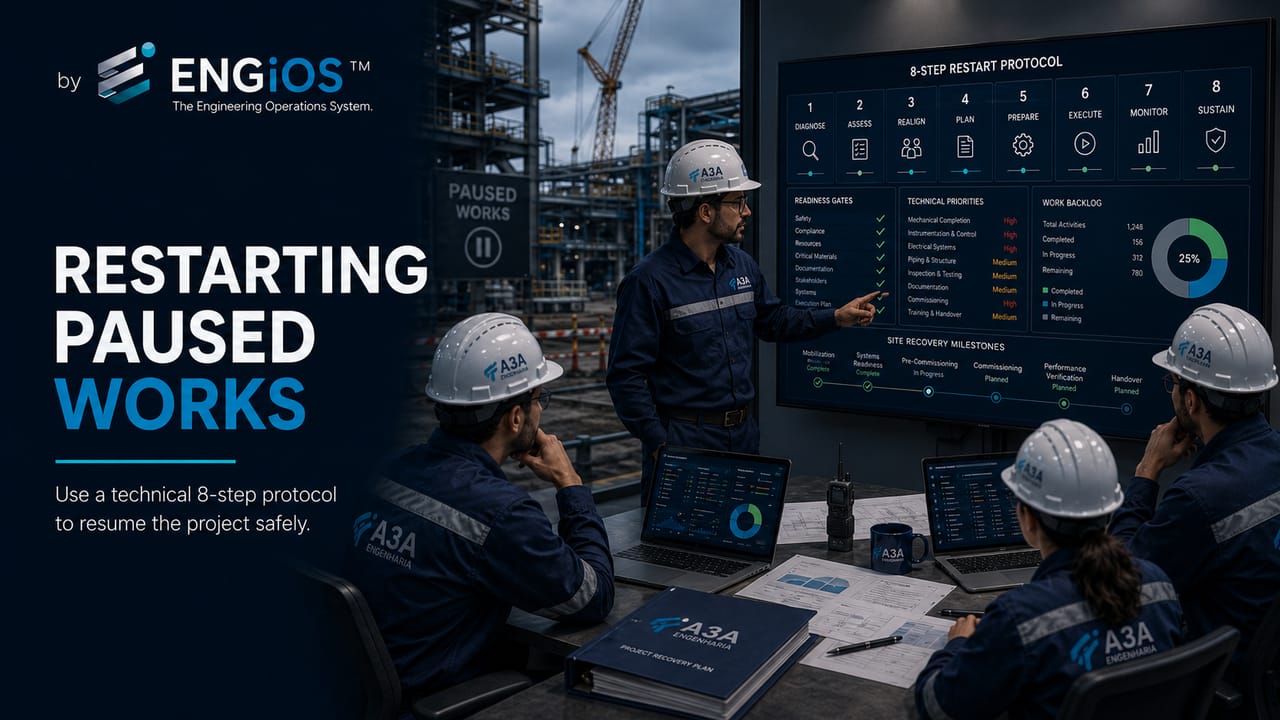
How to safely restart a stalled public work: assessment, survey, physical-financial reconciliation, remaining scope, cost estimate, inspection and restart criteria in an 8-step protocol.
Check it out!
Restarting a stalled public work does not simply mean authorizing the former contractor to remobilize, hiring another company or updating the schedule. A technically safe restart begins by reconstructing the project’s real situation: what was actually executed, its physical condition, what was measured and paid, which obligations remain valid, which causes led to the interruption and which constraints still prevent continuity.
In practice, a stalled public work becomes a partially built project exposed to deterioration, often with outdated documentation, incomplete interfaces, uncertain remaining costs and accumulated contractual risks. The design available at the beginning of construction may no longer represent field conditions; measured quantities may not match what remains reusable; stored materials may have lost warranty or traceability; licenses may require renewal; and installed systems may need testing before they can be incorporated into the next stage.
For this reason, a restart protocol should produce enough evidence for the Administration to make a reasoned decision among continuing the existing contract when legally and technically possible, correcting conditions that prevent execution, terminating the relationship and contracting the remaining scope, or structuring a new procurement. Engineering provides the factual basis for this decision: surveys, inspection, assessment, physical-financial reconciliation, definition of the remaining scope, updated cost estimate, action plan, quality requirements and acceptance criteria.
In Brazil, the problem is structural. In an update released by the Brazilian Federal Court of Accounts (TCU) on July 30, 2025, 11,469 of the 22,621 federally funded public works mapped through April 2025 were stalled, equivalent to 50.7% of the total. Education and health accounted for 70% of stoppages. In June 2026, the TCU participated in a new stage of the Integrated Program for Restarting Public Works, known as Destrava, reinforcing that restart remains an issue of public management, governance, control and execution capacity.
The technical protocol below organizes restart into eight steps: preserve the asset and the evidence; reconstruct the documentary baseline; survey the physical condition; reconcile execution, measurement and payment; diagnose causes and constraints; compare continuity alternatives; structure the technical package for the remaining scope; and control remobilization until the project once again has effective conditions to advance.
Why a stalled public work must be treated as a new engineering assessment
When the Administration still cannot demonstrate what was executed, what can be reused and how much completion will cost, the first new contract should not be for construction. Technical Due Diligence organizes the existing condition, liabilities, documentary gaps and restart alternatives before new resources are committed.
The first mistake in a restart is assuming that the condition recorded in the latest measurement bulletin, inspection report or contractual schedule still represents the project. A stoppage creates a break between documents and reality. Even if no new work was performed during the period, the physical asset remained exposed to environmental actions, aging, corrosion, infiltration, movements, vandalism, loss of temporary protection, equipment obsolescence and deterioration of stored materials.
The appropriate approach is similar to applying Diagnostic Engineering to an interrupted project: collect evidence, establish current condition, identify anomalies and constraints, classify criticalities and convert findings into technical decisions. In more complex projects, this stage also resembles a Technical Due Diligence of assets and facilities, because checking visible defects is not enough; liabilities, interfaces, documents, future costs, risks and continuity conditions must also be understood.
Law 14,133/2021 reinforces the need for decisions based on public interest. Article 147 provides that, in the presence of an incurable irregularity, the decision on suspension or nullity must consider, among other factors, the economic and financial impacts of delay, social and safety risks, deterioration costs of executed portions, preservation, demobilization and remobilization expenses, physical-financial stage, cost of a new procurement and opportunity cost of capital. This turns restart into an engineering, economic and governance problem — not merely an administrative measure.
A mature assessment must answer four questions before any restart order:
- what actually exists: services, materials, equipment, temporary facilities and available documentation;
- what can be reused: intact, compliant and traceable elements that can remain incorporated into the project;
- what must be corrected or redone: defects, deterioration, incompatibilities, incomplete work and items lacking evidence of compliance;
- what still needs to be contracted and executed: remaining scope, interfaces, tests, documentation, commissioning and delivery requirements.
Without these answers, the new schedule is only a projection built on unverified assumptions.
Step 1 — Preserve the site, assets and evidence
Before surveying quantities, discussing the cost estimate or deciding who will continue the project, the team must prevent liabilities from increasing. The first step of the protocol is stabilization: protect people, areas, equipment, materials and records that will support the assessment.
A stoppage may leave structures exposed, excavations open, systems partially energized, temporary networks in place, equipment without preservation, materials exposed to moisture and areas without adequate access control. There is also a less visible risk: loss of evidence. Photographs, daily logs, test reports, certificates, invoices, receiving records, design approvals and contractual communications may be essential to reconstruct the execution history.
The technical team should verify, according to the nature of the project:
- site safety conditions and isolation of critical areas;
- temporary drainage, covers, enclosures and weather protection;
- need to de-energize, lock out or preserve partially installed systems;
- stored materials and equipment, identifying ownership, condition, warranty and traceability;
- executed elements that may deteriorate quickly;
- preservation of samples, reports, photographic records and quality documentation;
- inventory of keys, access points, temporary facilities and assets under custody;
- risks of theft, vandalism, unauthorized occupation or third-party interference.
The objective is not to perform the complete assessment during this first pass, but to freeze the situation in a controlled manner. When the project has been stalled for a significant period, preservation cost should be compared with the cost of losing what has already been executed. This reasoning is directly related to the factors that article 147 of Law 14,133 requires to be considered in the assessment of public interest.
Records produced at this stage should be dated, traceable and sufficiently detailed to distinguish the condition found from subsequent changes. Where disputes, controversial measurements or possible contract termination exist, this documentary discipline becomes even more important.
Step 2 — Reconstruct the documentary and contractual baseline
The second step creates the documentary baseline. The team should not assume that there is a single “current design” or a single “contract estimate.” Interrupted public works frequently accumulate revisions, work orders, amendments, RFI responses, material substitutions, field authorizations and decisions that were not always consolidated into a coherent final set.
The reconstruction should identify, at minimum:
| Document group | What to verify | Why it affects restart |
| Contract, procurement notice and attachments | object, execution regime, responsibilities, warranties, measurement and acceptance criteria | defines current limits and obligations |
| Designs and specifications | valid revision, approved changes, disciplines and interfaces | establishes what should have been built |
| Cost estimate and bills of quantities | quantities, prices, BDI, new items and amendments | basis for reconciliation and remaining scope |
| Schedules | baseline, revisions, milestones and critical path | shows planned sequence and effects of stoppage |
| Measurements and payments | measured services, deductions, retentions and paid amounts | allows money to be compared with physical execution |
| RDO and inspection | events, crews, work fronts, constraints and instructions | reconstructs facts and responsibilities |
| Quality | ITP/PIT, inspections, tests, NCRs, certificates | indicates whether executed work can be accepted |
| Licenses and authorizations | validity, conditions and responsible parties | may legally prevent restart |
| As-Built and records | recorded built condition | reduces the gap between design and field |
The Daily Construction Log — RDO is particularly valuable for reconstructing the factual sequence: site conditions, crews, events, interferences and decisions. Measurement bulletins allow verification of how execution was converted into payment. Neither document, however, should be accepted in isolation as absolute proof of current condition.
When documentation is fragmented, it is useful to structure a document matrix with identification, revision, date, approver, discipline, status and relationship to the contract. Engineering document management stops being merely administrative and becomes a restart-control mechanism.
Step 3 — Survey the actual physical condition
Historical designs and measurements do not replace current field condition. When a project has been interrupted for months or years, an existing-condition survey can reconstruct geometry, installations and actual quantities to review design, cost estimate and remaining scope.
Existing-Condition Engineering Survey of the current project condition
Once the documentary baseline is organized, the team goes to the field. The survey should not be merely quantitative. It must record quantity, location, state of preservation, apparent compliance, need for testing, accessibility for inspection, interfaces and possibility of reuse.
In civil works, geometric, topographic, structural and architectural surveys may be required. For installations, the team may need to trace circuits, piping, cables, equipment, panels, field devices and terminations. In multidisciplinary projects, the method should allow all disciplines to be consolidated into a single existing-condition baseline.
When documentation is outdated, an Existing-Condition Engineering Survey can establish the actual geometry and configuration needed to review designs and quantities. Depending on complexity, resources such as 3D Laser Scanning help record extensive areas and reduce omissions, but the point cloud does not replace inspections, testing or engineering judgment.
Each element can be classified using four practical states:
- executed and acceptable: may remain, subject to applicable evidence and criteria;
- executed but pending verification: requires testing, opening, measurement, documentation or complementary inspection;
- executed with nonconformity: requires correction, repair, replacement or an engineering decision;
- not executed: forms part of the remaining scope.
This classification should connect to requirements, evidence and acceptance-criteria management. It is not enough to say that an item “looks finished.” The team must know which requirement should be met and which evidence allows it to be considered acceptable.
For partially installed systems, idle time may require additional testing. A cable may have been installed without certification; a panel may be mounted but have remained in an unsuitable environment; waterproofing may appear intact but fail after exposure cycles; equipment may have lost manufacturer-specified storage conditions. Reuse criteria must consider future performance, not only the physical percentage already executed.
Step 4 — Reconcile physical execution, measurement, payment and quality
This is one of the most sensitive stages. Restart requires transforming different information sources into a single reconciled view of the project.
The progress percentage recorded in the schedule is not necessarily equal to the measured percentage; the measured percentage is not necessarily equal to what is physically usable; and what is physically installed is not necessarily acceptable from a quality standpoint.
Reconciliation should work with at least five dimensions:
| Dimension | Main question |
| Design/scope | Was the item included and under which revision? |
| Field | Was the item actually executed and in what quantity? |
| Measurement | What quantity was recognized by inspection? |
| Financial | What was actually paid, retained or deducted? |
| Quality | Is there sufficient evidence to accept what was executed? |
A discrepancy does not automatically mean an irregularity or improper payment. There may be timing differences among execution, measurement and payment; measurement criteria may be stage-based; certain regimes compensate milestones; corrections may have occurred later. Engineering’s role is to document the difference and indicate what needs clarification.
When the restart involves significant quantities, measurement records should be reconstructed by service, work front, location and period. The content on construction monitoring, technical inspection and measurement helps explain why field evidence must support each conclusion.
Quality must enter the same matrix. Services without certificates, tests or inspection records may require additional verification even if they have already been measured. In projects with structured controls, records of QA/QC, inspections and nonconformities help distinguish documentary issues from actual defects.
At the end, the Administration should be able to see three different values: gross executed work, reusable executed work and actual remaining scope. This distinction is essential to avoid having the new contract repeat reusable work or, conversely, fail to include necessary corrections.
Step 5 — Diagnose the cause of stoppage and the constraints that remain open
A public work should only be restarted when the cause that interrupted execution has been resolved or controlled. Remobilizing without eliminating the constraint tends to produce a second stoppage.
The assessment should distinguish apparent cause, immediate cause and systemic cause. Nonpayment, for example, may originate from insufficient budget, transfer-flow issues, a measurement dispute or documentary failure. Project delay may result from low contractor productivity, but also from incomplete design, unreleased areas, licensing, unknown interference or successive scope changes.
Law 14,133 itself recognizes different sources of interruption. Article 137 includes, among other situations, breach of clauses, specifications, designs or deadlines; failure to comply with inspection instructions; bankruptcy; force majeure; delay or inability to obtain an environmental license; and delay in releasing areas. The technical assessment does not determine legal effects by itself, but it must record facts capable of supporting that evaluation.
A constraints matrix can be organized as follows:
| Constraint | Evidence | Party responsible for treatment | Release condition | Impact if unresolved |
| Incompatible design | revision, RFI, survey | designer/contracting authority according to arrangement | approved solution | rework and amendment |
| Expired license | official document | party defined by contract/law | renewal/authorization | execution prevented |
| Area not released | map/field record | Administration or responsible party | formal possession/access | work front blocked |
| Degraded work | inspection/test | technical decision | repair or replace | future failure |
| Outdated estimate | cost calculation | Administration | update and budget availability | unviable contracting |
| Undefined scope | document discrepancy | project governance | approved baseline | new disputes |
The Risk Allocation Matrix in engineering contracts is useful for checking who should bear certain events, but it does not replace factual investigation. In contracts without a sufficiently clear matrix, analysis tends to require deeper reconstruction of documents, causation and responsibilities.
Restart constraints must also be separated from liabilities under the previous contract. A claim, responsibility investigation or discussion of economic-financial rebalancing may continue without necessarily preventing every work front. Mixing the two may stall the project again over issues that could be handled on parallel tracks.
Step 6 — Compare alternatives: continue, correct, terminate or contract the remaining scope
After establishing the actual condition and constraints, the team can compare alternatives. There is no universal solution for a stalled public work.
The first alternative is to restart the existing contract when the contractual relationship remains valid, the cause of the interruption has been resolved, the contractor retains execution capacity and the technical and economic-financial conditions can be regularized under the applicable regime. In this case, restart must be formalized with an updated baseline, milestones, responsibilities, corrected scope and control criteria.
The second is to technically correct the project before restart when the main problem lies in design, quantities, interfaces, licenses or requirements. The Administration may need to review the design and estimate before remobilizing execution. The Basic Design checklist before procuring or contracting a public work is also useful for restart: many failures that should have been eliminated during the preparatory phase must be corrected before the second attempt.
The third is to terminate the contract and structure continuity under another arrangement. Termination and its effects are administrative and legal decisions, not conclusions of the engineering consultant. The technical work provides evidence on execution, quality, costs, remaining scope, risks and continuity capacity.
When contracting remaining works as a consequence of rescission/termination, article 90, paragraph 7 of Law 14,133 provides for the possibility of calling the other ranked bidders, subject to the applicable legal criteria. This means that “remaining scope” is not automatically synonymous with an entirely new procurement. The strategy depends on the specific circumstances and legal framework of the proceeding.
The fourth alternative is a new procurement when there is no suitable path for continuity under the previous contract or through remaining-scope contracting, or when necessary changes make the object to be procured substantially different from the original balance. In this case, the technical assessment forms the basis for a new design, estimate, Terms of Reference, procurement notice and contracting strategy.
The comparison should transparently consider:
- time to make the public benefit available;
- preservation cost while waiting;
- cost of corrections and adaptations;
- execution capacity of the alternatives;
- risks of a new dispute or stoppage;
- need for a new design or license;
- possibility of reusing executed work;
- cost and time of new mobilization;
- legal suitability of the alternative;
- impact on future operation and maintenance.
In complex projects, an analysis similar to Multicriteria Decision Analysis — MCDA can be used to make criteria and weights explicit without turning the decision into an automatic spreadsheet result.
Step 7 — Structure the technical package for restart or the remaining scope
In multidisciplinary restarts, the difficulty rarely lies in a single discipline. Design, cost, contracts, quality, suppliers and operations must once again work from the same baseline. Owner’s Engineering structures this technical governance on behalf of the owner without replacing the Administration’s legal duties.
Choosing the alternative does not complete the work. The decision must be converted into an executable technical package.
For a consistent restart, the following should normally exist, depending on complexity:
- assessment and existing-condition report;
- survey records or As-Built of what will remain incorporated;
- list of accepted, pending, nonconforming and unexecuted services;
- revised and coordinated design for the current condition;
- updated design narrative and specifications;
- quantities and cost estimate for the remaining scope;
- replanned schedule with milestones and dependencies;
- updated risk and constraints matrix;
- measurement and payment criteria consistent with the new baseline;
- Inspection and Test Plan and acceptance criteria;
- documentation plan, As-Built, Data Book and handover;
- commissioning and entry-into-operation strategy where applicable.
The contract scope in engineering should make inclusions, exclusions, assumptions and interfaces explicit. This is particularly critical because the new executor may receive a project started by a third party. The document must distinguish what it must verify, correct, complete or merely preserve.
The estimate must also represent the real balance. It is not enough to subtract the amount paid from the original contract value. Remaining quantities may have changed; deteriorated work may require reinstatement; designs may have been corrected; reference prices and market conditions may differ. Price Research for Public Works and Engineering Services and Cost Engineering are used precisely to create a defensible basis for contracting.
At this stage, support from Owner’s Engineering can integrate disciplines, designers, estimating, procurement, inspection and operations into an owner’s view. The role is not to replace public authority, but to organize information technically and provide evidence so that decisions, approvals and acceptances are made by the legally responsible officials.
Step 8 — Remobilize with reinforced controls and exit criteria
After remobilization, the main defense against a second stoppage is to produce evidence continuously: verifiable physical progress, traceable measurements, controlled outstanding items, treated nonconformities and recorded decisions. Technical inspection support turns these elements into a control routine.
Restart is only complete when the project advances again under a controlled baseline. Remobilization must be treated as a formal transition, not simply as crews returning to the site.
Before releasing each work front, the following should be clear:
- which design and revision are valid;
- which predecessors are complete;
- which areas are released;
- which materials and equipment are approved;
- which inspections and tests will be required;
- how measurement will be performed;
- which outstanding items must be closed before the next milestone;
- who can approve changes;
- how RFIs and nonconformities will be controlled;
- which evidence feeds provisional and final acceptance.
Article 117 of Law 14,133 provides that contract execution must be monitored and inspected by representatives of the Administration and allows third parties to be contracted to assist them and provide supporting information. The responsibility boundary must remain clear: the technical consultant may inspect, measure, analyze, record and recommend; the contract inspector and competent officials retain their own legal duties.
A Technical Support service for Public Works and Engineering Contract Inspection can structure reports, evidence, measurements, outstanding-item tracking and technical decision support. In multidisciplinary projects, Owner’s Engineering expands this work to governance of interfaces, designs, quality, suppliers, costs, schedule and acceptance.
It is also important to plan the end from the restart. Article 140 of Law 14,133 connects acceptance of public works and services to verification of technical and contractual requirements and provides for tests and inspections to assess satisfactory execution. If the restart plan does not define how the project will be tested, documented and accepted, the risk is merely shifting the stoppage from the middle of construction to the delivery stage.
Planning must therefore connect execution to technical handover, final documentation and, where applicable, commissioning. Restart means recovering the path to a functional asset, not merely completing physical quantities.
What to contract to assess and restart a stalled public work
Contracting specialized support should reflect the project’s level of uncertainty. Contracting only “an inspection” tends to be insufficient when the decision depends on design, cost estimate, contract, measurement and physical condition. Likewise, directly contracting a new executor without a reliable baseline transfers uncertainties into the bid and increases the likelihood of defensive pricing, amendments, disputes or another stoppage.
An initial contract can be structured as a technical assessment / Due Diligence of the stalled public work, with scope to review documents, inspect the existing condition, reconcile the physical-financial position, classify liabilities, identify constraints and present restart alternatives. The expected product is not a generic opinion, but a traceable set of evidence and recommendations.
When the built condition is uncertain, the scope should include an existing-condition survey and, as appropriate, topography, 3D scanning, architectural and installation surveys. If deterioration or defects are suspected, specific inspections and tests should be included.
After the decision, services such as design review, cost engineering and estimating, review of the Terms of Reference and procurement notice, technical procurement support, Owner’s Engineering, inspection support, QA/QC, As-Built, commissioning and assisted operation may be required. They do not necessarily need to be separate contracts; the arrangement depends on the size, maturity, internal capability and governance model of the public body.
Law 14,133 includes among predominantly intellectual specialized technical services, among others, studies, planning, designs, technical opinions, forensic engineering, appraisals, consulting, audits, inspection, supervision, management, quality controls, tests and trials. The contracting method must be defined by the public body according to the object, legal requirements and specific circumstances; this article does not replace legal analysis of the procedure.
Recommended minimum scope for a restart consulting engagement
Terms of Reference for assessment and restart support may require the consultant to deliver, as applicable:
- work plan and required-information matrix;
- document inventory and identification of gaps;
- physical and georeferenced photographic survey where necessary;
- record of the existing condition;
- matrix of executed, acceptable, pending, nonconforming and remaining services;
- reconciliation among designs, bills of quantities, measurements and payments;
- analysis of causes and continuity constraints;
- assessment of technical, operational, schedule and cost risks;
- restart alternatives using comparable criteria;
- remaining quantities and cost estimate;
- restart schedule and sequencing;
- requirements for repairs and revalidation;
- inspection, testing, acceptance and handover strategy;
- technical support for review of the contracting scope.
The level of detail should be proportional to the decision. A daycare center with partially executed civil works requires a different method from a hospital with electromechanical installations and special systems already assembled, just as a treatment plant, substation or urban infrastructure project has its own risks.
How to prevent the restart from producing a second stoppage
The main difference between simply “restarting” and “restarting with engineering” lies in treating causes before rebuilding the schedule. If the first execution stopped because of incomplete design, a weak estimate, undefined scope, unavailable areas or insufficient governance, simply replacing the contractor does not solve the mechanism that generated the interruption.
The restart plan should transform lessons from the first cycle into controls for the second. This includes increasing design and scope maturity, establishing management of outstanding items, RFIs and nonconformities, defining interface owners, strengthening inspection, reviewing measurement criteria and ensuring document traceability.
Readiness milestones should also be created. The project should not move from one critical stage to the next simply because the calendar has reached the planned date. Objective criteria may require approved design, released areas, available materials, completed predecessors, satisfactory tests and closed critical outstanding items. This logic is similar to Project Readiness and reduces the risk of opening work fronts without real conditions for execution.
Finally, restart indicators must go beyond physical percentage. Open critical issues, RFI age, nonconformities, design compliance, measurement predictability, contingency consumption, release milestones and documentary status provide early warnings of governance deterioration.
Final considerations
A stalled public work is not merely a delayed project. It is a project whose baseline has lost reliability and that has accumulated physical, documentary, contractual, financial and operational uncertainties. The first technical duty of a restart is to reconstruct that reality before committing new resources.
The eight-step protocol creates a defensible sequence: preserve; document; survey; reconcile; diagnose; decide; structure; control. Consulting engineering is especially valuable where the Administration needs to transform a fragmented situation into evidence, alternatives and decision criteria.
When this work is completed before new mobilization, the contracting process stops asking the market to price uncertainty and instead presents a known remaining scope, verifiable requirements, identified risks and a clear path to acceptance. This transformation — from stalled project to technically governable scope — reduces the likelihood of a second stoppage and improves the ability to deliver the public benefit originally intended.
Technical references
[1] BRAZIL. Law No. 14,133, of April 1, 2021. Public Procurement and Administrative Contracts Law. Available at: https://www.planalto.gov.br/ccivil_03/_ato2019-2022/2021/lei/l14133.htm.
[2] BRAZILIAN FEDERAL COURT OF ACCOUNTS. Half of federally funded public works are stalled. 2025. Available at: https://portal.tcu.gov.br/imprensa/noticias/metade-das-obras-financiadas-com-recursos-federais-estao-paradas.
[3] BRAZILIAN FEDERAL COURT OF ACCOUNTS. TCU president signs agreement for restart of stalled public works. 2026. Available at: https://portal.tcu.gov.br/imprensa/noticias/presidente-do-tcu-assina-acordo-para-retomada-de-obras-publicas-paralisadas.
[4] BRAZILIAN CHAMBER OF THE CONSTRUCTION INDUSTRY. Stalled public works in Brazil: diagnosis, proposals and the New Procurement Law. 2023. Available at: https://cbic.org.br/obras-publicas-paralisadas-no-brasil-diagnostico-propostas-e-a-nova-lei-de-licitacoes/.
Frequently asked questions
The first technical step is to preserve the condition found and reconstruct the project’s actual situation. Before authorizing new mobilization, documents, physical condition, executed services, measurements, payments, quality, constraints and risks must be surveyed.
Replacing the executor should not be treated as an automatic solution. The actual remaining scope, condition of existing work, required corrections and legal framework for continuity must first be defined. Law 14,133 provides, under certain conditions, for calling ranked bidders to contract remaining works after rescission/termination, but the strategy depends on the specific case.
Not necessarily. Measurement reflects contractual criteria and a historical moment. At restart, design, field condition, measurement, payment and quality must be compared to identify how much of the work remains effectively reusable.
It is advisable when current condition is not sufficiently demonstrated, deterioration exists, documents diverge, measured services are uncertain, the remaining scope must be defined or restart alternatives need to be compared. The scope may include inspections, surveys, testing and physical-financial reconciliation.
The decision belongs to the Administration and officials with legal authority, supported by the applicable legal, administrative and technical analyses. Engineering consulting provides evidence, assessments, alternatives and recommendations without replacing public authority or the contract inspector.
There should be a technically controlled baseline: valid scope and design, remaining quantities and cost estimate, treated constraints, revised schedule, defined responsibilities, measurement criteria, quality plan, inspections, tests and delivery requirements.
Restart must eliminate or control the causes of the first stoppage, strengthen design and scope maturity, define governance for changes and interfaces, establish readiness milestones, strengthen inspection and ensure traceability of measurements, outstanding items, nonconformities and decisions.
Depending on the case, Technical Due Diligence, existing-condition surveys, inspections and reports, design review, cost engineering, review of the Terms of Reference and procurement notice, Owner’s Engineering, technical inspection support, QA/QC, As-Built, commissioning and handover support may be contracted.
Supplementary technical materials
Related solutions
- Contracts, Scope and Deliverables Management
- Requirements, Evidence and Acceptance Criteria Management
- Outstanding Items, RFIs and Nonconformities Management
- Document Governance and Document Management System
- Project, Program and Portfolio Governance
Related services
- Engineering Technical Due Diligence
- Existing-Condition Engineering Survey
- Technical Support for Public Works and Engineering Contract Inspection
- Owner’s Engineering
- Construction and Engineering Services Cost Estimating
- Engineering Commissioning
Main content on the topic
- Why public works stop before they even begin
- Diagnostic Engineering: Inspection, Diagnosis and Action Plan
- Technical Due Diligence of Assets and Facilities
- Construction Planning and Control
- Technical Inspection of Public Works and Engineering Services
- Complete Guide to Procurement and Contracts for Public Works and Engineering Services
Related technical content
- Owner’s Engineering: Executive Framework for Contracting, Governance and Acceptance
- Contracting Consulting Engineering with Traceability, Governance and Cost Engineering
- Technical Handover Framework for Public Works and Systems
- Complete Guide to Cost Engineering and Estimating
- Complete Guide to Consulting Engineering
- Risk Allocation Matrix in Engineering Contracts
- QA/QC in Construction
- Technical Handover in Engineering