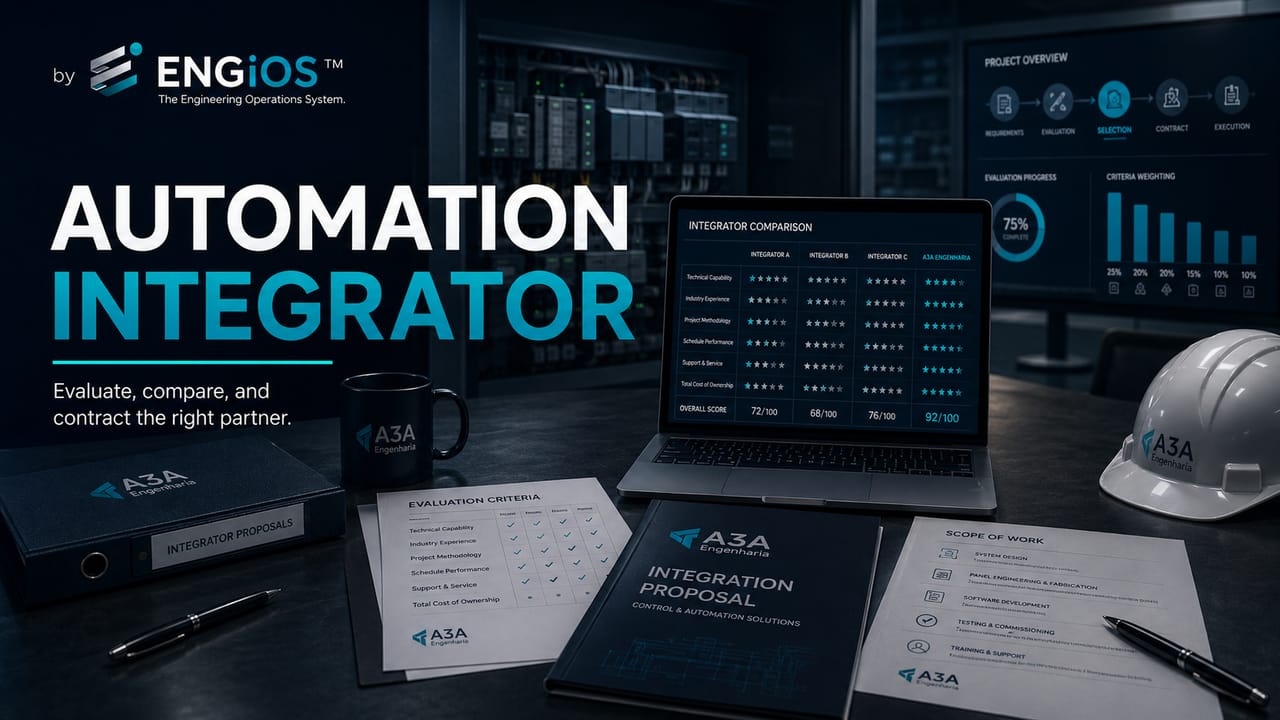
Learn how to evaluate and hire an industrial automation company: requirements, qualification, architecture, TBE, licensing, cybersecurity, FAT, SAT, commissioning, and acceptance.
Check it out!
An industrial automation company should be evaluated by its ability to transform process requirements into a verifiable, integrable, and sustainable control solution throughout the life cycle — not merely by the PLC brand it uses or the lowest bid price. To procure safely, the owner needs to define scope and criteria before competition, qualify experience and team, compare architecture and licensing, level interfaces, require FAT/SAT/commissioning, and clearly establish documentation, file ownership, access, support, and acceptance criteria.
What Does an Industrial Automation Company Do?
An industrial automation company may work across different parts of the engineering life cycle: field surveys, design, panel and equipment supply, controller programming, SCADA development, OT network integration, implementation, legacy-system migration, testing, commissioning, and support.
The problem is that the market uses expressions such as “automation company,” “system integrator,” “automation supplier,” and “automation engineering” for organizations with very different capabilities. Two companies may submit proposals for the same scope and, in practice, be offering technically incomparable packages.
Therefore, the first step in procurement is not to request a price. It is to understand which role the supplier must perform within the project architecture.
Engineering Consulting, System Integrators, and Manufacturers Are Not the Same
An engineering consultancy can define requirements, architecture, specifications, test criteria, and procurement strategy without necessarily supplying the solution. A system integrator typically develops and integrates hardware and software. A manufacturer or OEM masters its own product ecosystem. A panel builder may focus on panels and assembly. A commissioning specialist may participate as an independent verification party.
These roles can coexist within the same company, but that capability must be demonstrated. The mere presence of a manufacturer’s logo in a commercial presentation does not prove multidisciplinary engineering, integration, interface management, or commissioning capability.
When to Hire an Industrial Automation Company
Hiring is necessary when a project needs to transform operating requirements into an implemented system or when an existing installation requires modernization, integration, expansion, or recovery of technical control.
Typical cases include new plants, process-line expansion, replacement of obsolete PLCs or SCADA systems, industrial-network migration, integration of equipment from different suppliers, deployment of historians, telemetry, supervisory systems, controlled remote access, and data collection for IIoT applications.
In brownfield facilities, the need is usually more complex. The integrator must understand the legacy environment, preserve production, plan intervention windows, provide rollback capability, and control versions. In this scenario, field experience and migration methodology weigh as much as programming capability.
Before the RFP: the Owner Must Define the Problem
Requesting prices before defining requirements transfers engineering to the bidders and produces incomparable proposals. A well-structured technical scope, RFP, and evaluation criteria reduce gaps before the contract.
Requesting a proposal based on a short description such as “modernize the automation system” transfers responsibility for interpreting the scope to each supplier. The inevitable result is different solutions, non-comparable prices, and scope disputes during execution.
Procurement should begin with a minimum technical basis: existing condition, objectives, boundaries, required functions, interfaces, performance criteria, available documentation, operational constraints, and test requirements.
Existing-Condition Survey
In brownfield projects, existing documents must be checked against field conditions. Diagrams, I/O lists, topologies, addressing, firmware and software versions, licenses, backups, panels, and devices may have been modified without corresponding document updates.
The survey should also identify less-visible dependencies: old servers, protocol converters, engineering workstations, dongles or physical licenses, time-synchronization clocks, unmanaged switches, and temporary connections that became permanent.
Requirements Definition
Functional requirements should explain what the system will do and under which conditions. Non-functional requirements address performance, availability, security, retention, redundancy, expansion, diagnostics, and life cycle.
Verifiable criteria turn the proposal into a technical commitment. If a requirement merely says that the solution will be “modern,” “robust,” or “highly available,” objective evaluation becomes difficult.
The pillar article on industrial automation and its engineering architecture explores in greater depth the layers that need to be considered before procurement.
How to Structure the Scope for Comparable Proposals
The scope should clearly separate supply, engineering, development, installation, integration, testing, documentation, training, and support. It should also identify exclusions and interfaces with electrical, instrumentation, telecommunications, IT, process, mechanical, and operations disciplines.
A well-structured Engineering Scope of Work reduces the number of hidden commercial assumptions in proposals and makes responsibilities visible before contract signature.
Battery Limits and Boundaries
The supply boundary needs to indicate where each party’s responsibility ends. Who provides power? Who pulls cables? Who configures switches? Who provides IP addresses? Who integrates third-party equipment? Who updates firmware? Who provides VM, storage, or operating system? Who provides process signals for FAT?
Questions that appear minor become claims or delays when they are not answered before award.
Interface Matrix
An interface matrix records the discipline, information or resource, provider, receiver, due date, and closure criterion. It is especially important when there are separate electrical, instrumentation, telecommunications, IT, machine, and automation packages.
The integrator’s maturity can be observed in how it handles interfaces. Companies that assume “the client provides that” without recording dependencies tend to move the discussion to the field.
How to Qualify Industrial Automation Companies
Technical qualification should verify fit with the scope, not merely company size. An integrator that excels at serial machinery may not have experience with distributed systems in a brownfield plant; a company strong in SCADA may not master instrumentation or OT networks; another may know the hardware but lack the engineering and documentation processes required by the project.
Relevant Experience
Cases should be evaluated by similarity in complexity, criticality, technologies, interfaces, and operating environment. The raw number of projects is less important than the correspondence between prior experience and the risks of the new scope.
It is useful to request examples of architectures, test procedures, final documentation, and migration approaches — while naturally preserving confidential information from other clients.
Key Team
The proposal should identify those responsible for engineering, development, networks, cybersecurity, commissioning, and project management when these functions are relevant.
Manufacturer certifications help demonstrate product knowledge, but do not replace project experience, process understanding, and integration capability. Likewise, a strong résumé from one professional does not prove that the individual will actually be allocated to the contract.
Support and Life-Cycle Capability
Automation does not end at acceptance. The owner needs to assess support availability, version management, replacement capability, manufacturer relationships, remote and onsite service structure, response time, and obsolescence strategy.
Architecture Before Brand
A technical proposal should explain the architecture and the decisions supporting the solution. When the response is merely an equipment list, there is still insufficient evidence that the supplier understood requirements and interfaces.
Topology, redundancy, controllers, servers, storage, workstations, networks, protocols, synchronization, integrations, security zones, and failure behavior need to be analyzed.
Vendor Lock-In and Technical Dependence
Proprietary ecosystems are not necessarily inappropriate. The problem arises when the owner discovers only after implementation that expansion, maintenance, or access to project files depends exclusively on the original integrator.
Procurement should clarify project formats, ownership of code and configurations, engineering licenses, administrative passwords, certificates, backups, required tools, and manufacturer-support limits.
Standardization versus Interoperability
Standardizing technologies can reduce inventory, training, and complexity. However, standardization should not prevent legitimate integration with third-party equipment. Interfaces need to be specified and tested.
Protocols such as OPC UA can reduce dependence on ad hoc integrations, while legacy protocols such as Modbus require careful documentation of registers, scaling, and failure handling.
How to Compare Technical Proposals
In automation, the lowest proposal may simply be the one that left the most items out. TBE records compliance, deviations, and alternatives before commercial leveling and helps turn price comparison into comparison of equivalent scope.
Comparison should occur before commercial leveling. If one proposal includes redundancy, testing, licenses, and complete documentation while another does not, comparing only total price rewards incomplete scope.
Technical Bid Evaluation — TBE is useful for translating requirements into compliance criteria, recording deviations, and building a common technical basis for negotiation.
Compliance, Deviation, and Alternative
Each relevant requirement should receive a clear classification. An item may be compliant, partially compliant, noncompliant, or proposed as a technical alternative. Alternatives can be valuable, but they should not be silently mixed into the base proposal.
It is advisable to require the bidder to explicitly declare all deviations. Without this discipline, limitations may appear only after contract award.
Mandatory and Scored Criteria
Not everything should become a score. Minimum safety, compatibility, capacity, documentation, or qualification requirements may be mandatory. Other aspects, such as expansion capability, diagnostic resources, or implementation methodology, may receive scores.
Separating these two groups prevents a secondary advantage from compensating for a critical nonconformity.
Commercial Leveling Only Makes Sense after Technical Leveling
The lowest nominal price does not necessarily represent the lowest cost. Proposals may differ in licenses, engineering hours, number of screens, tags, servers, redundancy, FAT, travel, testing, training, documentation, and support.
Leveling should identify included, optional, excluded, and conditional items. Only then is it possible to compare CAPEX and, where relevant, life-cycle cost.
Licensing
Understanding the licensing metric is essential. Some platforms license by tag, connection, driver, server, client, redundancy, history, user, or functional module.
The owner should understand both the initial configuration and the foreseeable expansion cost. A solution that is inexpensive to purchase can become costly if every expansion requires a new license package.
Engineering Hours and Assumptions
Proposals with very few hours may conceal a simplified scope. It is important to understand which documents will be produced, how many revisions are included, how workshops, tests, and meetings will be conducted, and what assumption is used for third-party integration.
Cybersecurity Must Be Part of Integrator Qualification
The security of the solution depends on both architecture and supplier processes. The integrator will have privileged access to controllers, servers, engineering workstations, networks, and backups. Therefore, its security maturity is part of technical qualification.
IEC 62443-2-4:2023 specifically addresses security-program requirements for IACS service providers during integration and maintenance activities. This is directly applicable to evaluating integrators and service providers working on automation systems.
What to Evaluate
Depending on project risk, due diligence may include:
- credential and privileged-account control;
- remote-access process;
- management of laptops and engineering workstations;
- vulnerability handling;
- backup and configuration protection;
- removable-media control;
- change management;
- activity logging;
- incident-response process;
- separation between development and production environments.
Not every procurement needs to become an extensive cybersecurity audit. Depth should be proportional to system criticality and exposure.
FAT: the First Evidence That the Solution Meets the Contract
FAT should be defined during procurement. Leaving test definition until after development creates a conflict of interest: the same supplier that implemented the solution then decides what will be considered sufficient for approval.
The procedure should derive from requirements and describe preconditions, steps, expected results, evidence, responsibilities, and treatment of nonconformities.
What Can Be Tested at the Factory
Depending on the project, FAT can verify:
- logical architecture and versions;
- startup and recovery;
- screens and navigation;
- alarms and events;
- sequences and interlocks;
- communication among controllers;
- redundancy;
- histories;
- users and permissions;
- simulated integration;
- backups;
- documentation and punch lists.
Not everything can be reproduced outside the plant. The procedure needs to clearly identify what remains for SAT and commissioning.
SAT, Commissioning, and Acceptance
After implementation, SAT verifies the solution in the real environment. Commissioning broadens the analysis to interfaces and integrated system behavior under operating and failure conditions.
The content on Industrial Commissioning details pre-commissioning, cold testing, hot testing, start-up, and readiness. When hiring the integrator, these milestones need to be connected to responsibilities and acceptance criteria.
Test Failures, Not Only Normal Conditions
Redundancy is demonstrated only when a controlled failure of the primary component occurs. Backup is demonstrated only when restoration is tested. Server failover needs to be observed. Loss of communication must produce the specified behavior.
Testing only the nominal scenario leaves the main resilience mechanisms without evidence.
Minimum Handover Documentation
The contract should list mandatory documents and digital assets. “Deliver As-Built” is too generic for automation systems.
The final package may include, according to scope:
- As-Built architecture;
- topology and addressing;
- I/O list;
- equipment and firmware list;
- control philosophy and functional narratives;
- cause-and-effect matrix;
- alarm list;
- source programs and engineering projects;
- controller, HMI, and server backups;
- switch and gateway configuration files;
- licenses and evidence of entitlement;
- administrative credentials according to agreed governance;
- FAT/SAT procedures and reports;
- commissioning records;
- manuals and training;
- closed punch list.
The article An Installed System Is Not a Delivered System is particularly relevant: physical completion is not equivalent to accepted technical handover.
Intellectual Property, Files, and Owner Access
Procurement should distinguish supplier intellectual property, third-party licenses, and the owner’s right to operate and maintain the acquired system.
Access to programs, backups, projects, parameters, documentation, and credentials needs to be clarified. Legitimate restrictions should be explicit before procurement, not discovered when another company needs to provide maintenance.
Source Code and Engineering Projects
Not every solution requires delivery of proprietary software source code. However, applications developed specifically for the project — PLC logic, screens, tag databases, scripts, and configurations — need a clearly defined access and ownership regime.
Administrative Accounts
The integrator should not remain the sole holder of administrative access after handover. The owner needs governance over accounts, certificates, and recovery mechanisms, even if support remains outsourced.
Warranty, SLA, and Support
Equipment warranty and engineering support are different matters. A CPU may be covered by the manufacturer while logic, integration, or configuration requires service from the integrator.
Procurement should define service hours, criticality, response time, remote support, onsite mobilization, escalation, software updates, and responsibility for interaction with manufacturers.
Spare Parts and Obsolescence
For long-life systems, availability of modules, power supplies, switches, servers, and licenses needs to be analyzed. The supplier should disclose end-of-sale or near-obsolescence items when that information is available.
Automation Companies in Brownfield Projects
Brownfield work requires additional capability because the existing system remains part of the process during transition. The company needs to demonstrate a methodology for surveys, coexistence, migration, cutover, and rollback.
The content on Brownfield Projects presents engineering risks in existing facilities. In automation, these risks are amplified because software changes can have immediate physical impact.
Migration Plan
The plan should organize sequence, prerequisites, backups, responsibilities, window, intermediate tests, go/no-go criteria, and rollback conditions.
Migrating “over the weekend” is not a plan. The available period needs to be broken down into verifiable activities with margins and decision points.
Red Flags in an Integrator’s Proposal
Some signs justify additional due diligence:
- a proposal essentially composed of a bill of materials;
- absence of architecture or integration assumptions;
- FAT described only as “factory test”;
- final documentation without a list of deliverables;
- broad and generic exclusions;
- no cybersecurity approach for remote access;
- licenses without defined metrics or quantities;
- dependence on a single professional without formal commitment;
- no migration strategy for brownfield work;
- a much lower price without a corresponding technical explanation;
- absence of responsibilities for third-party interfaces.
A red flag does not automatically mean incapability. It identifies a point that needs clarification before contract award.
How to Use RFP and TBE in Procurement
An Engineering RFP organizes scope, requirements, instructions to bidders, and response format. This reduces incomparable submissions.
Then TBE records compliance and deviations. Commercial negotiation should occur on a technically leveled basis.
The sequence is especially important in automation because hidden costs appear in integration, licensing, testing, and documentation, not necessarily in the major hardware items.
The Role of Owner’s Engineering
When multiple integrators offer different architectures, an independent owner function helps preserve requirements, witness FAT/SAT, control interfaces, and verify documentation before acceptance.
When the owner does not have sufficient internal staff to structure and oversee procurement, Owner’s Engineering can act as an independent technical function.
The role may include surveys, requirements, reference architecture, RFP, technical evaluation, leveling, development monitoring, FAT witnessing, implementation oversight, commissioning, punch-list management, and handover verification.
Independence is valuable when each integrator proposes the solution it knows best. The owner needs to compare alternatives according to the project’s interests, not the portfolio of a specific supplier.
Technical Checklist before Award
Before closing the procurement, it is advisable to be able to answer objectively:
- are the scope and exclusions clear?
- are critical requirements testable?
- do interfaces have defined owners?
- has the proposed architecture been reviewed?
- are versions, licenses, and growth understood?
- is there a preliminary FAT, SAT, and commissioning plan?
- is final documentation listed in the contract?
- are owner files, backups, and access rights defined?
- are cybersecurity and remote-access criteria established?
- have brownfield strategy and rollback been addressed where applicable?
- have warranty and support been conceptually separated?
- are technical deviations from the proposal formalized?
If these answers depend on “we’ll check with the supplier later,” procurement is not yet technically mature.
Final Considerations
Selecting an industrial automation company is not merely selecting hardware, software, or price. It is contracting engineering capability to transform process requirements into a controllable, testable, documented, and sustainable solution throughout its service life.
The better the owner structures requirements, interfaces, evaluation criteria, and acceptance before award, the less dependence there is on negotiations during implementation. Suppliers stop competing based on different interpretations of scope and start competing on a comparable technical basis.
This process improves procurement quality, protects operations, and strengthens governance over FAT, SAT, commissioning, documentation, support, and future expansions.
Technical references
[1] 1. INTERNATIONAL ELECTROTECHNICAL COMMISSION. IEC 62443-2-4:2023 — Security for industrial automation and control systems — Part 2-4: Security program requirements for IACS service providers. Geneva: IEC, 2023. Available at: [https://webstore.iec.ch/en/publication/67631](https://webstore.iec.ch/en/publication/67631)
[2] 2. NATIONAL INSTITUTE OF STANDARDS AND TECHNOLOGY. Guide to Operational Technology (OT) Security. NIST SP 800-82 Rev. 3. Gaithersburg: NIST, 2023. Available at: [https://csrc.nist.gov/pubs/sp/800/82/r3/final](https://csrc.nist.gov/pubs/sp/800/82/r3/final)
[3] 3. INTERNATIONAL SOCIETY OF AUTOMATION. ANSI/ISA-95.00.01-2025 (IEC 62264-1 Mod), Enterprise-Control System Integration — Part 1: Models and Terminology. Research Triangle Park: ISA, 2025. Available at: [https://www.isa.org/products/ansi-isa-95-00-01-2025-iec-62264-1-mod-enterprise](https://www.isa.org/products/ansi-isa-95-00-01-2025-iec-62264-1-mod-enterprise)
[4] 4. INTERNATIONAL ELECTROTECHNICAL COMMISSION. IEC 62443-3-2:2020 — Security for industrial automation and control systems — Part 3-2: Security risk assessment for system design. Geneva: IEC, 2020. Available at: [https://webstore.iec.ch/en/publication/30727](https://webstore.iec.ch/en/publication/30727)
Frequently asked questions
First define requirements, scope, interfaces, and acceptance criteria; then evaluate relevant experience, team, proposed architecture, interoperability, licensing, cybersecurity, testing methodology, documentation, support, and field capability.
The manufacturer develops products and platforms; the integrator combines equipment and software to deliver a solution applied to the process. Some companies perform both roles, but responsibilities need to be clearly defined.
Not by itself. Proposals may have different scopes for redundancy, licensing, engineering, FAT, integration, documentation, and support. Technical leveling should precede commercial comparison.
An approved procedure with traceable requirements, preconditions, steps, expected results, evidence, and treatment of punch items. Depending on the system, logic, alarms, screens, integrations, redundancy, histories, and backups should be tested.
Depending on scope: As-Built architecture, topologies, I/O lists, control philosophy, programs and backups, configurations, licenses, test procedures and reports, commissioning records, manuals, and handover documentation.
Assess processes for credentials, remote access, engineering workstations, vulnerabilities, backups, change management, and incident response. IEC 62443-2-4 specifically addresses security requirements for IACS service providers.
When the owner needs independent support to structure requirements and the RFP, compare proposals, monitor development and implementation, witness FAT/SAT, manage interfaces, and verify technical acceptance.
Complementary technical materials
Related solutions
- SCADA Systems: supervision, control, alarms, and operational data
- Digital Supervision and Control Systems (SDSC): automation and integrated operation
Related services
- Industrial Automation Design: control, supervision, OT networks, and integration
- Owner’s Engineering: technical governance, oversight, and acceptance
Main content on the topic
- Industrial Automation: what it is, architecture, systems, and Engineering applications
- Engineering RFP: how to structure scope, requirements, and selection criteria
- TBE — Technical Bid Evaluation in Engineering
Related technical content
- Strategic Sourcing in Engineering: supply strategy, market, and suppliers
- Engineering Scope of Work (SOW): how to define the work scope of a procurement
- Industrial Commissioning: pre-commissioning, start-up, cold and hot tests
- Brownfield Projects: engineering in existing facilities, surveys, As-Built, and retrofit