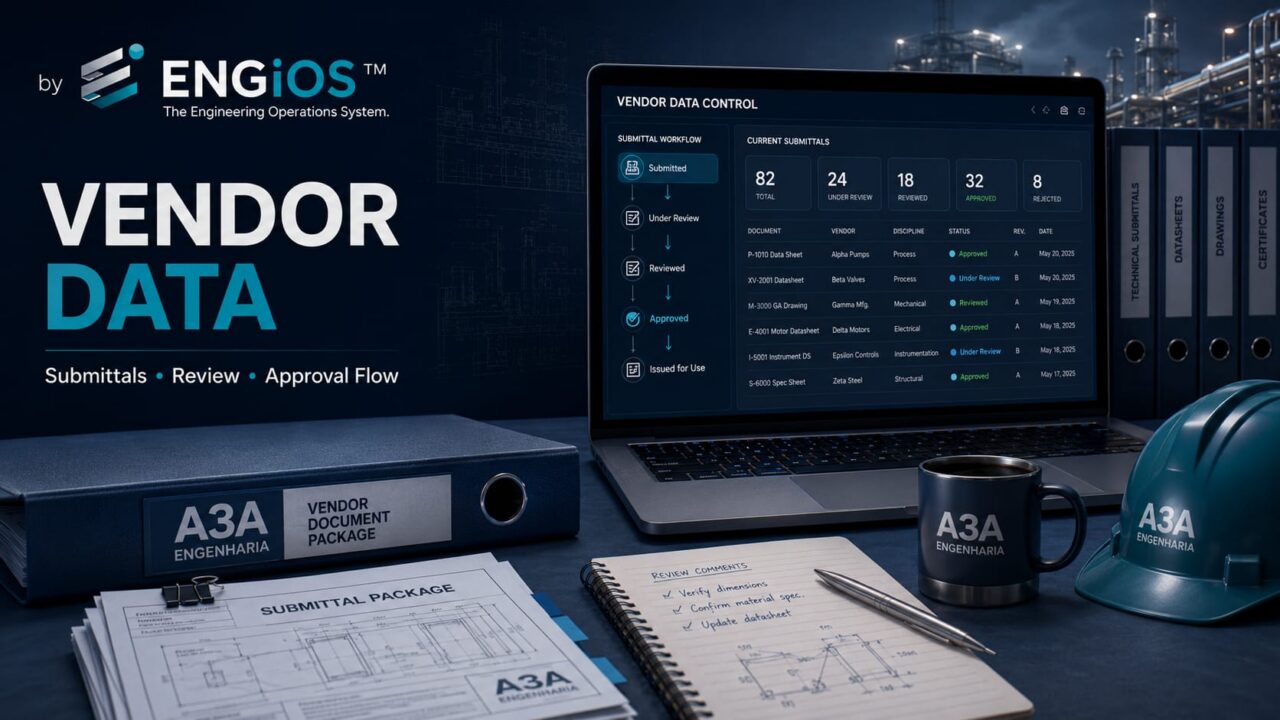
Manage supplier documents after award: Vendor Data, submittals, VDR, shop drawings, review cycles, comments, approval and final documentation.
Check it out!
Vendor Data and submittals in Engineering are the documents, data and records that suppliers and contractors need to submit to the client throughout the supply cycle to enable technical review, design continuity, manufacturing, installation, testing, operations and document closeout. Control of these deliverables is part of technical Procurement because document delays or failures can block Engineering, manufacturing, construction and commissioning even when the physical equipment itself is not yet late.
Management needs to begin before award. The technical requisition and contracting documents should define which deliverables will be required, in what format, revision, deadline and for what purpose. After contracting, these requirements become a Vendor Data Register or Submittal Register that makes it possible to control issue, review, comments, resubmittal, approval and incorporation into final documentation.
Vendor Data is not synonymous with technical documentation in general or with Document Control. This process focuses on information produced by the supplier to demonstrate, detail, integrate and record the contracted supply, from shop drawings and product data to test procedures, certificates, manuals and closeout documents. Corporate document control manages revisions, transmittals and archive traceability; Vendor Data and submittal management specifically governs the technical cycle of submission, comment, reissue and acceptance of those supplier deliverables.
What Vendor Data and submittals are
In industrial and infrastructure projects, vendor data is a broad term for data and documents supplied by manufacturers and vendors. Submittals is the term frequently used in construction and contracts for items formally submitted for review by the owner, contractor or designer.
WBDG/SpecsIntact standardizes submittal categories such as shop drawings, product data, samples, design data, test reports, certificates, manufacturer’s instructions, field reports, O&M data and closeout submittals. This classification shows that control extends far beyond drawings.
Why Vendor Data needs to originate in contracting
Vendor Data should be contracted before it is needed. When critical drawings, data sheets and reports are negotiated only after award, the project loses schedule control precisely over the information that feeds Engineering and manufacturing.
If the document list is discussed only after award, the owner may discover that certain drawings, models, calculations, certificates or manuals were not included in the supplier’s price or schedule.
Prior definition makes it possible to:
- price the documentation effort;
- establish contractual milestones;
- link documents to manufacturing;
- plan review cycles;
- require editable or native formats when necessary;
- define language and coding;
- structure final documentation from the beginning;
- avoid late negotiation of critical deliverables.
Within the Procurement cycle in Engineering projects, the Technical Requisition in Engineering should therefore contain or reference the initial vendor data list.
Types of Vendor Data
The list varies by package. A practical classification may include:
Design and integration data
- dimensional drawings;
- static and dynamic loads;
- electrical consumption;
- heat dissipation;
- connection points;
- I/O lists;
- protocols and interfaces;
- functional diagrams;
- foundation and support requirements;
- BIM models or digital files where applicable.
Product data
- certified data sheets;
- catalogs;
- performance curves;
- bill of materials;
- component identification;
- material and finish information.
Quality and manufacturing
- quality plan;
- ITP/PIT;
- manufacturing procedures;
- material certificates;
- inspection reports;
- NCRs and disposition records;
- FAT procedures and reports.
Installation and commissioning
- assembly instructions;
- installation procedures;
- checklists;
- energization procedures;
- field test requirements;
- SAT or commissioning protocols.
Operations and closeout
- O&M manuals;
- spare-parts lists;
- training documentation;
- final certificates;
- warranties;
- manufacturer As-Built drawings;
- configuration files;
- closeout documentation.
Vendor Data Register: the supplier master register
The Vendor Data Register (VDR), Vendor Document Register or Vendor Data Requirements List organizes each expected document and its status. There is no universal naming convention, but the function is the same: turn document obligations into traceable items.
Useful fields include:
| Field | Purpose |
| document code | unique identification |
| title | expected content |
| type/category | drawing, data sheet, report, manual, etc. |
| purpose | approval, information, manufacturing, operations |
| revision | current version |
| contractual date | first-issue deadline |
| forecast date | current best forecast |
| review status | technical status |
| review owner | discipline or authority |
| return date | review-cycle control |
| As-Built requirement | defines document closeout |
The VDR should integrate with the project Master Document List, without necessarily replacing it.
VDR and MDR are not the same thing
The MDR — Master Document Register controls the project’s entire document universe. The VDR is a specific view of supplier deliverables.
| Register | Scope |
| MDR | project documents as a whole |
| VDR | documents from one supplier or package |
| Submittal Register | items formally submitted for review |
| Data Book Index | documents that will compose the final dossier |
In well-structured projects, these registers are related through codes and metadata, avoiding isolated spreadsheets and duplicate controls.
Submittal Register and submission classification
Not every document needs the same treatment. The contract or document procedure should define review classes.
One possible classification is:
- Approval required: the supplier cannot proceed to a defined activity without a response;
- Review/comments: the document may require corrections before use;
- Information: submitted for awareness and record;
- Final record: delivered as closeout documentation.
The exact codes vary by organization. What matters is that their meaning is explicit and does not allow “approved” to be interpreted as transfer of technical responsibility from the supplier to the owner.
Approval does not transfer supplier responsibility
A recurring risk is treating client approval as full acceptance of the manufacturer’s design. In engineering contracts, review normally verifies compatibility with requirements, interfaces and contractual documents; it does not eliminate the supplier’s responsibility for sizing, manufacturing or performance that remains within its scope.
This principle should be expressly stated in the contract and the submittal procedure.
How to define submission deadlines
Vendor data dates should not be chosen only in relation to equipment delivery. Some documents are needed much earlier.
Examples:
- loads and dimensions may feed civil design;
- power consumption and protection data feed electrical design;
- I/O and protocols feed automation;
- layout drawings affect infrastructure;
- FAT procedures need approval before testing;
- manuals need to be available before training and operations.
Therefore, the correct deadline is derived from the date when the information will be consumed.
Review cycle and status codes
The process needs to record each issue and return. A typical workflow involves:
- supplier issues the revision;
- Document Control registers and distributes it;
- technical disciplines review it;
- comments are consolidated;
- status is issued;
- the supplier corrects and resubmits when necessary;
- an acceptable revision is released for its defined use;
- the final version is incorporated into closeout.
The number of cycles and response times should be planned. Successive reviews can consume manufacturing lead time and need to appear in expediting.
How to avoid conflicting comments
Vendor data often crosses multiple disciplines. An equipment drawing may receive comments from civil, electrical, automation, maintenance and safety teams.
Without consolidation, the supplier receives contradictory directions. Governance should define a coordination authority responsible for consolidating comments before the formal response.
Interface Management in Engineering Projects complements this control when multiple disciplines and contracts depend on the same data.
Vendor Data and manufacturing
Some documents have hold status for manufacturing. If the supplier starts production before the required review, it may assume rework risk; if the owner takes too long to review, the client side may create a schedule impact.
The relationship between document and manufacturing should appear in the VDR or supplier schedule.
Expediting needs to monitor these documents especially closely because they are material predecessors of physical milestones.
Vendor Data and TBE
Part of document management begins while the bid is still being evaluated. The TBE can verify whether the supplier accepts documentation requirements, formats, deadlines, deliverable lists and responsibilities.
A technically strong proposal that excludes critical vendor data or offers only generic catalog documentation may create cost and delay later.
Shop drawings
Shop drawings detail how part of the supply will be manufactured, assembled or integrated. WBDG distinguishes them from contract drawings and treats them as specific submittals prepared by the contractor or supplier.
Review should focus on interfaces, compliance with requirements and coordination while preserving the author’s responsibility for detailing its supply.
Product Data and certified data sheets
General catalogs do not necessarily replace data specific to the contracted item. For critical packages, it may be necessary to require a certified data sheet or documentation identified with the project model, tag and revision.
This prevents generic commercial literature from being used to demonstrate parameters of a specifically configured item.
Test reports and certificates
Test reports and certificates need to be associated with the actual item supplied. Traceability may involve serial number, lot, tag, manufacturing order or another identifier.
Without that relationship, the document may exist but fail to prove compliance of the delivered equipment.
O&M Data and operations documentation
Operations and maintenance manuals need to be planned as formal deliverables. In many projects they arrive late or in generic form, when they should already be feeding training, maintenance plans and operational readiness.
The VDR should establish a date and revision consistent with the handover phase.
Closeout submittals and final documentation
Final documentation should not be rebuilt at the end. From the beginning, the VDR should identify which items will form the Data Book, Quality Dossier, As-Built or technical handover package.
This allows each document to progress together with the supply and reduces the concentration of open items at closeout.
The Data Book in Engineering article explores the final dossier structure without confusing that function with operational vendor data control.
Vendor Data and Document Control
Document Control ensures protocol, coding, revision, distribution and traceability. The technical area defines content and status. Procurement and expediting track obligations and schedule.
These responsibilities should not be informally concentrated in a single person.
| Role | Main responsibility |
| supplier | produce and submit compliant documents |
| Document Control | register, code and distribute |
| Engineering | review technical content |
| Procurement/Contract | enforce contractual obligation |
| Expediting | monitor schedule impact |
| QA/QC | review applicable quality records |
| PMO/Project Controls | integrate impacts into the project |
Useful Vendor Data metrics
Indicators may include:
- planned vs received documents;
- overdue submissions;
- delayed critical documents;
- average client review time;
- average number of cycles until acceptance;
- documents blocking manufacturing;
- documents blocking project disciplines;
- closeout open items.
It is important to distinguish supplier delay from owner review delay.
Automation and EDMS
In projects with many packages, isolated spreadsheets quickly lose traceability. An EDMS can relate document, supplier, package, revision, transmittal, status, comments, dates and dependencies.
The system should preserve history; replacing the previous revision without a record destroys decision evidence.
Common mistakes
Recurring problems include:
- vendor data list defined after award;
- document deadlines based only on physical delivery;
- generic catalogs accepted as final documentation;
- contradictory technical comments;
- approval status without defined meaning;
- owner delay not separated from supplier delay;
- VDR disconnected from the MDR;
- final documents requested only at closeout;
- files without controlled coding or revision;
- approval interpreted as transfer of responsibility.
Final considerations
Vendor Data and submittals are Engineering assets, not administrative Procurement appendices. They feed design, manufacturing, inspection, installation, commissioning, operations and final documentation.
When document requirements are defined before award and controlled through a register integrated with Document Control, expediting and the schedule, the project reduces hidden delays and preserves traceability from proposal through handover.
The VDR should not become a parallel spreadsheet disconnected from the project. Document governance is stronger when vendor data, MDR, transmittals, revisions and final documentation share coding and traceability.
Technical references
[1] WHOLE BUILDING DESIGN GUIDE. Unified Submittals — SpecsIntact. Available at: [https://legacy.wbdg.org/tools/specsintact/Help/Submittals/UnifiedSubmittals.htm](https://legacy.wbdg.org/tools/specsintact/Help/Submittals/UnifiedSubmittals.htm)
[2] U.S. DEPARTMENT OF VETERANS AFFAIRS. Section 01 33 23 — Shop Drawings, Product Data, and Samples. Available at: [https://www.wbdg.org/FFC/VA/VAASC/VA%2001%2033%2023.pdf](https://www.wbdg.org/FFC/VA/VAASC/VA%2001%2033%2023.pdf)
[3] ISO. ISO 9001:2015 — Quality management systems — Requirements. Geneva: ISO. Available at: [https://www.iso.org/standard/62085.html](https://www.iso.org/standard/62085.html)
[4] ISO. Guidance for implementing documented information using ISO 30301:2019. Geneva, 2021. Available at: [https://committee.iso.org/sites/tc46sc11/home/news/content-left-area/news-about-standarization-in-t-1/add-a-post-2.html](https://committee.iso.org/sites/tc46sc11/home/news/content-left-area/news-about-standarization-in-t-1/add-a-post-2.html)
Frequently asked questions
It is the set of documents and data produced by the supplier to detail, demonstrate, integrate and record its supply, such as drawings, data sheets, calculations, reports, certificates and manuals.
The VDR controls supplier document deliverables. The MDR controls the project’s complete document universe. The VDR can feed the MDR but has a more specific scope.
It is an item formally submitted by the contractor or supplier for review, approval, information or record, such as shop drawings, product data, certificates and test reports.
Normally no. Review verifies compatibility with requirements and interfaces, but the supplier’s technical responsibility remains as defined by the contract.
Before award, in the technical requisition and contracting documents, so quantity, format, deadlines and review cycles become part of the contractual obligation.
Because some drawings, data sheets or procedures need to be reviewed before the supplier can proceed with manufacturing, testing or integration.
Complementary technical materials
Related solutions
- Engineering Document Management: GED, EDMS, revisions and traceability
- Requirements, Evidence and Acceptance Criteria Management
Related services
- Technical Procurement: specification, equalization, suppliers and contracting support
- Owner’s Engineering: technical governance, inspection and acceptance
Core content on the topic
- Technical Requisition in Engineering: how to prepare the technical package for Procurement
- Engineering Document Control: process, revisions, transmittals and traceability