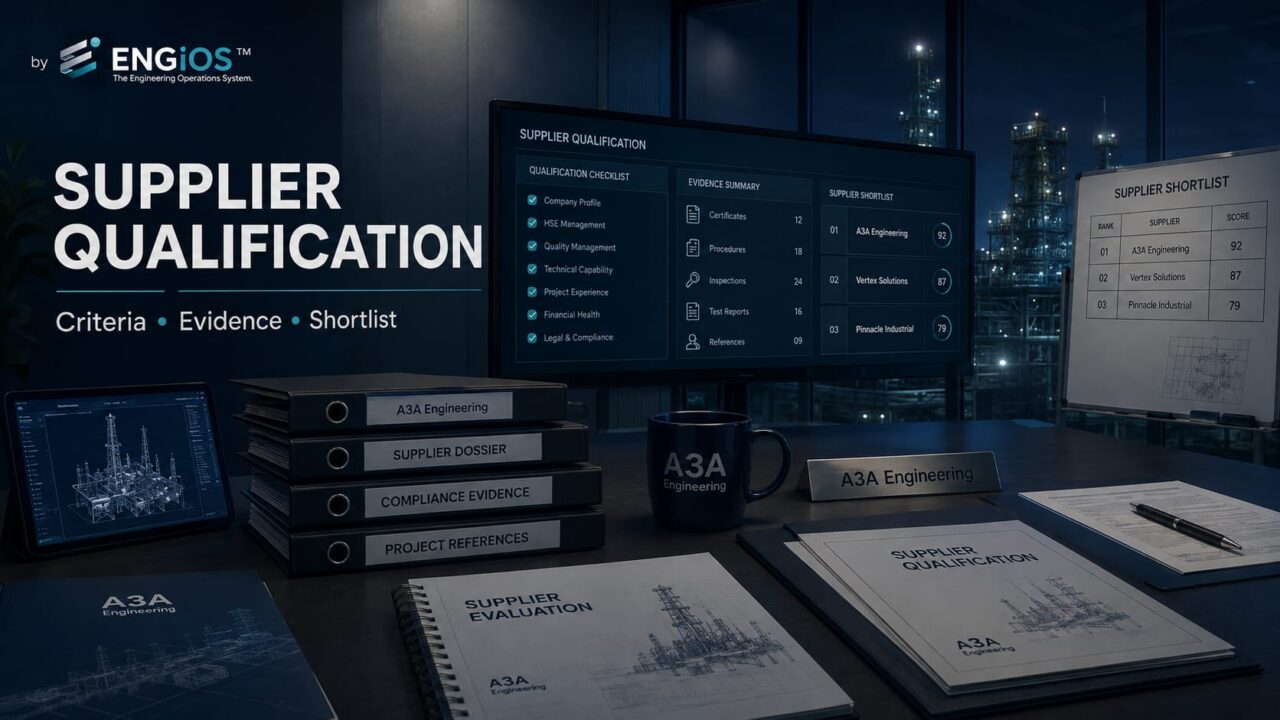
Learn how to qualify and approve suppliers in Engineering using technical criteria, evidence, due diligence, shortlists, validity and requalification.
Check it out!
Supplier qualification in Engineering is the process of verifying, before or during a procurement, whether potential suppliers demonstrate capability compatible with the nature, criticality and risk of the object. The objective is not to choose the winning proposal in advance, but to prevent the competition from proceeding with participants that lack sufficient evidence of technical competence, quality, production capacity, structure, experience or support to execute what will be contracted.
In Technical Procurement, qualification creates an important boundary between who can participate on a technically defensible basis and which proposal is best for the object. The first question belongs to qualification; the second belongs to proposal evaluation, TBE and the contracting decision.
Robust qualification is proportional to risk. Purchasing a standardized low-criticality item does not require the same level of due diligence as a critical electrical system, automation package, Data Center infrastructure, integrated security solution, long-lead supply or multidisciplinary Engineering service.
What is supplier qualification?
Qualifying a supplier means verifying whether it meets previously defined criteria to supply a particular type of product, service or Engineering package. Depending on the organization and contracting model, terms such as prequalification, initial selection, approval, approved supplier list, approved vendor list or shortlist may be used.
The terms are not always equivalent. A corporate approved supplier list may demonstrate that a company has passed general institutional checks, while project-specific prequalification should confirm compliance with the complexity and risks of a specific object.
Qualification is not proposal evaluation
This distinction reduces one of the most common Procurement errors.
| Process | Main question | Timing | Result |
| RFI | what does the market offer and what constraints exist? | before final definition | market intelligence |
| Qualification | does this supplier demonstrate capability for the object? | before or at the beginning of selection | qualified, qualified with open items or not qualified |
| TBE | does this specific proposal comply with the requirements? | after proposal receipt | compliance, deviations and technical recommendation |
| Commercial evaluation | what is the economic condition of the offer? | after or in parallel with technical evaluation | price and terms analysis |
| Contracting | which alternative provides the best overall decision? | after evaluations | award, negotiation or contracting |
A technically qualified supplier can submit a poor proposal. A technically attractive proposal can come from a company that does not demonstrate sufficient capability to assume the package. Supplier and proposal must be evaluated as related but distinct dimensions.
Why qualification should be proportional to risk
The depth of the process should reflect criticality, complexity, value, operational impact, safety, difficulty of replacement and project exposure.
For a low-criticality supply, it may be sufficient to verify basic documentation, service capability, references and product compliance. For a critical package, additional records of experience, team competence, quality management, manufacturing capability, supply chain, Engineering resources, support, testing, continuity and previous performance may be required.
Proportionality avoids two extremes: superficial qualification, which lets relevant risks pass through, and bureaucratic qualification, which creates barriers unrelated to the object.
Which technical dimensions should be evaluated?
Relevant experience
Experience should be analyzed by similarity in nature, complexity, scale, criticality and technology — not merely by the number of contracts performed.
Extensive history in simple supplies may not demonstrate capability for a high-availability integrated system. Likewise, requiring identical experience in every detail may unduly restrict the market and eliminate technically capable suppliers.
The team should define which experience attributes are genuinely relevant to package risk.
Engineering capability
When the supply requires design, detailing, configuration, integration, calculations, studies, shop drawings, documentation or application support, the supplier’s Engineering structure needs to be verified.
It is important to examine:
- available disciplines;
- key professionals;
- technical responsibilities;
- specific experience;
- tools and processes;
- ability to produce and review documents;
- interface with manufacturers and subsuppliers;
- team availability during the project period.
Production capability and supply chain
For equipment and materials, qualification may assess manufacturing capability, plant locations, production process, input availability, lead time, dependence on subsuppliers, obsolescence risks and production contingency.
The objective is not to audit the entire company in every procurement, but to identify whether the supply chain is sufficiently robust for the risk of the object.
Quality management system
Management-system certifications such as ISO 9001 may constitute relevant evidence, but they should not be treated as an automatic substitute for technical evaluation of the supplier and product.
The team may verify document control, inspection, traceability, nonconformity handling, calibration, external supplier control, release, records and improvement processes. For critical packages, it may also be necessary to examine NCR history, quality plans and the ability to execute ITP, FAT or other verification activities.
Technical assistance and support
Critical equipment may remain in operation for many years. Qualification should consider support availability, local structure, spare parts, response time, training, factory escalation and life-cycle policy.
Integration capability
In multidisciplinary systems, the supplier must demonstrate command of interfaces. Knowing only its own equipment is not enough. It is necessary to understand power, networks, protocols, automation, software, infrastructure, security, mechanical or civil requirements that affect final performance.
Health, safety and environment
When the scope involves field work, manufacturing, installation or hazardous activities, HSE criteria should be proportional to contracting conditions and the rules applicable to the project. The evaluation may consider management structure, training, procedures, indicators and evidence required by the owner.
Evidence matters more than declarations
Qualification based only on a self-declaration questionnaire tends to overestimate capability. A supplier may state that it has experience, team, certification, support or structure; Engineering must define what evidence supports each statement.
| Criterion | Insufficient declaration | Stronger evidence |
| experience | “we have completed similar projects” | contracts, certificates, references or verifiable records |
| team | “we have a specialized team” | resumes, roles, availability and applicable qualifications |
| quality | “we follow ISO 9001” | valid certificate when applicable and evidence of relevant processes |
| manufacturing capability | “we have high capacity” | production facility, stated capacity, lead time and references |
| support | “nationwide service” | structure, locations, proposed SLA and escalation channels |
| integration | “open solution” | protocols, interfaces, certificates and integration cases |
The intensity of verification should follow criticality. Not every piece of evidence needs to be submitted by every supplier, but the criteria must state in advance what will be accepted.
Define qualification criteria before consulting the supplier
Criteria should originate from the risks of the object. An efficient approach starts by asking: what could cause this supplier to fail even if its proposal appears technically correct?
If schedule is the risk, production capability and supply chain gain weight. If integration is the risk, specific experience and Engineering capability become central. If long-term operation is the risk, support, documentation and life cycle become relevant.
Criteria can be classified as:
- mandatory: minimum condition for participation;
- conditional: required only for a given technology, activity or criticality;
- differentiating: do not eliminate, but help prioritize suppliers when the process provides for graduated evaluation;
- informational: collected for planning and risk management.
Pass/fail criteria and rated criteria
Prequalifications may use minimum approval requirements and, in more complex processes, rated criteria to form a shortlist. The World Bank distinguishes prequalification and initial selection mechanisms and uses criteria proportional to the nature of the package.
The chosen method must be transparent and consistent with its purpose. If the intention is only to exclude participants without minimum capability, a pass/fail model may be sufficient. If the market has many capable participants and the later competition needs to be limited, graduated criteria may support the shortlist.
Scoring should not create false precision. An “experience” criterion without objective descriptors merely converts subjective judgment into a number.
How to structure a qualification matrix
A simple matrix can contain:
| Field | Purpose |
| criterion | capability requirement to be verified |
| justification | object risk associated with the criterion |
| required evidence | accepted document or record |
| nature | mandatory, conditional, differentiating or informational |
| result | compliant, pending or non-compliant |
| observation | identified gap or condition |
| due diligence | required clarification |
| decision | final treatment |
The justification column is important because it prevents requirements inherited from other processes from being automatically included when they are unrelated to the new object.
Market mapping before prequalification
The organization does not always know all potential suppliers. An RFI, market research, consultation with manufacturers, analysis of technical databases, project references and industry contacts can form an initial longlist.
Market mapping should be broad enough to reduce incumbent bias — the risk of inviting only companies already known. In rapidly evolving technologies, new participants may have relevant capability even without previous history with the owner.
Longlist, shortlist and Approved Vendor List
A longlist gathers potentially relevant suppliers identified in the market. A shortlist contains those selected to participate in a specific procurement. An Approved Vendor List (AVL) or approved supplier list generally has a corporate or category-based scope.
These lists should not be confused:
- being on the AVL does not guarantee inclusion in every shortlist;
- being on the longlist does not mean qualification;
- being on the shortlist does not mean the proposal will be technically accepted;
- being an incumbent supplier does not eliminate the need to verify capability for a new scope.
Documentary and technical due diligence
When evidence is incomplete or ambiguous, the team may issue a clarification request. The objective is to confirm facts and close gaps, not to relax criteria unequally.
Questions should indicate the criterion, missing evidence and response deadline. Every update must be incorporated into the qualification record.
For critical packages, due diligence may evolve into a technical meeting, interview with key personnel, factory visit, process audit or reference check. These actions should be proportional to risk and, where possible, provided for in the methodology.
Supplier site visit and audit
Not every process requires a visit. It makes sense when production capacity, manufacturing quality, test infrastructure or operational organization are material to the success of the supply.
A useful visit needs an agenda and criteria. Photographing facilities without relating them to risks does not produce qualification evidence. The team may verify production flow, test equipment, calibration, storage, traceability, product engineering, document control, inspection, nonconformities and available capacity.
Qualification of manufacturer, integrator and installer
In many projects, the chain includes several participants. The manufacturer may produce the equipment, the distributor import it, the integrator design and configure it, and another company install it.
Qualifying only the brand leaves gaps. The responsibility matrix should show which organization is responsible for:
- design and sizing;
- manufacturing;
- supply;
- software and licensing;
- integration;
- installation;
- testing;
- commissioning;
- training;
- warranty;
- support.
Each critical function needs demonstrated capability.
How to address subsuppliers
Subsuppliers can concentrate relevant risks. Panels, software, customized components, field services, laboratories and logistics may be outsourced.
Qualification should identify critical dependencies and, when necessary, require prior approval, evidence or a substitution process. The objective is not to control the entire chain indiscriminately, but to prevent the prime supplier from outsourcing precisely the competence that justified its selection.
Qualification and single-source risk
When only one supplier demonstrates capability, the issue is no longer merely selection and becomes a strategic risk. The team should record dependence, mitigation alternatives, obsolescence, support, intellectual property, spare parts and future replacement possibilities.
An RFI can help discover this market concentration early. The project can also review specifications to identify requirements that, without technical necessity, may be restricting the competitive universe.
Approval: turning qualification into a formal decision
Qualification produces evidence; approval turns that evidence into a formal eligibility decision. The record should indicate the category, technology, size, region or type of service for which approval is valid and which limits or conditions remain.
Useful governance distinguishes, for example, approved, conditionally approved, suspended, not approved and approval expired. Conditions need an action, owner and deadline; otherwise, they become mere observations with no effect on risk.
Approval does not mean approving a company for every procurement. The decision should clearly record the scope for which capability evidence exists and the triggers that require a new evaluation.
This formalization prevents a company approved for a simple supply from automatically being considered capable of a package with greater criticality, value or complexity. It also creates traceability for future shortlists, audits and Procurement decisions.
Previous performance and requalification
Qualification is not permanent. Capability, team, structure, certifications, supply chain and performance change over time.
The organization may define requalification triggers based on periodicity, scope change, criticality, occurrence of failures, relevant corporate changes, plant changes, certificate expiration or unsatisfactory performance.
Supply history should feed the process: recurring delays, nonconformities, poor documentation, support failures and commissioning difficulties are important information for future decisions.
Supplier performance indicators
After contracting, some indicators can close the learning cycle:
- on-time deliveries;
- nonconformities per lot or supply;
- NCR recurrence;
- response time to deviations;
- document compliance;
- performance in FAT and SAT;
- milestone compliance;
- post-delivery support;
- first-submission acceptance rate;
- warranty events.
These data should be interpreted in the context of the object. Comparing suppliers from completely different categories using a single corporate score can hide risks.
Relationship with Quality Management in Procurement
Qualification is one of the initial quality barriers. It does not guarantee final product compliance, but it reduces the probability of contracting a chain without capability to meet requirements.
After selection, controls such as document approval, submittals, inspections, FAT, receiving, SAT, commissioning and acceptance come into play. The article Quality Management in Procurement: requirements, suppliers, inspections and technical acceptance explores this continuity in more depth.
Relationship with TBE
The shortlist defines who reaches the competition; the TBE evaluates what those companies offer for the object. Integration between the two processes creates traceability between organizational capability and proposal quality.
Therefore, qualification criteria should not be mechanically repeated within the TBE. If minimum experience was already used to form the shortlist, the later evaluation should score it again only when there is a different and legitimately differentiating attribute.
Common errors in supplier qualification
- using the same requirements list for every category;
- confusing certification with complete capability;
- accepting declarations without evidence;
- requiring identical experience unrelated to risk;
- qualifying only the brand and ignoring the integrator or installer;
- failing to verify availability of the team that will actually execute the project;
- ignoring critical subsuppliers;
- failing to control evidence validity;
- turning an incumbent supplier into automatic approval;
- forming a shortlist without documenting criteria;
- never reviewing performance after contracting.
Recommended structure for a qualification dossier
- supplier identification and role in the chain;
- scope or category for which it is being evaluated;
- criteria and associated risks;
- documents and evidence received;
- evaluation matrix;
- clarifications and responses;
- visits or audits, when applicable;
- gaps and residual risks;
- qualification decision;
- validity, conditions and requalification triggers.
The level of documentation should increase with project criticality and exposure.
Final considerations
Supplier qualification is not bureaucracy before purchasing. When well designed, it turns market risk into verifiable criteria and prevents selection from focusing only on the appearance of the proposal.
The correct logic is sequential: understand the market, define risks, require proportional evidence, form a technically justified shortlist and then evaluate specific proposals using RFP, RFQ, TBE and equalization. This architecture improves competition, governance and procurement predictability without confusing reputation, capability and technical merit of the offer.
Qualification criteria should originate from package risks. Requirements inherited from other purchases, unrelated to criticality, merely create bureaucracy or competitive restriction without Engineering benefit.
Technical references
[1] PROJECT MANAGEMENT INSTITUTE. A Guide to the Project Management Body of Knowledge (PMBOK® Guide). 8th ed. Newtown Square: PMI, 2025. Available at: [https://www.pmi.org/standards/pmbok](https://www.pmi.org/standards/pmbok)
[2] WORLD BANK. Project Procurement Framework: Prequalification, Initial Selection and supplier evaluation resources. Available at: [https://www.worldbank.org/ext/en/what-we-do/project-procurement/framework](https://www.worldbank.org/ext/en/what-we-do/project-procurement/framework)
[3] WORLD BANK. Procurement Regulations for IPF Borrowers. 7th ed. Washington, DC, 2025. Available at: [https://thedocs.worldbank.org/en/doc/c84273d1b230aeb2b0b8134de5dc8cd7-0290012025/original/Procurement-Regulations-7th-Edition-Sep-2025.pdf](https://thedocs.worldbank.org/en/doc/c84273d1b230aeb2b0b8134de5dc8cd7-0290012025/original/Procurement-Regulations-7th-Edition-Sep-2025.pdf)
[4] ISO. ISO 9001:2015 — Quality management systems — Requirements. Available at: [https://www.iso.org/standard/62085.html](https://www.iso.org/standard/62085.html)
[5] WORLD BANK. Evaluating Bids and Proposals with Rated Criteria. Washington, DC, 2025. Available at: [https://thedocs.worldbank.org/en/doc/9dcb7971706bf29b2732779c39922b77-0290012025/original/Evaluating-Bids-and-Proposals-with-Rated-Criteria-Feb-4-2025.pdf](https://thedocs.worldbank.org/en/doc/9dcb7971706bf29b2732779c39922b77-0290012025/original/Evaluating-Bids-and-Proposals-with-Rated-Criteria-Feb-4-2025.pdf)
Frequently asked questions
It is the structured verification that a supplier demonstrates capability compatible with the nature, criticality and risks of the object before or during the selection process.
Qualification evaluates the organization’s capability to participate in the procurement. TBE evaluates the specific proposal submitted to meet the object.
It is the list of suppliers selected to proceed in a specific procurement after application of the defined prequalification or initial-selection criteria.
No. Certification can be relevant evidence of the quality management system, but technical, production, integration, support and execution capability must be evaluated according to the risk of the object.
It is a corporate or category-based list of previously approved suppliers. It does not necessarily replace project-specific qualification for a critical package.
When production capability, quality control, testing infrastructure or manufacturing process are material factors in procurement risk.
Yes, when defined triggers occur, such as a relevant scope change, elapsed time, capability change, evidence expiration, performance problems or a change in supply criticality.
Complementary technical materials
Main content on the topic
- Procurement in Engineering Projects: what it is, stages, criteria and supplier management
- Quality Management in Procurement: requirements, suppliers, inspections and technical acceptance
Related technical content
- RFI vs. RFP vs. RFQ: differences and when to use each document in Engineering
- RFP in Engineering: how to structure scope, requirements and selection criteria
- Contract and Supplier Risks in Engineering Projects: how to identify, allocate and control
- Engineering Technical Proposal Analysis: how to evaluate beyond the lowest price