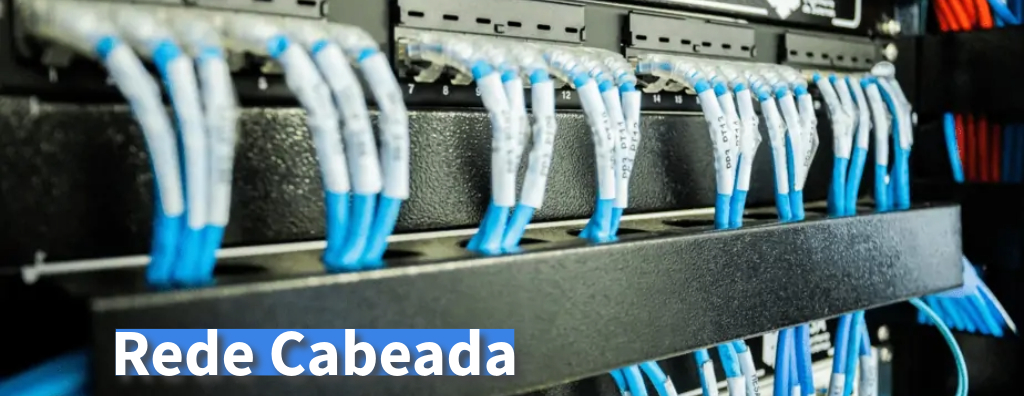
Wired network guide: Ethernet, Cat6 and Cat6A, fiber, switches, PoE, uplinks, redundancy, security, certification, commissioning, documentation, and retrofit.
Check it out!
A wired network is a communication infrastructure in which devices and network equipment are interconnected through physical media, mainly twisted-pair cables and optical fiber. In corporate, industrial, data-center, IP CCTV, and automation environments, it provides a predictable foundation for Ethernet, Power over Ethernet (PoE), high-capacity uplinks, and critical interconnections.
A wired network does not simply mean “running a cable between a computer and a switch.” Final performance depends on access and backbone architecture, category and type of physical medium, switch capacity, traffic aggregation, PoE, redundancy, electromagnetic compatibility, certification, documentation, and operations.
There is also no absolute opposition between wired networks and Wi-Fi. In modern designs, the two technologies are complementary: wireless provides mobility and flexibility; wired infrastructure supports access points, cameras, IP phones, fixed devices, servers, uplinks, and much of mission-critical connectivity.
What Is a Wired Network?
A wired network transports data between interfaces over a guided physical medium. In Ethernet, this medium is commonly balanced copper at the access layer and optical fiber in the backbone, although the choice depends on distance, capacity, environment, electrical isolation, and architecture.
A professional wired network integrates passive and active components. Cables, outlets, patch panels, fiber distribution frames, cords, and racks form the passive infrastructure; switches, routers, firewalls, servers, controllers, and endpoints process or use the data. Pathways, power, grounding/equipotential bonding, and documentation complete the operational infrastructure.
The quality of a wired network must be assessed as a system. A high-category cable does not correct an undersized switch, congested backbone, improper termination, or an architecture without redundancy.

How a Wired Ethernet Network Works
Ethernet defines communication between interfaces and uses different physical media and speeds. In a typical corporate LAN, the endpoint connects to an access switch. Access switches aggregate traffic and connect through uplinks to a distribution or core layer, which interconnects servers, firewalls, WAN links, data centers, and other segments.
Traffic does not necessarily use the full nominal capacity of every interface at the same time. Sizing requires understanding where flows converge and which links must carry aggregated traffic.
Wired Network vs. Structured Cabling
The terms are related but not equivalent.
A wired network describes the communication system using physical media. Structured cabling describes a standardized method of organizing passive infrastructure into subsystems, distributors, links, pathways, spaces, identification, and performance criteria.
A small point-to-point connection can be a wired network without constituting a complete structured-cabling system. In corporate buildings, however, structured organization is what allows growth, layout changes, documentation, and certification without rebuilding the infrastructure for every change.
Components of a Wired Network
Endpoints
Computers, servers, printers, IP cameras, access points, IP phones, controllers, sensors, and automation devices are network endpoints. Each application has a different traffic, availability, power, and security profile.
Designing only by port count ignores these differences. A PoE PTZ camera, a multigigabit access point, and an office workstation may each occupy one RJ45 port, but they have different power and capacity requirements.
Access Switches
Access Switches conectam dispositivos finais e podem fornecer PoE, VLANs, autenticação, QoS e monitoramento. O projeto deve considerar quantidade e tipo de portas, velocidades, orçamento PoE, capacidade de switching, uplinks, redundância de fontes quando aplicável, recursos de gestão e ambiente de instalação.
Port density should include a reasonable reserve for growth. Using every slot on day one eliminates flexibility and can bring replacements forward.
Distribution and Core
In larger networks, distribution switches aggregate access and create boundaries for routing, policy, and redundancy. The core provides high-capacity transport between major network blocks.
In smaller networks, these functions can be combined into a collapsed core. Architecture should follow scale and availability requirements, not a rigid rule about the number of layers.
Routers and Firewalls
Routers connect networks and routing domains. Firewalls apply security policies between zones and networks. These devices can become bottlenecks if their actual capacity — including with inspection features enabled — is not compatible with expected flows.
Port speed is not the only equipment-capacity metric.
Copper Cables and Connectivity
Twisted-pair cables are widely used at the access layer. Choosing among Cat5e, Cat6, and Cat6A must consider the application, service-life horizon, PoE, density, multigigabit potential, replacement cost, and available pathways.
The system includes horizontal cable, connectors, outlets, patch panels, and patch cords. The nominal category of the cable alone does not determine the channel category.
Optical Fiber and Backbone
Optical fiber is common in uplinks and backbones because it supports high capacity, longer distances, and galvanic isolation, while being immune to electromagnetic interference within the medium itself.
The design must specify fibers, connectors, fiber distribution frames, transceivers, fiber count, spare capacity, optical budget, and tests. Backbone availability depends both on the cable and on pathway and equipment architecture.
Cat5e, Cat6, and Cat6A: How to Choose
A useful comparison should avoid the idea that the highest category is automatically best for every scenario.
| Category | Reference range | Applications and context |
| Cat5e | 100 MHz | can still support 1000BASE-T in properly certified existing networks |
| Cat6 | 250 MHz | broad corporate application, greater margin than Cat5e; 10GBASE-T under reduced-distance/condition constraints |
| Cat6A | 500 MHz | natural reference for 10GBASE-T channels up to 100 m and longer-horizon designs |
In new corporate designs, Cat6 or Cat6A are typically evaluated according to requirements. In retrofit projects, existing Cat5e does not need to be discarded solely because of age if it is in good condition, certified, and suitable for the application.
Cat6A, in turn, has a larger diameter and may require resizing conduits, cable trays, organizers, and connectivity. Upgrading category without checking pathways can create an installation problem.
Copper or Optical Fiber?
Copper and fiber play complementary roles.
Copper is advantageous at the access layer because it has a broad ecosystem, controlled cost, and supports PoE. Fiber is advantageous in backbones, long distances, interbuilding links, high-capacity applications, and environments with strong electromagnetic disturbances.
The choice should consider:
- distance;
- current and future speed;
- PoE requirement;
- electromagnetic environment;
- galvanic isolation;
- fiber count and spare capacity;
- transceiver availability;
- criticality and redundancy;
- total implementation and operating cost.
In campus and industrial environments, using fiber in the backbone and copper at endpoints is a common architecture.
Power over Ethernet in Wired Networks
PoE allows data and DC power to be transmitted over the same balanced cabling. IP cameras, access points, phones, intercoms, controllers, and sensors can be powered by the switch or by compatible injector equipment.
Sizing must consider device power, PoE class, power available at the port, total switch power budget, channel losses, temperature, and cable bundling. The convenience of eliminating local power outlets does not reduce the need for engineering.
A switch with 48 PoE ports does not necessarily deliver maximum power simultaneously on all 48 ports. The PoE budget must be verified for actual load and expansion scenarios.
MPTL and Fixed Devices
For permanently installed devices such as cameras and access points, a Modular Plug Terminated Link (MPTL) can be used when provided for by the standard and design. The horizontal cable terminates in a compatible field plug directly at the device, eliminating an outlet and patch cord at the far end.
MPTL is not simply “crimping an RJ45 onto horizontal cable” in any manner. Components, termination procedure, and test configuration must be appropriate for the system.
Wired Networks and Wi-Fi Are Complementary
Wireless provides mobility and access flexibility; the wired network provides a dedicated medium to the port and greater capacity predictability. Both share infrastructure.
Every access point needs an uplink and often PoE. Therefore, a high-capacity Wi-Fi design may require Cat6A, multigigabit switches, higher-power PoE, and more robust uplinks.
Likewise, even predominantly wireless users depend on the wired backbone to reach servers, the Internet, and corporate services.
The correct decision is not “wired or Wi-Fi,” but which combination serves each device type and application.
Performance: Port Speed Is Not Network Speed
A workstation connected at 1 Gb/s has up to that capacity on its access link, but perceived performance depends on the full path: switch, uplinks, core, firewall, WAN, server, storage, and application.
One hundred 1 Gb/s ports connected to a single 10 Gb/s uplink create an aggregation ratio. This is not necessarily a problem: not all devices transmit at maximum capacity simultaneously. The design must understand utilization profiles and criticality.
For CCTV, for example, many cameras generate continuous flows that add up on uplinks. Office traffic tends to be more variable. For storage and backup, peaks can occupy a large portion of a backbone.
Oversubscription: When It Is Acceptable
Oversubscription is the relationship between the sum of access capacities and available aggregation capacity. Cost-effective designs normally use some degree of oversubscription because sizing the entire backbone for the theoretical sum of all ports may be unnecessary.
The problem occurs when the ratio is not calculated or when critical applications are treated as sporadic traffic. Sizing must consider normal behavior, peaks, growth, and the failure scenario of a redundant link.
Latency, Jitter, and Packet Loss
Wired networks tend to offer predictable latency and less exposure to radio-frequency variability, but they are not immune to congestion, queueing, physical errors, or equipment processing.
Latency is transit time; jitter is variation in that time; packet loss occurs when data is dropped or corrupted. Voice, real-time video, automation, and interactive applications are especially sensitive.
Before blaming cabling, physical errors must be separated from congestion and logical policies. A certified link can perform poorly because of oversubscription; an uncongested uplink can receive corrupted packets from a degraded physical channel.
Wired Network Redundancy
Redundancy can involve parallel links, fibers on distinct paths, duplicated switches, redundant power supplies, multiple uplinks, and high-availability core equipment.
Two links in the same conduit do not provide the same resilience as two links on physically independent routes. Likewise, two physical paths do not provide useful failover if the logical configuration does not converge correctly.
Redundancy must be designed around the failure domains the organization intends to withstand.
LACP and Link Aggregation
LACP can aggregate multiple physical interfaces into one logical interface, providing aggregate capacity and tolerance to member failure. However, flow distribution normally uses hashing functions; a single flow does not necessarily use the total combined capacity of all ports.
The design must define the number of links, capacity, distribution, equipment compatibility, and behavior when a member fails.
It is also necessary to avoid redundant links unknowingly sharing the same physical single point of failure.
Spanning Tree and Loop Control
In Layer 2 Ethernet networks, redundant paths can create loops. Spanning Tree family protocols control the logical topology, maintaining contingency paths without allowing frames to circulate indefinitely.
Layer 2 loops can cause broadcast storms and widespread outages. Therefore, redundancy must be implemented with appropriate mechanisms and topology-change monitoring.
Security: Wired Does Not Automatically Mean Secure
A wired network reduces exposure through the radio-frequency medium but is not inherently secure. Someone with physical access to an active outlet or rack can attempt to connect an unauthorized device.
Security requires physical and logical controls:
- protection of racks and technical rooms;
- port identification and administration;
- disabling unused ports where appropriate;
- network segmentation;
- 802.1X authentication or NAC according to policy;
- firewalls and ACLs;
- secure device management;
- monitoring and logs;
- firmware updates and hardening.
Physical infrastructure reduces some exposure surfaces but does not replace a security architecture.
Segmentation and VLANs
VLANs allow functions to be logically separated over the same switching infrastructure. Users, voice, CCTV, Wi-Fi, management, and automation can have distinct segments with specific communication policies.
Segmentation improves organization and control but must be coordinated with routing and security. Creating many VLANs without documentation or need increases operational complexity.
The wired network provides the path; the logical network defines how that path is used.
Shielded Cabling and Electromagnetic Compatibility
Industrial environments or areas with relevant electromagnetic disturbance may require evaluation of shielding, pathways, segregation, or optical fiber.
Constructions such as F/UTP, U/FTP, and S/FTP provide different shielding arrangements. Selection must consider compatible connectors, continuity, and equipotential bonding. Simplistic rules such as “always ground at one end” do not replace design.
In many well-designed offices, U/UTP can be technically suitable. Shielding should respond to the environment, not to a generic perception that “more metal is always better.”
Dry Infrastructure and Pathways
Cable trays, conduits, ladder racks, shafts, pull boxes, and technical rooms affect installation and maintenance capacity.
Pathways must respect fill, bend radius, pulling tension, access, and separation of incompatible systems. They should also allow expansion without dismantling existing cables.
A Cat6A design, for example, can fail during implementation if the larger cable diameter was not considered in conduit and organizer fill.
Corporate Applications
In offices, the wired network supports fixed workstations, IP phones, printers, access points, meeting rooms, cameras, and other devices. The design must consider layout flexibility and growth.
Structured cabling with well-distributed outlets avoids improvised extensions and allows changes to be made through patching rather than new cable runs for each user change.
Data Centers and Technical Rooms
Data centers require high density, capacity, organization, and availability. Copper and fiber coexist according to architecture and distances, but pathway management, identification, segregation, and documentation become even more critical.
The choice of medium depends on equipment interfaces, topology, speed, distance, density, and migration strategy. Infrastructure must support asset evolution without creating physical barriers to upgrades.
IP CCTV
IP cameras use Ethernet for video, control, metadata, and frequently PoE. Cable category should not be selected solely by camera resolution: individual bitrate is normally far below 1 Gb/s, while the greater challenge is often aggregating dozens or hundreds of streams on uplinks and servers.
The design must size access, PoE, switches, backbone, VMS, recording servers, and storage as a chain.
Industrial Networks
Industrial environments add vibration, dust, temperature, chemical agents, electromagnetic disturbance, and availability requirements. Fiber can be strategic in backbones and high-EMI areas; industrial copper can serve endpoints according to environmental classification.
Topology can also be influenced by production processes and rapid-recovery requirements. Architecture must coordinate IT and OT networks without assuming that office criteria are sufficient.
Automation, Access Control, and IoT
IP automation and security devices increase the number of ports and network dependencies. Many operate via PoE and remain connected for years.
These systems require inventory, segmentation, time synchronization, availability, and access policies. Wired infrastructure must accommodate expansion without turning every new sensor into an improvised project.
How to Size Access Switches
Sizing goes beyond counting ports.
- Survey current and planned devices.
- Separate 1G, multigigabit, and other required port speeds.
- Calculate PoE power per device and aggregate budget.
- Define uplink quantity and speed.
- Assess VLAN, QoS, authentication, and monitoring features.
- Define availability and power-supply/equipment redundancy where needed.
- Reserve capacity for growth and contingency.
- Check rack environment, ventilation, and power.
A switch may have enough ports and still be unsuitable because of insufficient PoE budget or uplinks.
How to Size Uplinks and Backbone
The wired network must be sized as a system: access points, switches, PoE, uplinks, backbone, and physical pathways must address the same capacity and expansion scenario.
Uplinks should be calculated from the flows that actually converge. Sizing may consider average traffic, peaks, continuous applications, backup, replication, CCTV, Wi-Fi, and failure scenarios.
The capacity of the alternate path must also be considered. If two 10 Gb/s uplinks normally share load, loss of one may require the other to carry all traffic.
The backbone should have growth margin so that every access expansion does not require immediate core replacement.
Wired Network Design
An engineering design can follow this sequence:
- business requirements, applications, and criticality;
- survey of existing infrastructure;
- definition of topology and hierarchy;
- definition of physical media and categories;
- sizing of outlets, racks, and pathways;
- sizing of switches, PoE, and uplinks;
- backbone and redundancy architecture;
- segmentation and addressing coordinated with the logical network;
- technical specifications and equivalence criteria;
- testing, certification, and commissioning plan;
- documentation and As-Built.
This sequence avoids purchasing equipment before understanding the system.
Procurement and Technical Equivalence
Network procurement must compare function and performance, not just commercial descriptions. For switches, requirements may include ports, speeds, PoE, uplinks, capacity, protocols, security, management, and support. For cabling, the system, category, standards, construction, reaction to fire, PoE compatibility, connectivity, and warranty should be verified.
One “Cat6” product is not automatically equivalent to another if construction and certification characteristics differ from the specification.
In bids and competitive procurement, objective criteria protect performance without unnecessarily tying the solution to a brand.
Installation and Construction Oversight
Oversight should verify that implementation preserves the design:
- approved models and materials;
- routes and pathway fill;
- bends and mechanical stresses;
- rack organization;
- separation and compatibility with power systems;
- connectivity and identification;
- shield continuity where applicable;
- fiber and distribution-frame installation;
- change documentation;
- preparation for testing and acceptance.
Installation errors can reduce the margin of a technically well-specified system.
Infrastructure Certification
Certification proves the physical medium; commissioning proves solution behavior. In critical networks, both forms of evidence complement each other for technically defensible acceptance.
For copper, certifiers measure parameters such as wire map, length, insertion loss, NEXT, and return loss according to the selected test configuration and limit. Permanent Link and Channel have distinct limits and components.
For fiber, Tier 1 OLTS/LSPM tests verify loss and length; OTDR can complement characterization and event location where specified.
Reports must be traceable to the actual link identifier. Native instrument files, where required, increase auditability and allow later review.
Network Commissioning
Cabling certification proves the passive medium; commissioning verifies the solution in operation.
It may include:
- interface state and speed;
- PoE under load;
- VLANs and trunks;
- uplinks and aggregations;
- failover and convergence;
- routing and policies;
- critical-service connectivity;
- monitoring and alarms;
- final documentation.
Accepting only that “the cable passed” does not validate the complete network architecture.
Documentation and As-Built
Documentation should allow a future team to understand the network without reconstructing it through trial and error.
Common items include:
- outlet and pathway drawings;
- rack diagrams;
- patch-panel map;
- backbone and fibers;
- physical topology;
- L2/L3 logical diagram;
- VLAN and addressing table;
- asset and transceiver list;
- test reports;
- configurations and backups according to policy;
- change records.
The As-Built must reflect the delivered condition, not merely copy the original design.
Maintenance and Operations
A well-built wired network requires less corrective physical intervention, but it is not “maintenance-free.” Patch cords are moved, connectors can be damaged, racks change, fibers require cleaning, and active equipment evolves.
Good practices include change management, rack inspection, documentation updates, error monitoring, capacity review, and handling alarms before they become outages.
Preventive maintenance should be based on risk and condition, not indiscriminate periodic replacement of cables that continue to meet requirements.
Wired Network Troubleshooting
A layered sequence reduces resolution time:
- confirm power and physical link;
- check patching, port, and transceiver;
- analyze physical errors and negotiated speed;
- test the link when indicated;
- validate VLAN, LACP, and spanning tree;
- check IP, gateway, and routing;
- analyze capacity and congestion;
- test the application and dependencies;
- correlate with recent changes;
- document cause and correction.
Replacing a switch or cable before proving the hypothesis can turn a simple incident into multiple variables.
Retrofit of Existing Wired Networks
An older network does not need to be completely replaced as a matter of principle. The decision should start from survey data and evidence.
Items that can be evaluated include:
- cabling condition and category;
- certification margins;
- backbone capacity;
- rack and pathway utilization;
- PoE and future needs;
- asset obsolescence;
- lack of redundancy;
- documentation;
- outage risks.
From this baseline, retrofit can prioritize the backbone, critical areas, or genuinely deficient points before intervening in healthy parts of the network.
When a Wired Network Needs Modernization
Common signs include switches without adequate capacity or support, frequently saturated uplinks, undocumented cabling, recurring failures, lack of certification, insufficient PoE, difficulty supporting new access points or cameras, saturated racks, and expansion through improvised switch cascades.
Modernization is also relevant when the infrastructure no longer supports modern security and monitoring policies.
Modernization should resolve structural causes, not merely replace equipment with newer models.
Final Considerations
Wired networks remain the backbone of digital infrastructure because they provide predictable media for Ethernet, PoE, backbones, and critical devices. Their value, however, is not simply that cables exist: it lies in the integration of architecture, capacity, physical media, assets, redundancy, security, testing, and documentation.
Copper, fiber, and Wi-Fi should be selected according to the role they perform. Cat6 or Cat6A should respond to lifecycle requirements, not marketing. Redundancy must be physically independent and logically functional. Certification should be followed by commissioning when the object of acceptance is the complete network.
A well-designed wired network turns infrastructure into a long-term platform for users, Wi-Fi, electronic security, automation, communications, and new IP applications.
In existing networks, efficient modernization starts with a baseline. Knowing what is healthy, saturated, obsolete, or poorly documented prevents unnecessary infrastructure replacement.
Technical references
[1] INSTITUTE OF ELECTRICAL AND ELECTRONICS ENGINEERS. IEEE 802.3 Ethernet Working Group. Available at: https://www.ieee802.org/3/
[2] INSTITUTE OF ELECTRICAL AND ELECTRONICS ENGINEERS. IEEE P802.1Q — Bridges and Bridged Networks. Available at: https://standards.ieee.org/ieee/802.1Q/11285/
[3] BRAZILIAN ASSOCIATION OF TECHNICAL STANDARDS. ABNT NBR 14565:2019 — Structured cabling for commercial buildings. Available at: https://www.abntcatalogo.com.br/
[4] INTERNATIONAL ORGANIZATION FOR STANDARDIZATION; INTERNATIONAL ELECTROTECHNICAL COMMISSION. ISO/IEC 11801-1:2017 — Generic cabling for customer premises. Available at: https://www.iso.org/standard/66182.html
[5] ISO; IEC. ISO/IEC 11801-1:2017/Amd 1:2025 — Amendment 1. Available at: https://www.iso.org/standard/93480.html
[6] TELECOMMUNICATIONS INDUSTRY ASSOCIATION. ANSI/TIA-568.2-E — Balanced Twisted-Pair Telecommunications Cabling and Components Standard, 2024. Available at: https://tiaonline.org/standardannouncement/tia-publishes-new-standards-ansi-tia-568-2-e-and-ansi-tia-568-5-1/
Frequently asked questions
It is a network in which communication between devices uses guided physical media, mainly copper cables and optical fiber. In professional environments it also involves switches, racks, pathways, PoE, backbone, documentation, and test criteria.
Not automatically. It reduces exposure through the radio-frequency medium, but outlets, racks, and ports require physical protection and logical controls such as segmentation, authentication, and access policies.
It can be suitable in many designs, but the decision depends on application, service-life horizon, PoE, future speed, density, and replacement cost. Cat6A is considered when 10GBASE-T up to 100 m and a longer technology horizon are requirements.
Fiber is normally evaluated for backbones, longer distances, high capacity, interbuilding links, galvanic isolation, and environments with relevant electromagnetic interference.
The application must comply with standards, category, construction, temperature, and channel limits. The device power requirement and switch PoE budget must also be verified.
No. It is necessary to determine whether they have genuinely independent pathways, equipment, and power sources and whether the logical layer has configured and tested recovery mechanisms.
No. It demonstrates passive-medium performance according to the selected test limit. Switches, VLANs, PoE, redundancy, and services require additional validation and, where applicable, commissioning.
Not necessarily. If the links are in good condition, certified, and suitable for the applications, they can remain in operation. Retrofit should be based on evidence and future requirements.
Additional technical materials
Related solutions
Related services
- Projeto de Structured Cabling
- Technical Testing and Verification
- Commissioning
- Technical Due Diligence
- Engineering As-Built
Main content on the topic
- Network Infrastructure: complete guide
- Physical Network: components, physical layer, failures, and troubleshooting
- Physical Network vs. Logical Network: differences, integration, and troubleshooting
