
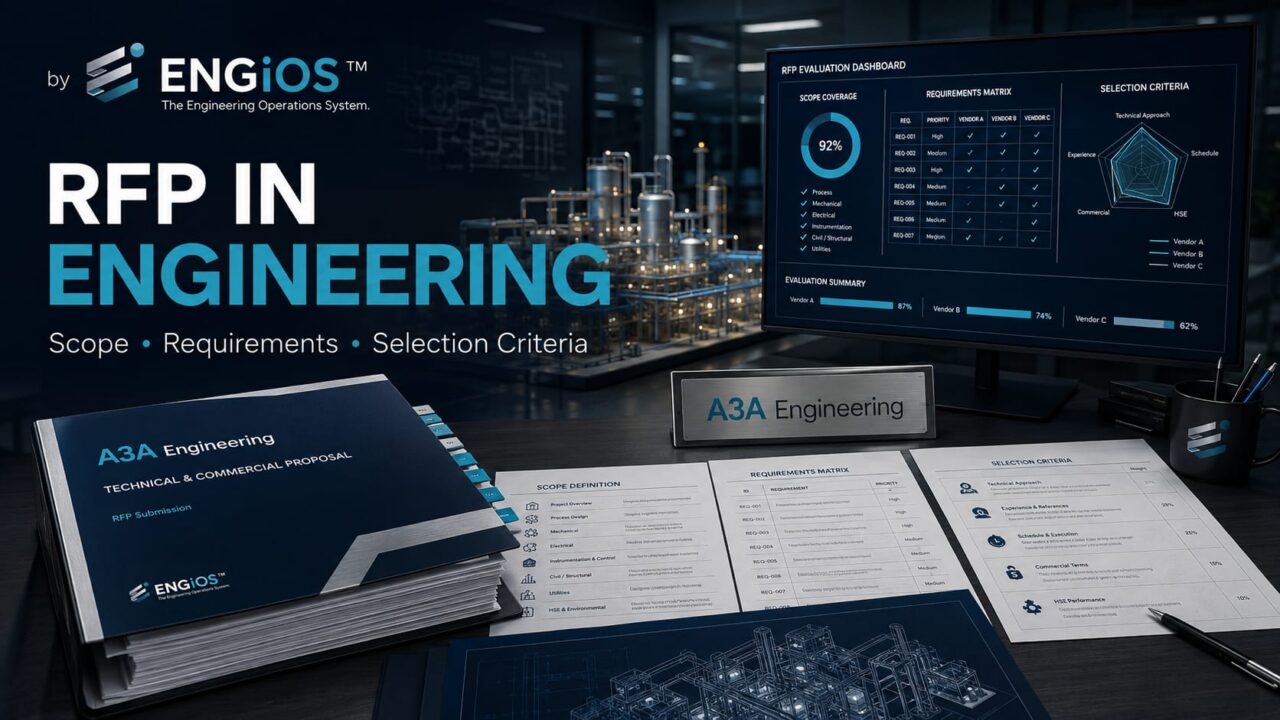
Learn how to structure an Engineering RFP with scope, requirements, compliance matrix, evaluation criteria, risks and a baseline for comparable proposals.
Check it out!
An RFP in Engineering (Request for Proposal) is a document — or package of documents — used to request technical and commercial proposals when the owner needs to compare not only price, but also solution, methodology, team, schedule, risks, responsibilities, performance and execution capability. In complex procurements, the RFP turns an Engineering need into a structured baseline so that different bidders respond to the same problem and can be evaluated against criteria defined in advance.
A well-built RFP is not merely a request for a quote. It should state the purpose of the procurement, organize input information, define scope and interfaces, establish verifiable requirements, specify deliverables, set the response format and explain how proposals will be evaluated. When these elements are weak, the process tends to produce proposals that are difficult to compare, numerous reservations, price contingencies and a high risk of change orders after contract award.
What is an RFP in Engineering and what is its role in Procurement
RFP means Request for Proposal. In Engineering, it is used when the owner wants a structured response to a technical problem and accepts that suppliers may present different approaches, methodologies or solutions.
This point distinguishes an RFP from a simple quotation. When the need is completely defined, items are standardized and price is the main variable, an RFQ may be sufficient. When the market still needs to be investigated before the procurement can be defined, an RFI may be more appropriate. The RFP occupies the space where the need is mature enough to be procured but the quality of the proposed solution is still a relevant part of the decision.
Within Procurement in Engineering Projects, the RFP connects contracting planning, requirements definition, market engagement, supplier selection and future contract management. Its quality therefore influences the process far beyond proposal receipt.
The logic is straightforward: if the documentation sent to the market allows different interpretations of what must be delivered, the owner does not receive equivalent proposals. It receives responses to different objects even if all proposals carry the same title.
When to use an RFP instead of simply asking for price
An RFP is especially appropriate when the bidder must demonstrate how it will meet the need, not merely state how much it will charge for something already fully specified.
Typical situations include Engineering design services, Owner’s Engineering, EPC, EPCM, systems integration, facility modernization, multidisciplinary packages, specialized consulting, commissioning, automation, critical infrastructure and services where methodology, experience or execution organization affect the outcome.
| Procurement condition | Likely most appropriate instrument |
| Market still needs to be understood | RFI |
| Need defined, but solution and approach may vary | RFP |
| Standardized scope and solution already defined | RFQ |
| Complex procurement with technical and commercial evaluation | RFP with evaluation matrix |
| Repetitive purchase or technical commodity | RFQ or structured quotation process |
The choice does not depend only on financial value. A lower-value scope may justify an RFP if there is high technical criticality, operational risk, integration with existing systems or a need to evaluate specific supplier competencies.
The opposite can also occur: a high-value purchase that is highly standardized and sufficiently specified may be compared through a well-structured RFQ, provided technical risks were addressed before quotation.
What needs to be defined before issuing the RFP
An RFP does not automatically fix immature scope. Before going to market, the owner needs to establish requirements, boundaries, interfaces and acceptance criteria at a level compatible with the procurement.
One of the most frequent Procurement failures is using the RFP to try to resolve uncertainties that should have been addressed in Engineering before contracting. The document can organize questions and allow alternatives, but it does not replace diagnosis, surveys, requirements definition, contract strategy or acceptance criteria.
Before issuing the RFP, the owner should know, at a level appropriate to the object:
- the problem that needs to be solved;
- the expected outcome;
- the environment where the solution will be implemented;
- the main technical and operational constraints;
- the available input information and its level of reliability;
- the boundaries between the contracted scope and other parts of the project;
- mandatory requirements;
- expected deliverables;
- relevant schedule milestones;
- contracting and risk-allocation strategy;
- how the delivery will be tested, measured and accepted.
When these definitions do not yet exist, the process may need to begin with Engineering Terms of Reference, a basic design review, Due Diligence or a conceptual Engineering stage.
Sufficient maturity does not mean a fully prescribed solution
An RFP can allow technical freedom. The owner does not necessarily need to detail every component or execution method. What must be clear is which problem will be solved, which conditions must be respected and how compliance will be demonstrated.
For some objects, the best RFP is strongly prescriptive because compatibility, standardization or safety requires a defined solution. For others, functional and performance requirements generate better competition because they allow the market to propose alternatives.
How to structure an Engineering RFP package
For simple procurement, the RFP may be a single document. For more complex projects, it is preferable to organize a package with volumes or appendices controlled by revision.
A typical structure can include:
| Block | Expected content |
| Instructions to bidders | dates, communications, site visit, clarifications, submission method and validity |
| Context and objective | need, current situation and intended result |
| Scope | inclusions, exclusions, boundaries, interfaces and responsibilities |
| Technical requirements | functional requirements, performance, standards and constraints |
| Input data | drawings, surveys, inventories, models, reports and assumptions |
| Deliverables | documents, products, services, evidence and formats |
| Planning | schedule, milestones, dependencies and execution constraints |
| Quality and testing | inspections, plans, FAT, SAT, commissioning and acceptance criteria |
| Technical proposal format | methodology, team, experience, schedule, compliance matrix |
| Commercial proposal format | price composition, taxes, currency, escalation and terms |
| Evaluation criteria | pass/fail, scored factors, weights and selection method |
| Draft contract | responsibilities, risks, warranties, changes, insurance and closeout |
The package should have version control. If clarifications or changes occur during the process, the organization needs to identify which documents were modified, which answers became part of the procurement baseline and which changes supersede previous conditions.
How to define the object, scope and supply boundaries
The object should accurately communicate the result of the procurement. Expressions such as “complete solution supply,” “execution as required” or “turnkey implementation” are not sufficient unless the actual inclusions are decomposed.
The scope should explain activities, disciplines, locations, phases, systems, interfaces and products. It also needs to explicitly address the boundaries of the procurement.
A good boundary definition answers questions such as:
- who provides input data and who validates it;
- who develops Engineering and who approves it;
- who supplies materials and equipment;
- who performs construction and installation;
- who integrates third-party systems;
- who provides power, network, access, work area and temporary utilities;
- who performs tests and who witnesses them;
- who corrects deviations;
- who produces final documentation;
- who decides on technical changes.
Interface Management in Engineering Projects is directly related to this stage. Many change orders and disputes arise from activities that were neither completely outside nor completely inside any party’s scope.
Inclusions and exclusions need to be symmetrical
It is not enough to create one list of inclusions and another of exclusions. The team needs to verify that the entire expected outcome is actually assigned to someone.
If the RFP excludes an activity from the supplier, the process needs to identify who will perform it, by when and under which criteria. Otherwise, the exclusion simply creates an orphan interface.
How to write verifiable technical requirements
Requirements are the core of the RFP. They need to guide both proposal development and future verification of the delivery.
A weak requirement states a vague intention: “the system shall be robust,” “the solution shall have high availability” or “the supplier shall use best practices.” A better requirement establishes context, condition, performance and verification criteria.
Requirements Management in Engineering helps separate need, requirement, solution, evidence and acceptance. This traceability is particularly useful in an RFP because it allows each bidder’s response to be compared requirement by requirement.
Functional requirements
They define what the solution must do. They are appropriate when the owner wants to preserve implementation alternatives.
Performance requirements
They define capacity, tolerance, time, availability, accuracy, consumption, productivity, redundancy or another measurable characteristic. They should include the measurement condition and approval criterion.
Prescriptive requirements
They define a specific technology, architecture, material, method or characteristic. They make sense where there is technical justification, compatibility, a corporate standard, a regulatory requirement or an already-consolidated Engineering decision.
Process and governance requirements
They define how the supplier must plan, document, review, submit, control changes, manage nonconformities and record evidence. In Engineering contracts, these requirements can be as important as the requirements for the final product.
Compliance matrix: turning requirements into comparable responses
A lengthy RFP should not depend on the evaluator finding responses scattered across hundreds of pages. A compliance matrix requires each bidder to declare how it meets the requirements.
| Field | Example use |
| Requirement ID | ENG-REQ-042 |
| Description | summarized requirement or document reference |
| Classification | mandatory / desirable / informative |
| Bidder response | complies / partially complies / does not comply |
| Proposal reference | section, drawing, narrative or appendix |
| Deviation or reservation | objective explanation |
| Future evidence | calculation, test, certificate, FAT, SAT or document |
This structure reduces the risk of a proposal appearing compliant merely because it repeats the language of the RFP. The bidder must demonstrate where and how the requirement is met.
The matrix also facilitates subsequent Engineering Technical Proposal Analysis, especially when different suppliers adopt different assumptions or solutions.
Deliverables: define what will actually be received
Scope describes work. A deliverable describes a verifiable result of that work. This distinction is fundamental for measurement, governance and acceptance.
In an Engineering procurement, deliverables may include studies, design narratives, drawings, BIM models, specifications, bills of materials, calculations, schedules, reports, equipment, installations, configured software, test reports, certificates, as-built documentation, manuals, training and commissioning documentation.
Each relevant deliverable should have, as applicable:
- format;
- minimum content;
- preparer;
- reviewer;
- comment cycle;
- due date or milestone;
- acceptance criterion;
- approval evidence;
- relationship to payment or measurement, where appropriate.
The article on Deliverable-Based Measurement in Consulting Engineering shows why verifiable deliverables reduce discussions about percentage progress and make contracting more traceable.
Instructions to bidders and clarification governance
Even a good RFP generates questions. The process needs a formal clarification channel and must ensure that relevant information reaches participants on an equivalent basis.
The instructions should define dates, responsible parties, question format, response deadlines, site visits, meetings, presentation of alternatives and the amendment procedure.
Answers provided only in individual conversations create information-asymmetry risk. In a structured competition, a clarification that changes the interpretation of scope, a requirement or a commercial condition should be recorded and incorporated into the process.
A site visit does not replace documentation
A visit can reveal access restrictions, existing conditions, physical interfaces and operational limitations. It should not be used as justification for transferring to the bidder all responsibility for information that the owner could document.
Statements such as “the supplier declares that it knows all site conditions” need to be used carefully. A short visit does not automatically turn hidden conditions into risks that are known and priceable.
How to standardize the technical proposal received
The RFP should tell bidders how to respond. Without a minimum index, each company organizes its proposal differently and evaluation becomes slower and more subjective.
A recommended structure includes:
- understanding of the object and assumptions;
- compliance matrix;
- technical solution;
- execution methodology;
- organization and responsibilities;
- key personnel and qualifications;
- schedule and mobilization;
- quality and testing plan;
- risk and interface management;
- list of deviations, exceptions and alternatives;
- deliverables and documentation;
- support, warranty and post-delivery services;
- commercial proposal in a separate envelope or section, depending on the process.
Separating the technical and commercial proposals can be important when the selection methodology is intended to evaluate technical quality before exposing price. The strategy should be defined before the RFP is issued and applied consistently to all participants.
Evaluation criteria: define them before receiving proposals
Selection criteria should not be invented after the owner already knows the responses. They need to be defined before issue and disclosed in a manner proportionate to the nature, complexity, risk and value of the procurement.
PMBOK 8 presents selection methods that vary according to the object, including least cost, qualifications, quality-based selection, quality and cost, sole source and fixed budget. The selected method should reflect the type of result expected and the degree of technical differentiation among suppliers.
The World Bank Procurement framework likewise emphasizes that criteria and methodology should be described in the solicitation document and applied consistently. In complex procurement, factors beyond price can be scored to distinguish quality, methodology, capability, key personnel, risk management and sustainability.
| Criterion | Possible nature | Typical evidence |
| scope compliance | pass/fail or scored | compliance matrix |
| technical solution | scored | narrative, architecture, calculations |
| methodology | scored | execution plan |
| relevant experience | pass/fail/scored | certificates and comparable cases |
| key personnel | scored | résumés and availability |
| schedule | scored | plan and milestones |
| risks and interfaces | scored | initial register and approach |
| quality and testing | scored | plan, ITP and commissioning strategy |
| cost | financial | equalized commercial proposal |
| life-cycle cost | financial/technical | TCO, OPEX, maintenance and replacements |
Pass/fail criteria and scored criteria are not the same thing
A pass/fail criterion defines the minimum necessary for a proposal to remain in the process. A scored criterion differentiates proposals that are already admissible.
Making every requirement a pass/fail criterion can reduce competition without technical benefit. Conversely, scoring a requirement that represents a minimum safety, compliance or performance condition can allow an inadequate proposal to compensate for a critical deficiency with points in another area.
Weights and scoring method
Where weighted evaluation is used, the weights should represent the owner’s real priorities. It makes little sense to assign 5% to the technical solution and 30% to a commercial presentation if the object depends on performance and complex integration.
The scale also needs to be defined. Scores from 0 to 10 without descriptors leave too much room for subjective judgment. A better scale describes what insufficient, minimum, adequate and superior performance means.
Conceptual example:
| Score | Interpretation |
| 0 | not submitted or does not comply |
| 1 | insufficient compliance with critical gaps |
| 2 | minimum compliance, no differentiation |
| 3 | consistent and complete compliance |
| 4 | superior compliance with demonstrable benefit |
| 5 | exceptional solution with clear evidence and controlled risk |
The purpose of scoring is not to replace technical judgment. It is to make that judgment more disciplined, traceable and comparable.
Technical equalization before economic comparison
Selection criteria are defensible only when proposals are comparable. Technical equalization, deviation records and documented clarifications prevent scope differences from being mistaken for price advantage.
See how to structure technical proposal analysis and equalization
Proposals should not be compared financially as if they were equivalent when one includes activities that another excludes. Technical equalization identifies differences in scope, assumptions, quantities, models, tests, schedule, documentation, warranties, responsibilities and risks.
This process may generate formal requests for clarification. The expected result is a comparable baseline on which the owner understands the cost and risk of each alternative.
The analysis should also distinguish a deviation from an alternative. A deviation is a condition in which the bidder does not meet the original requirement. An alternative is a different solution, presented transparently, that may or may not create value for the owner. Both situations need to be explicit rather than buried in the proposal.
Price, TCO and Value for Money
The lowest initial price may not represent the most economically advantageous solution when operations, maintenance, energy, licenses, parts, obsolescence, support, downtime or change-order risk are significant.
The RFP can therefore require information that allows total cost of ownership and life-cycle cost to be evaluated. This is particularly important for equipment, critical systems, maintenance contracts, digital solutions, energy infrastructure and technologies with recurring costs.
Economic analysis needs a common baseline. If one supplier includes five years of support and another only one, comparing total value without normalization produces a misleading conclusion.
Schedule, milestones and integration with Procurement Planning
The RFP should state dates that actually constrain the supplier: mobilization, area releases, Engineering dates, manufacturing, inspections, FAT, delivery, installation, energization, SAT, commissioning and acceptance.
Dates need to reflect dependencies. Requiring equipment delivery before submittals or designs can be approved creates a schedule that is formally aggressive but technically inconsistent.
Procurement planning should identify long-lead items, critical packages, Engineering dependencies, required-on-site dates and decision points. An RFP issued late can make the schedule impossible to meet even with a good supplier.
How to address risks and responsibilities in the RFP
Risk should not simply be transferred to the supplier through generic wording. Good allocation assigns each risk to the party with the greatest ability to understand, control or mitigate its cause and impact.
The RFP needs to make risks visible regarding input data, existing conditions, interfaces, permitting, access, logistics, lead time, exchange rates, integration, changes, testing, utility availability and simultaneous operations.
The connection with Contract and Supplier Risks in Engineering Projects is direct: poorly allocated conditions tend to reappear as price contingencies, exclusions, disputes or claims.
RFP and contract strategy
The document needs to be consistent with the contracting model. A design RFP, an EPC RFP and an EPCM RFP cannot have the same responsibility matrix.
In EPC, the contractor assumes Engineering, Procurement and construction according to the contract and the owner’s bases. In EPCM, the service provider may develop Engineering, support Procurement and manage construction while supply contracts remain with the owner. In Owner’s Engineering, the role is to technically represent the owner, review, inspect, coordinate and support decisions without replacing the obligations of the main contractor.
Contract, Scope and Deliverables Management should begin during the procurement phase. The contract does not automatically correct a contradictory RFP; it often merely incorporates its ambiguities.
RFP in private companies and public procurement
RFP is widely used in private and international Procurement. In Brazil, private companies can structure their processes with contractual freedom consistent with applicable law and internal policies.
In public procurement, the RFP terminology does not replace the formal instruments required by legislation, the regulations of the public entity and the corresponding administrative process. Law No. 14.133/2021 governs public procurement and administrative contracts and uses instruments such as preliminary technical studies, terms of reference, preliminary design, basic design and detailed design depending on the object and contracting regime.
Thus, the concepts of a good RFP — clear requirements, evaluation criteria, traceability, comparable responses and clarification governance — can be useful to the technical structure, but they must be aligned with the applicable legal and administrative procedure.
Common mistakes when preparing an Engineering RFP
Some mistakes recur because they seem to simplify the process initially but transfer effort and risk to evaluation or execution.
Issuing the RFP with insufficient Engineering
If the owner still does not understand the problem, environment, interfaces or minimum requirements, suppliers will fill the gaps with their own assumptions. The received price then reflects different hypotheses.
Using generic specifications copied from another project
Inherited documents may carry capacities, standards, models, responsibilities and conditions that do not match the current project.
Requiring a “complete solution” without a boundary matrix
The expression does not define interfaces with existing systems, third parties, utilities, civil works, licenses, data or owner-provided infrastructure.
Mixing mandatory requirements with preferences
The bidder does not know whether a discrepancy eliminates the proposal or simply reduces its score. This generates avoidable reservations and clarification requests.
Failing to require an explicit deviation list
Without a consolidated list, exclusions can remain scattered among notes, commercial terms and appendices.
Evaluating price before technical equalization
This practice favors apparently inexpensive proposals that left part of the scope out of their price composition.
Not defining acceptance
If the RFP describes the solution but does not explain how delivery will be demonstrated, the dispute is merely postponed until the end of the project.
Review checklist before releasing the RFP to the market
Before issue, the team can verify:
- the objective is clear and consistent with the contracting strategy;
- relevant input information is available and identified by revision;
- the scope has explicit boundaries and interfaces;
- there are no essential activities without an owner;
- mandatory requirements are verifiable;
- preferences are separated from minimum requirements;
- deliverables have content requirements and acceptance criteria;
- the schedule is compatible with Engineering, manufacturing and approvals;
- the bidder knows how to respond;
- deviations and exclusions must be presented in consolidated form;
- evaluation criteria were defined before proposals are received;
- weights and scoring method reflect risks and priorities;
- the commercial proposal has a comparable structure;
- clarifications and amendments will have formal governance;
- the draft contract is consistent with scope and risk allocation.
This checklist does not replace a detailed technical review, but it helps identify inconsistencies before they are multiplied across all bidders.
When to contract Consulting Engineering support to prepare an RFP
Independent Engineering participation is especially useful when the owner has a complex problem, multiple disciplines, existing infrastructure, interface risks or a need to select among technically different solutions.
Support may include surveys and diagnosis, requirements definition, scope structuring, responsibility matrix, preparation of technical documentation, evaluation strategy, responses to clarifications, proposal equalization and issuance of a technical opinion.
Within Technical Procurement, these activities can be integrated into a single governance model connecting Engineering, Procurement, Project Management and the owner’s decision-making process.
Final considerations
An effective Engineering RFP creates a common baseline for competition. It does not eliminate each supplier’s ability to propose better solutions; it eliminates unnecessary ambiguity about the problem, responsibilities and decision criteria.
The more critical the procurement, the less acceptable it is to treat an RFP as a simple price request. Scope, requirements, interfaces, deliverables, evaluation, risk and acceptance need to form a coherent system. That coherence is what makes it possible to receive comparable proposals, select with traceability and start the contract on a stronger technical baseline.
Technical Procurement connects Engineering, purchasing, risks, contracts and acceptance. In complex packages, this integration allows the RFP to be treated as part of a contracting process rather than as an isolated document.
Technical references
[1] PROJECT MANAGEMENT INSTITUTE. A Guide to the Project Management Body of Knowledge (PMBOK® Guide) — Eighth Edition. Newtown Square: PMI, 2025. Available at: https://www.pmi.org/pmbok-guide-standards/foundational/pmbok
[2] WORLD BANK. Procurement Regulations for IPF Borrowers. 7th ed. Washington, D.C.: World Bank, September 2025. Available at: https://thedocs.worldbank.org/en/doc/c84273d1b230aeb2b0b8134de5dc8cd7-0290012025/original/Procurement-Regulations-7th-Edition-Sep-2025.pdf
[3] WORLD BANK. Project Procurement Framework: Standard Procurement Documents — Request for Proposals, Consulting Services. Washington, D.C.: World Bank, 2025. Available at: https://www.worldbank.org/ext/en/what-we-do/project-procurement/framework
[4] BRAZIL. Law No. 14.133, April 1, 2021. Public Procurement and Administrative Contracts Law. Available at: https://www.planalto.gov.br/ccivil_03/_ato2019-2022/2021/lei/l14133.htm
Frequently asked questions
An Engineering RFP is a structured request for a technical and commercial proposal used when a procurement needs to compare solution, methodology, capability, risks, schedule and price rather than simply obtain a quotation.
An RFP is more appropriate when the solution or execution approach may vary among suppliers. An RFQ is more appropriate when scope and solution are sufficiently defined and the main objective is to obtain comparable prices and commercial terms.
An RFI is primarily used to obtain market information before fully defining the procurement. An RFP is issued when there is enough maturity to request a formal proposal and apply selection criteria.
An RFP should include context, objective, scope, boundaries, technical requirements, input data, deliverables, schedule, quality and acceptance criteria, response format, evaluation criteria and applicable commercial and contractual conditions.
Yes. Criteria, weights and methodology should be defined before proposals are received and applied consistently, reducing subjectivity and preventing selection rules from being adjusted after responses are already known.
Standardize the response format, require a compliance matrix and deviation list, clarify assumptions and then perform technical equalization before comparing prices.
Not necessarily. In private processes, Terms of Reference may be part of the RFP package. In Brazilian public procurement, mandatory instruments and documents must follow applicable legislation and regulations.
Consulting Engineering support is especially useful in complex, multidisciplinary or high-risk procurements, with existing infrastructure or multiple possible solutions, where requirements, interfaces and selection criteria need to be independently structured.
Complementary technical materials
Related solutions
- Contract, Scope and Deliverables Management
- Requirements, Evidence and Acceptance Criteria Management
Related services
- Technical Procurement: specification, equalization, suppliers and contracting support
- Owner’s Engineering: technical governance, inspection and acceptance
- Engineering Technical Consulting: diagnosis, strategy and decision support
Main content on the topic
- Procurement in Engineering Projects: what it is, stages, criteria and supplier management
- Engineering Technical Proposal Analysis: how to evaluate beyond the lowest price
