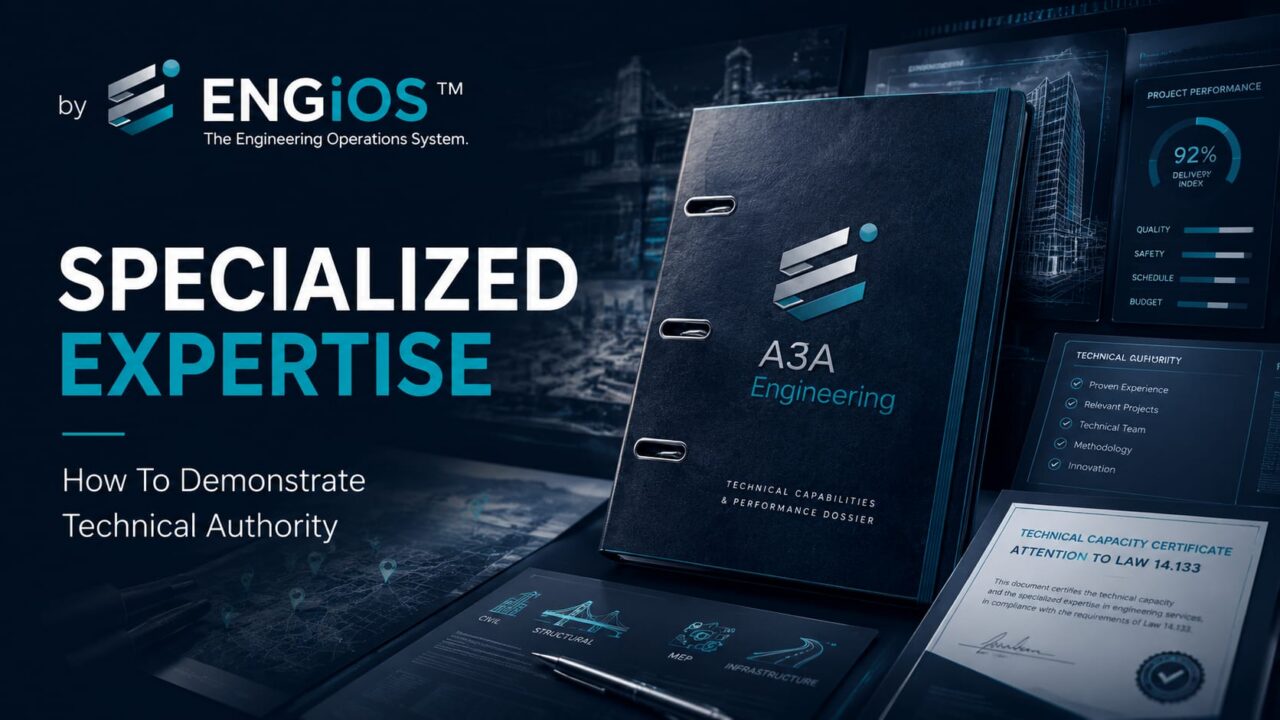
Understand recognized expertise under Brazilian Law 14,133 and how to demonstrate it in engineering services through experience, certificates, team qualifications, publications, organization and alignment with the object.
Check it out!
Recognized expertise under Brazilian Law 14,133 is not synonymous with fame, a lengthy résumé or a large number of certificates. For purposes of noncompetitive procurement of specialized technical services, it must be demonstrated through objective evidence — prior performance, studies, experience, publications, organization, resources, technical team or other requirements — and, above all, must support the inference that the work of that professional or company is essential and demonstrably suitable for the full satisfaction of the object.
In engineering services, the analysis must be based on relevance. The Administration must connect the specific need to the competencies that genuinely affect the outcome and only then verify whether the potential contractor has sufficient evidence of those capabilities. Recognized expertise without alignment with the object does not, by itself, support noncompetitive procurement.
Where Brazilian Law 14,133 Defines Recognized Expertise
The concept appears in Article 6, XIX and is reiterated in Article 74, § 3. The law considers a professional or company to have recognized expertise when its standing in its field of specialization, arising from prior performance, studies, experience, publications, organization, resources, technical team or other requirements related to the activities, allows the inference that its work is essential and demonstrably suitable for the full satisfaction of the contract.
The definition contains two layers that should not be separated:
- demonstrable technical recognition in the relevant field;
- essential suitability for the specific object the Administration intends to procure.
The first answers “does the provider actually have differentiated capability?” The second answers “is that differentiated capability decisive for this need?”
Recognized Expertise Is Not a Title Granted by the Administration
Recognized expertise is not generic fame. Evidence gains value only when it demonstrates capability directly related to the problem the Administration needs to solve.
The Administration does not “declare” someone an expert by discretionary decision. It examines pre-existing evidence and determines whether that evidence supports the legal classification.
For this reason, justifications based only on expressions such as “renowned company,” “trusted professional,” “market leader” or “industry reference” are weak when they are not accompanied by documentation and an analysis of relevance.
A sound procurement file converts reputation into verifiable evidence. The process should allow internal control, legal counsel or a court of accounts to reconstruct the reasoning and understand why a given experience, publication, team or methodology is relevant to the object.
What Evidence the Law Itself Allows
Law 14,133 does not establish a closed list. It presents categories of evidence that may be combined according to the nature of the service.
| Evidence | What it may demonstrate | Points of attention in the analysis |
| prior performance | capability already applied in real situations | verify scope, responsibility, outcomes and alignment |
| studies | technical depth and command of a specific field | distinguish generic education from relevant knowledge |
| experience | accumulated practical track record | verify complexity and context, not only years in business |
| publications | intellectual command and technical contribution | assess relationship to the object, authorship and content quality |
| organization | ability to coordinate and deliver | verify processes, governance and available structure |
| resources | resources required for performance | assess whether the resources are genuinely relevant to the service |
| technical team | combined competencies | verify key professionals, responsibilities and effective participation |
| other requirements | field-specific capabilities | provide a technical rationale for why they are relevant |
The strength of the demonstration usually lies in the combination of evidence, not in one isolated document.
Prior Performance: Experience Must Be Comparable in Substance, Not Only in Name
A certificate with the same title as the current object does not guarantee equivalent experience. In engineering, two projects both called “technical consulting” may differ profoundly in disciplines, criticality, number of interfaces, responsibility, scale, operating environment and decision complexity.
The analysis should consider:
- which activities were actually performed;
- the role of the company and professionals;
- which deliverables were produced;
- the degree of autonomy and responsibility involved;
- which disciplines and systems were involved;
- which operating, safety or continuity constraints existed;
- which outcomes or decisions were supported by the work.
This logic brings the assessment of recognized expertise close to the analysis of technical certificates, but with a different purpose. In qualification for a competitive tender, the focus is to demonstrate compliance with previously defined criteria. In noncompetitive procurement, the focus is to demonstrate why that track record helps infer that the provider is essential and demonstrably suitable for the specific problem.
Studies and Education: Depth Matters More Than Quantity
Degrees, postgraduate programs, certifications and courses may support the demonstration, but they must be read together with applied experience.
In Consulting Engineering, education in project management, systems engineering, risk analysis, telecommunications, electrical engineering, automation, security, BIM, data or other areas may be relevant when the object requires those competencies. Merely accumulating diplomas, however, does not replace evidence of practical application.
A sound justification explains what that education adds to the expected outcome. If that bridge does not exist, the document may enrich the résumé without strengthening the basis for procurement.
Publications and Technical Production Can Demonstrate Intellectual Command
The law itself mentions publications. This is especially consistent with predominantly intellectual services, in which structured knowledge and the ability to formulate methods have relevant value.
Depending on the case, the analysis may include:
- technical articles;
- books and chapters;
- guides and manuals;
- papers presented at events;
- published research and studies;
- signed institutional technical content;
- reference documents produced by the professional or team.
Quantity should not be treated as automatic scoring. The content must relate to the field of specialization and demonstrate useful command for the public need.
Organization and Resources Are Also Part of the Concept
Recognized expertise is not limited to an individual professional. When procurement involves a company, organizational capability may be decisive.
In complex projects, the Administration may assess:
- ability to mobilize specialists from different disciplines;
- technical review and quality-control processes;
- requirements and document-management tools;
- engineering technology environment;
- coordination and traceability systems;
- specific instruments and equipment;
- ability to work with multiple stakeholders;
- structure to support different locations or work fronts simultaneously.
Resources add value to the justification only when they relate to the object. Sophisticated equipment with no utility for the service does not demonstrate relevant expertise.
The Technical Team Is a Central Part of Recognized Expertise
The technical team supporting the justification must also appear in performance. This traceability should begin in the Terms of Reference and remain through deliverables and acceptance.
Many Consulting Engineering services depend less on a corporate brand and more on the combination of professionals who will actually make decisions and produce the deliverables.
The analysis should identify:
- responsible engineers or technical leads;
- key specialists;
- coordinators and managers;
- relevant individual experience;
- complementarity among competencies;
- availability and planned participation;
- responsibility for critical deliverables.
This connects directly to Article 74, § 4, which prohibits, in procurements under item III, the performance by professionals different from those who justified the noncompetitive procurement.
Alignment with the Object: The Point That Turns Documents into Justification
A file containing dozens of certificates, attestations and résumés may remain technically weak if there is no explicit relationship with the need.
The best approach is to create an alignment matrix:
| Need or risk | Required competency | Provider evidence | Conclusion |
| multidisciplinary coordination | integration of designs and interfaces | prior contracts and deliverables | aligned / partial / not demonstrated |
| risk management | identification, analysis and treatment | experience, methodology and technical production | aligned / partial / not demonstrated |
| critical systems | experience in high-availability environments | cases, team and certifications | aligned / partial / not demonstrated |
| technical inspection | ability to review, record and decide | contracts, ARTs, technical opinions and team | aligned / partial / not demonstrated |
This structure reduces generic statements and helps demonstrate why the specialization is useful for the object.
Recognized Expertise and Essentiality Are Not Identical Concepts
A company may have recognized expertise in a given field and yet its work may not be essential for a specific object.
Imagine a consulting firm recognized in data centers being considered for a routine low-complexity project that several companies can perform with equivalent results. Recognized expertise may exist, but the essentiality of that differentiation for the object may not be demonstrated.
The opposite must also be avoided: the Administration cannot state that a provider is “essential” without first demonstrating that it has differentiated and verifiable capabilities.
The correct chain is:
need → critical competencies → evidence of recognized expertise → alignment → essentiality → analysis of the feasibility of competition.
The Former Singularity Requirement Should Not Be Used as an Argumentative Shortcut
Law 14,133 did not retain singularity of the object as an autonomous requirement of Article 74, III. The TCU draws attention to this change.
This means the process does not need to prove that the object is absolutely unique. It needs to demonstrate why the specific characteristics require the work of a professional or company whose differentiated expertise is essential to the full satisfaction of the object.
Using the word “singular” without developing this analysis does not strengthen the process. What matters are the facts: risk, complexity, decisions, interfaces, consequences of error and required competencies.
How to Analyze Publications, Certifications and Market Recognition Without Excessive Subjectivity
The assessment will always contain a technical component, but it can be structured. One approach is to classify each item of evidence using four criteria:
- relevance — is it directly related to the object?
- depth — does it demonstrate meaningful practice or only superficial contact with the topic?
- currency — does it remain technically applicable?
- traceability — can it be confirmed through documentation?
This method avoids turning qualitative elements into personal preferences.
Can Prior Experience with the Same Public Entity Be Considered?
It may form part of the context, but it should not be the sole basis. The fact that the Administration already knows a provider’s performance can generate valuable evidence regarding quality, schedule compliance, coordination capacity and outcomes.
However, “we have worked with this company before” is not equivalent to recognized expertise and does not, by itself, demonstrate essentiality for a new object.
Prior experience should be treated as one item of evidence among others, documented and analyzed with the same rigor applied to experience performed for other clients.
How to Separate Technical Qualification from Recognized Expertise
Minimum qualification and recognized expertise are not the same level of evidence. The latter must demonstrate differentiated capability and its essentiality for the object.
The concepts are related but serve different purposes.
Technical qualification, in competitive procurement, determines whether a participant meets the minimum requirements established to compete for and perform the object.
Recognized expertise, in noncompetitive procurement, seeks to demonstrate differentiated capability whose relevance to the object is so significant that the provider’s work is essential and demonstrably suitable for fully satisfying the need.
A company may be technically qualified without having recognized expertise. And the demonstration of recognized expertise must go beyond the minimum necessary to perform a common or standardized service.
How to Structure the Potential Contractor’s Documentation
When a company is considered for noncompetitive procurement, it should facilitate an independent assessment without producing the legal conclusion in its own favor.
A useful documentation structure may contain:
- objective institutional presentation;
- description of areas of expertise;
- key team and responsibilities;
- summary résumés and relevant evidence;
- certificates and professional records;
- cases organized by technical similarity;
- technical production and publications;
- relevant certifications and education;
- performance methodologies and processes;
- relevant structure and resources;
- technical proposal with scope, deliverables and governance;
- pricing build-up and comparison elements when requested.
The Administration should compare this material against its own studies, risks and requirements.
What Weakens a Justification of Recognized Expertise
Recurring errors include:
- résumé with no connection to the object;
- certificates presented as automatic proof of essentiality;
- attestations with incompatible scope;
- publications unrelated to the contracted field of expertise;
- using years in business as the sole argument;
- justification based on “trust”;
- failure to analyze the team that will actually perform the work;
- institutional praise without supporting documents;
- superficial comparison with competitors;
- attempting to transform recognized expertise into market exclusivity.
Recognized expertise does not mean monopoly. A company may be highly recognized and competition may still be feasible. Therefore, analysis of the feasibility of competition remains necessary.
How A3A Engenharia Can Present Its Expertise Without Interfering with the Public Entity’s Decision
A3A Engenharia presents technical evidence of its capabilities when requested; assessment of recognized expertise and the procurement classification remain the independent responsibility of the Administration.
When considered for a Consulting Engineering procurement, A3A Engenharia can provide documents enabling objective assessment of its capability: attestations, professional records, project portfolio, résumés, technical production, certifications, methodologies, engineering structure and a detailed proposal.
A3A Engenharia should not draft the conclusion that its own procurement is noncompetitive nor replace the legal analysis, rationale for selection or authorization. Its role is to provide verifiable technical evidence so that the Administration can carry out an independent and reasoned assessment.
Final Considerations
Recognized expertise is an evidentiary construction, not an adjective. Law 14,133 allows prior performance, studies, experience, publications, organization, resources and technical team to demonstrate differentiated capability, but these elements gain strength only when connected to the specific object.
For engineering services, the process should answer three questions: what differentiated competency is needed, what evidence demonstrates that the provider has it, and why is that competency essential to fully satisfy the need?
When this chain is clear, the analysis of noncompetitive procurement no longer depends on generic statements and becomes supported by technical evidence, traceability and governance.
Technical References
[1] BRAZIL. Law No. 14,133 of April 1, 2021 — Public Procurement and Administrative Contracts Law. Available at: https://www.planalto.gov.br/ccivil_03/_ato2019-2022/2021/lei/l14133.htm.
[2] BRAZILIAN FEDERAL COURT OF ACCOUNTS (TCU). 5.10.1.3 Specialized technical services of a predominantly intellectual nature with professionals or companies of recognized expertise. Available at: https://licitacoesecontratos.tcu.gov.br/5-10-1-3-servicos-tecnicos-especializados-de-natureza-predominantemente-intelectual-com-profissionais-ou-empresas-de-notoria-especializacao-inciso-iii/.
[3] FEDERAL COUNCIL OF ENGINEERING AND AGRONOMY (CONFEA). Confea/Crea System — professional responsibility and technical track record. Available at: https://www.confea.org.br/.
Frequently Asked Questions
It is the quality of a professional or company whose standing in its field, demonstrated by performance, studies, experience, publications, organization, resources, team or other requirements, supports the inference that its work is essential and demonstrably suitable for the object.
They may contribute to the demonstration, but they are not sufficient alone. It is necessary to show relevance among education or certification, practical experience and the competencies required by the object.
Attestations are important evidence of prior performance, but the law allows a broader set of elements. The assessment should consider the nature of the service and alignment of the evidence with the object.
Not by themselves. Time in the market may provide context for experience, but it must be accompanied by evidence regarding activities actually performed, team, results and relevance to the object.
Yes. Law 14,133 mentions publications among the possible elements, especially when they help demonstrate intellectual command related to the contracted service.
No. A provider may have recognized expertise without being the only provider in the market. The feasibility of competition must be analyzed separately.
For procurements under Article 74, III, § 4 prohibits performance by professionals different from those who justified the noncompetitive procurement, as well as subcontracting companies.
Complementary Technical Materials
Related Solutions
- Requirements, Evidence and Acceptance Criteria Management
- Contracts, Scope and Deliverables Management
Related Services
- Engineering Technical Consulting
- Ongoing Consulting Engineering Services
- Technical Support for Engineering Bidder Qualification
Main Content on the Topic
- Noncompetitive Procurement of Engineering Services: When Is It Permitted Under Brazilian Law 14,133?
- What Is Inexigibilidade? Understanding Noncompetitive Procurement Under Brazilian Law 14,133