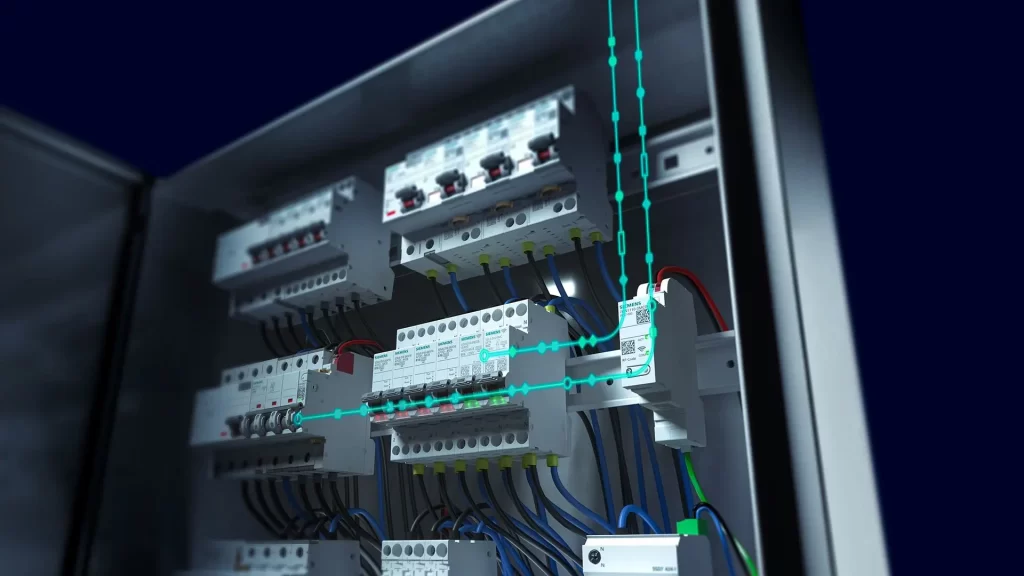
Understand what electrical safety is, the main protection measures involved, the most common installation mistakes, and why proper design, grounding, and maintenance are essential.
Check it out!
Electrical safety is the set of principles and measures that, throughout the life cycle of an installation (design, execution, operation, and maintenance), prevent and control electrical risks.
In this article, we present the basic principles, essential protection measures, good design and installation practices, common mistakes to avoid, and guidance for inspection and maintenance over time.
Take a look!
[elementor-template id=”24446″]
What Is Electrical Safety (and Why Does It Matter)?
Electrical safety is the application, throughout the life cycle of an installation (design, execution, operation, and maintenance), of principles and measures that keep the risks of electric shock, arc flash, thermal effects/fire, overcurrents, and overvoltages/electromagnetic disturbances under control.
In practice, this means preventing access to live parts and ensuring that exposed conductive parts do not become dangerous even in fault conditions (basic and supplementary protection), limiting heating and arcing, coordinating devices against overloads and short circuits, addressing switching and atmospheric overvoltages with surge protection measures (SPM), providing emergency shutdown, lockout, and signage, and documenting inspections, testing, and maintenance.
Electrical safety is essential to:
- Protect lives and assets by reducing electric shocks, arc events, and fires;
- Ensure service continuity and operational availability;
- Minimize financial losses caused by unplanned downtime, rework, and equipment damage;
- Improve power quality and electromagnetic compatibility for sensitive loads;
- Support safe operation and maintenance through isolation, lockout, and continuous verification.
Main Foundations of Electrical Safety
Electrical safety consists of a set of principles and measures that reinforce one another, guiding everything from design to maintenance.
Protection Against Electric Shock
Protection against electric shock concerns the set of measures intended to limit the current that may pass through the body and the touch voltage to safe values.
This discipline can be divided into basic protection (preventing contact with live parts under normal conditions) and protection in fault conditions (ensuring that, if a fault occurs, the supply is automatically disconnected within proper times and exposed conductive parts do not present a hazard).
In general terms, this involves the use of enclosures and barriers, the definition of insulation distances and protection ratings compatible with the environment, a circuit architecture that reduces the probability and consequences of faults, the creation of a potential reference through grounding and equipotential bonding, and coordination between protective devices for fast and selective operation.
In practice, risk control combines prevention and limitation of effects.
The selection of materials and proper conductor routing mitigate damage resulting from faults, while emergency controls, lockout procedures, and signage make safe intervention possible.
Effectiveness depends on systematic verification through visual inspections, continuity and polarity tests, loop impedance measurements, and functional testing of electrical protection devices, in addition to planned maintenance and operation by qualified personnel to maintain consistent performance throughout the installation’s service life.
Protection Against Thermal Effects and Fire
Protection against thermal effects covers the set of engineering measures aimed at preventing ignition and limiting fire spread caused by resistive heating, arcing, and overheating in equipment, conductors, and connections.
It starts with the proper sizing of current-carrying capacity with adequate correction factors, verification of thermal and electrodynamic withstand under short-circuit conditions, and coordination of protective devices to reduce let-through energy and operating times, so heating is contained before it becomes critical.
In installation practice, this translates into selecting and assembling components with thermal characteristics compatible with the environment, routing and segregating circuits to mitigate heat buildup, ensuring proper ventilation and heat dissipation in panels and enclosures, controlling accessible surface temperatures, and minimizing contact-resistance points through properly specified and tightened terminals, splices, and connectors.
In addition, it involves the use of materials and arrangements that do not favor flame propagation, sealing penetrations and compartmentalization to preserve the integrity of routes and critical areas, as well as clearly identifying circuits and sources so interventions can be safe and fast.
Effectiveness depends on systematic verification and maintenance, including visual inspections, functional testing of protections, assessments of heating during operation, and preventive corrections on connections and components subject to thermal aging. The goal is to maintain sufficient thermal margins and effective physical barriers throughout the life cycle so that electrical faults do not develop into incipient fire or compromise the safety of people, assets, and operational continuity.
Protection Against Overcurrents
Protection against overcurrents deals with the sizing, selection, and coordination of devices capable of limiting and interrupting currents above normal operating conditions, whether due to sustained overload or short circuit, protecting conductors, connections, equipment, and service continuity itself.
Design begins with defining design currents and circuit current-carrying capacity, moves on to choosing thermal-magnetic or electronic circuit breakers and current-limiting fuses with compatible curves and settings, and verifies that the prospective short-circuit current at the installation point is below the interrupting capacity of the device and the upstream combination.
Coordination ensures fast enough operation to respect the thermal and electrodynamic withstand of conductors (let-through energy), without sacrificing selectivity between stages, so only the affected section is disconnected.
In applications with high fault currents or continuity requirements, solutions such as time/energy selectivity and backup (cascading) are used, in which an upstream current-limiting device reduces the stress on the downstream device and increases its associated capacity.
The particular characteristics of motor starting, transformer energization, and inrush currents are considered to avoid unwanted tripping, as are short-circuit contributions from different sources and the initial asymmetric behavior (peak and DC component).
Verification includes the study of maximum and minimum short circuits, fault loop impedance, permissible voltage drop, and compatibility between trip curves, documenting single-line diagrams, prospective currents, interrupting capacities, and selectivity tables. In operation, functional inspections, trip-history analysis, retightening, and periodic thermal assessments keep the protection aligned with expected performance throughout the installation’s service life.
Protection Against Lightning
Protection against lightning is the set of engineering measures intended to reduce the risks arising from direct strikes and the electromagnetic effects of lightning on people, structures, and systems.
It covers the controlled interception, conduction, and dissipation of lightning current through external arrangements that intercept the discharge, carry it through defined paths to the grounding system, and limit potential gradients, preventing side flashing by means of adequate separation distances and intentional bonding of metallic parts.
Internally, it integrates surge protection measures that address the electromagnetic field generated by lightning inside the structure: main and local equipotential bonding, staged coordination of surge protective devices, cable organization and routing, shielding, and the protection-zone approach, in order to reduce touch and step voltages and the exposure of electronic equipment.
The interface with power, telecommunications, data, antenna, photovoltaic, and other service networks is handled through equipotential connections and suitable devices at the point of entry, preserving service continuity and the electromagnetic compatibility of the whole system.
The design starts from a risk assessment and the required performance level, considers the geometry and materials of the structure, external influences, and preferred current paths, and is integrated with the grounding system to establish a consistent potential reference.
Effectiveness depends on coordination with internal overvoltage protections, clear technical documentation, and an inspection and maintenance plan that ensures the mechanical and electrical integrity of the subsystems throughout their service life.
Protection Against Overvoltages and Disturbances
Protection against overvoltages and disturbances comprises the systematic treatment of temporary (TOV) and transient overvoltages, originating from switching, grid faults, coupling from the electromagnetic field of lightning (LEMP), and internal commutation, as well as the management of the electromagnetic compatibility of the installation as a whole.
The goal is to limit the amplitude and energy that reach equipment, maintain stable potential references, and preserve system immunity, reducing nuisance tripping, insulation degradation, and latent failures.
The approach integrates surge protection measures such as main and local equipotential bonding, low-impedance interconnections, and defined return paths, staged coordination of surge protective devices (SPD) from the service entrance to points close to sensitive loads, and protection-zone organization that sectors the environment and grades exposure and immunity levels.
These strategies are complemented by cable routing and segregation, minimization of loops and SPD connection lengths, shielding and screen grounding with proper termination, and isolating interfaces where galvanic continuity of circuits creates risks (for example, fiber optics, isolated couplings, and line filters).
Design considers equipment withstand parameters, protection distances, expected surge energy, the grounding topology, and the presence of internal sources that generate disturbances (inductive loads, motor starts, electronic converters).
Effectiveness depends on coordination between protection stages and switching and overcurrent devices, the quality of equipotential connections, and the physical positioning of mitigation elements, in addition to periodic verification and maintenance – inspection of SPD end-of-life indicators, continuity of connections, retightening, measurements, and record updates – to ensure consistent performance throughout service life.
Isolation and Control / Emergency Shutdown
Isolation and control cover the ability to isolate parts of the installation for safe intervention, switch circuits under load when necessary, and rapidly remove power in abnormal situations without introducing new hazards.
The design distinguishes functions: electrical isolation (disconnecting in the absence of current, with unambiguous open indication and the possibility of mechanical locking), functional switching (load switching with appropriate breaking capacity), and emergency shutdown (a single, immediate, accessible action that reduces risk to people and assets).
Devices intended for isolation must provide visible opening or positive separation indication, means for locking in the open position, and LOTO resources; devices intended for switching must have appropriate interrupting capacity, coordination with protections, and resistance to electrodynamic stresses.
The EPO or emergency stop must be clearly identified, unobstructed, close to risk zones, and designed to prevent unexpected re-energization, preserving essential safety services when applicable (for example, emergency lighting) and following fail-safe logic with intentional reset.
Engineering defines the control architecture (local and remote), mechanical and electrical interlocks to prevent enclosure opening under load, automatic reclosing inhibition after faults, and clear signaling of states and sources.
External influences and enclosure ratings are considered to ensure accessibility and field legibility, including in harsh environments, as well as special requirements in hazardous areas. Interfaces include source transfer, zoned isolation to limit outages, and integration with supervision systems.
Safe operation requires lockout and tagging procedures, discharge of stored energy, temporary grounding when indicated, and verification of absence of voltage before intervention.
Periodic testing of controls and emergency shutdown, visual inspections, retightening, and functional tests maintain reliability throughout the life cycle, reducing response times and operational risk.
Electrical Protection Devices
There are several devices and pieces of equipment designed to detect abnormal conditions, limit energy or voltage, and interrupt circuits, keeping people, assets, and operations at safe levels.
Selection and specification must consider interrupting capacity and withstand, operating curves and selectivity between stages, the environment and external influences, as well as integration with grounding and equipotential bonding.
The main devices include:
- Circuit breakers and fuses – protection against overload and short circuit, with trip/interruption characteristics appropriate to the circuit and the fault level at the installation point.
- Protection relays and contactors – selective detection (current, voltage, ground, etc.) and switching control, including interlocking logic.
- Residual current devices (RCD) – mitigation of shocks under fault/indirect contact by detecting leakage currents to ground.
- Surge protective devices (SPD) – limitation of transient overvoltages and integration with internal surge protection measures.
- Motor protection relays/devices – overload, phase loss, locked rotor, and specific starting/service functions.
- Arc-fault detection (AFDD/arc-flash) – mitigation of ignition caused by series/parallel arcs in susceptible sections.
- Disconnect switches, lockout switches, and EPO – electrical isolation, lockout/tagout, and accessible emergency shutdown.
- Transformation/isolation and SELV/PELV – reduction of accessible voltages and functional segregation where required.
- Measurement, supervision, and interlocks – continuous monitoring, records, and prevention of unsafe switching operations.
Many market solutions integrate functions into a single assembly – for example, a circuit breaker with residual current function, a fused disconnect switch, SPD modules coupled to circuit breakers, and motor protection units with integrated thermal/electronic relay – and, in those cases, the analysis must consider aggregated performance and coordination with adjacent stages, as well as verification and maintenance requirements to preserve system effectiveness.
Key Installation Considerations
The success of an electrical installation results from disciplined execution and consistent field control, supported by standardized methods, qualified teams, material conformity, interface management, and objective acceptance and commissioning criteria.
When these factors act coherently – with traceability and independent verification – variability and improvised work are reduced, sustaining safety, availability, and performance throughout the entire service life.
Importance of Design
Safety begins at the design stage. Before any cable or breaker is installed, the design organizes the installation on paper: it defines circuit routing, protection levels, grounding and equipotential bonding, isolation and emergency shutdown, materials, and installation methods.
When this stage is ignored or replaced by jobsite improvisation, the chances of shock, overheating, recurring trips, equipment failures, and unnecessary downtime increase.
Technical Standards
Technical standards establish minimum safety requirements, performance criteria, and verification methods for design, installation, operation, and maintenance.
In Brazil, the core references are ABNT NBR 5410 (low voltage), ABNT NBR 14039 (medium voltage), and ABNT NBR 5419 (protection against lightning, including risk analysis, LPS, and surge protection measures).
Technical Responsibility and Qualified Professionals
Safety depends on decisions made by legally qualified professionals with proven competence. Design, execution, and maintenance require formal technical responsibility, in addition to adjustments, testing, and records that demonstrate compliance and performance. Unqualified intervention increases the risk of accidents, warranty loss, and contractual liabilities.
Cost Savings with Criteria (Cost x Risk)
Cost reduction is legitimate when based on engineering: standardization of materials, rational route planning, modularity, and ease of maintenance. “Saving money” through undersized conductors, removal of protective devices, elimination of equipotential bonding, or improvised connections increases the probability of failures, fires, and downtime. The reference should be the life-cycle cost, not only the lowest initial price.
Guidance for Users and Facility Managers
In residential and public-use environments, signs such as abnormal heating, a burning smell, recurring trips, loose outlets, and heavy use of adapters indicate the need for technical assessment. During storm periods, it is recommended to reduce the exposure of sensitive equipment and follow basic safety routines. Periodic reviews and planned interventions by qualified professionals keep risk at an acceptable level and preserve service continuity.
Common Mistakes That Cause Incidents (and How to Avoid Them)
- Absence of RCD in socket circuits and wet areas – use high-sensitivity RCD where indicated and test it periodically
- Poorly positioned or uncoordinated SPD – protect the service entrance and panels, minimize connection lengths, and coordinate protection levels
- Undersized conductors and overheating connections – size by current-carrying capacity/voltage drop and execute terminations with proper connectors and torque
- Insufficient interrupting capacity – match Icu/Icn to the prospective short-circuit current and, when necessary, use backup/cascading solutions
- Lack of selectivity – adjust curves so only the affected section trips, preserving service continuity
- Deficient grounding/equipotential bonding – ensure continuity and interconnection between exposed parts and services; avoid isolated “grounds” that raise touch voltages
- Enclosures/IP ratings unsuitable for the environment – select compatible IP/IK ratings and materials, maintain ventilation, and preserve firestop seals
- Inadequate segregation and routing – separate power, control, and data; reduce loops and critical lengths
- Ignoring separation distances in the LPS – avoid side flashing through proper equipotential bonding and the use of SPD at interfaces
- Lack of identification and as-built documentation – identify circuits/devices and keep diagrams and records updated
- Insufficient commissioning – perform inspections, measurements (continuity, loop impedance), and functional tests before energization
- Improvisation in use – avoid splitter plugs/branching and adapt the number of outlets and circuit capacity to actual demand
Conclusion
Electrical safety is the result of a coherent system: design criteria translated into disciplined installation, coordinated protections, effective grounding and equipotential bonding, initial verification, and periodic maintenance. When treated this way, it reduces shocks, fires, and losses, sustains service continuity, and provides cost predictability throughout the life cycle. The work of qualified professionals and the adoption of good practices turn risk into consistent performance – from first energization to day-to-day operation.
