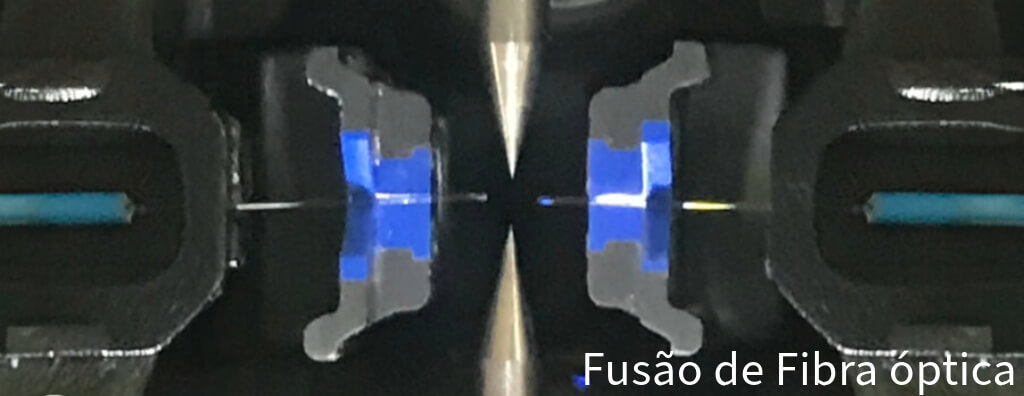
What is Fiber Optic Fusion? Fiber optic fusion is the process of permanently joining two fiber cable ends by aligning and fusing them using heat. The result is a continuous connection that minimizes signal loss and unwanted reflections, ensuring high efficiency in data transmission. In this article, we will discuss one of the most important […]
Check it out!
What is Fiber Optic Fusion?
Fiber optic fusion is the process of permanently joining two fiber cable ends by aligning and fusing them using heat.
The result is a continuous connection that minimizes signal loss and unwanted reflections, ensuring high efficiency in data transmission.
In this article, we will discuss one of the most important processes for ensuring the integrity and efficiency of fiber optic-based networks: fiber optic fusion.
This procedure is essential in high-speed, long-distance network projects and is the most effective method for joining two fiber cables with minimal signal loss.
[elementor-template id=”24446″]
When is Fusion Necessary?
Fiber optic fusion is widely used in Network Projects:
- Long-distance connections in telecommunications networks;
- Cable interconnection during field installations;
- Repairs of damaged cables;
- Creation of passive optical networks (PON) for internet service providers.
Stages of the Fiber Optic Fusion Process
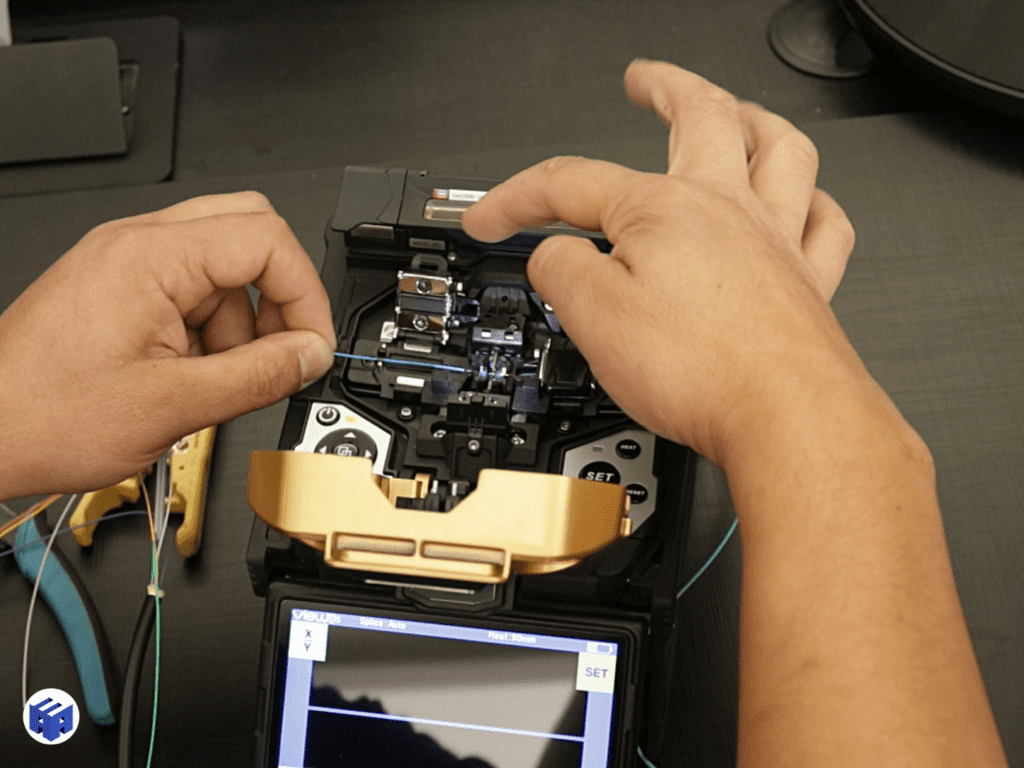
A3A Engenharia de Sistemas Archive
1. Cable Preparation
Before performing the fusion, the fibers must be properly prepared. This includes removing the protective coating and cleaning the fibers to avoid any impurities that could compromise alignment.
2. Fiber Cleaving
To ensure a perfect fusion, the fibers must be cut with precision. The cleaving process uses a specific tool to cut the fiber cleanly and straight, without cracks or imperfections. The quality of the cut directly affects signal loss in the fusion.
3. Fiber Alignment
The two fiber ends are precisely aligned in a fusion splicer. Alignment is performed automatically by cameras that ensure the fiber cores are perfectly adjusted, which is crucial for fusion efficiency.
4. Electric Arc Fusion
With the fibers properly aligned, the machine applies an electric arc to the fiber ends, heating them until they melt and fuse together. Electric arc fusion is the most common method, as it provides a high-quality connection with very low signal loss.
5. Splice Protection
After fusion, it is necessary to protect the area where the fibers were joined. For this, a heat-shrink protection sleeve is used which, when heated, adheres to the junction and provides mechanical strength to the splice, protecting it against tension and physical damage.
Advantages of Fiber Optic Fusion
- Low Signal Loss: Fiber fusion provides a connection with low attenuation, ensuring signal integrity over long distances.
- Lasting Connection: Once the fibers are permanently joined, the fusion point becomes highly resistant to environmental and mechanical variations.
- High Reliability: Unlike mechanical connectors, fusion is less susceptible to future problems such as disconnections or increased losses over time.
Required Equipment
To perform fiber optic fusion properly, some fundamental equipment is required:
- Fusion Splicer: Responsible for aligning and fusing the fibers with the electric arc.
- Fiber Cleaver: Used to cut the fibers with precision before fusion.
- Cleaning Tools: To ensure the fibers are free of any type of dirt.
- Splice Protection Sleeve: Protects the splice after fusion.
How is Fiber Optic Fusion Performed?
Fiber optic fusion uses an electric arc (or arc discharge) to join the fiber ends. The process is more complex than simply “fusing with heat,” as it involves a series of precisely controlled steps to minimize signal loss and ensure an efficient junction.
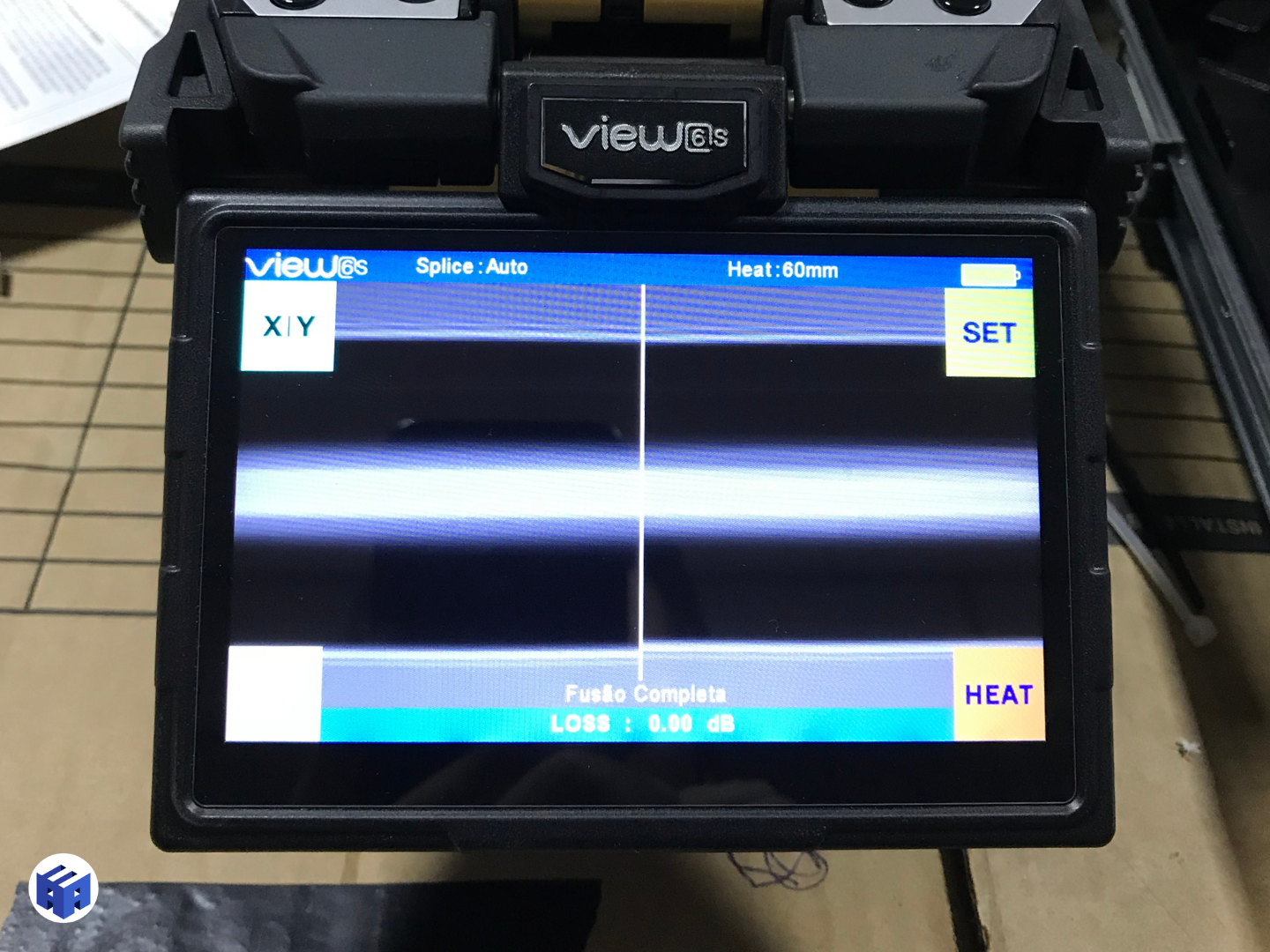
A3A Engenharia de Sistemas Archive
Technical Fusion Process:
- Alignment: The optical fibers are aligned with great precision, generally with the aid of high-resolution cameras in the fusion splicer. This alignment is crucial, as the core of a fiber is extremely thin (on the order of micrometers), and any misalignment can result in significant signal losses.
- Electric Arc Application: When the arc is activated, an electric current passes through the electrodes of the fusion splicer, generating an extremely high temperature (typically between 1,000°C and 2,000°C), sufficient to melt the fiber ends.
- Fiber Fusion: The fibers begin to melt at the ends, fusing into each other. As the process is electronically controlled, the machine adjusts the arc intensity and application time to ensure that fusion occurs without generating bubbles, imperfections, or misalignment.
- Solidification: After fusion, the fibers cool and solidify, forming a virtually perfect junction, with no visible interfaces between the two cables. This junction is highly efficient in light transmission, resulting in minimal signal loss.
Why is the Electric Arc Used?
The electric arc is ideal for fiber optic fusion due to its ability to generate intense heat in a very small area in a controlled manner. This is essential to ensure that the fiber ends melt without burning or damaging the surrounding material. The process is extremely precise and controlled, ensuring that the fusion point is homogeneous, without defects that compromise the integrity of the connection.
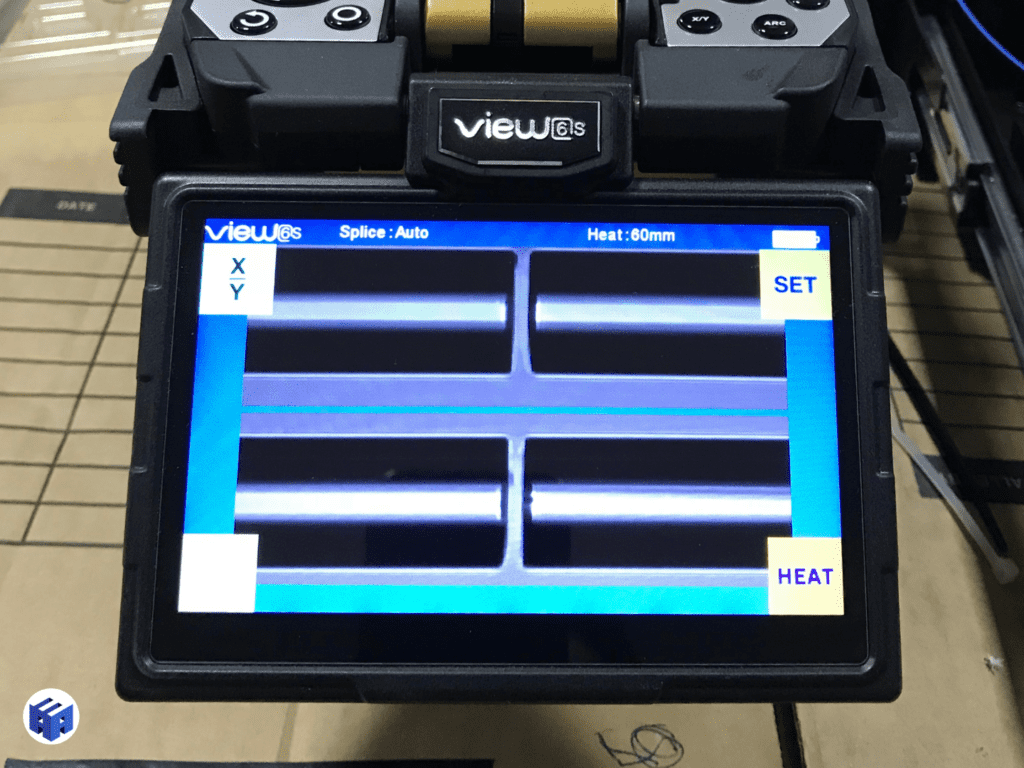
A3A Engenharia de Sistemas Archive
Advantages of Electric Arc Fusion
- Low Insertion Loss: Since the fusion is nearly perfect, light passes through the junction with minimal loss.
- High Mechanical Strength: The fusion forms a solid and durable connection.
- Low Return Loss: Signal reflection at the junction is very low, which is essential for high-speed networks.
Importance of Fiber Optics in Network Projects:
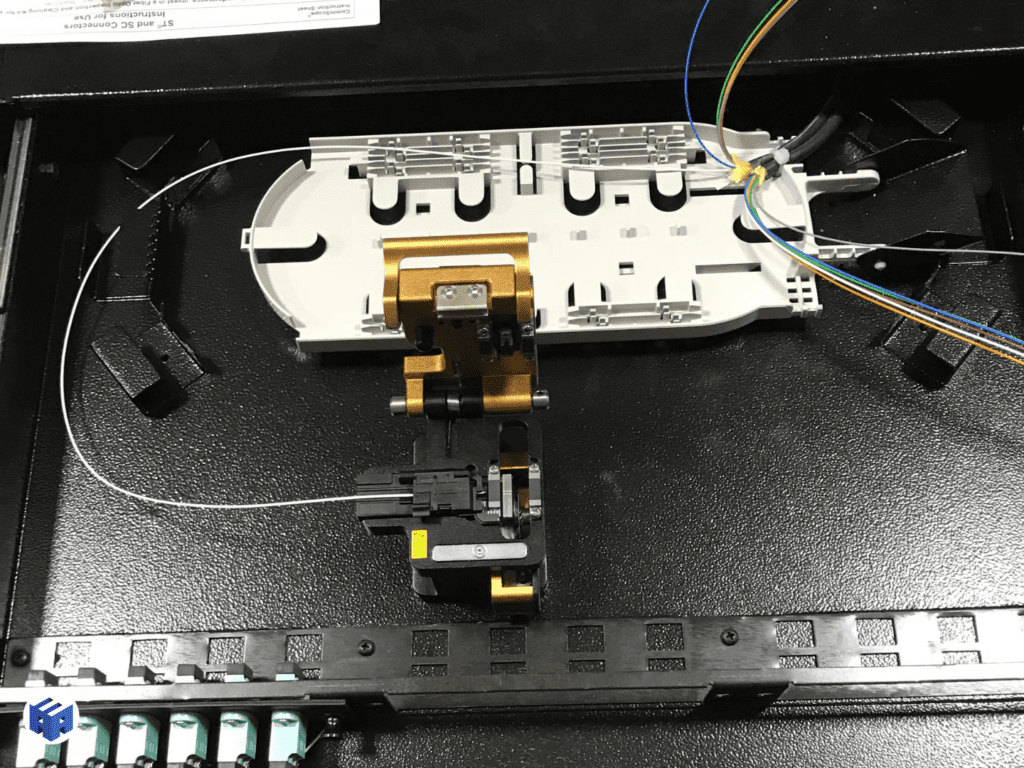
A3A Engenharia de Sistemas Archive
In structured cabling projects, fiber optics plays a fundamental role due to its ability to transmit data over long distances with minimal signal loss. With the growing demand for high-speed networks, especially in data centers and corporate environments requiring high transfer rates, fiber optics becomes a natural choice.
Main advantages of fiber optics:
- High Bandwidth: Capable of supporting enormous amounts of data, fiber optics is essential in networks that require scalability and future expansion capacity.
- Stability and Reliability: Fiber optic fusion, which ensures a solid physical connection between cables, minimizes problems related to data loss and disconnections, offering a long-term solution for critical infrastructures.
- Security: Fiber optics offers more security than copper cables, being much harder to intercept or breach, which is vital for protecting the integrity of data in transit.
Network Topology using Fiber Optics:
Fiber optics plays a fundamental role in building Networks, especially in interconnecting buildings within a Campus or in industrial environments.
Let us highlight two of the main topologies used in Network projects:
Star Topology
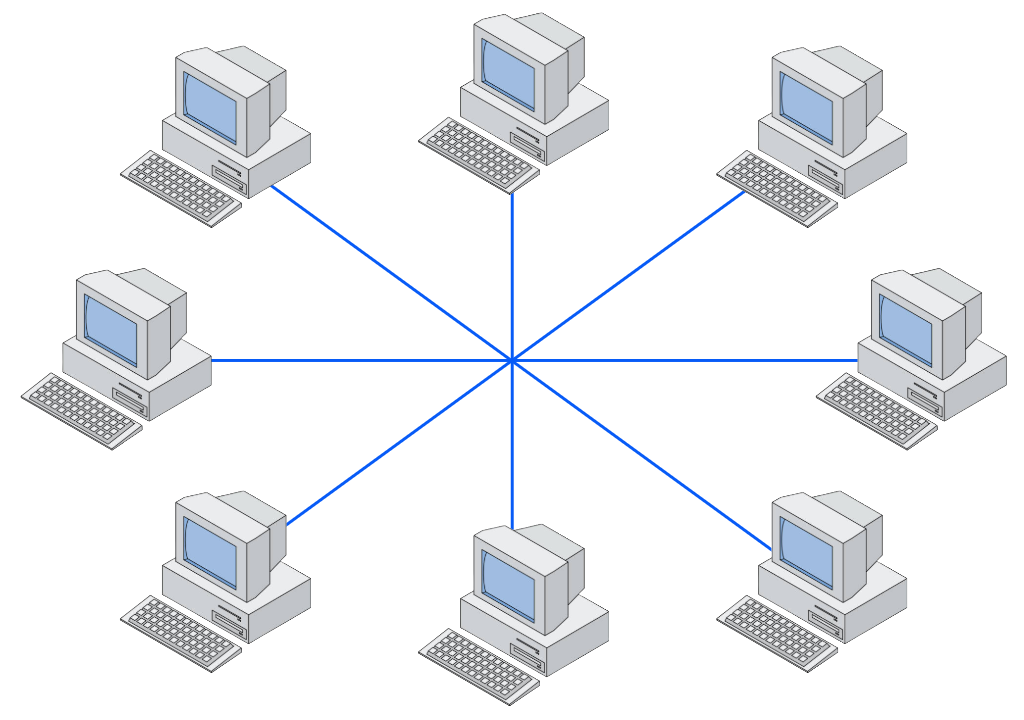
In star topology, all network devices are connected to a central point, typically a central rack with the network core switch.
Fiber optics is widely used to connect this central point to other devices and other buildings in large facilities, such as Data Centers or corporate campuses. The transmission capacity of fiber optics allows the central point to handle large volumes of data without bottlenecks.
Advantage: Fiber optics offers high bandwidth and can connect long distances between the central point and remote devices, ideal for environments that require data distribution with low signal loss and high capacity.
Ring Topology
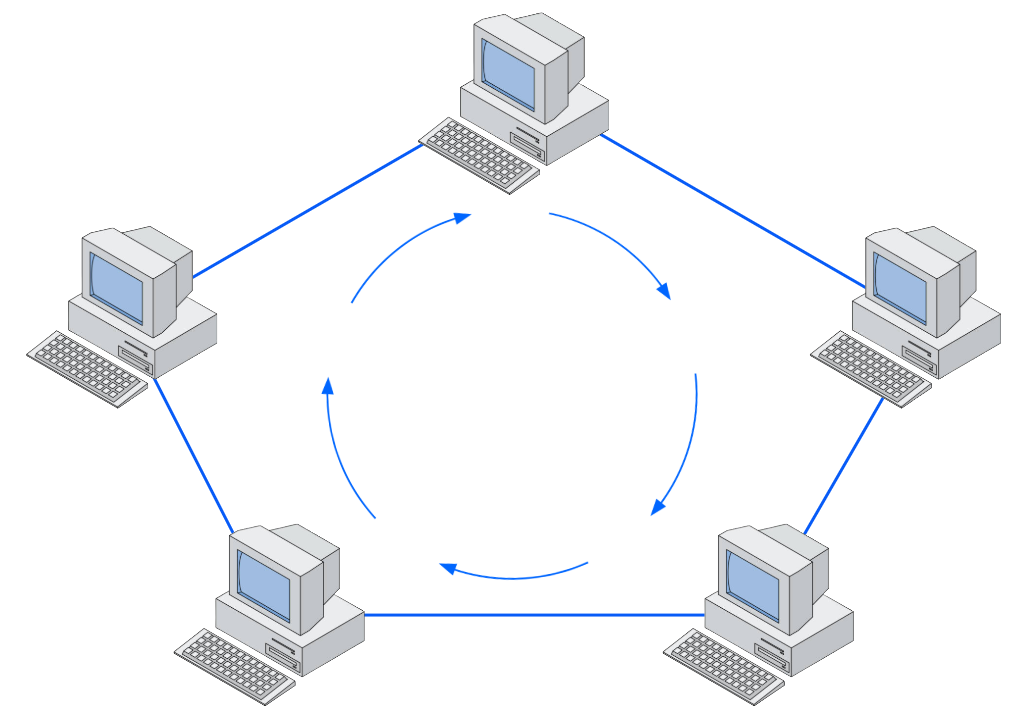
In ring topology, devices are connected in a closed circle, and data circulates in one direction (or both, in redundant rings).
Metropolitan area networks (MANs) and passive optical networks (PONs) frequently use fiber optics in a ring topology. Fiber optic fusion is crucial here to maintain a continuous and efficient connection, ensuring that no signal loss occurs at critical points.
- Advantage: Fiber optics allows data to travel long distances in the ring with minimal attenuation and low latency, being highly resistant to failures when combined with redundancy.
Standards Related to Fiber Optic Fusion
The standards that regulate the process of installing and maintaining fiber optics:
- ANSI/TIA-568: Defines cabling standards for telecommunications, including fiber fusion.
- ISO/IEC 11801: International standard that establishes requirements for data network cabling, including fiber optics.
- ABNT NBR 14565: Brazilian standard that specifies requirements for telecommunications cabling systems.
Network Project Consulting and Fiber Optic Fusion Services
Performing fiber optic fusions efficiently requires specialized knowledge and adequate equipment.
A3A Engenharia de Sistemas offers consulting and structured cabling project services including fiber fusion, as well as preventive and corrective maintenance, topology adaptation, and fiber backbone recovery.

Normative References
“NBR 14565 – Structured Cabling for Commercial Buildings” – ABNT (Associação Brasileira de Normas Técnicas)
“ISO/IEC 11801 – Generic Cabling for Customer Premises“- ISO/IEC (International Organization for Standardization) & (International Electrotechnical Comission)
“”ANSI/TIA 568 – Generic Telecommunications Cabling for Customer Premises” – ANSI/TIA (American National Standards Institute) & (Telecommunications Industry Association)
“What are the structured cabling services and their respective Technical Responsibilities?” – CREA (Conselho Regional de Engenharia e Agronomia)
“Structured Cabling Systems: the Fact File” – CommScope
Frequently Asked Questions
The Structured Cabling System (SCS) is a standardized infrastructure of cables, connectors, racks, cable trays, patch panels, and network active equipment that provides the foundation for a telecommunications network to operate optimally.
A Structured Cabling System works through the installation of various network components, including cables, network active equipment, patch panels, and other devices, following technical standards and norms.
A cabling structure is a generic system, organized in interconnected subsystems, composed of cables, connectors, and devices, designed to support multiple services such as voice, data, video, and building automation, in a standardized, flexible, and application-independent manner, enabling modifications and expansions without major interventions to the physical infrastructure.
The structured cabling system is designed to meet connectivity needs in corporate, commercial, industrial, and residential environments, providing a reliable, high-performance network.
The most common are UTP cable (unshielded twisted pair), STP cable (shielded twisted pair), coaxial cable, and fiber optic. Each has different applications and transmission capabilities.
UTP (Unshielded Twisted Pair) has no shielding. It is cheaper and used in environments with low levels of interference. STP (Shielded Twisted Pair) has shielding that reduces electromagnetic interference, making it suitable for industrial environments or areas with high electromagnetic pollution.
The main standards are ABNT NBR 14565 (Brazil), ISO/IEC 11801 (international), ANSI/TIA-568 (North America), and NBR 16264 for Data Centers. They define installation, performance, and testing rules.
Horizontal cabling connects telecommunications outlets to distribution rooms on the same floor, while vertical cabling, or backbone, interconnects different floors or buildings, transporting data between main and floor distributors.
It is the main cabling that connects telecommunications rooms, data centers, or buildings to each other. It typically uses higher-capacity cables, such as fiber optics or higher-category copper cables.
Electrical engineers, network engineers, telecommunications technicians, network infrastructure designers, and companies specialized in corporate network design and deployment.
Relevant Links (Complementary Technical Materials)
All about Design
Complete Guide to Structured Cabling
Structured Cabling Design – Complete Guide
eBook – Why hire a Structured Cabling Design?
Structured Cabling Technical Standards
Infrastructure and Subsystems
Network Certification for Structured Cabling Systems
Consulting in Structured Cabling Projects
Structured Cabling Installation
How to avoid common problems in Structured Cabling Systems?
Key Benefits of Structured Cabling
Cable Types and Categories