
Understand how availability, stability, and scalability define a well-designed structured cabling system for present and future network demands.
Check it out!
Structured cabling is the fundamental component of a network infrastructure, connecting devices and systems and transmitting data quickly and reliably. When designed and implemented by a specialised engineering company, a structured cabling system provides availability, stability, and scalability, ensuring that the network meets the company’s present and future needs with high performance and security.
In this article, we will explore these three fundamental characteristics and how they contribute to the excellence of a well-designed structured cabling system.
[elementor-template id=”24446″]
Availability: Ensuring Connectivity
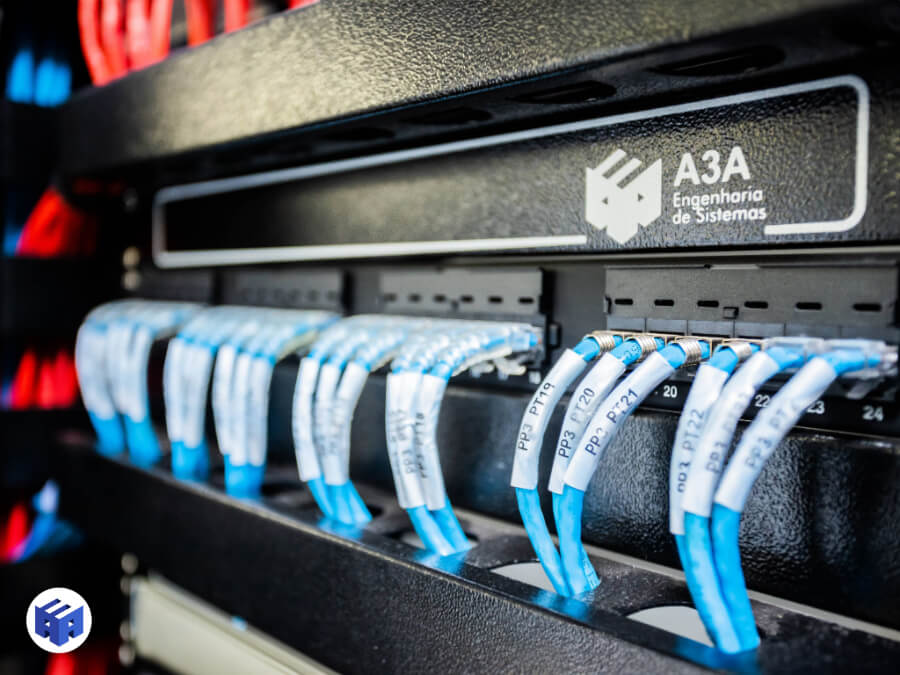
Collection: A3A Engenharia de Sistemas
The availability of a structured cabling network refers to its ability to remain operational and accessible at all times, with minimal interruptions. In corporate environments, continuous connectivity is vital to maintaining productivity, the performance of critical systems, and efficient communication between devices and users.
Redundancy for High Availability
A network well designed by a specialised engineering company includes redundancy mechanisms that ensure that, even if part of the infrastructure fails, the network continues operating normally. This can be achieved through the installation of redundant cable routes, ring topologies, or mesh layouts that provide multiple paths for data communication.
- Practical example: In corporate environments where network availability is critical, such as data centres or financial environments, implementing redundant paths ensures that the network remains accessible even if one segment fails.
Monitoring and Proactive Maintenance
In addition to redundancy, preventive maintenance and constant monitoring of structured cabling are essential to ensure high network availability. Early detection of potential failures and replacement of degraded components before they cause interruptions keep the system continuously available.
- Preventive maintenance: Engineering companies specialising in structured cabling carry out periodic audits of the cabling infrastructure, testing cable continuity and integrity to ensure the system is functioning correctly, while issuing technical reports and maintenance records.
Stability: Reliability in Data Transmission
The stability of a structured cabling system is related to its ability to maintain stable and reliable data transmission, without signal loss or interruptions. In a stable system, information flows freely between connected devices, allowing critical operations to run without failure.
Eliminating Electromagnetic Interference
A structured cabling system that is well designed for complex environments, such as factories or large commercial centres, must mitigate the effects of electromagnetic interference (EMI) sources that may affect signal quality and cause interruptions in data transmission. To ensure stability, the use of shielded cables or optical fibre is highly recommended.
- Recommended practice: Physically separating network cables from power cables and interference sources is an essential measure to avoid stability issues. In high-risk environments, such as industrial facilities, using conduits and additional cable protection contributes to system stability.
Testing and Certification Implementation
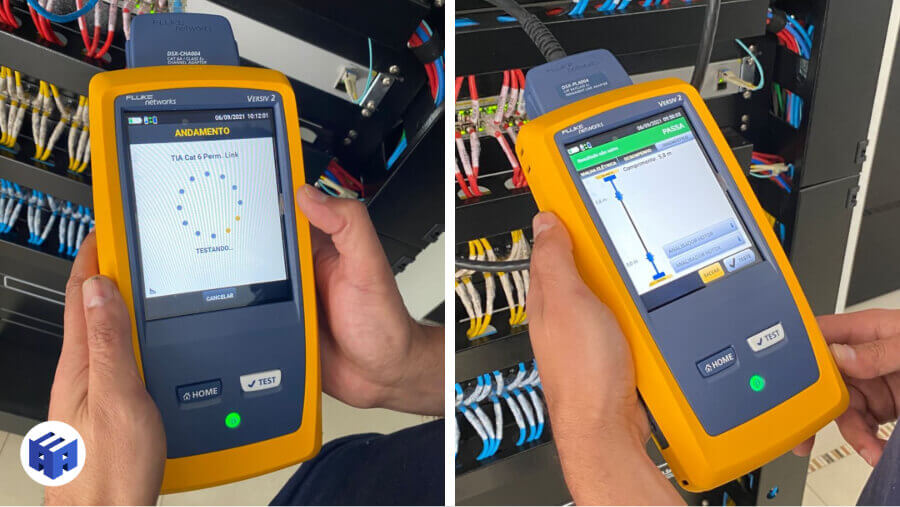
Collection: A3A Engenharia de Sistemas
To ensure the stability of structured cabling, installation certification is an indispensable practice. Using specialised equipment, engineering companies perform continuity, attenuation, crosstalk, and other tests that guarantee the system’s stability and performance over time.
- Preventive maintenance: A system certified, tested, and documented by an engineering company ensures that quality parameters have been met and that the infrastructure is prepared to support critical operations without signal interruptions or transmission failures.
Scalability: Ready for the Future
Scalability is the ability of a structured cabling system to grow and adapt to a company’s future needs, supporting new technologies, devices, and expansions without the need to restructure the existing infrastructure.
Modular Design for Easy Expansion
Scalability is ensured by a modular design for structured cabling, allowing new network points and devices to be integrated without affecting the performance of the current system. When planning scalable infrastructure, a specialised engineering company takes the organisation’s future growth into account, sizing data transmission capacity and the amount of cabling required.
- Recommended practice: Design the network with a medium-term growth margin. Specify the use of Category 6 or 6A cabling, which supports high-speed networks and large data volumes, as well as modular racks and patch panels that allow fast and efficient expansion.
Support for New Technologies
With the exponential growth of the Internet of Things (IoT), the increase in connected devices, and the growing demand for higher transmission capacity, it has become essential to implement a scalable network capable of supporting emerging technologies without requiring frequent replacements.
- Scalable solution: A scalable structured cabling system designed by a specialised engineering company ensures that the infrastructure can be upgraded to support new technologies, such as adopting optical fibre over long distances or integrating new systems, without requiring major interventions in the existing network.
Why Hire a Specialised Engineering Company?

Hiring a specialised engineering company to provide consulting, design, and implementation services for structured cabling works is essential both in terms of efficiency and medium- to long-term savings:
- Reduced operating costs: A system designed with a focus on availability, stability, and scalability avoids frequent maintenance issues and failures that could cause financial losses and operational interruptions.
- Compliance with technical standards: The engineering company ensures that the design complies with all international structured cabling standards, certifying the quality and safety of the infrastructure.
- Long-term strategic planning: A scalable structured cabling system gives the company the flexibility it needs to grow without the need for costly and time-consuming restructurings.
Conclusion
Structured cabling is essential to ensuring an efficient, reliable, and future-ready network infrastructure. By working in partnership with a specialised engineering company, it is possible to reduce acquisition costs and optimise investments without sacrificing performance, while implementing a system that will provide availability, stability, and scalability.
A3A Engenharia de Sistemas has an extensive technical portfolio of network infrastructure, electrical installations, and digital security projects.