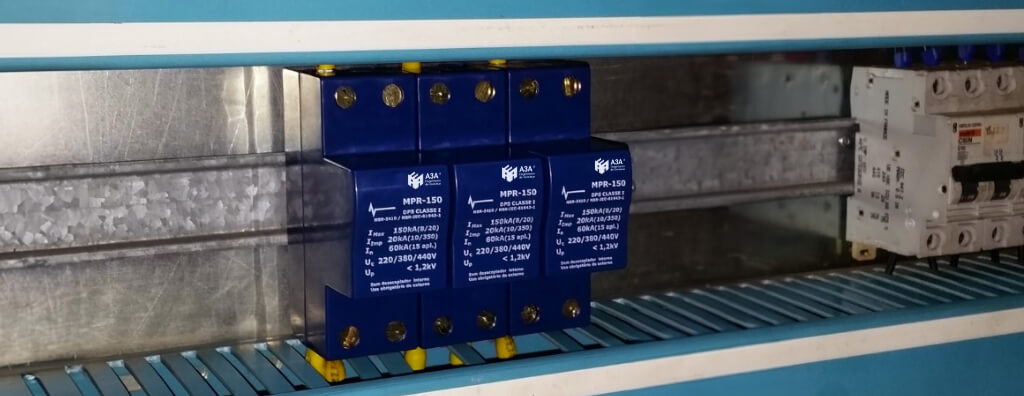
The SPD (Surge Protection Device) is an electro-electronic equipment designed to protect electrical installations and equipment against transient overvoltages, such as those caused by lightning strikes or power grid switching operations. Surge Protection Devices (SPDs) play an essential role in protecting electrical installations and equipment within a corporate or industrial environment. An electrical installation protection […]
Check it out!
The SPD (Surge Protection Device) is an electro-electronic equipment designed to protect electrical installations and equipment against transient overvoltages, such as those caused by lightning strikes or power grid switching operations.
Surge Protection Devices (SPDs) play an essential role in protecting electrical installations and equipment within a corporate or industrial environment.
An electrical installation protection project aims to divert excess energy to the grounding system, minimizing the effects of overloads within the installations and also preserving sensitive equipment so they are not exposed to voltages beyond their operating limits, maintaining their integrity and functionality.
SPD installation is essential to protect all environments that depend on continuous, uninterrupted operation, such as industries, Data Centers, commercial buildings, and corporate environments, where downtime can represent significant losses including missed deadlines and lost revenue.
[elementor-template id=”24446″]
What is an SPD and what is it used for?
The SPD (Surge Protection Device) has the function of discharging unwanted currents and voltages that exceed the limit supported by the equipment to the grounding system, when an overvoltage occurs in the power supply network or when voltages are injected into cables through electromagnetic inductions.
These overvoltages can be caused by lightning strikes, power grid switching operations, or other transient events, and without proper protection, they can reach and damage connected equipment, resulting in failures or even burnout of sensitive components.
How does an SPD work?
The protection activation mechanism of a Surge Protection Device is based on transient overvoltage detection and acts automatically to divert excess energy to the grounding system, protecting connected equipment.
The devices have internal components, such as zinc oxide varistors (MOV), silicon avalanche diodes (SAD), or spark gaps, which remain inactive under normal operating conditions, i.e., while the power grid voltage is within specified limits.
However, when an overvoltage occurs, such as those caused by lightning strikes or power grid switching operations, the voltage exceeds the SPD’s trigger threshold, activating the following mechanism:
- Overvoltage Detection: When the grid voltage exceeds the safe level for equipment, the SPD detects this overvoltage. The active component, such as the varistor, which has a very high resistance under normal conditions, undergoes a drastic reduction in resistance.
- Excessive Current Conduction: After detection, the SPD begins to conduct the excess current directly to the grounding system. At this point, the varistor or diode enters conduction mode, diverting the electrical current to ground, preventing the surge from reaching protected equipment.
- Energy Dissipation: The devices direct the excess energy from the surge to the grounding system, where it is safely dissipated. This prevents the overvoltage from traveling through electronic circuits, preventing damage to devices connected to the network.
- Return to Normal State: After the overvoltage event, when the voltage returns to normal levels, the SPD returns to its inactive state, with internal components returning to high resistance. The device “disconnects” from the network until a new overvoltage occurs.
This protection cycle occurs very quickly, in a matter of microseconds, which ensures efficient protection of equipment against sudden voltage spikes.
Depending on the SPD type, it can withstand several overvoltage events before needing replacement or maintenance.
How to protect a building against the effects of a lightning strike?
The complete protection of a building against voltage surges cannot be achieved solely with the use of SPDs. The efficiency of the protection system depends on an interdisciplinary integration between different subsystems:
- SPD and LPS (Lightning Protection System): The LPS, responsible for receiving and discharging lightning strikes to the ground, works in conjunction with the SPD. While the LPS protects the physical structure of the building, the SPD protects internal systems and electronic equipment from surges induced by lightning. Without the SPD, surges generated by the LPS during a discharge can propagate through electrical and communication systems, damaging equipment.
- SPD and Electrical Installations: The SPD must be properly integrated into the building’s electrical installations, especially in main entry and power distribution panels. The correct distribution of SPDs at protection levels within the installation, especially at entry points and critical equipment, ensures comprehensive surge protection.
- SPD and Equipotential Bonding: For the SPD to function correctly, it is essential that the grounding system and equipotential bonding are adequate. Equipotential bonding prevents potential differences between different metallic parts of the installation, minimizing the circulation of unwanted currents and improving SPD efficiency in conducting surges to ground.
- SPD and Structured Cabling: The SPD can also be applied to protect network infrastructure, acting directly on structured cabling and grounding metallic cable trays through which communication and automation networks pass. Overvoltages can be induced in network cables, resulting in data loss and component burnout. The use of SPDs specifically designed for communication systems, such as SPDs for data and network lines, ensures that cable network integrity is preserved, even during surge events.
Basic Requirements of an SPD Project:
Cascade Protection:
Cascade protection is a surge protection strategy that involves installing Surge Protection Devices (SPDs) at different points of an electrical installation, forming successive layers of protection.
The objective is to ensure that voltage surges are gradually reduced and dissipated as they advance through the different stages of the installation, providing complete protection from the main power entry to the most sensitive equipment.
Protection Levels in an SPD Project:
Cascade Protection Classes
- First Class: Class I SPD (Main Power Entry)
- Installation Location: Generally at the main power entry panel, near the connection to the electrical grid.
- Function: Dissipate large surges, such as those caused by direct or indirect lightning strikes. This SPD protects the entire installation against high-intensity overvoltages.
In NBR 5410 (Low Voltage Electrical Installations), the terms upstream and downstream refer to the installation position of the SPD (Surge Protection Device) in relation to other protection devices, such as circuit breakers and fuses, in the electrical circuit.
Upstream SPD
When to use: Upstream SPD installation is primarily used when the goal is to protect the installation against overvoltages from the external electrical grid, such as those caused by indirect lightning or switching operations in the distribution network. It is recommended to ensure global protection of the installation.
What it means: When the SPD is upstream, it is installed before other protection devices, such as circuit breakers or fuses, relative to the power source.
Application: Upstream installation is indicated when the SPD needs to protect the entire installation, including circuit breakers, from an overvoltage that may originate from the external power supply network.
This type of installation is common in locations near the building’s power entry.
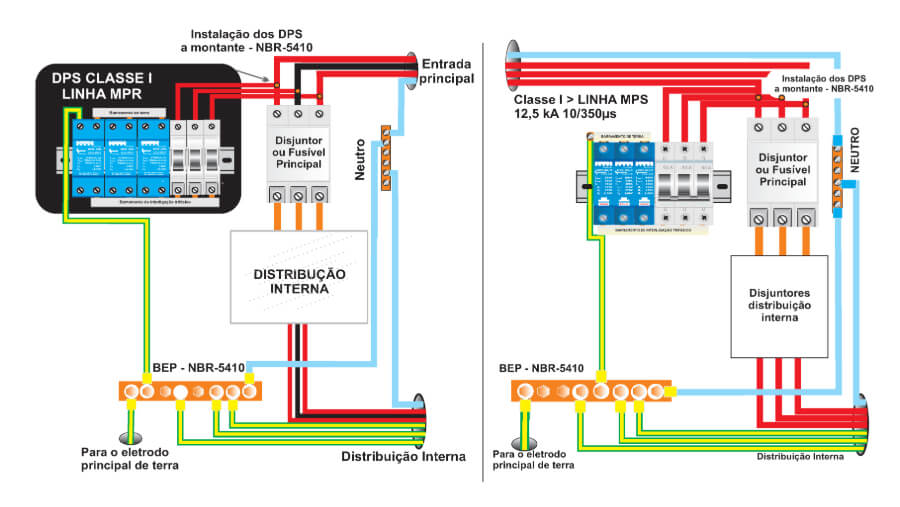
Installation of Class I SPDs, upstream of the main power entry – NBR5410
Archive: MTM Electro Electronics
Downstream SPD
- What it means: When the SPD is downstream, it is installed after the protection devices, such as circuit breakers or fuses, in the direction of electrical current flow.
- Application: Downstream installation is used to protect sensitive equipment, such as servers, automation systems, or electronic devices, against residual overvoltages that may have passed through protection devices installed upstream.
- When to use: Downstream SPD is typically used to protect specific circuits or equipment, ensuring that even the smallest overvoltages that may reach them are dissipated. This is common in secondary distribution panels or near critical equipment, providing an additional layer of protection.
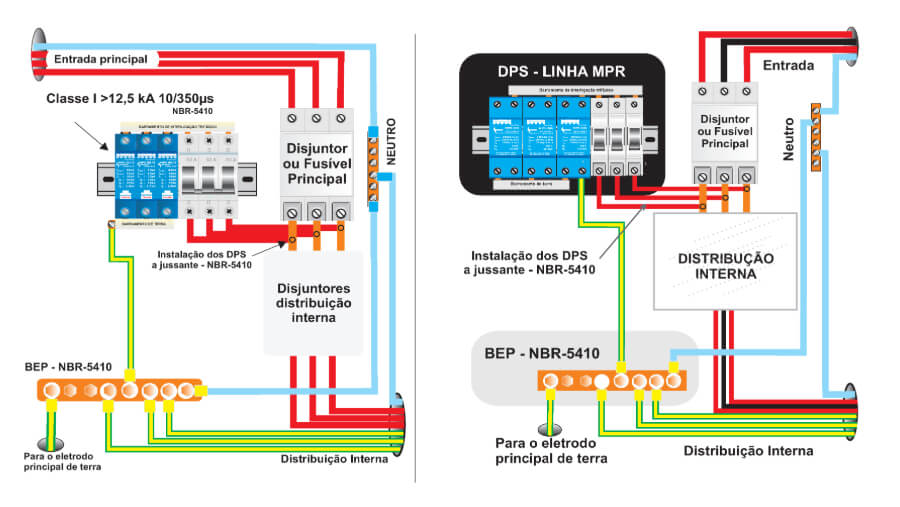
Archive: MTM Electro Electronics
- 2 – Second Class: Class II SPD (Secondary Distribution Panels)
- Installation Location: In the internal or secondary circuit distribution panels.
- Function: Reduce overvoltages that passed through the Class I SPD or that originated within the installation. This layer offers intermediate protection and ensures that voltage is maintained at acceptable levels for secondary circuits.
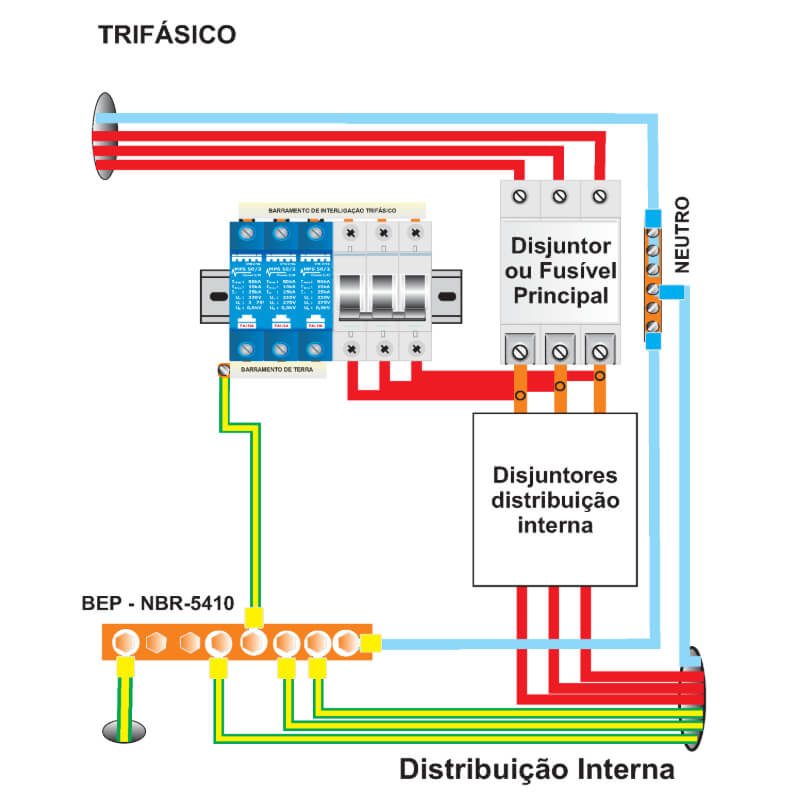
Archive: MTM Electro Electronics
- 3 – Third Class: Class III SPD (Points Near Equipment)
- Installation Location: Near sensitive electronic equipment, such as servers, computers, automation systems, etc.
- Function: Protect critical equipment against residual low-intensity surges that may still be present after the action of previous SPDs. This final layer ensures maximum protection for connected devices.
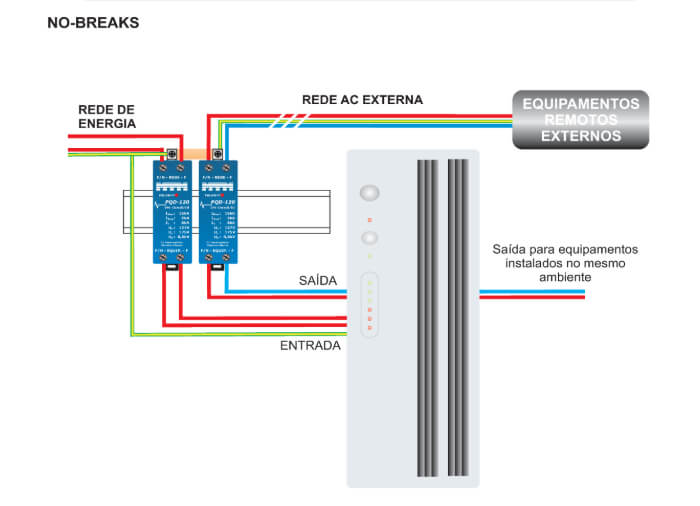
Archive: MTM Electro Electronics
1. Proper SPD Sizing
- Choose the correct SPD type (Class I, II, or III) according to the required protection level. Class I SPD is recommended for areas exposed to direct lightning strikes, while Class II SPD is suitable for protection against indirect surges, and Class III SPD is used for more precise protection at points near sensitive equipment.
- Size the maximum continuous operating voltage level (Uc) in a manner compatible with the electrical grid. This prevents accidental SPD triggering during normal grid fluctuations.
- Correctly define the surge current level (Imax) that the SPD can withstand. This value must be chosen considering the installation characteristics and the probability of intense surges.
2. Strategic SPD Positioning
- Install the devices as close as possible to the power entry of the installation (in entry panels) to protect against surges originating from the power supply network.
- Use layered protection (cascade protection), sizing and installing at different points of the electrical network, such as in distribution panels and at critical equipment outlets. Multi-layer protection helps dissipate surges progressively, minimizing the impact at each stage.
- Install SPDs specifically designed for data cables and communication networks, such as structured cabling and automation systems. These devices protect against overvoltages induced by lightning or surges in the power network.
3. Correlation with the Grounding System
- Ensure that the building’s grounding system has resistance values as low as possible and preferably low impedance as well, since low resistance at the cost of high impedance is not ideal in this scenario, as the SPD depends on grounding to dissipate excess energy.
- Verify equipotential bonding to minimize electrical potential differences within the installation. This procedure is essential to minimize current circulation within the installations and ensure the SPD has the best conditions to divert these currents directly to ground.
- Ground the SPD and LPS (Lightning Protection System), Install the equipotential bonding box with the MEB (Main Earthing Bar) and connect to ground at a single point. All SPDs in the project must be grounded at the same potential on the same LPS mesh to avoid potential differences and current circulation.
4. Proper Installation
- Minimize cable length between devices and the grounding system. The shorter the connection cable, the lower the inductance and the greater the SPD’s efficiency in diverting overvoltage.
- Ensure that the grounding conductors used to connect devices to ground have adequate cross-section to withstand surge currents.
- Perform a robust and safe installation, following manufacturer recommendations and technical standards, such as NBR 5410 (Low Voltage Electrical Installations) and NBR 5419 (Protection of Structures Against Lightning).
Considerations for SPD Projects:
An efficient electrical protection project is not limited to the installation of SPDs alone; it must be part of an integrated approach that includes:
- LPS (Lightning Protection System) with an up-to-date LPS Report;
- Well-sized grounding system with up-to-date maintenance and grounding report;
- Equipotential bonding.
To ensure that all these systems function efficiently, it is essential to hire a specialized Engineering company.
A company with expertise can develop a complete and integrated project, taking into consideration all the technical aspects necessary to mitigate risks and ensure the protection of your electrical and communication infrastructure.
Additionally, a qualified engineering company can issue technical reports and ARTs (Technical Responsibility Certificates) and specify the best SPD brands and manufacturers, ensuring that the devices used are of market-recognized quality. Choosing a reliable brand is crucial, as it ensures that SPDs adequately withstand overvoltage surges and offer lasting and efficient protection. Brands with a solid reputation, certifications, and technical recognition are essential for the safety of your systems.
Complementary Technical Article Suggestions:
- Electromagnetic Compatibility (EMC): Challenges and Solutions in Structured Cabling Projects
- LPS Project: Why hire and main stages
- Electrical Grounding: Fundamentals, Types and Importance for the Protection of Electrical Systems – Complete Guide
Final Considerations:
Surge Protection Devices (SPDs) are essential to ensure the safety and integrity of electrical and electronic systems, protecting them against transient overvoltages, such as those caused by lightning strikes or power grid switching operations.
Their correct installation, sizing, and integration with other systems, such as the LPS, equipotential bonding, and the grounding system, are fundamental to ensure that overvoltages are properly directed and dissipated, avoiding damage to critical equipment and ensuring operational continuity.
Acknowledgments
We thank you for dedicating your time to reading our article about SPDs. We hope that the information provided has been useful and has clarified the importance of surge protection for the safety of your installations.
If you need more information or wish to discuss a complete protection project, our Engineering team is available to help. Contact us.