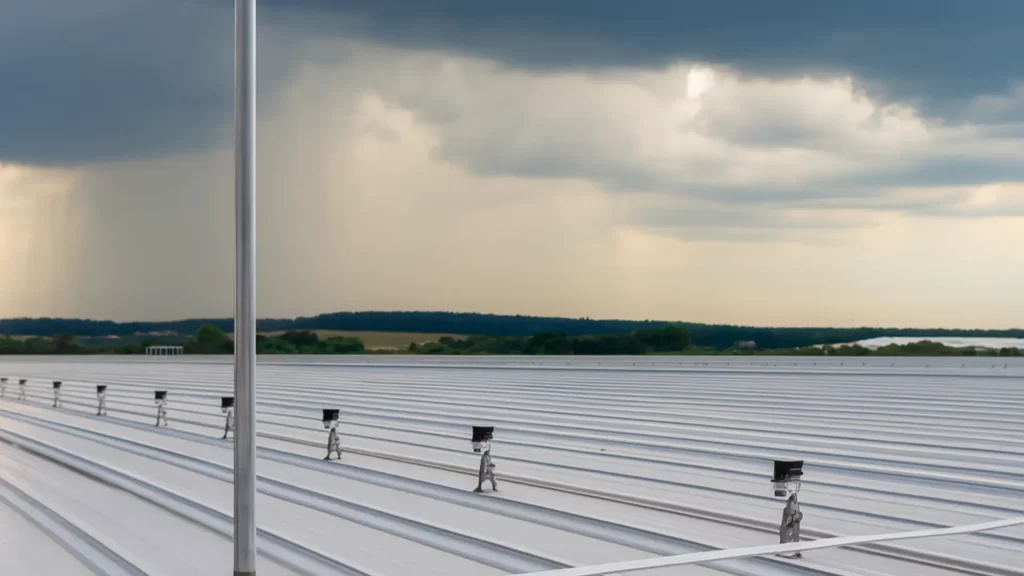
The lightning rod is a set of components installed in buildings to capture the electrical discharge of a lightning strike and safely conduct it to the ground, protecting people, structures, and equipment from damage. Brazil is the country with the highest incidence of lightning in the world, and each discharge can release millions of volts […]
Check it out!
The lightning rod is a set of components installed in buildings to capture the electrical discharge of a lightning strike and safely conduct it to the ground, protecting people, structures, and equipment from damage.
Brazil is the country with the highest incidence of lightning in the world, and each discharge can release millions of volts in fractions of a second. In this scenario, the lightning rod (or LPS – Lightning Protection System) becomes indispensable to protect buildings, people, and equipment.
But after all, do you know exactly what a lightning rod is, how it works, what types exist, and what the technical standards say?
In this article, we will clarify all these questions, show the importance of the lightning protection system, and explain when and why its installation is mandatory.
[elementor-template id=”24446″]
What is a Lightning Rod (LPS)?
Technical definition of LPS
The lightning rod, technically known as LPS (Lightning Protection System), is a set of devices designed to protect buildings, people, and equipment against the effects of atmospheric electrical discharges. The system is designed to capture the lightning and safely conduct its energy to the ground, dissipating it into the grounding system.
Historical origin of the lightning rod
The invention of the lightning rod is attributed to Benjamin Franklin in the 18th century, with the famous kite experiment in a storm. Since then, the concept has evolved, and today systems follow strict technical standards, such as ABNT NBR 5419 (in Brazil), ensuring standardized protection for different types of buildings.
Difference between terms: lightning rod and LPS
Although there are several ways to refer to it, they all designate the same concept. In the technical and normative environment, the correct term is LPS (Lightning Protection System), but in popular use, the term lightning rod is the most common.
How Does a Lightning Rod Work?
Capture of the atmospheric discharge
The system uses metal points installed on the top of the building, designed to capture the atmospheric electrical discharge.
Electrical conduction to the ground
Once captured, the current is conducted by metal cables called down conductors, which direct the energy to the grounding system.
Grounding system and equipotentialization
The electrical current is dissipated in grounding meshes or rods buried in the ground. Equipotentialization ensures that all metal parts of the building are at the same electrical potential, reducing the risk of sparks, shocks, and surges.
Types of Lightning Rods
Franklin Lightning Rod (conventional)
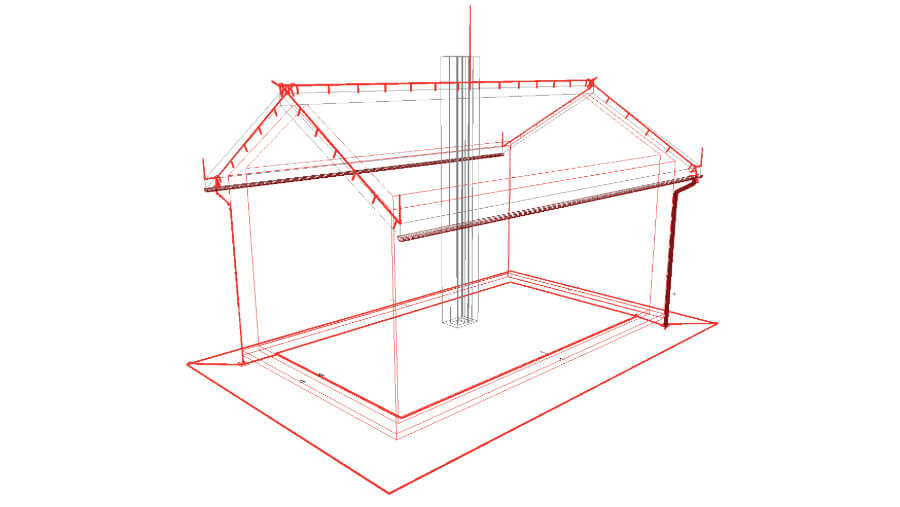
The Franklin system uses pointed metal rods connected to down cables and grounding. It is the most common in residential and commercial buildings.
Faraday Cage
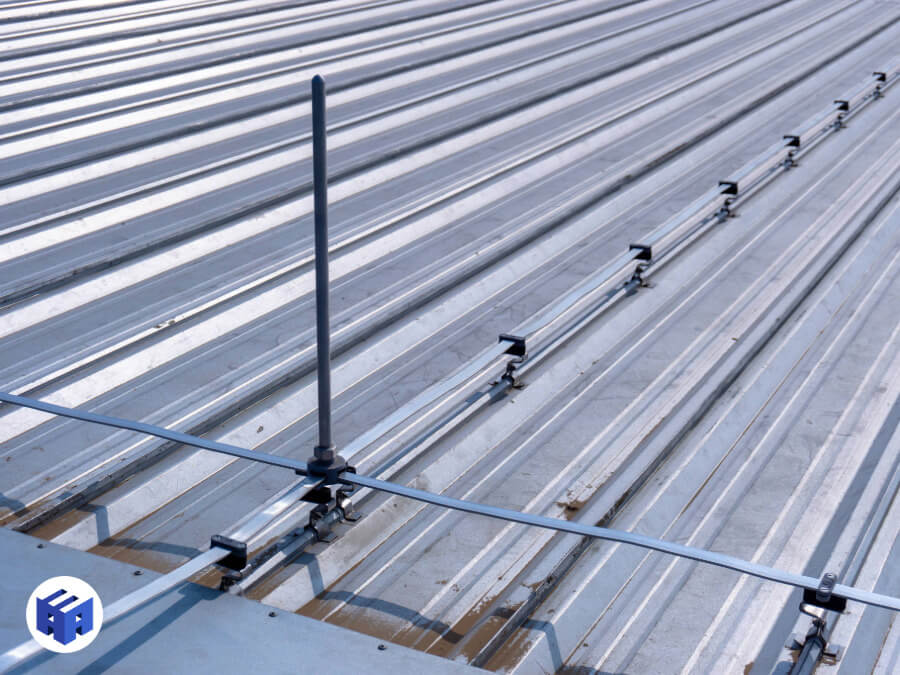
Composed of a metal mesh (cables or profile) that surrounds the building, the Faraday cage distributes electrical currents evenly. It is widely used in industries and large structures.
Early Streamer Emission (ESE) systems
The so-called active capture systems, or ESE (Early Streamer Emission), are devices that promise to anticipate the emission of ions to attract and conduct atmospheric discharges before they hit the structure.
Despite being sold in some countries, the Brazilian standard ABNT NBR 5419:2015 does not recognize or approve this type of technology in Brazil.
This means that:
- The installation of ESE does not meet the Brazilian standard;
- Projects based on ESE cannot be validated with an ART (Technical Responsibility Notation) issued by electrical engineers;
- The use of this system can compromise the building’s safety, in addition to generating legal risks and loss of insurance coverage.
Only the systems provided for in NBR 5419 — such as Franklin Lightning Rods (conventional) and Faraday cage — are accepted for LPS projects in Brazil.
Thus, although ESE is cited here for informational purposes, it is crucial to highlight that its application should not be considered in executive lightning protection projects as long as it is not approved in the Brazilian Standard.
“In Brazil, all lightning protection projects and systems must strictly follow ABNT NBR 5419. Technologies such as active capture systems (ESE) are not recognized by the Brazilian standard and therefore cannot be considered valid protection solutions. The use of unapproved methods compromises safety, prevents the issuance of an ART, and can even void insurance coverage. Only the strict application of NBR 5419 ensures technical compliance, building safety, and the legal responsibility of the professionals involved.”
— Eng. Altair Galvão, Technical Director, A3A Engenharia
Residential, commercial, and industrial applications
Each type of building requires a risk analysis. While smaller buildings can use a simple Franklin system, factories and commercial buildings demand more complex systems, requiring a risk analysis and complementary electrical protection projects with SPD (Surge Protective Devices) and potential equalization.
Standards that Regulate Lightning Rods
NBR 5419 – Lightning Protection System
This is the main Brazilian standard, divided into four parts: risk assessment, physical protection requirements, electrical protection measures, and maintenance.
Relationship between LPS and NBR 5410 (electrical installations)
NBR 5410 complements the protection, dealing with internal electrical installations. The integration between LPS and electrical installations ensures complete safety against surges and discharges.
Importance of SPDs (surge protective devices)
The SPD acts as a complement to the lightning rod, protecting electronic equipment from overvoltages induced by lightning. It is essential in environments with servers, automation, and telecommunications.
Importance of the Lightning Rod for Safety
Protection of human life
Lightning can release millions of volts in microseconds. The LPS prevents this energy from directly hitting people, drastically reducing fatal risks.
Prevention of fires and property damage
Without a proper system, the discharge can cause fires, explosions, or the destruction of the civil structure.
Protection of equipment and electronic systems
Corporate environments rely on servers, switches, and sensitive systems. The lightning rod, combined with the SPD, preserves these critical assets.
Inspection and Preventive Maintenance of Lightning Rods
Frequency of inspections according to NBR 5419
The standard mandates inspections:
- Annually for commercial and residential buildings.
- Semiannually in critical areas such as hospitals, Data Centers, and high-risk industries.
After the inspection of the lightning protection system, an LPS Technical Report must be issued, a document prepared and signed by a qualified electrical engineer, with the proper ART (Technical Responsibility Notation) registered with the CREA (Regional Council of Engineering and Agronomy). This report proves the system’s compliance with ABNT NBR 5419, records the results of grounding measurements, visual inspections, and tests performed, and establishes any recommendations for adjustments or maintenance. It is an indispensable document both for technical safety and for legal requirements, audits, and insurance coverage.
Grounding tests and mandatory measurements
The ohmic resistance test of the grounding must be within the standard’s limits. Connections, cables, and structural integrity must also be checked.
The Grounding Report is the technical document that certifies the efficiency and compliance of a building’s electrical grounding system. Prepared and signed by a qualified electrical engineer, with the respective ART registered with CREA, the report presents the results of soil ohmic resistance measurements, the integrity of the rods, busbars, and connections, as well as the compliance with current standards, such as ABNT NBR 5410 and ABNT NBR 5419 (when integrated into the LPS). This report is essential to prove that the energy from atmospheric discharges will be properly dissipated, ensuring safety for people, protection for equipment, and legal compliance in audit, certification, and insurance contract processes.
Only qualified electrical engineers registered with CREA can prepare and sign LPS reports and grounding reports, always accompanied by the respective ART (Technical Responsibility Notation). The ART is the legal instrument that links the responsible professional to the project, execution, inspection, or maintenance, ensuring technical traceability and compliance with Brazilian legislation.
Without the issuance of reports by a qualified professional, the system cannot be considered compliant with ABNT NBR 5419 (LPS) and ABNT NBR 5410 (electrical installations). In such cases, in the event of an accident caused by failures in the lightning protection system, the responsibility will fall directly on the contracting company, which may be held civilly and criminally liable.
Therefore, the issuance of technical reports by an electrical engineer, with a registered ART, is indispensable not only for the safety of buildings and people but also to legally protect the organization during audits, inspections, and possible claims.
Technical documentation and ART
Every project, installation, and inspection must be accompanied by an ART (Technical Responsibility Notation), a descriptive memorial, and a compliance report signed by a qualified engineer.
Importance of Hiring an Engineering Company for Lightning Rod (LPS) Projects
Only the electrical engineer can elaborate an LPS project
Developing an LPS (lightning rod) project requires advanced technical knowledge in electrical systems, grounding, electromagnetic compatibility, and safety standards. By legal determination, only qualified electrical engineers registered with CREA can design lightning protection systems.
Professional association and ART
Every LPS project and implementation must be linked to an ART (Technical Responsibility Notation) with the CREA – Regional Council of Engineering and Agronomy.
The ART is the document that proves who is technically responsible for the project, guarantees legal security for the client, and ensures that the work is under the supervision of a qualified professional.
Technical responsibility and safety
Hiring an engineering company guarantees:
- Project in compliance with ABNT NBR 5419 and related standards.
- Safe and certified execution, with descriptive memorial and technical drawings.
- Periodic inspection and maintenance performed with a signed technical report.
- Property and legal security — in audits, inspections, or claims, the absence of a project signed by an engineer can result in fines, interdictions, or denial of insurance.
Final Considerations
Installing a lightning rod (LPS) goes far beyond attaching metal rods to a building. It is a complex protection system that requires deep technical knowledge in electrical engineering, grounding, electromagnetic compatibility, and the strict application of the ABNT NBR 5419 standards.
Therefore, only a specialized engineering company can guarantee that the project is developed and executed correctly, safely, and in normative compliance. This specialization ensures not only protection against atmospheric discharges but also legal security, since every project requires an ART (Technical Responsibility Notation) issued by an electrical engineer registered with CREA.
Conclusion
The lightning rod (LPS) is an essential element for the protection of buildings, people, and equipment in a country with the highest incidence of lightning in the world. More than a normative requirement, it is a solution that guarantees safety, operational continuity, and property preservation.
A well-designed lightning protection system must strictly follow ABNT NBR 5419 and can only be developed and executed by qualified electrical engineers, with proven technical responsibility.
Investing in a professional LPS project means not only complying with the law but, mainly, ensuring that the building is protected against risks of fires, electrical shocks, loss of equipment, and business interruptions.
Technical Portfolio
With 29 years of experience, A3A Engenharia has built a broad technical portfolio in critical infrastructure projects, covering Low Voltage electrical installations, LPS and SPD, structured cabling, and electronic security. This track record gives the company the necessary expertise to plan and execute LPS projects with excellence and reliability.
Throughout its history, A3A Engenharia has consolidated itself as a reference in highly complex solutions, always based on:
- Normative compliance in all projects.
- Team of specialized engineers with recognized certifications.
- Technical portfolio, which guarantees efficient and innovative solutions.
- Guaranteed technical responsibility, with the issuance of an ART in all works.
A3A Engenharia has a specialized team for the elaboration of executive projects, implementation, periodic maintenance, and issuance of LPS technical reports, in compliance with ABNT NBR 5419.
Contact us to ensure normative compliance and full protection of your building against atmospheric discharges.
References
CREA (Regional Council of Engineering and Agronomy) – “CREA recommends hiring an Electrical Engineer to install an LPS“
ABNT (Brazilian Association of Technical Standards) – “NBR 5419 – Lightning Protection”
DEHN – “Lightning Protection Guide 3rd Edition”
INPE (National Institute for Space Research) – “Biennium Map”
Frequently Asked Questions
What is an LPS?
An LPS (Lightning Protection System) is an integrated system consisting of capture elements (rods, meshes, or interception devices), down conductors, grounding, and equipotentialization, designed to safely conduct lightning currents to the ground, protecting structures, people, and equipment against direct and indirect damage, as established in the ABNT NBR 5419 standard.
How many meters does a Lightning Rod protect?
The protection radius of a lightning rod is not fixed. It depends on the height of the rod, the LPS protection class defined by NBR 5419, and the sizing method adopted (rolling sphere, protection angle, or mesh).
As a practical reference, a 5-meter high rod can protect an area with a radius of approximately 20 meters around it, but this value varies depending on the building’s risk class.
Therefore, only an executive project prepared by a qualified electrical engineer can correctly define the protection zone for each case.
When is an LPS mandatory?
The requirement for an LPS is determined by the risk analysis defined in NBR 5419, considering factors such as: building height (above 30 meters), geographical location (high density of atmospheric discharges), presence of flammable materials, or critical structures (hospitals, chemical industries, data centers).
What is the difference between a Lightning Rod and an LPS?
The lightning rod refers specifically to the capture elements that intercept the atmospheric discharge. The LPS encompasses the entire system, including capture elements, down conductors, grounding, and equipotentialization measures, ensuring the safe dissipation of the lightning current.
What are the methods of lightning protection?
The methods standardized by NBR 5419 include: Franklin Method (pointed rods), Faraday Cage (peripheral conductive mesh), Protection Angle Method (definition of geometric protection zones), and Systems with ESE (Early Streamer Emission), which use ionization for early lightning interception (note that ESE is not approved by NBR 5419).
How much does an LPS service cost?
The cost of implementing a Lightning Protection System (LPS) is influenced by technical variables such as the structure’s complexity, the protection methodology selected, the specification of materials, and local conditions.