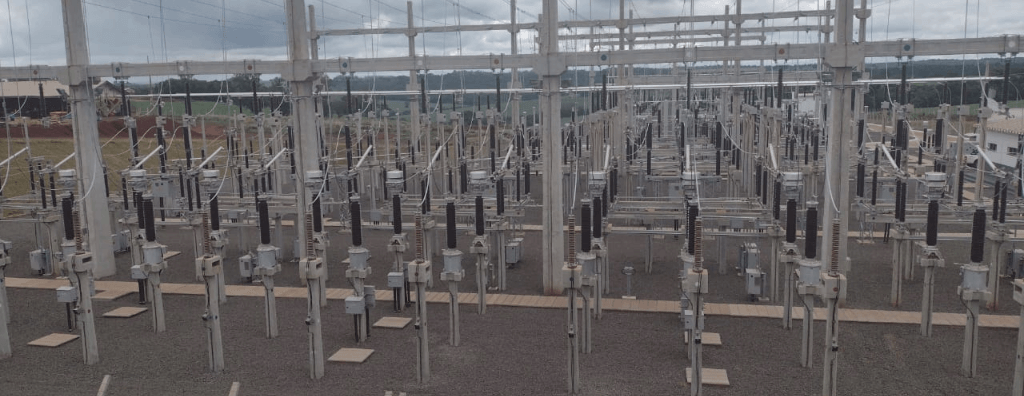
Learn the engineering challenges and practical solutions for telecommunications, surveillance, and remote assistance systems in power distribution substations.
Check it out!
Telecommunications, surveillance, and remote assistance design for electric power distribution substations.
In this article, we explore the main challenges involved in modernising power distribution substations and present technical solutions that combine reliable communications, intelligent monitoring, and secure remote operation. The approach is based on integration between telecommunications, electronic surveillance, and remote assistance systems, with a focus on real-world applications, sound engineering practices, and alignment with regulatory requirements.
[elementor-template id=”24446″]
The modernisation of distribution substations requires technical solutions that ensure secure connectivity, efficient monitoring, and remote operation with a high degree of reliability. This is an environment where availability cannot be compromised, and where the integration between telecommunications, electronic surveillance, and remote assistance must be planned from the earliest design stage.
Within the telecommunications pillar, the main challenge is to establish a robust, segmented, and redundant infrastructure that allows secure data traffic between the different functional sites. Hydroelectric plants and power distribution substations often operate in remote regions or with limited connections, which demands properly sized optical networks, suitable transceivers, industrial switches, and efficient logical configuration, with VLANs and redundancy protocols implemented in a deliberate and technically coherent way.
Challenges in Implementing Telecommunications Systems in Distribution Substations
1. Physical dispersion between operational units
Distribution substations are often located in remote or decentralised areas, with significant distance between their elements, such as the switchyard, shelters, control house, and fibre entry points. This makes it difficult to create an efficient communication mesh and requires detailed planning of the infrastructure route, including underground crossings, aerial routes, and mechanical protection.
2. Geographic and topographic barriers
The presence of rugged terrain, dense vegetation, bodies of water, or restricted-access areas imposes physical limitations on the passage of ducts, trenches, and optical cables. These barriers require engineering adaptations such as dedicated pole lines, crossings over metallic structures, or protected microducts.
3. Logistical difficulty for field deployment
Implementing telecommunications infrastructure in active substations involves strict safety restrictions, tight schedules, and the need for coordination with multiple work fronts. In addition, the transport and handling of fibre reels, splice closures, and sensitive equipment must follow strict procedures to avoid damage.
4. Lack of pre-existing civil infrastructure
Many substations do not have ducts, shafts, cable trenches, or physical space reserved for telecommunications systems, forcing the project to adopt alternative solutions such as exposed external ducts, shielded metallic conduits, or adaptations to existing cable tray infrastructure.
5. Need for operational continuity during implementation
Interventions cannot affect substation operation. This imposes the need for maintenance windows, progressive commissioning, and controlled transition between the old system and the new one. In some cases, implementation must be carried out while the system remains energised, requiring trained personnel, specialised PPE, and contingency plans.
Telecommunications System Topology and Architecture
The structuring of telecommunications systems in hydroelectric plants and distribution substations requires an architecture capable of offering reliability, scalability, and security for the various subsystems involved, such as automation, surveillance, voice, data, and remote supervision. The adopted approach follows the concept of a layered network, with distributed optical backbone and logical segmentation by service.
In most cases, the proposed topology follows the collapsed core model, which is well suited to the reality of substations, where the main concentrator, typically located in the control house or technical room, acts as the core of the network’s logical and physical distribution. From that point, redundant optical links extend to access switches distributed across the remaining sectors, such as relay shelters, switchyards, gatehouses, and outdoor areas.
Each link is composed of fibres dedicated to each function, with spare fibres foreseen and the use of dedicated SFPs, avoiding interference and facilitating fault diagnosis. The switches used are manageable and compatible with redundancy and security protocols such as STP/RSTP, SNMPv3, and MAC-based access control.
Segmentation is carried out through VLANs, isolating services according to their level of criticality and traffic volume. The automation VLAN receives the highest priority through QoS, ensuring proper response time for IEDs and protection systems. The surveillance VLAN operates with bandwidth control and event prioritisation, while the data VLAN supports administrative access and routine communication between internal devices.
To guarantee communication continuity in the event of failures, the architecture considers logical and physical redundancy. The duplication of fibre routes between key points and the use of self-healing rings ensure network resilience.
In addition to the local structure, the system provides secure external connectivity for integration with remote operation centres, whether through private corporate networks, dedicated links, or VPN connections with strong authentication and end-to-end encryption.
This architecture enables the telecommunications system to simultaneously meet operational, regulatory, and security requirements, serving as a solid foundation for the other subsystems that make up the project.
Surveillance System in Power Distribution Substations
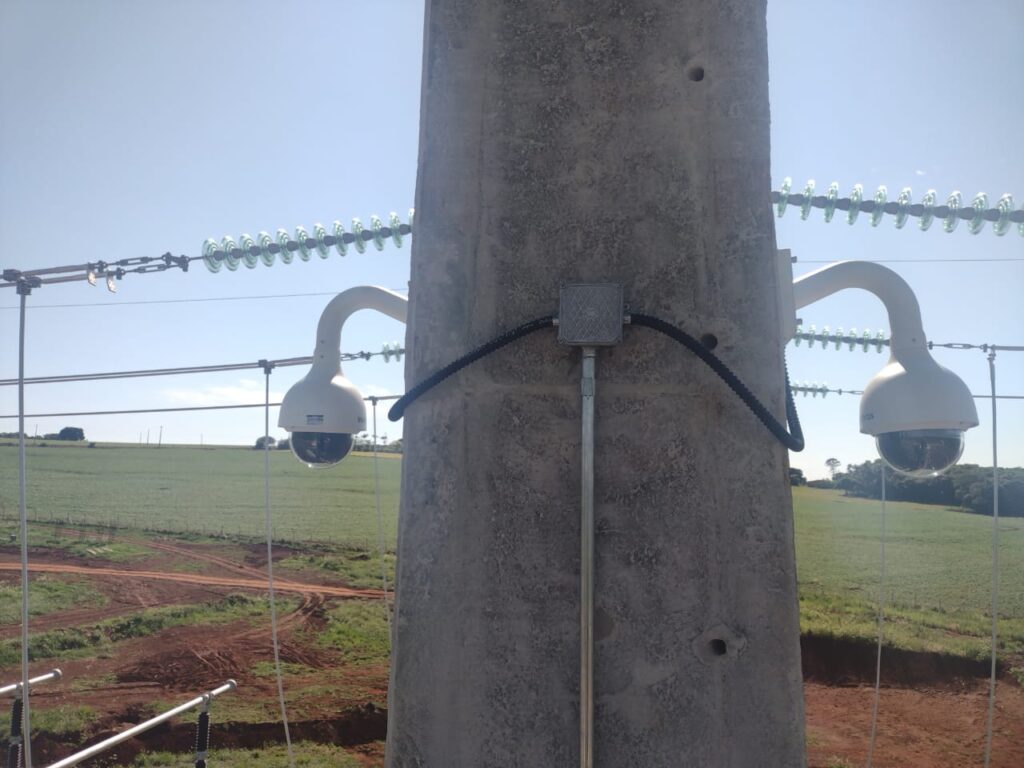
Archive – A3A Engenharia de Sistemas
Implementing an efficient surveillance system in power substations requires much more than simply installing cameras. It involves designing a solution integrated with the electrical infrastructure and the site’s environmental conditions, capable of operating autonomously, intelligently, and above all, safely.
The surveillance architecture starts from the principle that the entire perimeter and all access points must be monitored with full coverage and no blind spots, while respecting the geometry of the terrain and the existing structures. Fixed and mobile cameras are strategically positioned at elevated points, gatehouses, vehicle entrances, switchyards, and technical areas, enabling real-time event recognition and retrospective analysis through indexed recordings.
The system is composed of IP cameras with a protection degree suitable for outdoor environments, IP66 or higher, vandal resistance rated IK10, operation across a wide thermal range, and support for embedded video analytics resources, such as motion detection, line crossing, loitering in a defined area, and attempts at unauthorised access.
Choosing models with embedded intelligence reduces dependence on centralised processing and allows relevant events to be handled at the network edge, with alarm triggering, alert transmission, and automatic start of recording with pre- and post-event buffering.
The VMS (Video Management System) centralises camera operation, recording, management, and configuration. It enables remote PTZ control, synoptic map definition, access-profile creation, and integration with sensors, panic buttons, audible alarms, and access control systems.
Recording is distributed and segmented through a dedicated VLAN, ensuring proper performance even in high-traffic scenarios. In some cases, cameras with SD cards are used to maintain local recording if there is a temporary loss of connectivity.
In situations where the substation operates without on-site personnel, electronic surveillance assumes an even more strategic role. The ability to generate real-time alerts to a remote centre, trigger security protocols, and register all occurrences creates a controlled environment even at isolated sites.
Finally, integration between the surveillance system and the other subsystems, such as telecommunications and remote assistance, enhances its effectiveness, enabling faster responses, risk reduction, and increased operational availability of the installation.
Remote Assistance System in High-Criticality Environments
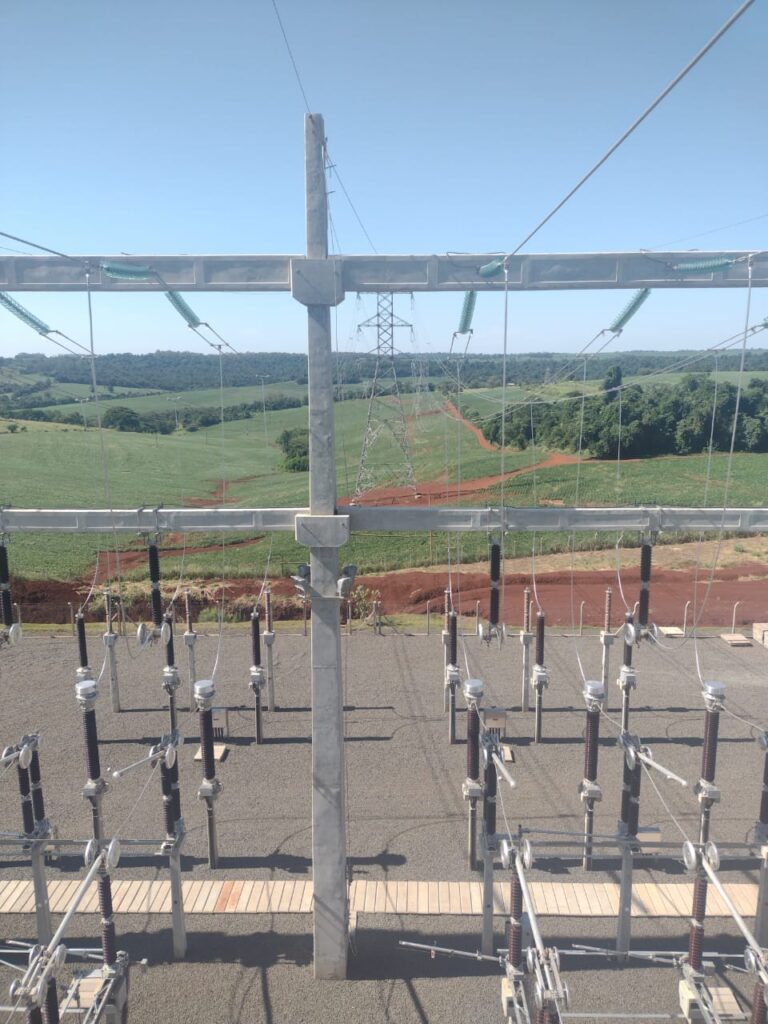
The concept of remote assistance in power substations goes beyond remote supervision by video. It encompasses technical operation, access control, event response, and remote logistical support, centralising actions that previously required local physical presence.
In projects involving multiple geographically dispersed substations or the absence of fixed local operators, remote assistance allows a control centre, usually connected to an operation centre or a technical security company, to assume responsibilities such as answering IP intercom calls, opening gates, releasing access through remote commands, and carrying out visual or technical verification after alarms.
Operation is made possible through integration between the VMS, IP cameras, presence sensors, access control systems, and automation devices. The system is structured to notify remote operators based on specific events, such as perimeter violations, out-of-hours movement, opening of technical compartments, or emergency button activation.
Each occurrence is handled according to a project-defined response logic, which may involve anything from a simple video verification to the mobilisation of field teams. The use of systems with integrated event management makes it possible to prioritise real alarms and minimise false positives, ensuring more efficient operation.
Communication between the remote operator and the visitor or local technician takes place through IP intercoms with two-way audio and associated cameras, ensuring accurate identification before releasing any access. In more advanced cases, it is possible to trigger lights, audible alarms, or interact with the automation system through SCADA or dedicated gateways.
To guarantee the effectiveness of remote assistance, the project must ensure continuous connectivity, secure communication protocols, and resilient logical architecture. In addition, the entire human-machine interface must be designed to be responsive, fast, and simple, including during contingency situations.
The implementation of remote assistance represents not only resource savings with travel and in-person surveillance, but above all an evolution in operational control, aligned with best practices for critical infrastructure security.
Monitoring of Sectionalising Switches: Operational Visibility and Electrical Safety
Sectionalising switches are essential components in the switching system of distribution substations. Their main function is to isolate circuit sections, allowing safe interventions on equipment or energised lines. However, the incorrect or unknown status of these switches may represent a risk to operation, assets, and the safety of maintenance teams.
The absence of reliable monitoring, especially in remote substations or those operated under remote supervision, makes fault diagnosis more difficult, may generate incorrect switching operations, and can compromise the re-energisation sequence of critical sections. In addition, response time to an occurrence increases considerably when there is no real-time visibility of the status of switching devices.
Monitoring sectionalising switches through cameras with video analytics integrated into image management software allows the operator, from the control centre or supervision room, to have an accurate representation of the operational status of the system: open, closed, or in transition. This reading is carried out by high-resolution cameras and AI-based video analytics directed at the switch, ensuring visual verification in critical situations.
When integrated into a remote assistance and surveillance system, switch monitoring enables coordinated action in emergency and maintenance scenarios. It also contributes to switching traceability and event auditing.
In telecommunications infrastructure modernisation projects, including monitoring of sectionalising switches is a decisive factor in raising the installation’s automation level, meeting occupational safety standards such as NR10, and improving the reliability of the electrical system as a whole.
The successful implementation of these solutions demands technical experience, integrated vision, and regulatory knowledge. A3A Engenharia de Sistemas works in both consultative and execution roles, delivering everything from preliminary studies and executive design to installation and final commissioning, with full command of the applicable requirements and a focus on results for critical operations.
Each solution is developed in a customised way, considering not only the functional scope, but also the implementation environment, infrastructure conditions, and future scalability.
A3A Engenharia has broad expertise in implementations in mission-critical infrastructure environments, such as substations, with successful cases in telecommunications projects, perimeter protection, and monitoring of sectionalising switches. (Remote assistance)
Contact our Engineering Department.