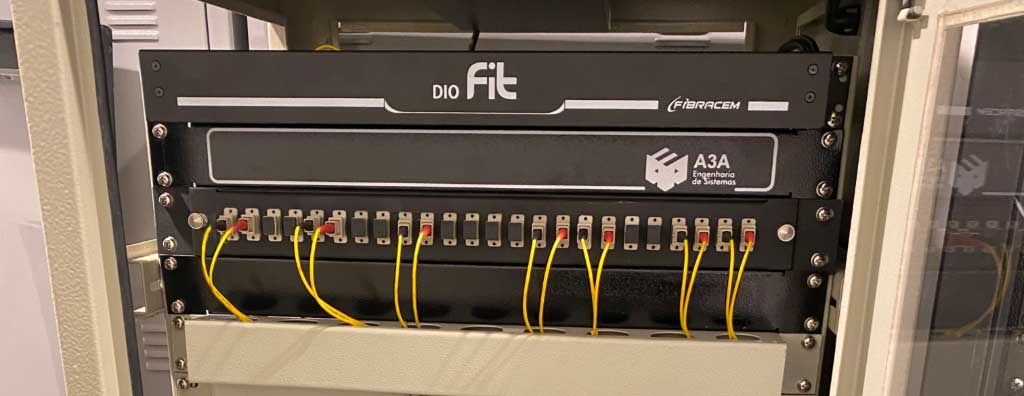
Understand what an optical distribution frame is, how it works, and which components organize, protect, and distribute fiber optic connections in telecom networks.
Check it out!
The Optical Distribution Frame is an interconnection device used in telecommunications systems and fiber optic cabling.
In this article, we discuss the importance of the ODF, highlighting its essential functions in managing optical cables in telecommunications networks.
Take a look.
[elementor-template id=”24446″]
What Is the Function of an Optical Distribution Frame?
The main function of an Optical Distribution Frame (ODF) is to ensure the integrity of optical connections, reducing the risk of breakage and minimizing external interference.
This device serves as a termination point so that fibers can be organized, protected, and distributed to different segments of the network.
These aspects are fundamental to the durability, performance, and reliability of the cabling system, especially in large-scale and highly complex projects.
In simple terms, the ODF plays the same role for fiber optics that the Patch Panel plays for twisted-pair cabling. It enables the connection between optical cabling and network equipment, providing flexibility in configuring and maintaining interconnections.
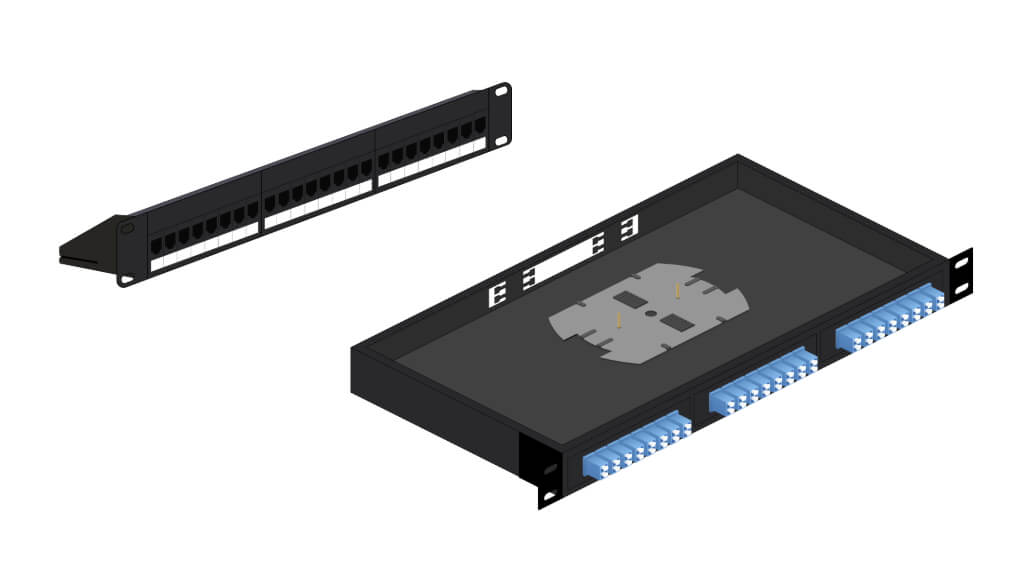
The optical distributor allows optical fibers to be routed according to the application needs of the network. It can be installed in racks or mounted directly on walls and is commonly used in telecommunications closets and equipment rooms.
How Does an Optical Distribution Frame (ODF) Work?
An ODF is generally made up of a metal or durable plastic enclosure designed to house and protect optical fibers and their components.
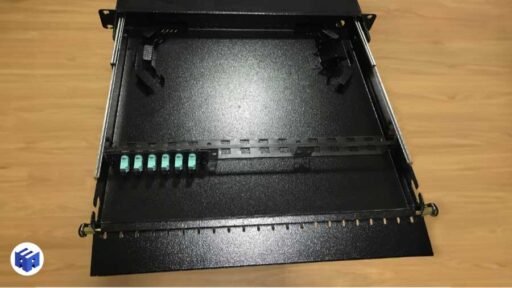
Its operation involves several crucial steps to ensure a reliable, high-performance connection.
Fiber Optic Splicing
When a fiber optic cable reaches the ODF, it goes through a preparation process that includes removing the outer protective layers and preparing the fibers for fusion splicing.
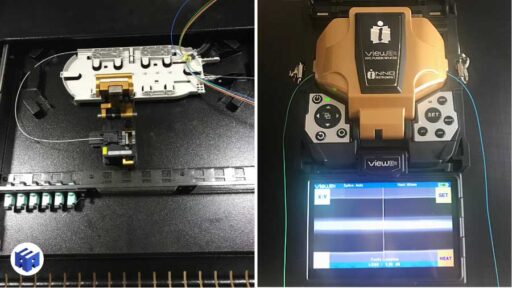
Fiber Optic Fusion Splicing is used to permanently join two ends of optical cables. This procedure is essential for connectorizing distribution panels because it significantly reduces signal loss and reflection, common problems in connections made with mechanical connectors.
Splice Accommodation
After splicing, the fibers are carefully accommodated in the splice trays inside the ODF.
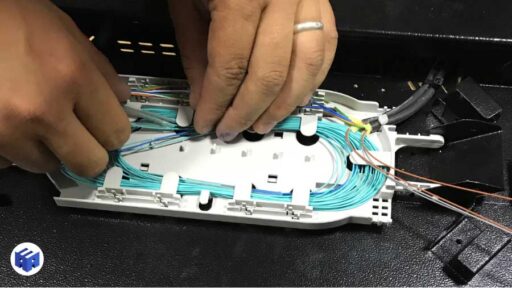
These trays organize and protect the splices, keeping them safe from physical damage and making future maintenance or network expansion easier.
Connection to Network Equipment
Once the fibers are accommodated, the next step is connection to the optical coupler. Optical couplers serve as termination points for fibers, allowing interconnection with network equipment.
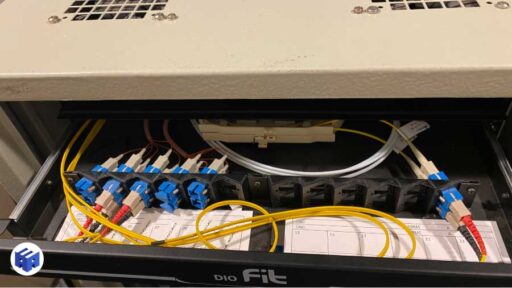
The connection to equipment can be made through transceivers or media converters.
Main Components Used in Fiber Optic Cabling
Fiber Optic Cabling integrates several essential components to ensure efficient data transmission.
Optical Pigtails
Optical pigtails are fiber optic cables with a connector on one end and an open, unconnectorized end on the other. They are used to connect optical fibers in splice boxes, trays, or distribution panels.
The open end of the pigtail is fused or spliced to the main network fiber, creating a standardized connection interface and ensuring low signal loss and greater reliability in data transmission.
Optical Patch Cords
Optical patch cords are fiber optic cables with connectors on both ends. They are used to connect the ODF to network equipment such as switches and routers. They are essential for ensuring data transmission and simplifying network maintenance.
Splice Trays
Splice trays are components used inside an ODF to accommodate and organize fiber optic splices. They protect splices against physical damage, simplify cable management, and allow maintenance or network expansion to be performed efficiently.
Optical Couplers
Optical couplers enable the connection of two optical fibers, ensuring an efficient and stable junction between different network segments. They serve as termination points for the fibers inside the ODF, making interconnection between cables and network devices easier.
Transceivers
Transceivers are devices that convert electrical signals into optical signals and vice versa. They are used in network devices such as switches and routers to transmit data over fiber optics. Although they are not internal components of an ODF, transceivers are fundamental for communication between different types of network equipment.
Media Converters
Media converters are devices used to convert optical signals into electrical or copper-based signals, enabling interoperability between different network types, such as fiber optics and copper Ethernet. They are used to connect equipment that relies on different transmission technologies, expanding the flexibility and adaptability of the network infrastructure.

Why Hire a Specialized Company for an Optical Connectivity Project?
With so many details to consider, it is essential to rely on a qualified company specialized in optical connectivity.
An optical connectivity project requires the selection of high-quality components and the expertise of trained professionals able to deal with the technical specifics of the network environment.
Only a specialized company has the knowledge required to guarantee a robust network infrastructure with low latency and high transmission capacity, ready to meet growing communication and data-transfer demands while minimizing losses and ensuring compliance with technical standards.
By investing in qualified professionals, the project benefits not only from solutions optimized for the specific environment, but also from reduced failure risks, lower long-term maintenance costs, and infrastructure that is prepared for future expansions and technological evolution. Choosing a specialized company is therefore a strategic step for any organization seeking excellence in communication and data transfer.
Final Considerations
Throughout this article, we highlighted the importance of the Optical Distribution Frame (ODF) as an essential component for the organization and management of connections in fiber optic networks.
Its role is fundamental in ensuring flexibility, ease of maintenance, and expansion of communication infrastructures, allowing networks to operate with high efficiency and reliability.
Get to Know Our Work
With more than 25 years of experience, A3A Engenharia de Sistemas is a reference in the development and implementation of Structured Cabling Projects. We work closely with our clients, offering specialized consulting to identify the specific needs of each project and develop tailored solutions that ensure the best performance and return on investment.
In addition to our services, our Online Store offers a wide variety of high-quality products and materials, such as ODFs, optical cables, pigtails, patch cords, and other essential items for your network infrastructure. All of our products are selected to ensure the efficiency and safety of your installations.
Whether for technical consulting, custom project development, or material supply, our solutions are designed to meet your needs efficiently and accurately, ensuring performance and compliance with technical standards.
Conclusion
We hope this article has clarified the importance of the optical distribution frame in the organization and efficiency of fiber networks.
For more information or specialized technical support, our team is available to assist you.
Relevant Links (Supplementary Technical Materials)
Support content:
Complete Guide to Structured Cabling
Structured Cabling Project – Complete Guide
Complementary content:
eBook – Why hire a Structured Cabling Project?
Structured Cabling Technical Standards
Structured Cabling Services:
Network Certification for Structured Cabling Systems
Consulting for Structured Cabling Projects
Normative References
“NBR 14565 – Structured Cabling for Commercial Buildings” – ABNT (Brazilian Association of Technical Standards)
“ISO/IEC 11801 – Generic Cabling for Customer Premises” – ISO/IEC (International Organization for Standardization) and International Electrotechnical Commission
“ANSI/TIA 568 – Generic Telecommunications Cabling for Customer Premises” – ANSI/TIA (American National Standards Institute and Telecommunications Industry Association)
“What are structured cabling services and their respective technical responsibilities?” – CREA (Regional Council of Engineering and Agronomy)
“Structured Cabling Systems: the Fact File” – CommScope
Frequently Asked Questions
A Structured Cabling System (SCS) is a standardized infrastructure of cables, connectors, racks, cable ladders, connection panels, and network equipment that provides the foundation for a telecommunications network to operate optimally.
A Structured Cabling System works through the installation of several network components, including cables, network equipment, connection panels, and other devices, following technical standards and specifications.
A cabling structure is a generic system, organized into interconnected subsystems, composed of cables, connectors, and devices, designed to support multiple services such as voice, data, video, and building automation in a standardized, flexible way independent of specific applications, allowing changes and expansions without major intervention in the physical infrastructure.
Structured cabling is designed to meet connectivity needs in corporate, commercial, industrial, and residential environments, providing a reliable, high-performance network.
The most common types are UTP cable (unshielded twisted pair), STP cable (shielded twisted pair), coaxial cable, and fiber optics. Each one has different applications and transmission capacities.
UTP (Unshielded Twisted Pair) has no shielding. It is less expensive and is used in environments with low interference levels. STP (Shielded Twisted Pair) has shielding that reduces electromagnetic interference, making it suitable for industrial environments or places with high electromagnetic pollution.
The main standards are ABNT NBR 14565 (Brazil), ISO/IEC 11801 (international), ANSI/TIA-568 (North America), and NBR 16264 for Data Centers. They define installation, performance, and testing rules.
Horizontal cabling connects telecommunications outlets to distribution rooms on the same floor, while vertical cabling, or backbone, interconnects different floors or buildings, carrying data between the main and floor distributors.
It is the main cabling that connects telecommunications rooms, data centers, or buildings to each other. It normally uses higher-capacity cables, such as optical fibers or higher-category copper cables.
Electrical engineers, network engineers, telecommunications technicians, network infrastructure designers, and companies specialized in corporate network design and implementation.