Learn how to certify a structured network with the right methods, tools, reports, and maintenance practices to ensure performance and compliance.
Check it out!
Certifying a structured network is an essential step to ensure that the infrastructure is operating as planned and within technical parameters. This certification ensures that the network delivers proper performance and complies with Technical Standards.
In this article, we explore the methods and tools used to certify a structured cabling installation, ensuring the system’s efficiency and reliability.
[elementor-template id=”24446″]
Importance of Structured Cabling Certification
Structured cabling certification is the process of verifying whether all installed cables and connections comply with international standards such as ANSI/TIA and ISO/IEC. This process ensures that the network infrastructure can support current and future data transmission demands without failures or performance degradation.
- Benefits of certification: ensuring that the installation complies with technical standards, improving network reliability, avoiding connectivity problems, and generating documentation for future maintenance and expansions.
Cabling Certification Methods
Structured cabling certification involves a series of tests and methods that verify the integrity of the installed cables. The main tests used are:
a. Continuity Test
The continuity test checks whether all conductors inside the cable are properly connected from end to end. Any interruption or contact failure can compromise network performance.
- Method: a continuity tester is used to verify whether there are failures along the signal path between cable ends, ensuring that all connections are complete.
b. Crosstalk Test
Crosstalk occurs when the signal from one cable interferes with the signal of another adjacent cable, degrading transmission quality. This test is critical to ensure that interference between cables remains minimal.
- Method: crosstalk testers check interference between cable pairs within the same cable and between nearby cables, ensuring that signals are transmitted clearly and without interference.
c. Attenuation Test
Attenuation is the signal loss that occurs along the cable length. Over long distances, attenuation can become a significant issue, affecting data transmission quality.
- Method: test equipment verifies attenuation at each network point, ensuring that the signal is not degraded to the point of compromising network performance.
d. Impedance Test
The impedance test checks the resistance the cable offers to signal flow. Variations in impedance can cause reflections and distortions in the signal.
- Method: use a specialized tester that verifies whether the cable is operating within the specified impedance parameters, ensuring that data transmission occurs without distortion.
e. Cable Length Test
This test verifies the actual length of the installed cables, ensuring that they remain within the limits defined for each cable type, such as Cat5e, Cat6, or Cat6A.
- Method: the cable length tester measures the cable and verifies that it does not exceed the distance limit, which for twisted-pair cabling is usually 100 meters.
Tools Used in Cabling Certification
Structured cabling certification requires the use of specialized tools that perform detailed tests and generate compliance reports. The main tools include:
a. Cabling Certification Tester

Collection: A3A Systems Engineering
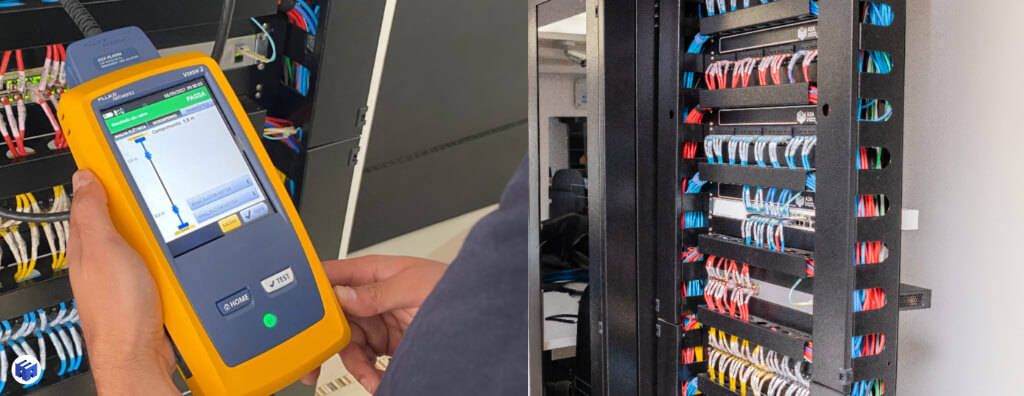
The cabling certification tester is the main device used to verify cable integrity and ensure compliance with technical standards. This device performs a series of automatic tests and provides detailed reports on cabling performance.
- Function: this equipment can test continuity, crosstalk, attenuation, resistance, and cable length, generating reports that prove the installation complies with applicable standards.
b. Network Cable Tester
A network cable tester is a simpler tool that checks cable continuity and detects connection faults. Although it does not replace full certification, it is useful for initial verification during installation.
- Function: the cable tester performs continuity tests and checks for failures along cable paths, such as reversed or broken wires.
c. Network Protocol Analyzer
A network protocol analyzer is used to verify communication between network devices and identify possible connectivity issues, such as protocol errors or congestion.
- Function: this tool allows real-time analysis of network traffic and diagnosis of failures that may be related to cabling or connected devices.
Certification Reports
Collection: A3A Systems Engineering
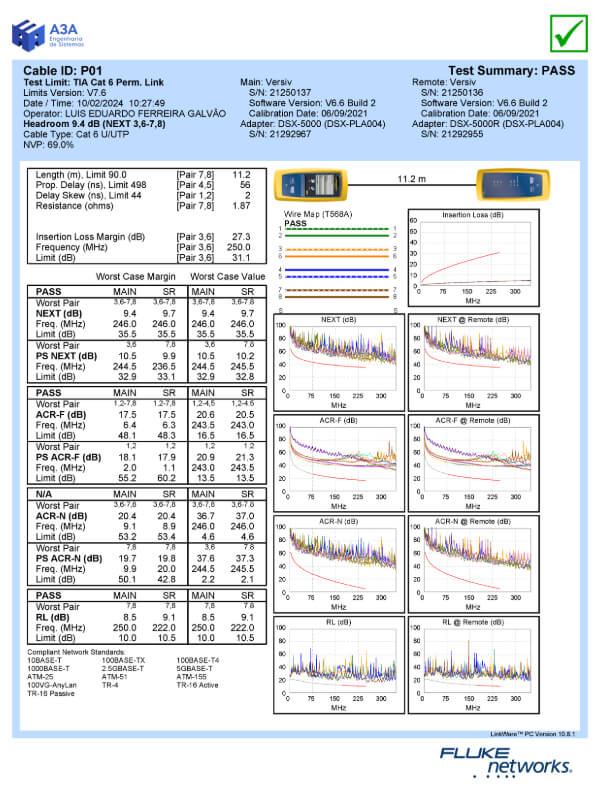
After the tests are performed, certification reports are automatically generated by the certification devices. These reports are essential to document that the installation was carried out according to technical standards and that all network points are functioning properly. They also provide a reliable technical baseline for future audits, maintenance, and expansion decisions.
- Benefit: the specialized engineering company provides these reports to the client as part of the project handover, ensuring that all technical requirements have been met. These documents are important for future maintenance, expansions, and compliance audits.
Corrective maintenance based on certification
It consists of identifying and correcting failures or performance degradation in structured cabling systems and other network infrastructure elements, supported by precise technical analyses carried out through certification testing.
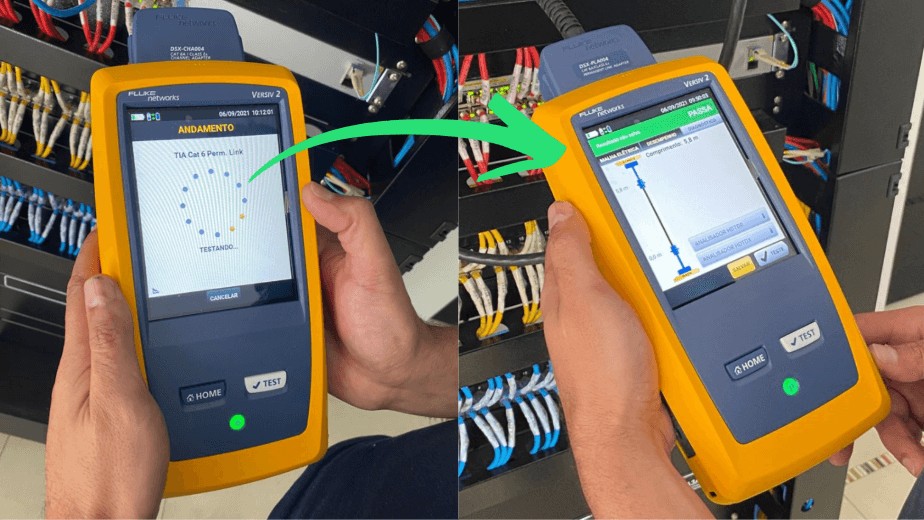
Network certification uses specific equipment (such as the Fluke DSX 5000) to validate the compliance of components with international technical standards, such as those defined by TIA/EIA, ISO/IEC, and ABNT NBR 14565, identifying issues such as:
COLLECTION: A3A SYSTEMS ENGINEERING
- Signal loss (attenuation);
- Electromagnetic interference;
- Inadequate data transmission performance (e.g. NEXT, FEXT);
- Connectivity failures or cable breaks.
Benefits of Corrective Maintenance with Certification:
- Accurate Diagnosis: identification of the root cause of problems through certified testing;
- Standards Compliance: assurance that the network aligns with the required technical specifications;
- Reduced Downtime: quick and effective correction of identified faults;
- Increased Reliability: restoration of ideal network performance after intervention.
Stages of Corrective Maintenance Based on Certification:
- Initial Diagnosis: identification of the problem reported by users or monitoring systems.
- Certification Tests: conducting tests with certifiers (e.g. Fluke Networks, IDEAL), which generate detailed fault reports.
- Fault Correction: replacement or repair of defective cables, connectors, or components.
- Retesting and Validation: after correction, new tests are carried out to validate compliance and restore certification.
- Technical Documentation: delivery of certification reports, ensuring transparency and proper recording of the interventions performed.
Ultimately, corrective maintenance based on network certification ensures that the IT infrastructure operates with maximum performance and technical compliance, offering stability and reliability for corporate operations.
Preventive Maintenance Based on Certification
Certification also plays an important role in preventive maintenance. With documented test results, it is possible to identify areas that may require future attention, preventing problems before they affect network operation.
- Recommended practice: perform periodic certifications to ensure that the network continues operating within parameters, especially in environments that undergo frequent upgrades or infrastructure expansions.
Conclusion
Structured cabling certification is a critical step in ensuring the efficiency, reliability, and compliance of the installed network infrastructure.
Using appropriate certification methods and tools ensures that the installation complies with technical standards and is prepared to support the company’s technological demands.
Hiring a specialized engineering company to carry out all necessary tests and provide certification reports and the project’s As Built documentation is essential to ensure that the network can operate with maximum performance and security.