Network infrastructure is the set of physical and logical components that enables communication, performance, security, and scalability in corporate networks.
Check it out!
Network infrastructure is the set of physical and logical components that enable data communication between devices on a network.
[elementor-template id=”24446″]
1. Introduction
In this article, we will explore the concept of network infrastructure, its importance in corporate environments, and how a well-designed network directly impacts the performance, security, and scalability of communication systems.
Understanding network infrastructure is crucial to ensuring the efficient operation of IT services and data communications.
What Is Network Infrastructure?
Network infrastructure is made up of physical and logical elements that support the interconnection of devices for data transmission and management.
Physical Components of Network Infrastructure:
Network Cables:
- Twisted-pair cables, such as Cat5e, Cat6, and Cat6a, are widely used for Ethernet networks. They are responsible for transmitting data over short and medium distances, such as inside a building or corporate environment. For longer distances and higher speeds, optical fiber is the most appropriate choice because of its high transmission capacity and immunity to electromagnetic interference.
Patch Panels and Racks:
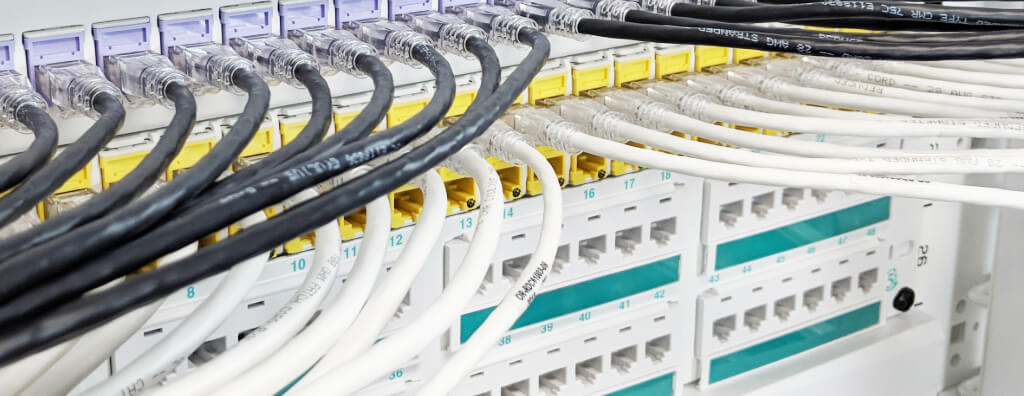
- Patch panels are used to organize and simplify cable connections within a structured cabling infrastructure. They are mounted in racks, which also house switches, servers, and other network equipment, making management and maintenance easier.
Switches and Routers:
- Switches are devices responsible for connecting multiple devices within a local area network (LAN), allowing data packets to be forwarded efficiently. Routers, in turn, connect different networks and direct data traffic to the correct destination, both on internal networks and in communication with the internet.
Access Points:
- In wireless networks, access points (APs) are used to connect mobile and other devices to the network, creating an interface between wired and wireless components. APs must be strategically distributed to ensure full coverage and avoid dead zones.
Logical Components of Network Infrastructure:
In addition to physical components, network infrastructure depends on a series of logical elements that ensure the efficient operation and management of data traffic. These include:
Communication Protocols:
- Protocols are sets of rules that define how data should be transmitted, received, and interpreted on a network. TCP/IP is the most common communication protocol used in most networks, defining how data is split into packets and routed between source and destination. Other protocols, such as UDP, are used for applications that demand high speed and less error control, such as video streaming.
IP Addressing and DHCP:
- Each device connected to a network must have a unique IP address, which allows it to be identified and communicate with other devices. The DHCP (Dynamic Host Configuration Protocol) automates IP address assignment, simplifying network administration.
Network Segmentation and VLANs:
- Network segmentation consists of physically or logically dividing a network into subnetworks to improve performance and increase security. Creating VLANs (Virtual Local Area Networks) allows devices in different parts of an organization to share the same physical infrastructure while remaining on logically separate networks, isolating data traffic.
Name Resolution Systems (DNS):
- DNS (Domain Name System) translates human-readable domain names, such as “www.empresa.com“, into IP addresses, making it easier to access network resources without having to memorize complex IP addresses.
Interaction Between Physical and Logical Components
Network infrastructure is the result of efficient interaction between physical and logical components. For example, when a device is connected to a network via an Ethernet cable (physical component), the TCP/IP protocol (logical component) is responsible for defining how data travels between that device and others on the network.
The router uses routing protocols to decide the best path for data to reach its destination, while the switch segments traffic to improve performance within the local network. Proper VLAN configuration and IP addressing optimize the use of physical resources and ensure secure, efficient data transmission.
In summary:
Network infrastructure is a complex combination of physical and logical components that, working together, ensure connectivity and data transmission between devices. By correctly integrating cables, switches, routers, and communication protocols, it is possible to build a network that meets scalability, security, and performance requirements, which are fundamental for modern corporate and residential environments.
Essential Components of a Network Infrastructure
To ensure an efficient and robust network, network infrastructure depends on a series of essential components responsible for connecting devices, managing data flow, and maintaining the integrity and security of communications.
Below, we detail the main elements that make up this infrastructure:
Structured Cabling

Structured cabling is the system of cables, connectors, and distribution devices that interconnect all network elements. It is responsible for ensuring the physical connection between network devices such as computers, servers, printers, and telecommunications equipment. Structured cabling is fundamental to data transmission and must be designed in an organized, scalable, and durable way.
- Types of Cables:
- Twisted Pair (Cat5e, Cat6, Cat6a): Twisted-pair cable is widely used for Ethernet transmissions over short and medium distances. It is made up of twisted wire pairs, which reduces electromagnetic interference. Cat5e supports up to 1 Gbps, while Cat6 and Cat6a allow speeds of up to 10 Gbps over shorter distances.
- Optical Fiber: Optical fiber is used in environments that require high transmission speed and long-distance coverage. Because it uses light instead of electrical signals, it is immune to electromagnetic interference and has lower attenuation over distance. Fiber is common in corporate network backbones, data centers, and interconnections between buildings.
- Cabling Organization:
- Structured cabling is installed in an organized way in racks and patch panels, allowing cables to be easily identified, replaced, and maintained. This simplifies future expansions and maintenance, ensuring infrastructure flexibility.
Switches
Switches are devices responsible for interconnecting devices on a local area network (LAN), enabling efficient communication between them. They play a crucial role in traffic segmentation, managing data transmission in a way that minimizes collisions and optimizes network performance.
- Managed Switches: These switches allow more detailed control over network traffic, enabling the creation of VLANs, traffic monitoring, and the application of security policies.
- Unmanaged Switches: These are simpler devices that act only as data distribution points, without advanced management capabilities.
Switches operate at Layer 2 (Data Link) of the OSI model, but they may also work at Layer 3 (Network), providing routing functionality between VLANs.
Routers
A router is a device that connects different networks, such as a local area network (LAN) to the internet or to other external networks. It is responsible for forwarding data packets between these networks, determining the best path for data to reach its destination efficiently.
- Edge Routers: These routers connect the local network to external networks such as the internet, ensuring that data flows securely and efficiently.
- Internal Routers: These are used to connect different segments within an organization, enabling communication between subnetworks and the application of traffic control policies.
Routers operate primarily at Layer 3 of the OSI model, using routing protocols such as OSPF, BGP, and EIGRP to determine the most efficient paths between networks.
Wireless Access Points

Access Points (APs) are devices that allow mobile and wireless devices to connect to the network. They create an interface between the wired infrastructure and wireless devices such as laptops, smartphones, and tablets, using technologies such as Wi-Fi.
- Centrally Controlled APs: Used in corporate networks, where multiple APs can be managed centrally, ensuring uniform coverage and traffic management across large areas.
- Standalone APs: More common in residential networks or small businesses, where each AP operates independently, providing connectivity for limited areas.
Wi-Fi infrastructure is essential in environments that require mobility, and proper AP configuration ensures the coverage, capacity, and security needed for good wireless network performance.
Servers and Storage Equipment
Servers centralize network services such as applications, databases, and file storage. They play an essential role in network infrastructure by providing controlled access to resources and data.
- Dedicated Servers: They provide services such as DHCP, DNS, and authentication, managing data flow and controlling access to network resources.
- NAS (Network Attached Storage): These are storage devices connected directly to the network, enabling centralized file sharing and backups.
Network Security
The security of network infrastructure is ensured by protective devices and software that monitor, filter, and control data traffic, preventing unauthorized access and external attacks.
- Firewalls: Devices that control the flow of traffic between networks with different levels of trust, such as between the local network and the internet, blocking unauthorized access.
- Intrusion Prevention Systems (IPS): They monitor the network in real time, detecting and preventing malicious activity.
- VPNs (Virtual Private Networks): They create encrypted tunnels to allow secure remote access to network resources.
Network infrastructure components play distinct but interconnected roles, ensuring efficient data transmission, secure communications, and network scalability. Careful planning and the correct choice of components are essential to build a network that meets current and future communication demands while providing high availability and optimized performance.
Network Infrastructure Planning:
Network infrastructure planning is a critical stage in ensuring that the network efficiently meets an organization’s current and future operational needs. Inadequate planning can result in performance bottlenecks, security problems, and difficulties in carrying out future expansions.
Therefore, it is essential to carry out a detailed and careful analysis to ensure that the infrastructure is robust, scalable, and secure.
Main stages in planning a network infrastructure.
Requirements Analysis
The first step in planning any network infrastructure is a detailed requirements analysis. This involves identifying the organization’s needs in terms of capacity, connectivity, performance, and security. Requirements analysis ensures that the network is designed to support current and future demand.
- Number of Devices: Estimate the number of devices that will be connected to the network, including computers, servers, mobile devices, IoT (Internet of Things) equipment, and others.
- Bandwidth: Determine the bandwidth required to support network traffic based on the users’ type of activity. Applications that demand high capacity, such as videoconferencing, streaming, and the transfer of large volumes of data, require a network infrastructure that offers high speed and low latency.
- Network Topology: Define the appropriate topology (star, mesh, tree, etc.) for the network based on the organization’s physical layout and the number of subnetworks required. In a large enterprise network, it is common to adopt a hierarchical topology with backbones to ensure scalability and redundancy.
Sizing and Scalability
Proper sizing of network infrastructure is fundamental to ensuring ideal performance and enabling future expansions. A well-sized project takes into account estimated traffic, the organization’s expected growth, and the possibility of adding new devices without compromising network operation.
- Traffic Capacity: The network must be sized to support traffic peaks without performance degradation. This involves forecasting the required throughput in switches and routers, ensuring that they can handle the data volume.
- Redundancy and High Availability: The infrastructure must include redundant components, such as power supplies, data links, and backup switches, to ensure high network availability. This practice minimizes the impact of failures and maximizes operational continuity.
- Scalability: Planning must account for network expansion, whether by increasing the number of devices or by adding new services. Choosing equipment and technologies that support scalability ensures that the network can grow without requiring major infrastructure changes.
Infrastructure Security
Security is one of the most important aspects of network infrastructure planning, especially in a scenario where cyber threats are increasingly sophisticated. Protecting the network involves a combination of physical and logical measures that guarantee data integrity, access control, and protection against external attacks.
- Network Segmentation: One of the most common security practices is network segmentation. By dividing the network into VLANs or subnetworks, it is possible to isolate traffic from different departments or services, minimizing the impact of possible vulnerabilities. This also makes it easier to apply security policies specific to each segment.
- Firewalls and Access Control: Implementing robust firewalls and access control systems ensures that network traffic is properly monitored and filtered. The use of ACLs (Access Control Lists) in switches and routers makes it possible to define which devices can communicate with one another, increasing environmental security.
- Encryption and VPNs: In remote-access scenarios, encryption is essential to protect data in transit. The use of VPNs (Virtual Private Networks) is a common practice to ensure that traffic between remote users and the network is secure and cannot be intercepted.
Monitoring and Management
A fundamental aspect of network infrastructure planning is the creation of a continuous monitoring and management plan. Even the best infrastructure can fail if it is not properly monitored and managed. This involves installing monitoring systems that make it possible to identify problems before they affect network performance.
- Traffic Monitoring: Traffic monitoring tools are used to track bandwidth usage, identify possible bottlenecks, and analyze the network’s overall health. These tools alert the IT team to abnormal traffic spikes, enabling a quick response to potential incidents.
- Centralized Management: In larger networks, it is common to use centralized management platforms that allow switches, routers, and access points to be monitored and controlled from a single point. This simplifies update deployment, configuration management, and fault identification.
- Logs and Auditing: Keeping a detailed record of network logs is essential for audits and security investigations. Logs help identify possible failures or suspicious activity and can provide valuable information for troubleshooting.
Best Practices in Implementing Network Infrastructures:
Implementing a network infrastructure is a complex process that requires careful planning and the adoption of best practices to ensure that the network is efficient, secure, and scalable. Following these practices helps avoid operational problems, facilitates maintenance, and ensures that the network will meet the organization’s future needs.
Below, we cover the main recommended practices for implementing a high-performance network infrastructure.
Use of Certified, High-Quality Cabling
One of the pillars of network infrastructure is structured cabling. Choosing high-quality cables with the proper certification is essential to ensure the network operates efficiently and durably. Low-quality cabling can compromise network performance and result in frequent failures.
- Structured Cabling: It is important to implement a structured cabling system to ensure organization and facilitate future maintenance or expansion. Structured cabling enables new devices to be connected to the network quickly and efficiently, without the need for substantial modifications to the existing infrastructure.
- Standards and Certifications: Using cables that meet Cat5e, Cat6, Cat6a, or higher standards, depending on bandwidth requirements and the type of environment, ensures that the cabling complies with performance demands. Certification of this structured cabling is fundamental to ensuring connection quality and stability.
Proper Project Documentation
Documentation is a practice that is often neglected, but it is extremely important for the long-term success of network infrastructure. A well-documented project facilitates management, troubleshooting, and future network expansions.
- Network Mapping: Documenting the network layout, including the location of each access point, cable, switch, router, and server, makes infrastructure maintenance and expansion easier. This mapping should be updated whenever there are changes or additions to the network.
- Configurations and Policies: In addition to physical documentation, device configurations (such as VLANs, IP addressing, and security policies) should also be recorded. This makes it easier to recover configurations in the event of failures and ensures operational continuity.
Redundancy and High Availability
Redundancy is one of the most important best practices for ensuring high network availability, especially in corporate environments where downtime can result in financial or operational losses. Implementing redundancy in critical infrastructure components minimizes the impact of failures.
- Component Redundancy: Using redundant switches, routers, and servers ensures that if one device fails, another automatically takes over, preventing interruptions in data traffic.
- Power Supplies and Backup: In addition to network devices, it is important to ensure that the infrastructure’s electrical power is redundant by using uninterruptible power supplies (UPS) to avoid outages.
- Redundant Connections: Using redundant internet links from different service providers ensures that the organization remains connected to the internet even if one link fails.
Capacity Management and Quality of Service (QoS)
To ensure that the network operates efficiently, it is essential to properly manage the capacity of network devices and use Quality of Service (QoS) techniques to prioritize the most critical traffic.
- Performance Monitoring: Monitoring the performance of switches and routers, identifying bottlenecks or traffic saturation, is essential for keeping the network operating efficiently. Network monitoring tools such as SNMP and NetFlow help identify where adjustments are needed.
- QoS: Implementing QoS policies allows more critical traffic, such as videoconferences, voice over IP (VoIP), and the transmission of sensitive data, to be prioritized over less urgent traffic. This improves the performance of critical applications, even during usage peaks.
Security Implemented at Multiple Levels
Network security is a priority in any infrastructure implementation. Adopting a multilayer security approach helps protect the network from external and internal threats, ensuring data integrity and confidentiality.
- Firewalls and Intrusion Detection Systems (IDS/IPS): Using next-generation firewalls and Intrusion Detection and Prevention Systems (IDS/IPS) helps monitor and block suspicious traffic before it can cause damage to the network.
- Access Control and Network Segmentation: Implementing robust access control, such as certificate-based authentication and security policies, ensures that only authorized devices can access the network. In addition, segmenting the network into VLANs isolates different types of traffic, increasing security and facilitating traffic management.
- Updates and Patches: Keeping network devices updated with the latest security patches is crucial to preventing known vulnerabilities. A good update management plan ensures that security improvements are applied without causing significant service interruptions.
Continuous IT Team Training
The team responsible for maintaining and operating the network infrastructure must always be up to date on best practices, new technologies, and possible vulnerabilities that may arise.
- Technical Training: Investing in ongoing technical training for the IT team ensures that network administrators are prepared to handle technological demands and security challenges that may arise.
- Failure Scenario Simulations: Performing tests and failure simulations helps the team respond quickly in emergency situations, minimizing downtime and ensuring fast network recovery.
The Importance of Maintenance and Updating
After implementing network infrastructure, the work is not finished. To ensure continuous and efficient operation, it is crucial to perform regular maintenance and periodic updates. These actions are essential to prevent problems, improve performance, and protect the network against new threats. A neglected infrastructure can become inefficient and vulnerable, leading to service outages and security breaches that may compromise the entire company’s operation.
Preventive Maintenance
Preventive maintenance is the set of actions taken proactively to avoid failures and problems in network infrastructure. It should be performed regularly and includes physical and logical network checks to identify possible failure points.
- Physical Inspection of Equipment: Performing regular inspections of network equipment such as switches, routers, cables, and servers ensures that damaged or worn components are replaced before they cause interruptions. Components subject to wear, such as power supplies, fans, and connectors, should be tested and, if necessary, replaced preventively.
- Cabling Cleaning and Organization: Structured cabling can be affected by physical factors such as dust, humidity, and frequent movement. Keeping the environment organized and the cabling protected helps avoid failures and facilitates future maintenance. The use of organized racks and the replacement of damaged cables are important actions.
- Continuous Network Monitoring: Using network monitoring tools that alert the IT team to abnormal variations in traffic, latency, and resource usage helps identify possible problems before they affect network performance. Tools such as SNMP (Simple Network Management Protocol) and NetFlow can provide valuable data about the state of the infrastructure.
Corrective Maintenance
Despite preventive practices, failures can occur. Corrective maintenance aims to resolve unexpected problems as quickly and efficiently as possible, minimizing the impact on the network environment. Agility in identifying and correcting these problems is crucial to reducing downtime and the business impact.
- Rapid Failure Identification: Having a real-time monitoring system capable of alerting the IT team as soon as a failure occurs is essential. This system must be able to identify whether the problem is in a specific device (such as a switch or router), in the cabling, or in a configuration failure.
- Data and Configuration Recovery: In severe failure scenarios, such as data loss or failure of critical devices, it is important to have a recovery plan that includes regular backups of network configuration and important data. Fast data recovery and restoration of previous configurations can prevent long periods of downtime.
- Replacement of Critical Components: Speed in replacing faulty components such as power supplies, storage disks, or network modules is crucial. Keeping spare parts available, especially in mission-critical networks, ensures that the network can be restored quickly.
Software and Firmware Updates
Regular software and firmware updates are fundamental to keeping the network secure and operating with the best possible performance. This includes not only bug-fix updates, but also security patches and functional improvements.
- Security Patches: Manufacturers of network devices such as switches, routers, and firewalls frequently release security patches to fix known vulnerabilities. Keeping firmware updated significantly reduces the risk of cyberattacks and data breaches.
- Performance Improvements: In addition to security patches, software and firmware updates may include performance improvements or new features. These updates can optimize bandwidth usage, improve routing protocol efficiency, or add new security features.
- Update Automation: In larger networks, where there are many devices to manage, automating updates through centralized management systems can help ensure that all updates are applied uniformly and promptly, without interrupting network operation.
Planning for Expansions
Keeping network infrastructure flexible and scalable is fundamental to supporting the organization’s future growth. Network needs evolve over time as more devices are added, new technologies are implemented, and the demand for bandwidth increases. Planning and implementing expansions efficiently avoids performance bottlenecks.
- Increasing Traffic Capacity: As the network grows, it is essential to ensure that switches and routers are capable of handling the increase in data traffic. Expanding backbone links and upgrading network devices to support higher bandwidth are important steps in this process.
- Adding New Devices: When new devices such as servers, Wi-Fi access points, or IoT devices are added to the network, it is important to ensure that the network infrastructure has sufficient capacity to support them without compromising overall performance.
- Security in Expansions: Any network expansion must also be accompanied by updates to security policies. New devices should be configured according to network security practices, and security updates should be applied before new equipment is introduced.
Regular Security Audits
With cyber threats constantly evolving, carrying out regular security audits on network infrastructure is an essential practice. These audits verify system integrity, identify vulnerabilities, and enable failures to be corrected before they can be exploited.
- Penetration Testing: Conducting penetration tests (pen tests) helps identify vulnerabilities that could be exploited by hackers. These tests simulate attacks at different network layers, allowing the IT team to adjust security policies and properly configure devices to avoid gaps.
- Review of Access Policies: Access-control policies should be reviewed periodically to ensure that only authorized devices and users can access the network. This includes user-permission management and the application of strong authentication practices such as multifactor authentication (MFA).
Conclusion
Network infrastructure is the foundation of all communication operations and IT services within an organization. From selecting the appropriate components, through planning and implementation, to ongoing maintenance and updating, each stage plays a fundamental role in ensuring that the network is efficient, secure, and scalable.
The Importance of a Well-Designed Network Infrastructure
A well-planned network infrastructure with up-to-date maintenance ensures reliability, performance, and security, resulting in fewer business interruptions, greater productivity, and the ability to expand and evolve according to the organization’s needs.
Ultimately, investing in network infrastructure provides the basis for reliable execution of day-to-day operations and also guarantees that the organization will be prepared for the future, with the capacity to adapt to new technologies and continuous growth.
If your company needs a network infrastructure project that is efficient, secure, and scalable, get in touch with our engineering team.
At A3A Engenharia, we offer solutions tailored to your needs. Contact us.

Relevant Links (Complementary technical materials)
Complete Guide to Structured Cabling
Structured Cabling Design – Complete Guide
eBook – Why hire a Structured Cabling Design?
Technical Standards for Structured Cabling
NBR 14565 – Structured Cabling
Network Certification for Structured Cabling Systems
Consulting for Structured Cabling Projects
Structured Cabling Installation
How to avoid common problems in structured cabling systems?
Main benefits of Structured Cabling
Network Cabling in CAT5e vs CAT6
Frequently Asked Questions
A Structured Cabling System (SCS) is a standardized infrastructure of cables, connectors, racks, cable trays, patch panels, and network equipment that provides the foundation for a telecommunications network to operate efficiently.
A Structured Cabling System works through the installation of various network components, including cables, active equipment, patch panels, and other devices, following technical standards and specifications.
A cabling structure is a generic system organized into interconnected subsystems, composed of cables, connectors, and devices, designed to support multiple services such as voice, data, video, and building automation in a standardized, flexible, and application-independent way, enabling changes and expansions without major intervention in the physical infrastructure.
A structured cabling system is designed to meet connectivity needs in corporate, commercial, industrial, and residential environments, providing a reliable, high-performance network.
The most common types are UTP cable (unshielded twisted pair), STP cable (shielded twisted pair), coaxial cable, and optical fiber. Each has different applications and transmission capacities.
UTP (Unshielded Twisted Pair) has no shielding. It is less expensive and used in environments with low levels of interference. STP (Shielded Twisted Pair) includes shielding that reduces electromagnetic interference, making it suitable for industrial environments or places with high electromagnetic pollution.
The main standards are ABNT NBR 14565 (Brazil), ISO/IEC 11801 (international), ANSI/TIA-568 (North America), and NBR 16264 for Data Centers. They define installation, performance, and testing requirements.
Horizontal cabling connects telecommunications outlets to distribution rooms on the same floor, while vertical cabling, or backbone cabling, interconnects different floors or buildings, carrying data between main and floor distributors.
It is the main cabling that connects telecommunications rooms, data centers, or buildings to each other. It usually uses higher-capacity media such as optical fiber or higher-category copper cables.
Electrical engineers, network engineers, telecommunications technicians, network infrastructure designers, and companies specialized in corporate network projects and deployment.
Normative References
“NBR 14565 – Structured Cabling for Commercial Buildings” – ABNT (Brazilian Association of Technical Standards)
“ISO/IEC 11801 – Generic Cabling for Customer Premises” – ISO/IEC (International Organization for Standardization) & (International Electrotechnical Commission)
“ANSI/TIA 568 – Generic Telecommunications Cabling for Customer Premises” – ANSI/TIA (American National Standards Institute) & (Telecommunications Industry Association)
“What are structured cabling services and their respective technical responsibilities?” – CREA (Regional Council of Engineering and Agronomy)
“Structured Cabling Systems: the Fact File” – CommScope