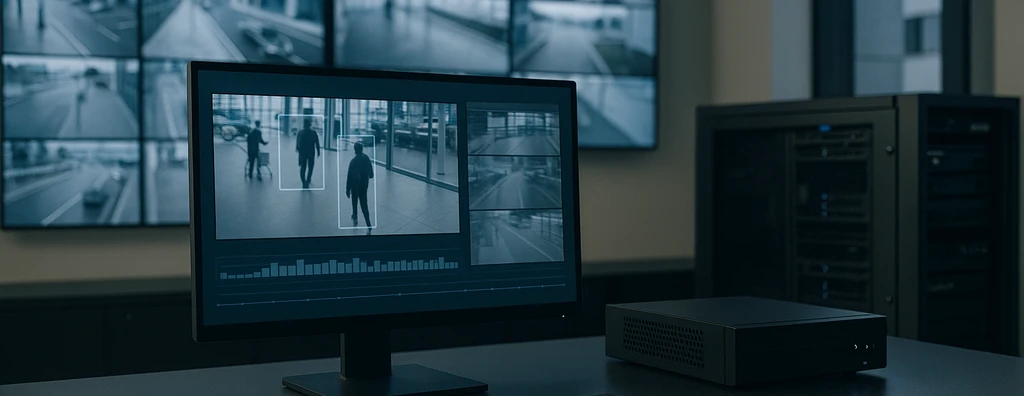
The advancement of video monitoring systems has resulted in an exponential growth in the volume of images produced daily, creating the technical challenge of extracting relevant information in a timely manner.
Check it out!
The advancement of video monitoring systems has resulted in an exponential growth in the volume of images produced daily by corporate, industrial, and urban environments. Although the continuous and massive generation of data increases the potential for security and operational efficiency, it also creates the central technical challenge of extracting relevant information in a timely manner in a scenario where most recorded content is never manually reviewed.
This article examines the principles and foundations of AI Video Synopsis, an approach based on artificial intelligence for automated summarization and analysis of video, aimed at enabling the review, search, and extraction of events from hour-long archives that are unreachable by conventional methods, in line with advanced electronic security engineering practices. Processing architectures, integration with video management software (VMS), operational advantages, normative aspects, and challenges linked to corporate adoption are addressed.
Check it out!
[elementor-template id=”24446″]
Technical Foundations of AI Video Synopsis
Automated video summarization, referred to as AI Video Synopsis, is based on analytics capable of continuously examining large flows of digital images, extracting metadata and events of interest. Artificial intelligence algorithms, applied to both live streams and recorded video, describe scene content, identify objects, classify behaviors, and recognize patterns relevant to operational and security analysis.
- Continuous processing: the system transforms raw data into actionable information in real time or through retrospective analysis.
- Event extraction: automated detection of critical situations, such as presence in restricted areas or atypical behavior.
- Metadata generation: descriptive attributes of identified objects and actions, such as mobility, classification, and direction.
This perspective makes detailed behavioral analysis feasible, optimizing security responses and reducing dependence on manual review.
Architectural Requirements for Implementation
Integrating AI Video Synopsis into electronic security deployments requires a robust architecture for processing large volumes of data, ensuring scalability and reliability in line with best engineering practices.
1. Acquisition Layer
The performance of summarization depends directly on the cameras employed and on digital capture methods, requiring high-resolution sensors, electronic stability, and native integration with analytics platforms.
2. Processing Layer
- Edge: execution of algorithms directly on capture devices, enabling real-time response, reduced network traffic, and lower latency.
- Dedicated server: centralized processing, ideal for scenarios that require complex analysis, local storage, and integration with multiple sources.
- Cloud: scalable services for analysis and massive storage, enabling highly dynamic workloads and remote integration.
- Hybrid architecture: strategic combination of the approaches above, targeting performance, cost, and security.
3. Video Management Platform (VMS)
Compatibility and vertical integration between advanced video analytics and video management software (VMS) are indispensable for centralizing notifications, automated searches, and intelligent summarization of the archive. The VMS acts as middleware, receiving metadata, triggering alerts, and enabling the search for relevant events across large video repositories.
Standards and Technical Compliance Criteria
The implementation of AI Video Synopsis in professional environments must respect normative and regulatory criteria, ensuring interoperability, scalability, and information security according to internationally accepted standards. It is particularly important to adhere to specifications such as IEC 62676, the global reference for video surveillance systems, which defines performance, interoperability, and security criteria for equipment and analytics software, including:
- Definition of minimum image and recording quality;
- Interoperability among devices from multiple manufacturers;
- Protection against unauthorized access through data encryption and VMS access authentication;
- Requirements for the management of analytic metadata and secure export of events.
Meeting the criteria established in sector standards raises the level of reliability and allows summarized video records and extracted events to be used as evidence in forensic, operational, or regulatory environments.
Advanced Analysis Mechanisms: Detection, Classification, and Summarization
Analytical intelligence applied to video systems goes beyond simple motion detection by incorporating high-value functionalities for security engineering:
- Automated object detection: differentiation among people, vehicles, animals, and other elements based on morphometric characteristics.
- Behavior-based classification: identification and tagging of movement patterns such as direction, speed, time spent in a defined area, grouping, and perimeter evasion.
- Extraction of relevant events: generation of alerts for predefined critical situations such as perimeter violation, abandoned objects, and unauthorized access.
- Temporal summarization: condensation of hours of video into segments of just a few minutes, gathering only records of interest with temporal and contextual indicators for accelerated search.
These mechanisms are optimized through machine learning, continuously refining detection criteria and minimizing false positives, with direct impact on monitoring efficiency and operational resource management.
Integration with the Electronic Security Ecosystem and Operations
Video summarization and automated analysis, when integrated into the corporate electronic security ecosystem, significantly expand the possibilities for incident response and operational assessment. The summarized video is exported to platforms used by response teams, audit departments, and operational intelligence areas, generating gains in:
- Investigation speed: review of multiple events in minutes, identifying converging episodes or recurring behavior patterns.
- Incident corroboration: cross-validation between summarized records and access control logs, alarms, or perimeter sensors.
- Improved efficiency: reduction of demands on human operators, who can focus on events already pre-filtered and summarized.
In addition, the ability to correlate video metadata with other systems, such as access control, alarms, environmental sensors, and integrated management systems, enhances contextual and preventive analysis.
Technical Challenges in Video Summarization and Analysis
Despite its evident benefits, the implementation of AI Video Synopsis imposes relevant technical challenges, especially in mission-critical environments:
- Volume and data density: the need for scalable architectures capable of supporting real-time processing of thousands of simultaneous channels without performance loss.
- Input video quality: direct impact on the accuracy of analytics algorithms, including underexposure, digital manipulation, and compression artifacts.
- Latency and response time: the balance between real-time analysis and retrospective summarization depends on efficient segmentation of data flows.
- Privacy and data protection: anonymization and masking mechanisms in compliance with data protection policies.
- Maintenance and updating of algorithms: requirement for continuous cycles of training, updating, and model validation.
Addressing these challenges requires detailed systemic design, from hardware specification through network flows to the development or selection of analytics aligned with the client’s risk profile and operational demands.
Use Cases in Corporate and Operational Environments
The adoption of AI Video Synopsis solutions is particularly applicable in environments with high requirements for continuous monitoring and retrospective analysis:
- Critical infrastructure: ports, airports, energy plants, and industrial facilities requiring detection of anomalous events and rapid incident management.
- Urban centers: public security and mobility operations, monitoring of roads, squares, and high-traffic areas.
- Industrial environments: process control, production line monitoring, and identification of operational failures through automated visual analysis.
- Large enterprises: internal auditing, review of access events, and analysis of situations in reduced time, with summarized history centralized in management platforms.
Efficient summarization supports decision-making under pressure, with fast evidence-based reports that improve the work of security and operations teams.
Operational Considerations for Engineering and Projects
The specification of AI Video Synopsis solutions in electronic security projects must contemplate:
- Sizing: detailed analysis of video flows, number of cameras, resolution, and retention times to ensure the feasibility of processing and summarization.
- Systemic integration: verification of compatibility with the corporate VMS and other analytics and control platforms.
- Information security: use of data protection mechanisms, multi-factor authentication, and normative compliance.
- Performance validation: execution of tests with real scenarios to measure accuracy, latency, and algorithm reliability.
- Operational training: qualification of teams for analysis of summarized reports and intervention on identified events.
An engineering-oriented approach ensures that the adoption of these technologies is sustainable, scalable, and adherent to the organization’s operational reality.
Conclusion
The implementation and consolidation of AI Video Synopsis represent a substantial advance in the efficient management of large volumes of images in corporate and operational environments. By combining artificial intelligence for the analysis, classification, and summarization of visual data, these technical solutions overcome the limitations of manual review, boosting agility in decision-making and incident response capacity.
The use of machine learning algorithms, combined with vertical integration into VMS and compliance with normative standards, raises the potential of electronic security systems. In this way, it becomes possible to shift from a reactive model to a predictive posture, with substantial reduction in operational costs and an increase in levels of control, traceability, and prevention.
In the context of systems engineering, AI Video Synopsis stands as a key element for robust protection projects, whether in critical infrastructures, industrial environments, or advanced urban operations. The technical and normative approach ensures reliability, scalability, and adherence to best practices in the electronic security sector.
Final Considerations
Based on the analysis presented, it becomes evident that the careful adoption of AI Video Synopsis significantly enhances the strategic value of monitoring systems, expanding security, resilience, and operational efficiency across different environments and sectors.
Thank you for reading this technical reference article on video summarization and artificial-intelligence-based analysis. To follow other content, updates, and trends in systems engineering, follow A3A Engenharia de Sistemas on social media.
