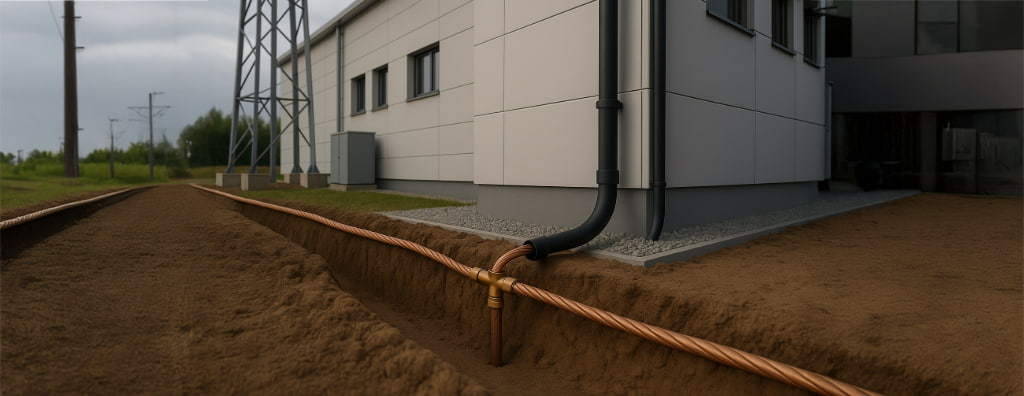
Understand the essential stages and critical design points for grounding systems according to NBR 5419, including risk analysis, electrode sizing, interconnections, and conformity testing.
Check it out!
The grounding project in electrical systems and lightning protection systems is a fundamental stage for ensuring the integrity of people, installations, and equipment in the face of transients, overvoltage events, and currents induced by atmospheric electrical discharges. In the technical context, according to current standards, proper grounding aims to reconcile safety requirements, operational continuity, and systemic performance for all subsystems involved in the built or industrial environment, addressing potential control and the safe conduction of fault currents to earth without generating additional risks.
The advance of protection demands in critical environments, the growing integration of sensitive devices, and the architectural complexity of grounding grids make the correct sizing and execution of this system one of the greatest challenges in electrical engineering, and it is frequently neglected, leading to compromise of the entire risk mitigation strategy.
In this article, the fundamental stages and critical points for grounding design according to the Brazilian Technical Standards Association NBR 5419 are presented, encompassing conception, sizing, execution, interconnections, and verification, as well as technical considerations that are indispensable for avoiding systemic failures and ensuring the efficiency of the Lightning Protection System (LPS), addressing practical issues of operation, maintenance, and electromagnetic compatibility.
Check it out!
[elementor-template id=”24446″]
Fundamental Grounding Concepts and the Importance of NBR 5419
Grounding, in the context of electrical installations and lightning protection, is defined as the intentional connection of metallic parts and protective conductors to the soil, aiming to standardize electrical potentials and provide low-impedance paths for the dissipation of fault currents or discharges. The sizing, construction, and interconnection of grounding systems must necessarily comply with ABNT NBR 5419, which establishes requirements for LPS design and details methodologies for implementing compatible and effective grounding subsystems.
Grounding objectives according to NBR 5419:
- Protection of human life: reduction of electric shock hazards by controlling touch and step potentials.
- Protection of the building and equipment: proper conduction of discharge currents to the ground, avoiding thermal, mechanical, and electromechanical damage.
- Maintenance of the functional integrity of installations: reduction of electromagnetic interference, service continuity, and safe operation of installations.
Essential Stages of Grounding Design According to NBR 5419
1. Risk Analysis and Definition of Initial Parameters
The starting point of any LPS project with grounding is risk analysis, as prescribed in NBR 5419, in order to determine the need for supplementary protection measures and establish technical criteria for sizing the structures, such as:
- Classification of the structure and occupancy;
- Location and environmental exposure;
- Soil characteristics and resistivity;
- Need for lightning protection zones and identification of the equipment to be protected.
2. Conception of the Grounding System
The grounding infrastructure must be conceived while observing the following requirements:
- Reliability and safety of people;
- Capacity to conduct fault currents to earth;
- Compatibility and joint application of electrodes provided for in NBR 5419 and NBR 5410;
- Compatibility with the equipotential bonding subsystem.
3. Sizing of Grounding Electrodes
The project must provide for electrodes sized according to lightning discharge current demands, the electrical properties of materials, and protection against corrosion and mechanical damage. The selection of materials, such as copper or steel, and their respective minimum cross-sections must ensure, in compliance with NBR 5410, the criteria of resistance, durability, and electrical performance:
- Copper: minimum cross-section of up to 2.5 mm2 if protected, 16 mm2 if unprotected, and 50 mm2 in acidic or alkaline soils and without anti-corrosion protection;
- Steel: minimum cross-section of up to 10 mm2 if protected, 16 mm2 if unprotected, and 80 mm2 in aggressive environments without anti-corrosion protection.
4. Planning of Interconnections and Equipotential Bonding
The integration of internal grounding systems is carried out by equipotential bonding conductors that run parallel to electrical cables, cable trays, and ducts. The interconnections ensure equalization of potentials and promote safety in the face of multiple discharges or electromagnetic transients. In places with different internal subsystems, equipotential bonding methods must be provided that consider the paths taken by conductors and conduits, integrating the grounding subsystems in order to avoid significant differences of potential between them.
5. Physical Execution of the Grounding System
- Adequacy to environmental conditions and protection against corrosion;
- Guarantee of accessibility for inspections and maintenance;
- Secure connections between conductors and electrodes, respecting electrical and mechanical requirements;
- Implementation of the mesh, rods, cables, and busbars according to the calculated flows.
6. Testing, Verification, and Technical Documentation
- Carrying out grounding resistance measurements with appropriate instruments;
- Comparison with reference values established in NBR 5419;
- Recording of the conformity report valid for technical audits and preventive maintenance.
Critical Points and Special Conditions in Grounding Design
Selection of the Grounding Configuration for the Power Entrance
The design must clearly specify the type of grounding system adopted for the power entrance – TN (TN-S, TN-C, or TN-C-S), TT, or IT – as indicated in NBR 5410 and NBR 5419. The choice of the system must be aligned with supply conditions, electrical safety requirements, and the equipment to be protected.
Avoid the Use of Utility Metallic Piping
The use of metallic water piping or utility networks as grounding electrodes is not permitted, due to the impossibility of guaranteeing continuity, dissipation performance, and safety over time.
Interconnection of Metallic Structures and Antennas
Antenna masts and other external metallic structures must be integrated into the LPS. This integration aims to ensure that accidental lightning discharges are not diverted in a dangerous manner to the interior of the building or to sensitive service lines.
Reinforced Equipotential Bonding in Critical Areas
Especially in industrial areas or buildings with multiple subsystems, it is necessary to plan the implementation of grounding meshes and parallel equipotential bonding paths, promoting equalization of potentials and avoiding improper paths for discharge currents.
Practical Examples of Grounding Grid Implementation
A well-structured grounding subsystem generally adopts a ring configuration, preferably around the perimeter of the building, interconnecting all points of interest as described in NBR 5419.
The grid must be sized to cover the entire sensitive area, crossing conductors at regular distances and providing redundant interconnections at strategic crossings. Accessible inspection points must be provided, and electrical continuity throughout the entire grid extension must be guaranteed.
Criteria for Interconnections and Equipotential Bonding Between Systems
To ensure safety and performance, NBR 5419 allows and, in many cases, recommends the unification of the grounding subsystems of the LPS with the functional or protective grounding of the electrical installations, provided that normative criteria are observed. Among the applicable methods, the following stand out:
- Parallel equipotential bonding conductors: installed alongside electrical cables to minimize potential differences;
- Continuous metallic ducts, integrated with both subsystems, increasing the contact surface with the ground;
- Grounding meshes or rings, promoting equipotentiality throughout the entire installation.
These practices reduce the risk of transfer currents and minimize electromagnetic impacts on sensitive circuits.
Specification of Materials and Execution of Connections
The correct specification of materials is a determining factor for the longevity and efficiency of the grounding system. Conductors and electrodes must be selected according to exposure conditions (protection against corrosion, mechanical damage, soil aggressiveness) and compatibility with expected discharge currents. The main points to consider include:
- Minimum copper cross-sections: from 2.5 mm2 to 50 mm2, according to exposure to damage or corrosive environments.
- Minimum steel cross-sections: from 10 mm2 to 80 mm2, under the same conditions.
- Electrical and mechanical connections must be made by recognized methods, ensuring continuity and very low contact resistance.
Physical execution must ensure accessibility to inspection points, protecting connections in suitable boxes and providing signage and documentation of the main points.
Conformity Tests and Verifications
After implementation of the grounding system, tests must be carried out to measure the ohmic resistance of the grounding and the continuity between conductors, using compatible instruments. The values obtained must be compared with the technical references established in NBR 5419. If values are above the specified threshold, design corrections must be provided – such as adding rods, expanding grids, or improving the quality of interconnections – before the issuance of the technical conformity report.
Technical Documentation and Maintenance Procedures
The grounding project according to NBR 5419 requires detailed documentation of the entire implemented system, including:
- Executive design with drawings, diagrams, and identification of test points;
- Descriptive memorial containing sizing criteria, construction methods, materials, and technical justification;
- Reports of initial tests and measurements;
- Periodic inspection procedures and recommended techniques for preventive maintenance, with routines for periodic measurement of system resistance and visual inspection of accessible connections.
These procedures ensure longevity, normative compliance, and traceability of the operating conditions of the system over time.
Conclusion
The development of a grounding project according to NBR 5419 demands a systematic approach, high precision in the specification of elements, and strict compliance with technical stages and normative requirements. Risk analysis, correct sizing of electrodes, choice of grounding configuration, integration with subsystems, and execution of tests are fundamental to ensure effective protection of installations and people. Negligence at any of these stages may compromise the overall safety of the system, increasing the risk of accidents, operational failures, and property damage.
Engineers and designers must adopt a proactive posture, planning redundant systems, promoting equipotential bonding, and documenting the process in detail, ensuring constant updating of procedures in response to normative revisions and technological evolution.
Final Considerations
Throughout this article, the main technical aspects, challenges, and essential stages for high-performance and reliable grounding projects according to NBR 5419 were explored. Thank you for reading and for your trust in the information presented. To follow updates, specialized content, and leading engineering solutions, follow A3A Engenharia de Sistemas on social media.