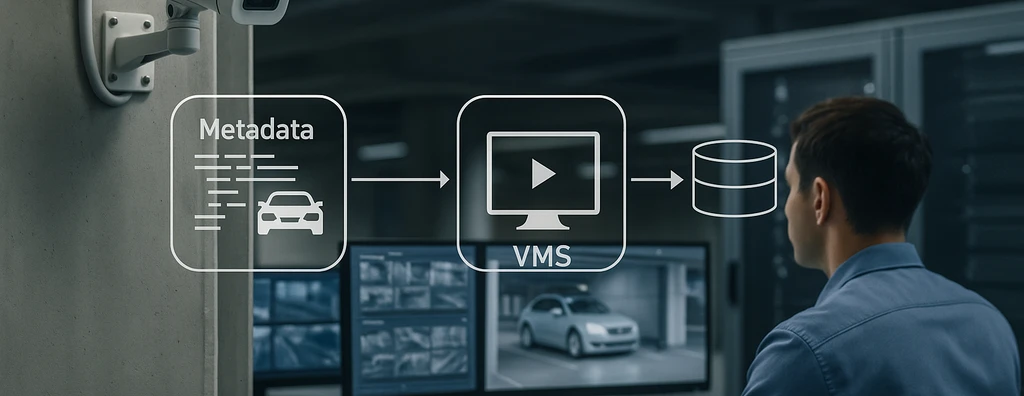
Understand how VMS platforms receive, interpret, and process metadata from cameras and analytics systems, including indexing, search, export, and ONVIF interoperability.
Check it out!
The field of electronic video monitoring systems is evolving rapidly, driven by the growing complexity of environments and the need for agile and intelligent operational responses. The integration of metadata, generated by edge devices, advanced analytics, and cloud applications, has become a central element for ensuring not only security, but also long-term efficiency and scalability. However, processing and structuring metadata from diverse streams presents relevant technical challenges, requiring interoperability between devices and software, adherence to standards such as ABNT NBR IEC 62676, and compatibility with standardized protocols such as ONVIF Profile S, G, and M.
In this article, the mechanisms through which video management systems (VMS) receive, interpret, and process metadata from cameras and analytics devices will be detailed, addressing normative aspects, logical architecture of data flows, encapsulation formats, and indexing, search, and export processes. The objective is to provide solid foundations for technical decisions, implementation, integration, and optimization of electronic security projects.
Check it out!
[elementor-template id=”24446″]
Metadata Conceptualization in Video Monitoring
Metadata is structured information that describes relevant elements extracted from the video stream, adding context and descriptive information about events, objects, scene characteristics, and operational parameters. In the context of security systems, metadata includes data such as location, time, object attributes (type, color, speed), classification by category (for example, vehicle or person), coordinates, dwell time in the scene, among others.
- Structural metadata example:
- Location: x,y coordinates in the image
- Date/time of the event
- Object type and class: e.g. vehicle -> car
- Attributes: color/black, plate/license ABC123
- Estimated object speed
The insertion of this data, often based on automated extraction through video analytics algorithms, enhances functionalities such as advanced-criteria searches, automatic alarm triggering, pattern detection, and historical or real-time trend analysis.
Normative Architecture and Protocols for Metadata Transmission
The transmission and reception of metadata in video monitoring systems follow established normative principles, with emphasis on ABNT NBR IEC 62676-1-2:2019, which defines protocols, formats, and minimum requirements for device integration and management software. IP video protocols, including ONVIF Profile S (video, audio, and PTZ control), Profile G (recording and search), and Profile M (metadata, events, and analytics), are responsible for standardizing transport, ensuring interoperability and reliability among products from different vendors.
- Standardized processes:
- Encoding and encapsulation of metadata associated with the video stream (preferably in XML, according to ABNT NBR IEC 62676-1-2:2019, item 8.3.1).
- Synchronous transmission of video streams and respective metadata packets in real time.
- Triggering of automatic events (for example, motion detection, abandoned objects) through the transport of analytics information defined at the edge.
- Metadata Capture and Generation: Algorithms embedded in cameras or analytics appliances perform the detection and classification of events, objects, or specific situations.
- Standardization and Encapsulation: The extracted data is formatted into XML, JSON, or other standards supported by ONVIF and ABNT norms, being associated temporally and logically with the video stream.
- Stream Transmission: Using IP protocols, video and metadata travel through synchronized streams to the VMS server or processing environment.
- Reception and Decoding in the VMS: The VMS identifies metadata streams, performing information decoding and indexing while maintaining correlation with the original video content.
- Storage, Indexing, and Querying: Once stored, metadata is indexed, allowing efficient searches by specific attributes (example: object color, vehicle plate, time range).
- Export and Integration: The data can be exported in various standardized formats for forensic analysis, auditing, or integration with third-party systems.
- Motion and Intrusion Detection: Analyzes scene variations to identify improper movement or access to restricted areas.
- Object Recognition and Classification: Captures attributes of people, vehicles, and baggage, assigning labels according to configured rules.
- Character and Plate Reading: Essential for vehicle monitoring, identifies alphanumeric sequences, colors, and relevant characteristics.
- Trajectory and Dwell-Time Tracking: Monitors movement, speed, and stopping zones of objects, useful for flow and behavior analysis.
- Automatic filtering and searching of incidents based on rules and attributes of received metadata
- Triggering of responses or alarms according to analytically identified conditions
- Storage and classification of metadata in databases for later extraction and analysis
- Fundamental transmission characteristics:
- Preservation of a single time stamp for synchronization with video
- Standardization of payload and documentation of metadata schemas
- Capability for simultaneous and correlated transmission of multimedia streams and metadata
- Resilience against packet loss and prioritization of critical information
- Keyword, attributes, or specific tags
- Date/time interval
- Type and/or combination of detected object types
- Heat maps, trajectories, and atypical behaviors
- “List all videos in which a red car remained parked in zone 4 between 6:00 p.m. and 7:00 p.m. on March 25”
- Strict access control to metadata repositories
- Implementation of logs and audit trails
- Key management for encryption/decryption
- Significant reduction in forensic analysis time
- Automation of responses for critical events
- Preparation of detailed reports for diagnostics and decision-making
- Early detection of anomalous behaviors and incident prevention
In addition, compliance with ONVIF specifications ensures that compatible VMS platforms can receive, decode, and process metadata in sync with analytics applied directly in cameras or central servers.
Logical Flows for Metadata Reception in VMS
The process of receiving metadata in a VMS can be described in logically ordered stages, ranging from initial capture at the camera to availability for search and export:
This modeling provides robustness to the system, optimizing responses to critical events and meeting auditing and compliance requirements.
Video Analytics: Detection, Generation, and Structuring of Metadata
Video analytics algorithms automatically detect relevant incidents, extracting metadata directly at the edge (in the camera itself) or centrally in specialized servers. Among the main analytical methods present in modern security systems, the following stand out:
This metadata is instrumental for retroactive searches, generation of statistical reports, and implementation of automated responses. The potential increases exponentially when combined with efficient indexing and automation mechanisms provided by VMS platforms.
Interoperability and ONVIF Specifications for Metadata
Interoperability among devices from different manufacturers is ensured through the implementation of ONVIF profiles, notably Profile M, which enables the transmission and querying of metadata streams and standardized analytics events. Cameras compliant with these profiles communicate transparently with VMS software, enabling functionalities such as:
Profile M standardizes syntactic and semantic elements of the metadata stream, promoting integration and scalability even in multi-vendor environments or with analytics from different suppliers.
Formatting, Transmission, and Synchronization of Metadata Streams
According to ABNT NBR IEC 62676-1-2, metadata must be encapsulated in a way that preserves temporal and referential information associated with the video stream. The typical flow involves the use of structured XML documents transmitted in parallel with video, in real time, including static attributes (camera ID, configuration parameters) and dynamic attributes (events, detections, state changes).
These principles ensure total traceability between detected events and the corresponding visual material, which is indispensable for audits and forensic investigations.
Metadata Indexing, Searching, and Export in VMS
One of the main differentiators enabled by the correct handling of metadata in a VMS is the aggressive reduction of search and forensic investigation time. The system stores and organizes detailed data about incidents, allowing queries by multiple criteria:
Textual example of a query flow:
The VMS may also export metadata in standardized formats, allowing integration with BI systems, external analyses, and generation of technical reports according to project requirements.
Normative Requirements and Information Security Considerations
Normative implementation requires the VMS to provide integrity detection mechanisms and, when applicable, encryption, ensuring that metadata is not tampered with or used to access sensitive content improperly. ABNT NBR IEC 62676-2 recommends the use of methods such as checksums and watermarking, avoiding any impact on the quality or fidelity of the original video stream.
These practices reinforce the reliability of records and support their use in strict legal and institutional processes.
Advanced Use Cases and Operational Benefits
The integrated use of metadata allows operators to develop complex searches and automated actions. Among the tangible benefits observed in practice, the following stand out:
In this way, proper structuring of metadata flows expands operational efficiency, system scalability, and the generation of strategic value for corporate security projects.
Conclusion
The careful processing of metadata in video management systems is a strategic component for the optimization and modernization of video monitoring. Normative rules such as ABNT NBR IEC 62676 establish standards for encapsulation, transmission, indexing, and querying, promoting interoperability and robustness. ONVIF protocols facilitate multi-vendor integration, enabling advanced searches and intelligent automation while meeting current and future security demands.
By adopting technical practices aligned with standards, projects become more auditable, resilient, and efficient, promoting a paradigm shift in the operational efficiency and intelligence of security operations.
Final Considerations
The fusion between analytical intelligence and normative standardization positions VMS-based systems with metadata as a reference for the next generation of electronic security. Thank you for reading this article, and we invite everyone to follow A3A Engenharia de Sistemas on social media to keep up with best practices and trends in security, networking, and electrical engineering projects.