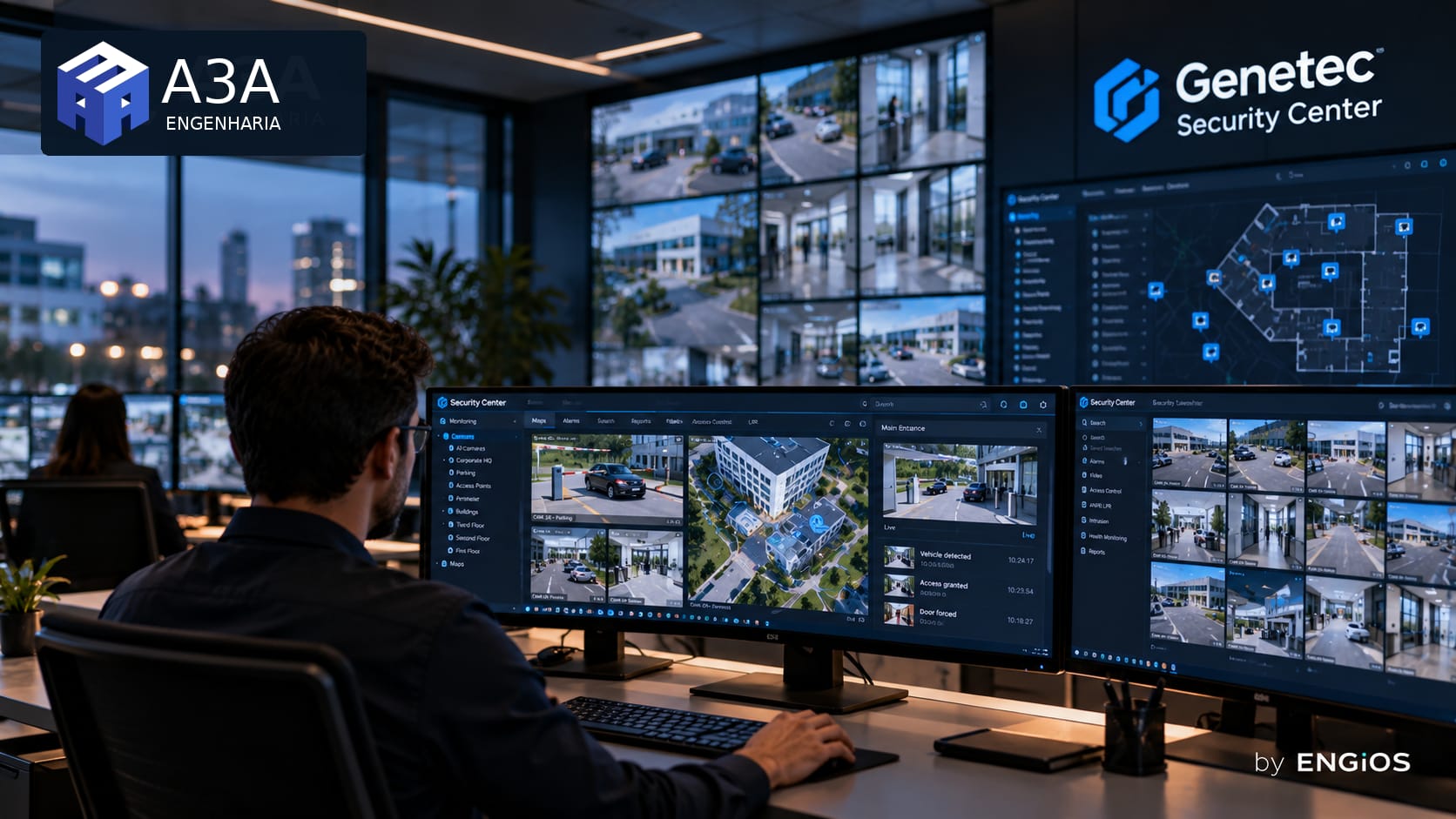
The Genetec Security Center is a modular and unified physical security platform designed to provide a centralized layer of management, control, and integration across different security subsystems, such as video monitoring (VMS), physical access control (ACS), automatic license plate recognition (ALPR), and event and incident analytics.
Compatible with a wide range of IP cameras, access controllers, IoT devices, and third-party security systems, Genetec Security Center stands out as one of the most complete and flexible solutions available on the market for protecting corporate environments, critical infrastructure, and distributed operations.
System Overview
The Genetec Security Center features a distributed architecture based on cooperating microservices, where each platform component is responsible for a specific set of functionalities, with internal communication through network protocols and event-driven messaging.
The modular design allows each subsystem (video, access, alarms, automation) to operate independently or in an interconnected manner, offering high flexibility for simple environments or distributed multilevel topologies.
The platform is composed of a series of specialized modules, each responsible for a specific function within the physical security ecosystem.
- Omnicast: Video monitoring module (VMS), responsible for capturing, recording, streaming, playback, and analysis of real-time and historical video feeds.
- Synergis: Physical access control module (ACS), responsible for managing controllers, doors, credentials, and access events.
- AutoVu: Automatic license plate recognition module (ALPR), responsible for processing license plate images captured by surveillance cameras and correlating them with configured lists and policies.
- Mission Control: Incident management and automated workflows module, enabling the creation of event-driven workflows.
Each module is implemented as a set of services that can be distributed across independent nodes, enabling load balancing, segmentation by site or function, and the flexibility to evolve the infrastructure in a modular fashion.
Communication between modules is carried out via standard TCP/IP protocols, using structured messages and metadata persistence in relational databases and event databases optimized for real-time querying.
Each server or service on the platform is registered and authenticated with the Directory Server, which acts as the central point for authentication, authorization, and service discovery.
The platform offers different client types for interacting with services:
- Security Desk (Thick Client): Full-featured desktop application with direct access to services, local video handling (client-side decoding), and complete administrative functionality.
- Web Client (Thin Client): Remote access web interface, where decoding and transcoding are performed on the Media Gateway server.
- Mobile App (Thin Client): Mobile device application focused on quick consultation and response, consuming optimized streams from the Media Gateway.
This separation allows balancing local performance, remote access, and security, ensuring that environments with high camera or event density can distribute the load between client and server according to the available infrastructure.
Integration and Extensibility Layer
All Genetec Security Center modules expose documented APIs and extension points for integration with external systems. This integration layer includes:
- SDKs and libraries for native plugin development (C#, .NET).
- RESTful APIs for integration with third-party systems (ERP, PSIM, SIEM).
- Hooks for real-time event consumption and injection.
- Configurable automation mechanisms (Event-to-Action).
This model ensures that developers can create extensions and integrations without direct dependency on core updates, enabling customization and adaptation to specific business rules.
Multisite and Federation
Genetec Federation enables the unification of multiple Security Center instances into a single, centralized view, where each site maintains its operational autonomy while sharing events, data, and global policies with the federated directory.
This model is especially relevant for:
- Enterprises with distributed branch offices.
- Logistics operators.
- Retail networks.
- Critical infrastructures with multiple monitoring points.
Hybrid and Cloud Scenario Support
Although traditionally deployed on-premises, Security Center also supports running components in hybrid cloud environments, allowing:
- Backup and replication services to be stored in cloud buckets (AWS S3, Azure Blob).
- Media Gateway to operate at the edge for remote access optimization.
- Advanced analytics to be executed on external AI and ML services.