
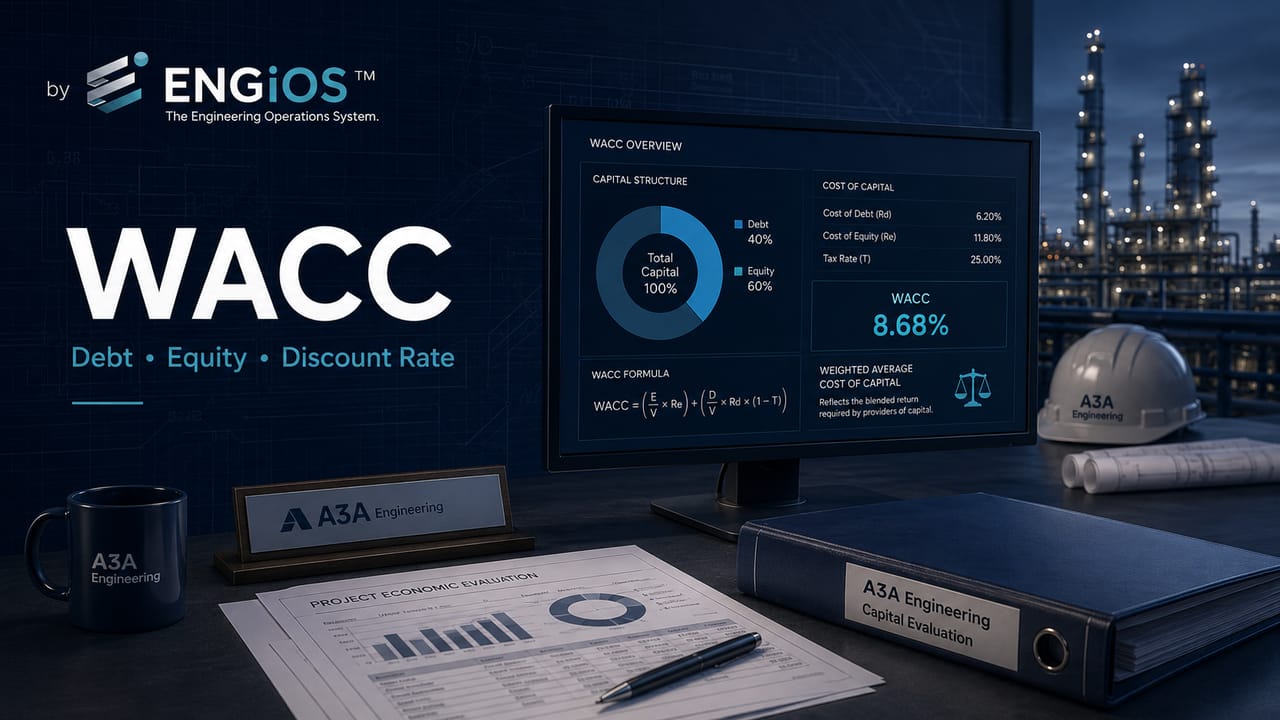
Understand WACC in engineering projects: weighted average cost of capital, cost of equity, debt, CAPM, capital structure, discount rate, and its application in DCF and NPV.
Check it out!
WACC stands for Weighted Average Cost of Capital. It represents the combined cost of a company’s main financing sources—typically equity and debt—weighted by each source’s share of the capital structure. In investment appraisal, WACC can serve as the discount rate for free cash flow to the firm when the project’s risk is consistent with the risk of the assets underlying that cost of capital.
In engineering projects, that last condition is critical. Automatically applying the corporate WACC to every CAPEX decision can create false precision. A low-uncertainty retrofit, an industrial expansion, a new plant in another country, an emerging-technology project, and regulated infrastructure can have very different risk profiles even when they belong to the same organization. WACC should therefore be understood as an economic benchmark linked to risk, financing structure, currency, inflation, and cash-flow perspective—not as a fixed percentage to be applied indiscriminately to every decision.
The practical role of WACC is to establish the average return required by the providers of capital that finance the company’s assets. When used in a DCF, it converts future cash flows into present value and provides the benchmark against which value creation can be assessed. The quality of the valuation depends on consistency: cash flow and discount rate must reflect the same currency, the same nominal or real basis, the same risk perspective, and the same economic structure.
What Is WACC and Why It Matters
The cost of capital functions as an opportunity rate. Capital committed to one project is no longer available for other investments and must compensate the parties that provide it. Shareholders bear residual risk and require a return on equity. Lenders provide debt and require interest consistent with credit risk, tenor, and market conditions.
WACC combines these two dimensions. In its most familiar form:
WACC = Ke × E/(D+E) + Kd × (1 − T) × D/(D+E)
where:
- Ke is the cost of equity;
- Kd is the pre-tax cost of debt;
- T represents the tax rate applicable to the debt tax shield, when relevant;
- E is the market value of equity;
- D is the economic value of debt considered in the financing structure.
The formulation can be expanded when preferred stock or other material sources of capital exist. The principle remains the same: each component is weighted by its economic share of the financing structure.
Aswath Damodaran’s NYU Stern datasets treat cost of capital as the weighted average of the cost of equity and the after-tax cost of debt, using market-value weights. The sector dataset published in January 2026 also shows that beta, cost of equity, cost of debt, capital structure, and WACC vary across sectors—practical evidence that a single rate does not represent every business equally.
WACC Is Not the Project’s Interest Rate
The interest rate on a financing facility is the contractual cost of that debt. WACC represents the average economic cost of the capital sources supporting the company or the set of assets being analyzed.
If a company funds a project with 100% equity, that does not make the cost of capital zero. Equity has an opportunity cost. Likewise, obtaining subsidized financing does not mean that the economic cost of the entire investment is simply the rate charged on that facility.
WACC Is Not the Same as a Hurdle Rate
A hurdle rate is a decision criterion established by the organization to evaluate investments. It may use WACC as a reference, but it can incorporate additional policy requirements, risk premiums, capital constraints, strategic targets, or portfolio criteria.
Discounted Cash Flow in Engineering Projects examines this distinction in greater depth. WACC seeks to represent the economic cost of capital associated with asset risk; the hurdle rate is a cutoff rate used in decision governance.
An organization may, for example, establish different hurdle rates for different classes of investment. What matters is not hiding that policy inside an apparently “objective” WACC.
The Relationship Between WACC, DCF, and NPV
The discount rate is not an administrative spreadsheet field. In long-life projects, it can materially change NPV and the ranking of alternatives.
In discounted cash flow analysis, the rate must be consistent with the cash flow being discounted. When the valuation uses free cash flow to the firm—before payments to lenders and shareholders—WACC is a natural benchmark because it jointly compensates debt and equity.
Conceptually:
Project value = sum of free cash flows to the firm discounted at WACC
The article on NPV, IRR, Payback, and ROI shows that NPV follows directly from this structure. A higher rate reduces the present value of future benefits; a lower rate increases it.
This is why selecting the rate is not a mathematical detail. In long-duration projects, infrastructure, and assets whose benefits are concentrated in the future, small differences in the rate can significantly change NPV and even reverse the ranking of alternatives.
How to Estimate the Cost of Equity
The cost of equity represents the return investors require to bear the residual risk of the business. Unlike debt, it does not appear in a contract as an explicit rate.
A widely used approach is CAPM—the Capital Asset Pricing Model:
Ke = Rf + β × ERP
where:
- Rf is the risk-free rate consistent with the currency and horizon;
- β is beta, a measure of the asset’s exposure to systematic market risk;
- ERP is the equity risk premium.
In international analyses or markets with material sovereign risk, the model may require additional adjustments, provided they are applied with methodological consistency.
The Risk-Free Rate Must Be Consistent with the Currency
A common mistake is choosing the risk-free rate solely according to the country where the project is located. The rate must be consistent with the currency in which the cash flows were modeled.
If the DCF is modeled in nominal Brazilian reais, the rate must reflect nominal conditions consistent with that currency. If the model is in U.S. dollars, the rate and premium references must be dollar-consistent. Mixing cash flows in one currency with a rate built in another can incorporate inflation and risk inconsistently.
Beta Measures Systematic Risk, Not Total Project Risk
Beta seeks to capture how the return of an asset or business relates to market risk that cannot be eliminated through diversification. It is not a generic score for operational risk.
Engineering failures, delays, cost overruns, permitting, supplier unavailability, and performance uncertainty are risks that must be addressed within the project. Some may affect expected cash flows; some may justify scenario adjustments; some may influence the selection of comparables. Simply increasing beta to “cover everything” tends to mix risks of different natures.
The Company’s Historical Beta May Not Represent the Project
A project may fall outside the organization’s current profile. A mature company may invest in emerging technology. A service company may build a capital-intensive asset. A domestic industrial company may begin operating in another jurisdiction.
In such cases, using the company’s historical beta without further analysis assumes that the new project has the same economic risk as the existing business.
One alternative is a bottom-up beta, using comparable companies from the relevant sector or activity, unlevering and relevering the exposure to a consistent capital structure. This approach reduces dependence on the statistical noise of a single company and can better approximate the risk of the asset being evaluated.
How to Estimate the Cost of Debt
The cost of debt represents the return required by lenders to finance the organization or asset. It depends on the base rate, tenor, credit risk, collateral, currency, liquidity, and market conditions.
A conceptual way to structure it is:
Pre-tax Kd = risk-free rate + credit spread
The credit spread represents the additional compensation required for default risk and other financing conditions.
Damodaran’s datasets use a risk-free rate plus a default spread to estimate the cost of debt. The exact methodology may vary, but the principle is useful: debt carries risk, and that risk changes over time.
Historical Debt Cost May Not Represent Marginal Debt Cost
An organization may have legacy contracts signed in interest-rate environments very different from current conditions. Using the accounting average of interest paid can understate or overstate the cost of raising new capital today.
For new-investment appraisal, the marginal cost of financing is generally more informative than the historical cost reported in the financial statements.
The Debt Tax Shield Must Be Applied Carefully
The classical WACC formulation uses the after-tax cost of debt:
After-tax Kd = Kd × (1 − T)
The logic is that interest may generate a tax benefit when it is deductible and when the company has sufficient taxable income to use that deduction.
Automatically applying the full tax rate can overstate the benefit when there are tax limitations, special regimes, tax losses, incentives, or structures in which deductibility does not occur as assumed.
The tax parameter should reflect the organization’s economic and regulatory reality.
Debt and Equity Weights: Why Market Values Matter
WACC is a measure of current opportunity cost. Its weighting therefore seeks to reflect the current economic value of the capital sources.
Damodaran emphasizes market-value weights: market value of equity and economic value of debt. Book values represent historical amounts recorded in the accounts and may differ substantially from the economic structure investors observe today.
Current and Target Capital Structures Are Not Necessarily the Same
If the company is transitioning its capital structure, the current mix may not represent the long-term condition that will support the project’s cash flows.
Long-duration projects may justify using a target or normalized capital structure, especially when the model assumes convergence toward a sustainable debt-to-equity mix.
The choice must be documented: using the current structure, the corporate target, or the structure of comparables produces different results.
Nominal WACC and Real WACC
Consistency between inflation and the discount rate is one of the most important checks in a DCF.
Nominal cash flows incorporate expected inflation and should be discounted using a consistent nominal rate. Real cash flows are modeled at constant prices and should be discounted using a real rate.
The relationship between nominal and real rates can be expressed through the Fisher equation:
(1 + nominal rate) = (1 + real rate) × (1 + expected inflation)
Using real cash flows with a nominal WACC artificially reduces present value. Using nominal cash flows with a real rate artificially increases value.
In engineering projects, the problem can be even more significant because different CAPEX and OPEX components may experience different inflation: labor, imported equipment, energy, commodities, technical services, and contracts may follow different indices. The model must decide whether it works in real or nominal terms and maintain consistency throughout the analysis.
WACC and Currency: The Project Must Be Evaluated on a Consistent Basis
The currency of the cash flow influences the risk-free rate, inflation, and part of the premiums used in the discount rate. A Brazilian project can be evaluated in reais or in foreign currency, but cash flow and rate must be aligned.
If equipment costs are dollar-denominated while revenues are in reais, foreign-exchange risk should appear consistently in the cash flow, scenarios, or contractual structure. It is not methodologically sound to “solve” all currency exposure by simply adding a few percentage points to the discount rate without explaining the rationale.
The cost-benefit analysis in engineering projects shows the importance of separating technical, economic, and scenario assumptions before synthesizing the decision into an indicator.
Corporate WACC Does Not Automatically Apply to Every Project
Using corporate WACC as a universal rate can penalize low-risk defensive projects or overvalue initiatives that are much riskier than the existing business.
This is one of the most important points in engineering applications. A company’s WACC reflects the average risk of its existing assets and the financial structure of the business. A new project should use that rate without adjustment only when its economic risk is sufficiently similar to the risk that produced that WACC.
Projects Below Average Risk
Mandatory replacement, efficiency, or mature-infrastructure investments may have lower cash-flow risk than an aggressive expansion or a new business. Applying the same hurdle rate to both can lead to underinvestment in high-value defensive projects.
Projects Above Average Risk
Experimental technology, entry into a new market, different regulatory exposure, or major demand uncertainty can make risk higher than that of the current business. In that case, corporate WACC may understate the required return.
The Solution Is Not an Arbitrary Premium
Adding “another 3% for project risk” without decomposing the reason produces a rate that is difficult to audit. Whenever possible, specific risks should first be reflected in cash flows, scenarios, probabilities, contingencies, and comparables.
A premium in the discount rate should be used when there is an economic basis for additional systematic risk, not as a container for every project uncertainty.
Specific Risk and Systematic Risk Must Be Separated
Project-specific technical risk should be modeled in cash flows, scenarios, and responses—not simply stacked into the discount rate until the model looks conservative.
Systematic risk is related to market factors that broadly affect assets and cannot be eliminated through diversification. It belongs in the formation of the cost of equity and WACC.
Project-specific risks—for example construction delay, productivity, supplier failure, technology performance, estimating error, logistics, or permitting—can be mitigated, contracted, insured, or diversified.
In project risk management, these events are treated through probability, impact, response, and monitoring. In economic appraisal, they should change expected cash flows, scenarios, or outcome ranges when materially relevant.
Adding all of them as a discount-rate premium can count the same risk twice: once in the downside cash flow and again in the rate.
WACC, Hurdle Rate, and Investment Governance
An organization can structure its investment policy in layers:
- Corporate WACC: benchmark for the average cost of capital of the current business.
- WACC by business unit or activity: approximation of the economic risk of different businesses.
- Project-adjusted rate: when the project has different systematic risk and there is an economic basis for adjustment.
- Hurdle rate: approval criterion defined by governance, potentially incorporating strategic or capital constraints.
This architecture is more transparent than using a single rate for everything.
The Business Case in Engineering Projects should record which rate was adopted, why it is appropriate, who approved the assumption, and how material changes will be treated over the life of the project.
WACC and the Social Discount Rate Are Not Equivalent
Public projects or social-impact evaluations may use social discount rates defined by economic policy. Their purpose differs from that of corporate WACC.
HM Treasury’s Green Book 2026 uses its own framework for social time preference and the appraisal of social costs and benefits. This rate is not intended to compensate a company’s shareholders and lenders; it is intended to compare social impacts over time.
Private-sector WACC therefore should not be transferred automatically into a social appraisal, nor should a social discount rate be used to calculate financial return to investors. The perspective of the appraisal determines the appropriate rate.
WACC and Project Financing
An economic decision must separate asset attractiveness from financing structure.
A project can be economically attractive and still have poor financing. It can also look attractive to equity because of high leverage even when the underlying asset does not create sufficient value.
When the DCF uses free cash flow to the firm and WACC, the financing structure is reflected in the rate and should not be deducted again from the cash flow as though it were an operating cost of the project.
If the analysis is from the shareholder’s perspective, the logic changes: equity cash flow includes debt, principal repayments, and interest, and the appropriate discount rate is the cost of equity, not WACC.
Mixing these two perspectives is one of the most common errors in investment models.
Simplified WACC Calculation Example
Consider a company with the following simplified economic structure:
| Component | Assumption |
| Market value of equity | 70% of capital |
| Debt | 30% of capital |
| Cost of equity | 14% p.a. |
| Pre-tax cost of debt | 9% p.a. |
| Applicable effective tax rate | 30% |
The after-tax cost of debt would be:
9% × (1 − 30%) = 6.3% p.a.
The simplified WACC would be:
WACC = 14% × 70% + 6.3% × 30% = 11.69% p.a.
This calculation demonstrates the mechanics, but it does not validate the rate for a real project. Before using 11.69% in a DCF, it would be necessary to verify, among other points:
- whether the weights represent market values or a target structure;
- whether the cost of equity is consistent with project risk;
- whether the cost of debt is current and marginal;
- whether the tax benefit can actually be used;
- whether cash flow and rate are in the same currency;
- whether both are nominal or real;
- whether the project horizon requires changes in capital structure over time;
- whether specific risks have already been incorporated into the cash flow.
The arithmetic is simple; engineering the assumption is the difficult part.
How to Use WACC in Engineering Projects
Capacity Expansion
The cash flow should reflect investment, ramp-up, incremental revenue or benefit, OPEX, working capital where applicable, and residual value. WACC should represent the economic risk of the expanded activity.
If the expansion replicates an existing business, the corporate rate may be a good reference. If it opens a different market or introduces a different technology, specific comparables may be necessary.
Retrofit and Modernization
In retrofit projects, a significant part of value may come from OPEX savings, availability, risk reduction, and deferred replacement. The project may have a lower risk profile than a commercial expansion.
Applying an excessively high hurdle rate can reject efficiency investments whose economic risk is relatively low and whose benefits are defensive.
Critical Infrastructure
Energy, telecommunications, security, automation, or data-center projects may generate benefits linked to continuity and resilience rather than revenue alone.
The discount rate does not solve the monetization of those benefits. First, the base case must be built and avoided losses or downtime costs modeled using technical evidence. WACC can then be used to discount the appropriate financial cash flows.
Regulatory or Mandatory Projects
When an investment is required to maintain compliance, the question may not be “does the return exceed WACC?”. The relevant decision may instead be which alternative satisfies the obligation at the lowest economic cost, lowest risk, or best life-cycle performance.
In such cases, cost-effectiveness, TCO, and multi-criteria analysis may be more useful than an approval rule based only on positive NPV.
Discount Rate Sensitivity
Even when WACC has been calculated correctly, it remains an estimate. The risk-free rate, market risk premium, beta, credit spread, capital structure, and tax conditions change over time.
A robust appraisal should therefore test how NPV responds to different discount rates.
A sensitivity table can show, for example:
| Rate | Project NPV |
| WACC − 2 p.p. | lower-rate scenario |
| WACC | base case |
| WACC + 2 p.p. | higher-rate scenario |
The NPV figures depend on the project’s actual cash flow. The purpose of the table is not to establish a universal range of ±2 percentage points, but to make the conclusion’s dependence on the rate visible.
If a small change in WACC changes the sign of NPV, the decision has a low economic margin of safety and deserves deeper analysis.
WACC That Changes over Time
Simplified models use a constant rate. However, cost of capital and financing structure can change over the asset life cycle.
A greenfield development may carry higher risk during implementation and lower risk after operations stabilize. The company may deleverage or refinance debt. A project may also pass through different economic regimes.
Modeling a time-varying WACC is justified only when there is an economic basis for estimating that path. Creating a different rate for every year without evidence adds complexity without necessarily improving quality.
For governance models, a practical alternative is to maintain a base rate, test sensitivity scenarios, and update the assumption at decision gates as the project matures.
WACC in Project Portfolio Management
The cost of capital also influences prioritization. If every project is evaluated using the same rate, investments with structurally different risks may be compared unfairly.
Project Portfolio Management must combine return, risk, capacity, dependencies, strategy, and resource constraints. WACC and NPV are important, but they do not by themselves produce the optimal portfolio ranking.
Mature governance defines investment classes, criteria, and common assumptions so that projects can be compared consistently without pretending they all have the same economic nature.
Common Mistakes When Using WACC
Using Book Value Instead of Economic Value
Book-value weights may be far from the market structure and produce a rate that does not reflect the current opportunity cost of capital.
Using Historical Cost of Debt
Interest rates on legacy contracts may not represent the marginal cost of raising debt today.
Using the Company Beta for a Very Different Activity
The systematic risk of the new project may differ from that of the existing business.
Putting Every Risk into the Discount Rate
Construction, supplier, schedule, and performance risks should primarily be treated in cash flows and scenarios. Adding them again to the rate can create double counting.
Mixing a Nominal Rate with Real Cash Flow
This error systematically distorts present value.
Mixing Currencies
A rate built in U.S. dollars combined with nominal cash flow in reais, without proper treatment, creates inconsistencies in inflation and risk.
Confusing WACC with the Cost of Contracted Financing
The borrowing cost is only one component; equity also has a cost.
Confusing WACC with the Corporate Hurdle Rate
Hurdle-rate policy may be higher than or structured differently from the cost of capital. The distinction should be transparent.
Applying the Same WACC to the Entire Portfolio
Projects with materially different economic risk may require different rates or different appraisal approaches.
Changing the Rate Until the Project “Passes”
The rate is a market-and-risk assumption, not an instrument for producing the desired NPV.
How to Document the Discount Rate in a Business Case
The discount rate used should be auditable. A robust Business Case records at least:
- valuation base date;
- cash-flow currency;
- whether the cash flow is nominal or real;
- risk-free rate;
- beta methodology and source;
- market risk premium;
- additional adjustments, if any;
- cost of debt and source;
- tax treatment;
- debt and equity weights;
- current or target capital structure;
- calculated WACC;
- relationship between WACC and the corporate hurdle rate;
- sensitivity range used;
- person responsible for validating the assumption.
This audit trail reduces future disputes over “which rate was used” and allows the appraisal to be updated without rebuilding the entire logic.
The Technical and Economic Feasibility Study service is appropriate when an organization needs to integrate engineering assumptions, costs, benefits, risks, and discount rate into a structured decision.
WACC Should Be Updated at Project Gates
WACC does not need to be recalculated daily, but material assumptions can change between concept development, FEL, basic design, contracting, and implementation.
Relevant changes include:
- change in investment currency;
- new financing structure;
- change of country or market;
- significant change in project activity;
- change in credit risk;
- major change in market conditions;
- revision of the tax regime;
- change in comparables or beta;
- corporate restructuring.
The FEL — Front-End Loading service provides a maturation environment in which the economic justification can be progressively reviewed before new capital commitments are made.
When Consulting Engineering Participates in Defining the Rate
The final determination of WACC normally involves corporate finance, controllership, or financial advisory functions. Consulting Engineering should not invent the cost of capital in isolation.
Its role is to ensure that the rate is applied to the correct cash flow and that technical risks are not treated inconsistently. This includes:
- structuring technically comparable alternatives;
- producing traceable CAPEX and OPEX;
- separating technical risk from systematic risk;
- building implementation and operating scenarios;
- checking useful life and residual value;
- estimating availability and reliability impacts;
- documenting assumptions;
- testing the robustness of the decision.
Engineering Technical Consulting acts, in this context, as the interface between engineering, operations, and financial governance.
Final Considerations
WACC is much more than a weighted-average formula. It represents the economic cost of capital associated with a given risk exposure and financial structure. Correct use in engineering projects requires consistency among cash flow, currency, inflation, risk, debt, equity, taxes, and time horizon.
Corporate WACC is a useful benchmark, but not a universal rate. Projects whose economic risk differs from the existing business require specific analysis. Execution risks should not be arbitrarily stacked into the rate, and corporate hurdle-rate policy must be distinguished from the cost of capital itself.
When the assumption is transparent and integrated into a technically sound DCF, WACC helps convert future projections into a comparable basis for decision-making. When used as a fixed percentage without an audit trail, it can conceal more uncertainty than it resolves. For material investments, the rate should be treated as a governance assumption: documented, reviewable, and consistent with the asset being evaluated.
The rate used in the Business Case needs an audit trail: source, base date, currency, inflation, beta, cost of debt, capital structure, and the person responsible for approval.
Technical References
[1] PROJECT MANAGEMENT INSTITUTE. The Standard for Project Management and A Guide to the Project Management Body of Knowledge (PMBOK® Guide). 8th ed. Newtown Square: PMI, 2025. Available at: https://www.pmi.org/standards/pmbok
[2] DAMODARAN, Aswath. Cost of Equity and Capital (US). New York: NYU Stern, updated Jan. 2026. Available at: https://pages.stern.nyu.edu/~adamodar/New_Home_Page/datafile/wacc.html
[3] DAMODARAN, Aswath. Financial Measures & Ratios — Cost of Capital. New York: NYU Stern. Available at: https://pages.stern.nyu.edu/~adamodar/New_Home_Page/definitions.html
[4] DAMODARAN, Aswath. DCF Inputs — Weighted Average Cost of Capital. New York: NYU Stern. Available at: https://pages.stern.nyu.edu/~adamodar/New_Home_Page/lectures/dcfinput.html
[5] HM TREASURY. The Green Book 2026: appraisal and evaluation in central government. London, 2026. Available at: https://www.gov.uk/government/publications/the-green-book-appraisal-and-evaluation-in-central-government/the-green-book-2026
Frequently Asked Questions
WACC is the weighted average cost of capital. It combines the cost of equity and the cost of debt, weighted by the economic share of each financing source, and can be used as the discount rate for free cash flow to the firm when risk is compatible.
In simplified form, WACC = Ke × E/(D+E) + Kd × (1−T) × D/(D+E), where Ke is the cost of equity, Kd is the cost of debt, T is the applicable tax effect, and E and D are the economic values of equity and debt.
No. WACC seeks to represent the average economic cost of capital associated with asset risk. A hurdle rate is a decision cutoff defined by the organization and may use WACC as a reference while incorporating additional policies and criteria.
Not automatically. Corporate WACC reflects the average risk of existing assets. Projects with materially different economic risk may require comparables, adjustments, or another discount-rate approach.
Because it seeks to reflect the current opportunity cost of capital sources. Book values are historical and may differ from the economic structure that investors and lenders observe today.
It is the cost of debt adjusted for the tax benefit of interest when that benefit actually applies. In simplified form, after-tax Kd = Kd × (1−T).
It depends on the cash flow. Nominal cash flows should be discounted using a consistent nominal rate; real cash flows using a real rate. Mixing the two bases distorts present value.
The higher the discount rate, the lower the present value of future cash flows tends to be. In long-duration projects, relatively small changes in WACC can materially change NPV.
Additional Technical Materials
Related Solutions
- Project, Program, and Portfolio Governance
- Engineering Indicators, Dashboards, and Executive Reports
- Process, Workflow, and Technical Approval Management
Related Services
Core Content on the Topic
- Discounted Cash Flow in Engineering Projects
- NPV, IRR, Payback, and ROI in Engineering Projects
- Business Case in Engineering Projects
- Cost-Benefit Analysis in Engineering Projects
