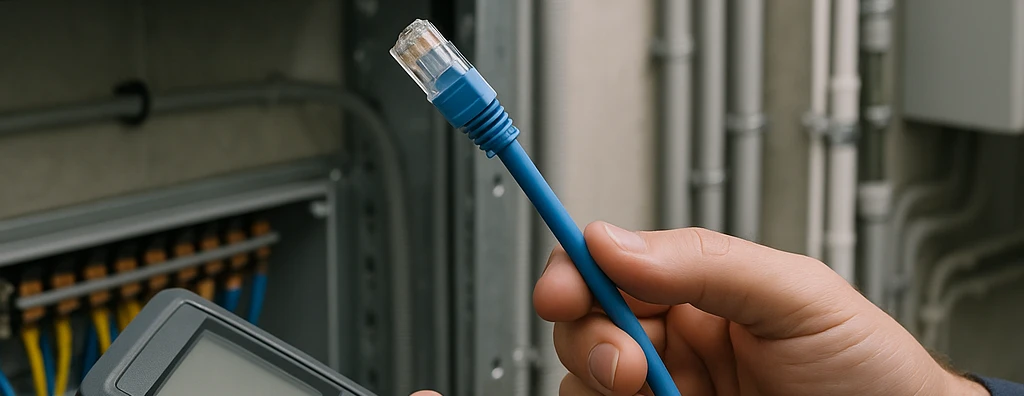
The selection and correct installation of cables, patch cords, and connectors are critical factors for the performance, robustness, and integrity of structured cabling systems, data networks, elect…
Check it out!
The selection and correct installation of cables, patch cords, and connectors are critical factors for the performance, robustness, and integrity of structured cabling systems, data networks, electronic security, and electrical installations. Technical dimensioning must strictly consider regulatory aspects, electromagnetic interference, installation environments, and specific transmission demands, whether for data, power, video, or voice. Inadequate considerations can result in performance degradation, susceptibility to failures, operational safety risks, and compromised regulatory compliance.
In this article, we will address in detail the technical criteria that guide the specification, physical routing, certification, and installation methods of cables, patch cords, and connectors in corporate environments, data centers, security systems, and areas with the coexistence of IT and power infrastructure. Regulatory reference requirements, technical best practices, and recommendations that ensure system performance, security, and interoperability will be explored.
Check it out!
[elementor-template id=”24446″]
Compliance with reference standards is imperative for the selection and installation of cables, patch cords, and connectors. Notable standards include:
- ANSI/TIA-568 (and European ISO/IEC 11801): standards for structured cabling in commercial environments, defining cable categories, performance, connections, methods, and certification limits.
- ANSI/TIA/EIA-569-C: specifies requirements for telecommunications pathways and spaces, establishing constructive and separation conditions for cable routing.
- ABNT NBR IEC 62676: establishes minimum requirements for video surveillance systems applied to electronic security, including transmission, network architecture, and IP connectivity.
- ABNT NBR 5410: regulates low-voltage electrical installations, with rules for routing, separation, protection, and installation methods for cables and conductors.
Adherence to these standards ensures security, prescribed performance, and interoperability between systems.
The choice of cables must be guided by technical criteria specific to the type of system, function, and environment:
1. Category and Cable Type
- Categories specified in ANSI/TIA-568, such as Categories 5e, 6, 6A (100 Ohm twisted pair), must be selected according to the required transmission rate, bandwidth, and application (voice, data, video, PoE).
- Optical cables OM3, OM4, or OS2 are indicated for high bandwidth and backbone applications, in accordance with international standardization.
2. Shielding
- Options such as UTP, FTP, STP, and S/FTP must be evaluated based on requirements for immunity to electromagnetic interference (EMI/EMC) and ambient noise – essential in industrial environments or proximity to power circuits.
3. Attenuation, NEXT, and PSNEXT
- Performance criteria such as attenuation, Near-End Crosstalk (NEXT), and Power Sum NEXT (PSNEXT) must be rigorously analyzed, following measurements and limits provided in ANSI/TIA-568-C.2.
4. Current Capacity and Gauges
- For cabling that supports Power over Ethernet (PoE) or power transmission, it is fundamental to respect the maximum current limits and thermal dissipation of the conductors, based on loading factors.
5. Electromagnetic Compatibility and Distances
- In security, telephony, or industrial transmission systems, it is recommended to limit the length of horizontal links (generally up to 90m for copper, according to specifications) and select shielded cables when subjected to noise sources.
6. Fire Reaction Classification
- Use cables with flame-retardant jackets and, when relevant, low smoke and toxic gas emission (LSZH), following local environmental or regulatory requirements.
Patch cords are critical elements for infrastructure flexibility and must be typologically compatible with the system cables, meeting the following requirements:
- Technical Category: Patch cords must meet the same categories as the link (CAS, CAE), avoiding performance bottlenecks.
- Shielding: According to the infrastructure (UTP or STP), to ensure continuity of electromagnetic protection.
- Length: The maximum length must be designed not to exceed the sum of 100 meters of the total channel, considering the restrictions of the ANSI/TIA-568 standard.
- Integrated Connectors: Patch cords must have compatible connectors (RJ-45, RJ-11, LC, SC) fully crimped, tested, and factory-certified.
- Flexibility and Robustness: Flexible, low-rigidity cables are indicated for temporary connections or dynamic setups. They must support connection/reconnection cycles while remaining within nominal performance tolerances.
The selection of the connector type is determined by the network application and cable category, prioritizing:
- Standardization: Use of connectors specified in standards (e.g., RJ-45 for data/voice, RJ-11 for telephony, LC/SC for optical fibers), with compatibility certification for the cable category/dimension.
- Performance: Connectors must ensure shielding continuity, correct mechanical alignment, and electrical/optical stability, respecting insertion and return loss requirements.
- Installation Techniques: Follow compatible termination methods (crimping, fusion, mechanical assembly) and use appropriate tools, preventing imperfections that cause excessive attenuation or increased crosstalk.
- Environment: In harsh environments, opt for industrial connectors or those protected against environmental factors (dust, moisture, chemical agents).
The physical installation process requires rigor to ensure system integrity and longevity. Key practical criteria include:
1. Routing and Physical Separation
- Segregate data/telecommunication cables from power circuits, as required by ABNT NBR 5410 and ANSI/TIA/EIA-569-C.
- Use properly dimensioned cable trays, ducts, and baskets with separators to minimize electromagnetic interference and facilitate maintenance.
- Observe minimum bend radius recommended by the manufacturer, avoiding areas of mechanical compression that could damage the cable structure.
2. Fixing and Support
- Cables must not be stressed or subjected to tensile forces higher than the specified limit.
- Employ clips, ties, and guides designed to support the weight of the cables without crushing.
3. Identification and Documentation
- Label cables, patch cords, connection points, and racks according to administrative standards, as prescribed by ANSI/TIA-606-B.
- Maintain updated records of routes, points, connected equipment, and physical diagrams.
4. Grounding and Shielding
- Implement efficient grounding of shielding systems, connectors, and racks for EMI dissipation.
5. Fire Protection and Adverse Environments
- Use technical pathways that prevent fire propagation and respect compartmentalization according to NBR 5410.
- In the case of floor, wall, or ceiling trunking, choose materials compatible with the installation environment and conditions of external influences (water, corrosive agents, heat, etc.).
After installing cables, patch cords, and connectors, it is essential to proceed with systematic certification according to international standards. The main stages and parameters include:
- Electrical and Performance Tests:
- Mapping of conductors and verification of pair integrity.
- Measurements of length, insertion loss, attenuation, Near-End Crosstalk (NEXT), Power Sum NEXT (PSNEXT), Attenuation to Crosstalk Ratio, Far-End (ACRF), and Power Sum Alien Near-End Crosstalk (PSANEXT), according to ANSI/TIA-568-C.2.
- Optical certification for fiber links, with tests for insertion loss, return loss, and polarity analysis.
- Testing Equipment and Procedures: Calibrated and approved certifiers must be used, ensuring traceability of results.
- Documentation: All test results must be recorded and integrated into the project administration system, in accordance with standardized administrative requirements.
In environments where power and data cables share paths, rigorous practices must be adopted to ensure electromagnetic compatibility, operational safety, and legal compliance:
- Separation and Compartmentalization: Deploy separators or distinct technical pathways (separate cable trays, double ducts, etc.), always respecting the minimum distances established in standards such as ABNT NBR 5410.
- Conductor Dimensioning: Calculate the cable gauge according to conduction capacity standards (e.g., ABNT NBR 11301 for current transmission and ABNT NBR 13248 for selection of low smoke emission cables or hospital environments).
- Electrical Protection: Provide adequate protection devices (circuit breakers, RCDs, surge protectors) and ensure effective interconnection of grounding systems throughout the cable network.
These measures prevent risks of shock, fire, cross-interference, and prolong the useful life of the systems.
In video surveillance, alarm, and access control systems, cabling criteria require special attention:
- Regulatory Compliance: Ensure adherence to ABNT NBR IEC 62676 for IP CCTV systems regarding minimum transmission performance, network architecture, IP connectivity, and integration with existing IT systems.
- Transmission Requirements: Provide cabling suitable for the bandwidth and operational environment of the cameras and devices, prioritizing shielded cables in high EMI areas and respecting prescribed topology for load balancing and availability.
- Simplicity and Clarity in Interconnections: Standardize the use of connectors, patch panels, and racks that simplify maintenance and allow for rapid identification of points in cases of failure or upgrades.
- Terrain and Power Considerations: In outdoor installations or long distances, evaluate attenuation and provide additional protection against external surges and crossing with power cables.
The systemic organization of the physical infrastructure must be supported by solid administrative processes, according to regulatory guidelines:
- Registration and Labeling: Rigor in labeling cables, panels, outlets, and devices for rapid identification and traceability.
- Technical Documentation: Updated path maps, wiring diagrams, layout updates, test reports, and maintenance history must compose the project’s collection.
- Change Management: Any change must be recorded, with updates to plans and equipment lists, preventing inconsistencies and loss of operational control.
Adherence to the administrative standard (ANSI/TIA-606-B) allows for greater predictive maintenance capacity and risk reduction.
The set of technical criteria, standards, and recommendations presented consolidates the bases for specifying and implementing structured cabling, patch cords, and connectors, whether for data networks, IP CCTV systems, access control, industrial environments, or high-availability corporate installations. Careful design and execution result in greater performance, safety, and longevity of the systems.
- It is recommended to start any project with a detailed analysis of the environments to be served and a survey of functional and regulatory requirements, aiming to establish the ideal mix of cable types, patch cords, and connectors.
- Rigor in the certification and testing process must be maintained as a mandatory stage, ensuring compliance and traceability of results.
- Physical and electrical separation, combined with systematic infrastructure administration, reduces operational risks and facilitates future expansions.
Engineering decisions based on the precepts discussed here not only maximize return on investment but also contribute to fully meeting the demands for security, performance, and flexibility required in contemporary technological environments.
